AI Reshapes Semiconductor 'Smile Curve': The Rising Logic of Global Distributed Bull Market

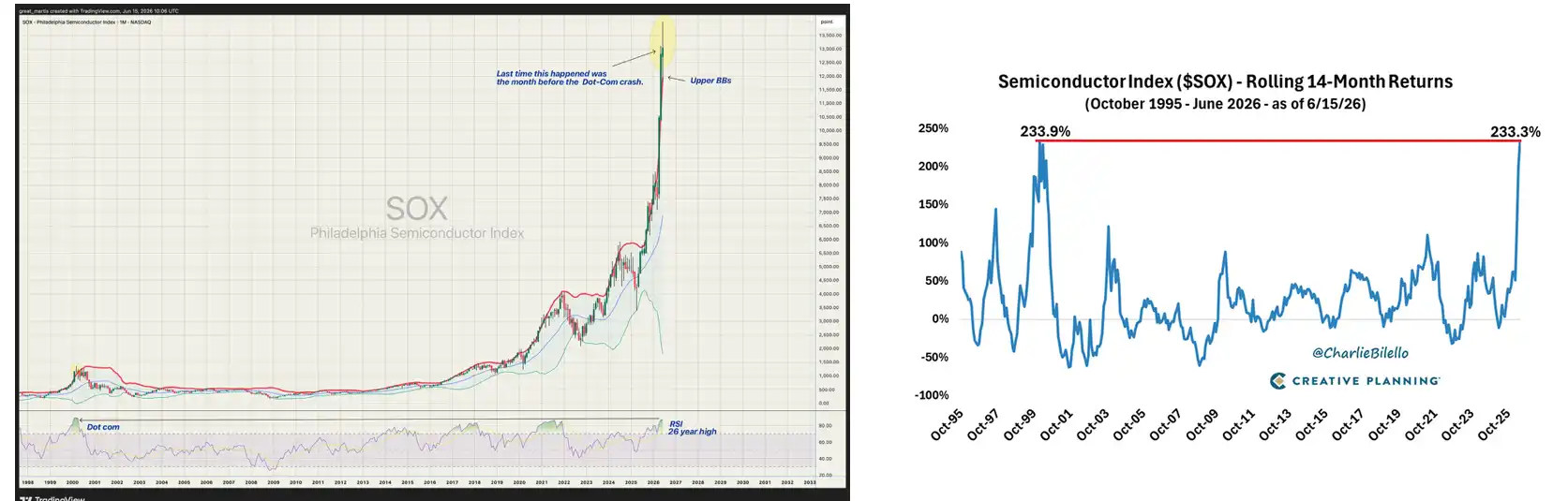
The U.S. stock market closed in the early morning, with the Philadelphia Semiconductor Index (SOX) breaking through 14,000 points for the first time, setting a new all-time high.
Historically, there have been only two periods where the SOX surged over 230% in a span of 14 months: from December 1998 to February 2000, and from April 2025 to the present.
This semiconductor bull market has seen significant and concentrated returns. The year-to-date gains of the storage giants Micron, SK Hynix, and Samsung are approximately 141%, 186%, and 114%, respectively. TSMC's U.S. ADR has risen by over 50% year-to-date.
NVIDIA hit a new all-time high of $235.47 on May 14. Broadcom, Marvell, and ASML are setting or approaching records in their respective niches. The 52-week range for the entire SOXX ETF is from a low of $148 to a high near $369, with a swing of nearly 150%.
In April, Goldman Sachs raised its 2026 DRAM supply-demand gap forecast from 3.3% to 4.9%, calling it the most severe storage shortage in 15 years. The price of HBM is even more staggering, with a single stack of HBM3E priced at around $300, and the upcoming mass-produced HBM4 estimated at $500 per stack. SK Hynix's 2026 HBM capacity has long been fully booked by Microsoft, Google, NVIDIA, with some customers even paying full deposits in advance to secure production capacity.
Evidently, the pace of AI data center construction is far outstripping the expansion of chip capacity.
The "Neck-Strangling" Bull Market
Scarcity is the most profitable product.
Understanding this statement is key to grasping the core logic of this semiconductor bull market. Whoever throttles the neck of AI infrastructure holds the strongest pricing power. Conversely, for those whose links can be replaced or squeezed on price, even with high demand, stock prices remain stagnant.
Optical modules are a typical example of the latter. A report by Photon Capital in April pointed out that although Chinese optical module manufacturers hold seven of the top ten global positions, they have not made much money; instead, it is chip companies that have profited. Companies like Acacia and NeoPhotonics, through their shipment volume and cost control for 800G and 1.6T optical modules, have reached a leading global level, directly squeezing the profit margins of U.S. optical module companies such as Coherent and Lumentum. Despite a doubling in demand, profit margins are being squeezed thin. The reason is simple: the assembly link of optical modules is not scarce enough.
Storage has become the central theme of this round of the US semiconductor industry. Essentially, it's because the bottleneck has become tighter and tighter.
HBM is not ordinary DRAM. With 3D stacking, TSV silicon vias, and specialized packaging processes, each technological barrier is the result of over a decade of heavy asset investment. Globally, only three companies can mass-produce HBM, and SK Hynix holds approximately half of the market share.
Interestingly, this logic also applies at the macro level of countries.
The true winner of AI data center infrastructure is not the "semiconductor nations" but those countries and regions that, in the past few years or even decades, have just happened to build a scarce industrial cluster in some irreplaceable part. Scarcity is the key.
Each Region Has Its Own Main Track
It's very interesting to see someone in the US stock community put forward this view.
The United States is still at the top of the value chain.
Nvidia, AMD, and Broadcom's ASIC designs, Synopsys and Cadence's EDA tools, Arista's AI network, the three major cloud providers packaging computing power as a service to sell to the world. Google, Amazon, Microsoft are all accelerating their in-house ASIC development. Broadcom and Marvell together hold approximately 95% of the market share in custom ASIC design, with Google alone spending around $8 billion annually on TPU development with Broadcom.
The core nodes of the manufacturing end are in Taiwan and South Korea, but they are pursuing completely different paths.
In Taiwan, the focus is on TSMC and advanced packaging. Globally, only TSMC can mass-produce 3nm and 2nm processes. All three of TSMC's CoWoS backend factories are operating at full capacity, with lead times ranging from 52 to 78 weeks. Nvidia alone has locked in 60% to 70% of CoWoS capacity. TSMC is expanding its monthly capacity from 35,000 wafers at the end of 2024 to 130,000 wafers by the end of 2026, nearly quadrupling. Even with this expansion, capacity remains tight. Taiwan's server foundry system, including Foxconn, Pegatron, and Wistron, is also ramping up shipments alongside AI server volumes.
The story in South Korea revolves entirely around storage. SK Hynix holds around 50% to 55% of the global HBM market, Samsung holds 19% to 35%, and Micron holds approximately 5% to 20%. HBM is not the same as regular memory. With 3D stacking, TSV silicon vias, and specialized packaging processes, each technological barrier is the result of Korean companies investing continuously over the past decade.
The roles of Japan and the Netherlands are also very important. Tokyo Electronics manufactures semiconductor equipment, Shin-Etsu Chemical and SUMCO produce silicon wafers, and Ajinomoto provides ABF substrate materials. Japan has long been out of the competition for chip end products, but its position in materials and precision processing remains unmatched to this day.
As for the Netherlands, ASML monopolizes EUV lithography machines. In January, Morgan significantly raised ASML's target price to 1400 euros, predicting that 2027 will be ASML's highest-profit growth year, with EPS increasing by 57% year-on-year. They base this judgment on three drivers: advanced logic foundry capacity expansion exceeding expectations, large-scale expansion in the DRAM storage sector, and overall demand performing better than expected. Dutch packaging equipment companies like BESI have also received a large number of orders amid the surge in demand for AI chip packaging.
China and Europe have different entry points, but the logic is similar, as they have both established cost advantages or delivery capabilities at a specific stage of AI infrastructure.
II-VI and Nexperia have achieved global first-line levels of shipment volume and price control in 800G and 1.6T optical modules. However, Photon Capital's analysis also highlights an important time window: the current high-profit margins of optical module companies result from temporary pricing power due to the transient shortage of 800G production capacity. When mass production of 1.6T begins from the second half of 2026 to 2027, and second and third-line manufacturers ramp up their capacity, price pressure at the module end will quickly emerge.
In Europe, companies such as Schneider Electric, ABB, and Vertiv, which are involved in power distribution and cooling, have received orders far beyond expectations against the backdrop of a significant increase in data center power consumption. Wedbush estimates that by 2026, hyperscalers' AI infrastructure spending will reach approximately $725 billion, a 77% year-on-year increase, with power infrastructure being one of the fastest-growing subcategories.
AI Reshaping the Semiconductor "Smile Curve"
If we were to summarize this diagram using the smile curve: the left end represents the United States responsible for "definition and design," the middle-high segment includes China (Taiwan), South Korea, the Netherlands, and Japan responsible for "advanced chip manufacturing," the mid-low segment involves China (Taiwan), China, and Southeast Asia responsible for "scale assembly," and the right end features the United States and China responsible for "cloud platforms, models, and customer access."
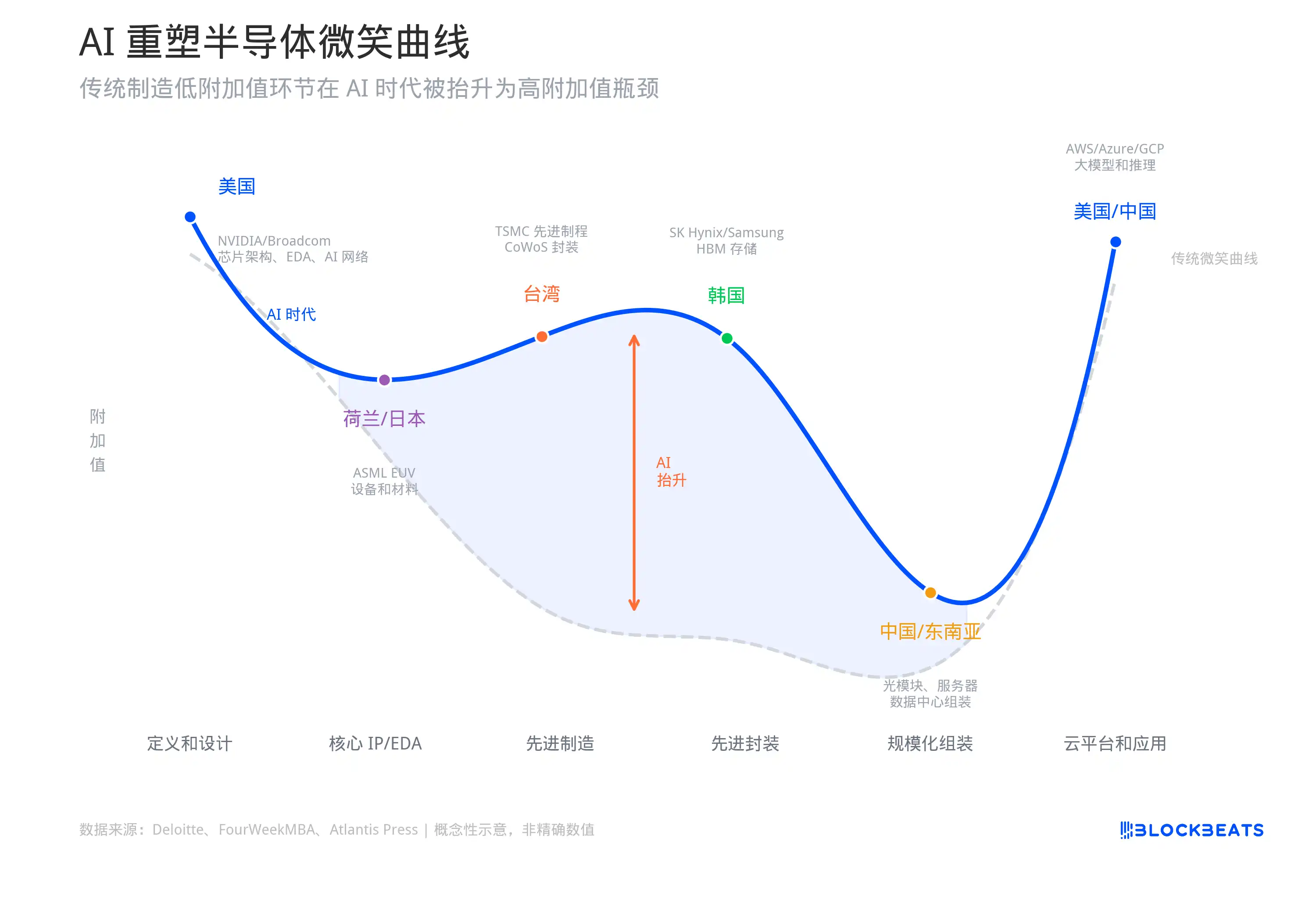
The originator of this curve was Stan Shih, the founder of Acer. In 1992, he used this model to explain why PC assembly had the thinnest profit margin.
However, thirty years later, AI data centers are reshaping this curve.
Both a Value Chain Analysis by FourWeekMBA and a paper published by Atlantis Press this year point to the same conclusion: AI is lifting the middle segment of the traditional smile curve again. TSMC's advanced CoWoS packaging, Samsung's HBM stacking, ASML's EUV lithography machines—these links in the traditional manufacturing smile curve used to belong to the thinnest profit segment, the "middle manufacturing segment." But in the AI era, they have become the scarcest resources, with profit margins and pricing power no lower than those of the design end and application end.
The data from the paper shows that NVIDIA's gross margin for 2023 to 2024 is 72.72%, with a net margin of 48.85%. However, TSMC achieved a gross margin of 66.2% in Q1 2026, with a net margin of 50.5%. The profit margin gap between the design end and the manufacturing end is narrowing, unprecedented in the history of the semiconductor industry.
The traditional smile curve assumed the manufacturing segment had the thinnest profits. AI has turned the most challenging manufacturing segment into the scarcest resource.
In Morgan's March Asia Semiconductor Research Report, a similar conclusion was reached: from 2023 to 2024, the AI cycle primarily focused on GPUs; from 2025 to 2026, demand started to spread to a broader industry chain, with storage, advanced packaging, custom ASICs, and data center networks taking over.
Each round of bottlenecks will bring a batch of previously overlooked companies to the forefront while putting the targets of the last round's largest gains into a digestion period.
How Far Can the Bull Run? Bull vs. Bear Views
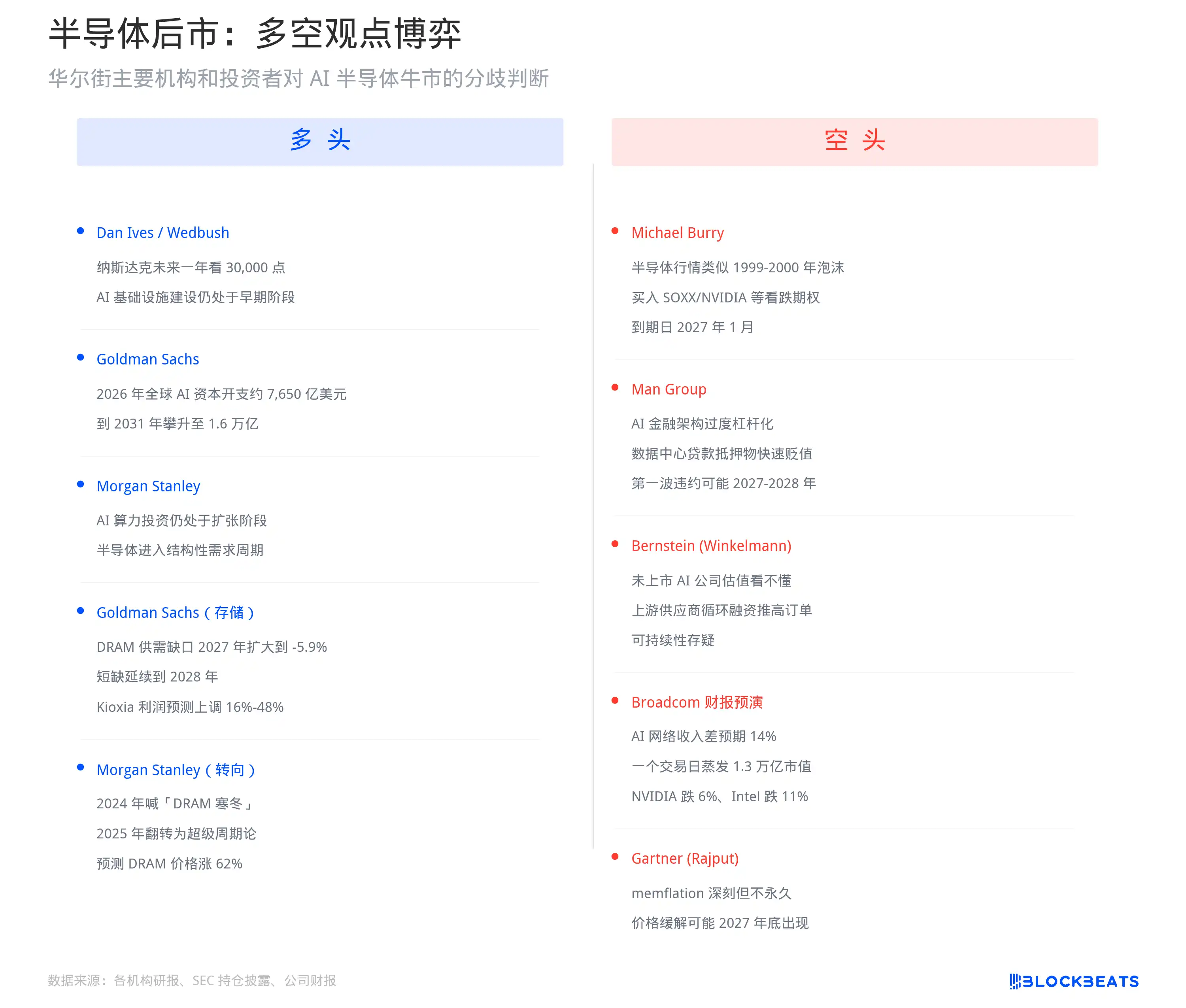
Let's first listen to the bullish view. Dan Ives of Wedbush boldly stated on CNBC in May that the Nasdaq will hit 30,000 in the next year, citing the continued high demand for AI chips. Goldman Sachs provided a more specific figure, estimating global AI capital spending to reach approximately $765 billion in 2026, rising to $1.6 trillion by 2031.
Morgan's March Asia Semiconductor Research Report explicitly stated: AI computing power investment is still in the expansion phase, and the semiconductor industry is entering a new structural demand cycle.
The bullish sentiment regarding storage is even more aggressive. Goldman Sachs recently revised all their DRAM supply-demand gap forecasts for 2026 to 2028 to a deeper shortage range, with the 2027 figure adjusted from the previous -2.5% to -5.9%, almost doubling. Their assessment is that this memory cycle is different from the past, with higher visibility of AI server demand, supply growth constrained by long-term locking agreements, and a longer-than-expected duration of price increases.
Goldman Sachs even raised Kioxia's operating profit forecast for the three years from 2027 to 2029 in one go, with the range increasing from 16% to 48%. The reason is that this high-profit cycle can continue for two to three years. For a company engaged in storage, a strong cyclical business, providing a "high-profit for three years" assessment is highly unusual on Wall Street.
Morgan's change in attitude is even more interesting. In 2024, they were still talking about the "DRAM winter," predicting a multi-year price decline starting in Q4 2024. By 2025, they directly shifted to the supercycle theory, forecasting a 62% increase in DRAM prices in 2026. They believe that Micron and Samsung's profits will exceed consensus expectations by 30% to 50%.
However, the bearish voices are not insignificant, and they come from notable figures.
In May, Michael Burry publicly warned that this semiconductor rally is highly reminiscent of the final months of the 1999 to 2000 Internet bubble. The SOX has risen 65% in the year, with a 10% increase in a single week. The SOXX ETF is 60% above its 200-day moving average, a level of technical overextension that has rarely been sustainable in history. SEC holdings disclosures show that he has bought a large number of put options on SOXX, QQQ, Nvidia, Palantir, and Oracle, with expiration dates set in January 2027 and exercise prices well below the current stock prices.
British asset manager Man Group (one of the world's largest publicly traded hedge funds) published a lengthy article in June specifically addressing the AI bubble risk. Their key point is that the financial architecture around AI has become too large, overly leveraged, and overly reliant on a few interconnected participants.
They particularly mentioned that a significant amount of AI data center construction has been financed through private credit, with the loans backed by "hardware that depreciates as rapidly as a mobile phone, rather than long-term assets like buildings." The first wave of defaults may occur between 2027 and 2028, when the initial leases expire, and the gap between financing assumptions and reality becomes unavoidable.
Looking ahead, there are several key milestones to watch.
Micron will release its financial report on June 24. The forward-looking guidance on HBM demand and capacity allocation will determine the direction of the entire storage sector throughout the summer. Nvidia's next earnings report is also critical. If there is even a slight signal of AI chip demand slowing down, the sentiment across the entire sector will once again be reevaluated.
Looking further ahead, the timeline for capacity expansion is a real turning point. Micron's M15X fab is expected to ramp up production in mid-2027, with the Yongin fab moving up to February 2027. Samsung's P5 fab is set to begin production in 2028. Micron's Idaho Fab 1 is expected to contribute output by mid-2027.
All together, industry capacity is projected to increase by 20% to 30% from the second half of 2027 to the first half of 2028. The challenge lies in the fact that the compounded growth rate for HBM demand is over 40%. Whether the supply can keep up with the demand will depend on whether AI capital expenditures slow down before then.
The final variable is geopolitics. The higher the concentration in the semiconductor supply chain, the greater the impact of black swan events. With TSMC accounting for over 90% of global advanced process foundry capacities, this figure represents efficiency in a bull market but systemic risk in a conflict scenario. Factors such as the Taiwan Strait situation, the escalation path of U.S. export controls on China, and the level of cooperation between Japan and the Netherlands on equipment controls are all topics no one wants to discuss when the market is good, but once something happens, pricing adjustments will be faster than any fundamental change.
Welcome to join the official BlockBeats community:
Telegram Subscription Group: https://t.me/theblockbeats
Telegram Discussion Group: https://t.me/BlockBeats_App
Official Twitter Account: https://twitter.com/BlockBeatsAsia