Huang Renxun's Strong Support, Annual Income Exceeds $100 Million, Top Semiconductor Institution SemiAnalysis Emerges from the Community

Over the past month, the hottest segment in the US stock market AI space has been optical modules.
AI data centers are not just about stacking GPUs. Between GPUs and GPUs, and between servers and servers, there is also a massive amount of data exchange. The larger the model and the cluster, the easier it is for data transfer between machines to become a bottleneck. Thus, the market has started to pursue the optical communication chain, with the hottest concept being CPO. CPO can be roughly understood as: placing optical communication components closer to the core chip. The closer the distance, the faster the data transmission and the lower the power consumption. In the increasingly massive AI data centers, this story sounds almost perfect.
This narrative was truly ignited thanks to Huang Renxun. As NVIDIA continues to push the AI infrastructure story forward, companies in the optical communication chain such as Marvell, Coherent, Lumentum, Corning, AAOI, either received large orders or saw their stock prices rise significantly.
However, a highly controversial research report published a couple of days ago suddenly poured cold water on this hot trend. The optical communication chain targets collectively experienced a pullback, with many seeing high single-digit or even double-digit declines.
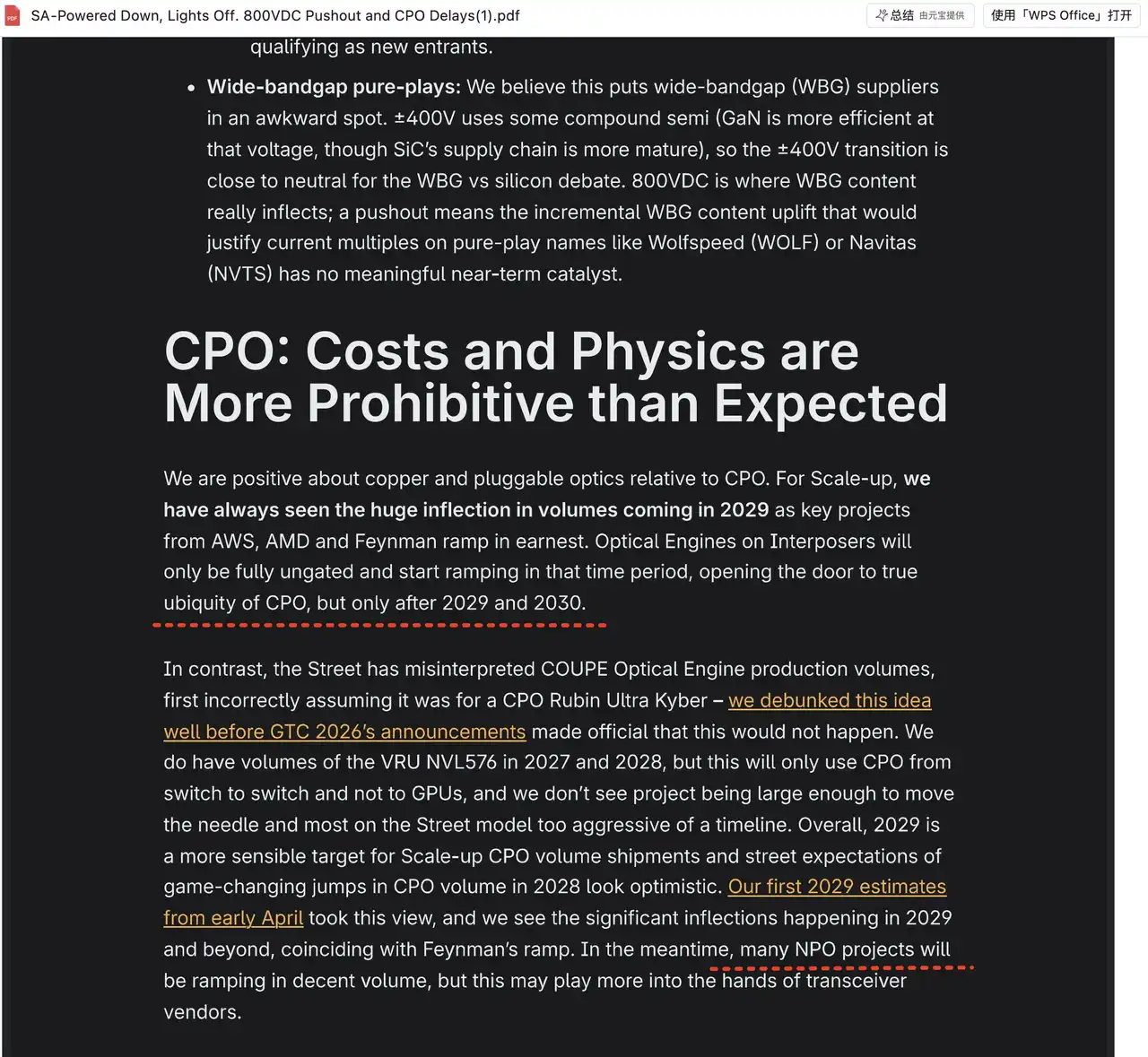
Questions arose: What did this report actually say? Who is SemiAnalysis, the entity that released the report? Why did a single report from them lead to a market repricing of the AI optical module chain?
In this article, BlockBeats will delve into this institution.
Why Is SemiAnalysis Regarded as the "Industry Bible"
In the eyes of many institutions in the AI and investment circles, SemiAnalysis is already a familiar name. However, for the average retail investor, it still holds some mystery.
SemiAnalysis is one of the fastest-rising star institutions in the semiconductor and AI infrastructure research in recent years. Although still a newcomer to the industry, it has rapidly gained a strong reputation in the AI and investment circles with in-depth analysis and incisive viewpoints. Currently with approximately 85 employees, SemiAnalysis focuses on providing deep reports and data models for the AI ecosystem, covering various aspects such as data center construction, supply chain economics, chip deployment, networking, power, packaging, and equipment.
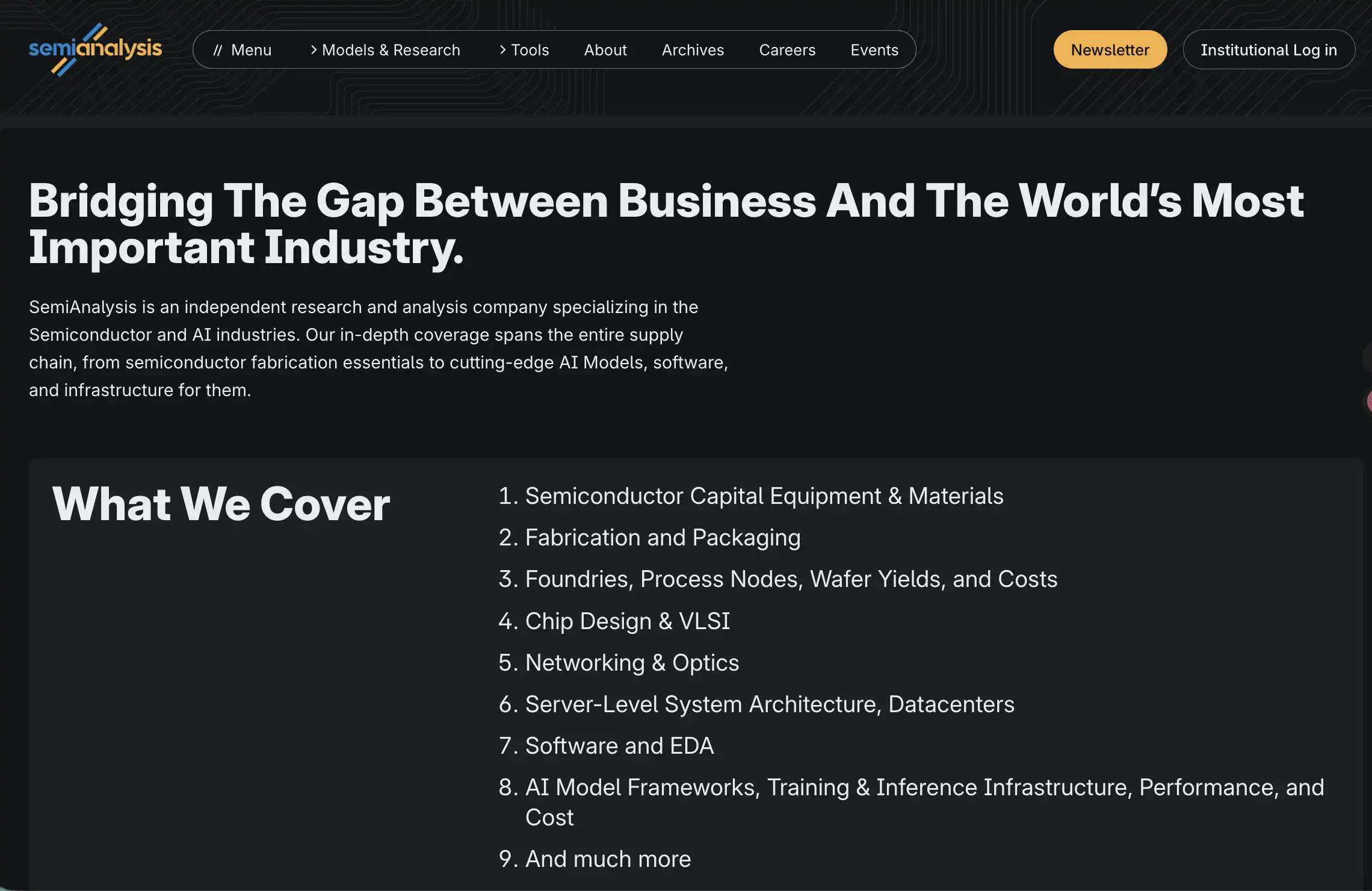
SemiAnalysis Official Website Introduction
SemiAnalysis has delivered a classic showdown that made the industry take notice, possibly with a reevaluation of DeepSeek's costs.
In early 2025, DeepSeek sparked a global sensation with a highly viral narrative: "Trained a model comparable to OpenAI o1 for only $6 million." This number directly challenged the AI compute investment logic. The market began to question whether the massive GPU capital expenditures, often in the tens of billions of dollars, were all in vain since a model could be trained so inexpensively.
In the midst of panic, NVIDIA's market value evaporated by about $600 billion in a single day, setting the record for the largest single-day market value loss in U.S. stock market history.
While the world debated whether the $6 million was real or a hoax, SemiAnalysis reevaluated DeepSeek's hardware costs in a research report. Instead of outright denying DeepSeek's technological advancements, it dissected this "low-cost myth" to examine what the $6 million actually covered and what it did not.
SemiAnalysis's conclusion was that the $6 million only covered the narrow cost of GPU pretraining and did not include research and development, infrastructure, cluster development, and long-term operation. It estimated DeepSeek's actual server capital expenditure to be around $1.6 billion, with cluster operation costs nearing $0.944 billion.
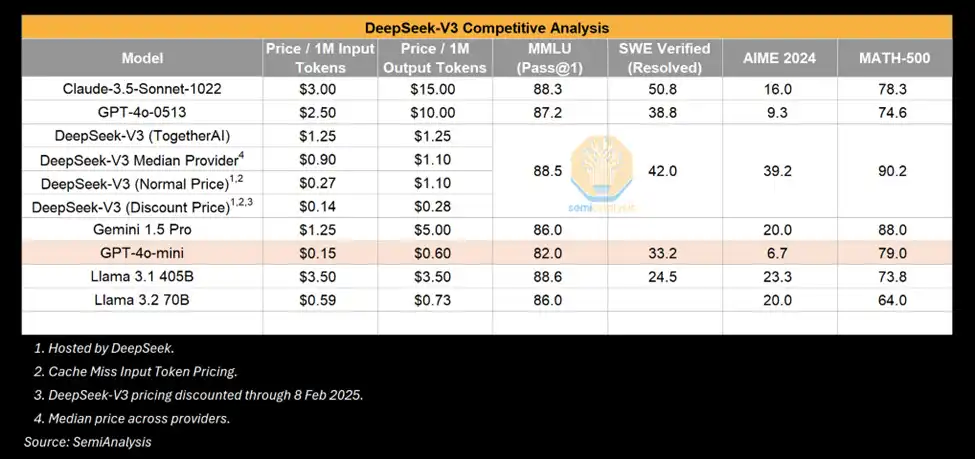
SemiAnalysis's Cost Calculation Data for DeepSeek
More crucially, it dissected DeepSeek's compute inventory. SemiAnalysis assessed that DeepSeek had approximately 50,000 Hopper GPUs, which were not all H100s but a mix of H800, H100, and a China-specific H20 variant. These cards were also shared with the quant fund magic square High-Flyer, dispersed across multiple locations for various tasks like trading, inference, training, and research.
Aside from DeepSeek, another widely discussed case was SemiAnalysis's "short" report on AMD.
At the time, a market focus was on whether AMD could catch up to NVIDIA. Most comparisons between AMD and NVIDIA GPU compute power were surface-level. However, SemiAnalysis repeatedly emphasized that NVIDIA's true moat was never just the silicon but its CUDA software ecosystem, network, system design, supply chain capabilities, and the deployment experience accumulated over many years. These were the real moats for NVIDIA.
In December 2024, SemiAnalysis released a report after spending five months testing the AMD MI300X. The report stated, "We had hoped AMD would become a strong competitor to NVIDIA in the training field, but that day has not yet come." The key conclusion was that while the MI300X should have had a significant lead over NVIDIA's H100 and H200 in paper specifications and total cost of ownership, the actual performance did not fully deliver, with the issue lying precisely on the software side.
Just a day after the report was published, AMD CEO Lisa Su proactively contacted SemiAnalysis founder Dylan Patel. What was initially scheduled as a 30-minute call ended up lasting a full 90 minutes.
Naturally, this also raised past suspicions in the community that SemiAnalysis was an institution supported by NVIDIA.
SemiAnalysis's influence also began to spill over from the report page to the industry scene.
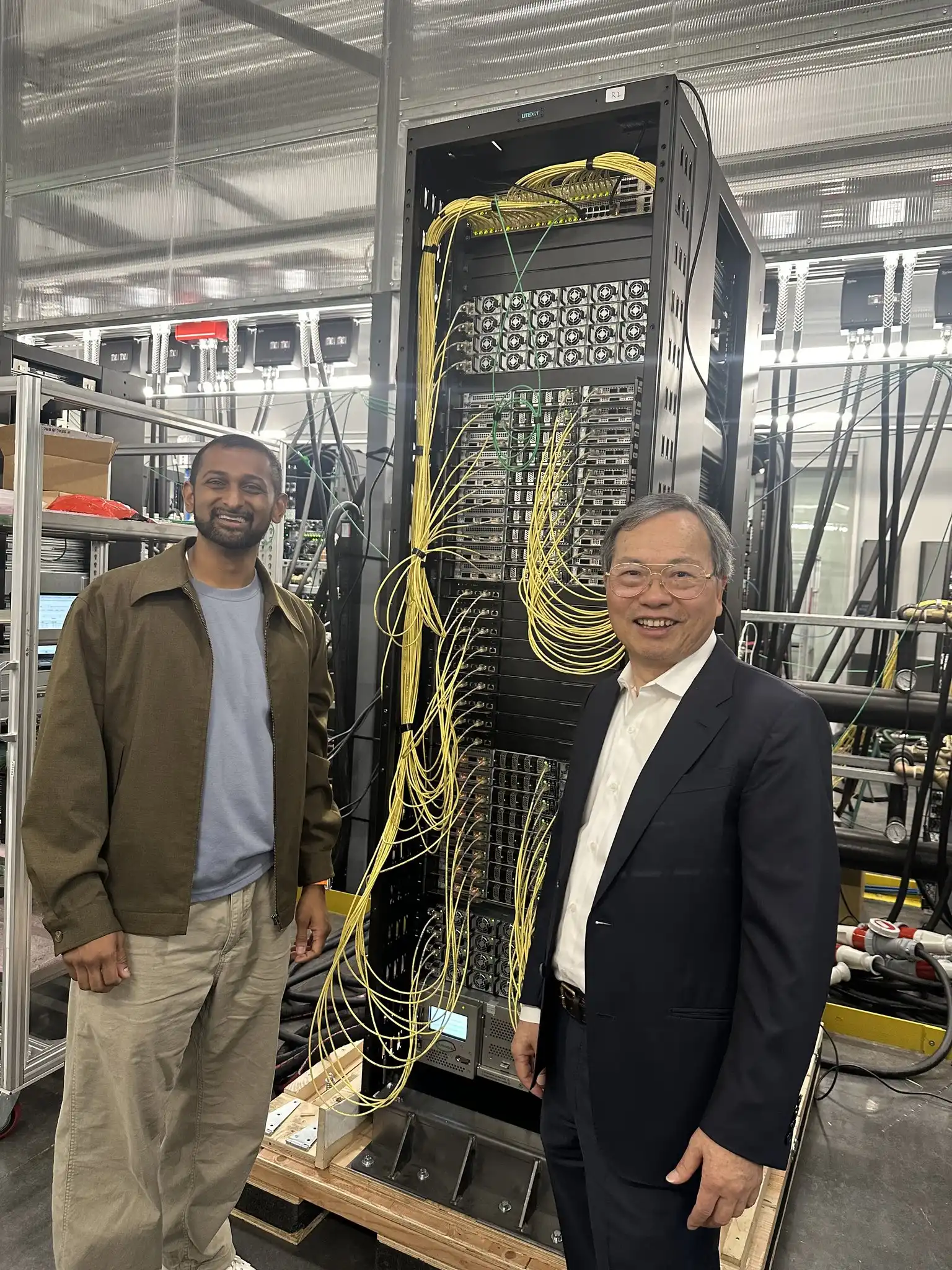
Dylan (left) with SuperMicro's founder and CEO Charles Liang (right)
Last year, Dylan was invited to visit the Supermicro factory, with CEO Charles Liang personally giving him a tour. According to The Information, when a reporter visited Dylan's San Francisco office, they almost collided in the lobby with Dylan's next visitor: Sequoia Capital partner Shaun Maguire was sitting there waiting to see him.
The highlight moment came during GTC in March 2026.
In Huang Renxun's two-hour keynote speech, he only mentioned two names throughout, and one of them was Dylan Patel. Not only did he reference SemiAnalysis's newly released chip performance ranking, InferenceX, but he also prominently displayed SemiAnalysis's logo on the big screen, spending a full 5 minutes explaining it. During the speech, Huang Renxun even publicly acknowledged: "Dylan Patel (SemiAnalysis founder) mentioned that I am hiding my strength, saying the real performance is 50 times; he didn't say it wrong."
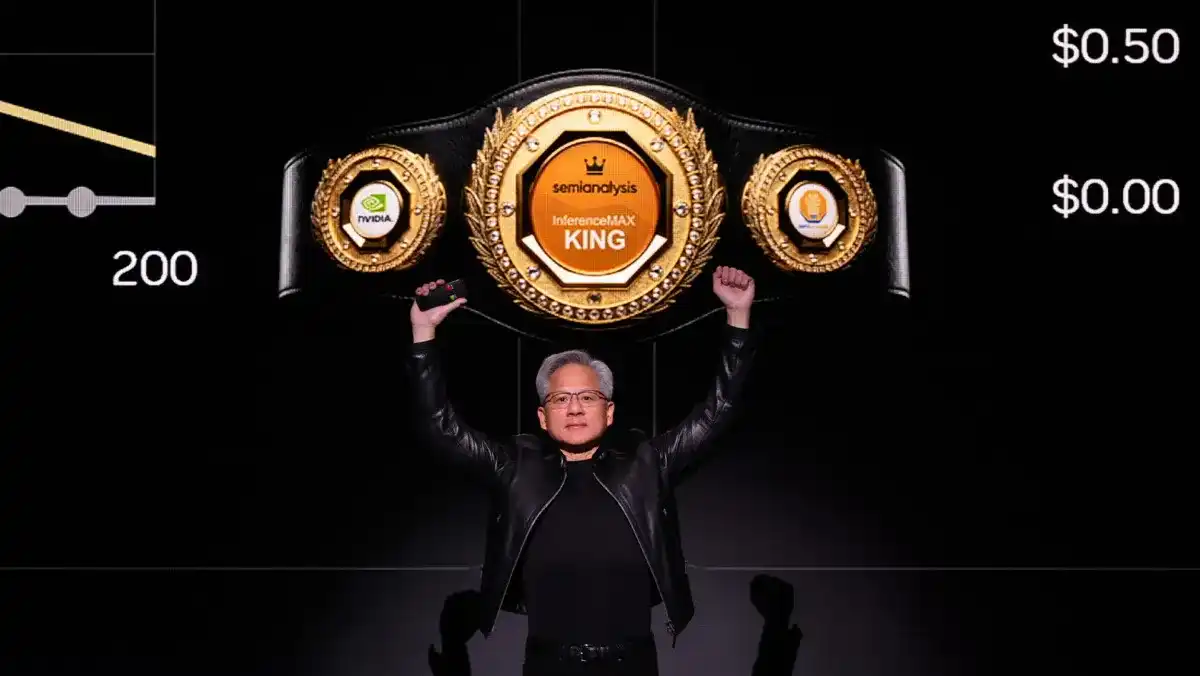
NVIDIA CEO Jensen Huang raised his hands in celebration at the latest GTC developer conference, mentioning SemiAnalysis and their recent assessment report of NVIDIA's chips
This status is also directly reflected in commercial revenue.
SemiAnalysis is expected to reach $100 million in revenue this year, up from about $20 million just a year ago. Its clients span tech giants and top-tier investment firms. While it does not publicly disclose client logos, the disclosed client types are sufficient to make the point: hyperscale cloud providers, chip majors, large public and private equity investors.
In other words, SemiAnalysis's main revenue comes not from regular newsletter subscribers, but from selling these reports to the batch of startups, investors, institutions, traders, and others who can sign off on tens of billions or hundreds of billions of dollars in AI infrastructure spending.
From Anonymous Hardware Enthusiast to Top AI Circles
Similar to the recent "White-Haired Stock God," SemiAnalysis founder Dylan Patel has an internet-savvy background.

Dylan Patel
According to BlockBeats, Dylan Patel's friend, Dr. Ian Cutress, once recalled in an article that prior to founding SemiAnalysis, Dylan was a popular hardware forum moderator.
In a podcast, Dylan himself recalled that before starting the company, he had run an anonymous blog in the "Silicon Valley Twitter circle" for many years. It was a small community not necessarily familiar to the average tech Twitter user, but it attracted a large number of hardware, chip, and supply chain professionals.
A Reddit community user also mentioned that Dylan Patel was just an early Reddit "nobody," a nobody. Public Reddit archives we found show that u/dylan522p and u/SemiAnalysis appeared in r/hardware's moderation discussions.
All these clues put together roughly point to the same picture: Dylan was active in the early years on Reddit and the WordPress community, being a hardware enthusiast. Back then, he didn't take writing as a serious business. While doing consulting on the side, he maintained an independent blog called "A thousand million," and this consulting business itself was related to the blog content and the industry.
In addition to Dylan, his partner Doug O'Laughlin was also a key figure at SemiAnalysis, being the turning point that drove the blog's commercialization.
After Doug started posting on forums, Dylan found this person "quite interesting," and the two started interacting more. Later on, Doug repeatedly advised him: you should use your real name, move to Substack, and start charging for your content. A few years later, Doug simply joined the company.
Today, SemiAnalysis is already the largest tech newsletter on Substack with over 285,000 subscribers. In addition to the Substack posts, it also has a podcast called Transistor Radio.
According to Dylan, the podcast is used to carry industry viewpoints that didn't make it into formal articles. Articles are responsible for in-depth full stories, while the podcast handles fragmented news commentary, casual market assessments, and weekly real-time industry discussions. It airs about once every two weeks, chatting about semiconductor news from the past two weeks.
As the podcast has developed, it has now become a regular operation, no longer relying solely on the two founders but with team members taking turns on the show. For example, in a March 2026 episode, Sravan Kundojjala, Ivan Chiam, and Jordan Nanos together dissected the AI chip shortage, discussing from TSMC and NVIDIA's CPO all the way to how the memory crisis affects GPU pricing, and even the next generation of smartphones.
In addition to their own channels, Dylan himself is also a frequent guest on various tech and investment podcasts, almost becoming a standard guest in AI hardware topics. He has been on No Priors, Invest Like the Best, Unsupervised Learning, and Dwarkesh Patel's show. He also had an in-depth conversation with Asianometry's Jon Y. The latter is considered by many viewers as one of the best channels on YouTube to talk about semiconductor and business history.
More Like an "Intelligence" Agency, But More Like Muddy Waters
An anecdote in The Information's report perfectly illustrates Dylan Patel's approach.
During the early days of his startup journey, Dylan Patel sought to deepen his semiconductor knowledge by attending nearly every industry conference he could. On-site, he would approach people and ask questions—not just small talk, but a relentless pursuit of information, turning engineers, supply chain professionals, and company executives into his own sources of intelligence.
As SemiAnalysis grew, this methodology remained unchanged but became more industrialized.
The Information notes that the company now has 85 employees spread across 11 countries. Every Monday, Dylan reviews the weekly briefs submitted by each team manager. Each team focuses on a specific aspect of the AI economy, condensing the previous week's news, leads, anomalies, and insights into their reports.
Think of it as an AI Infrastructure Intelligence Weekly Report. Each team monitors a segment such as GPUs, HBM, packaging, data centers, power, cloud providers, optical modules, and chip manufacturing equipment. Some even include former ASML engineer Jeffrey Koch, who specializes in the semiconductor equipment chain. When he looks at AI supply chain bottlenecks, his concerns have shifted from just power constraints to potential roadblocks in chip manufacturing equipment.
SemiAnalysis also excels at uncovering information from the gray areas.
The article mentions that Dylan once came across an internal Google memo circulating on Discord. After downloading it, he sought validation of its authenticity from inside sources at Google.
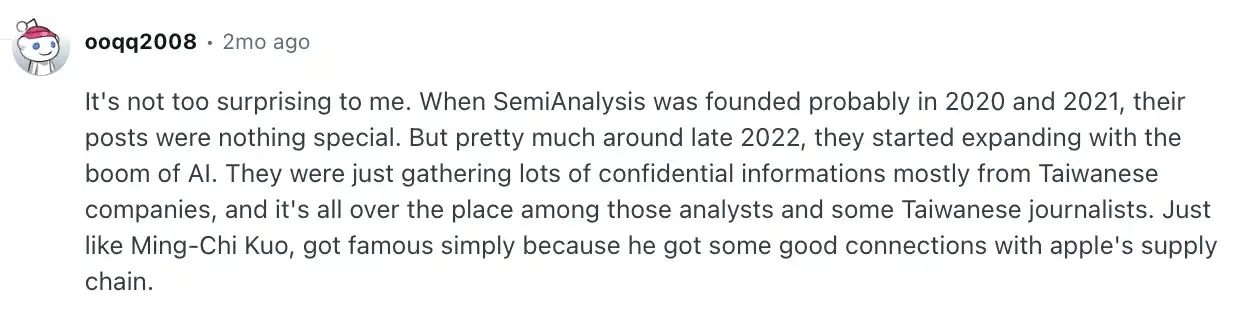
Reddit's community also points out that when SemiAnalysis was founded around 2020 or 2021, its content was not particularly unique. However, by the end of 2022, with the rising AI trend, it began to rapidly expand. The user believes that SemiAnalysis has gathered a substantial amount of non-public or semi-public information mainly from Taiwanese companies, which is being circulated among analysts and some Taiwanese journalists.
"To some extent, SemiAnalysis is like Ming-Chi Kuo, gaining fame simply because of their strong ties to the Apple supply chain."
Recently, a lawsuit between SemiAnalysis and a former employee has brought this "grey information gathering ability" to the forefront.
According to documents from the Superior Court of San Francisco County, SemiAnalysis's former employee Wei Zhou has accused Dylan Patel of running SemiAnalysis while personally investing in Fluidstack and using the non-public information obtained to conduct research. When Zhou refused to incorporate this information into SemiAnalysis's product, he faced retaliation and dismissal. (It is important to note that these are currently allegations from one party in the lawsuit and have not been proven in court.)
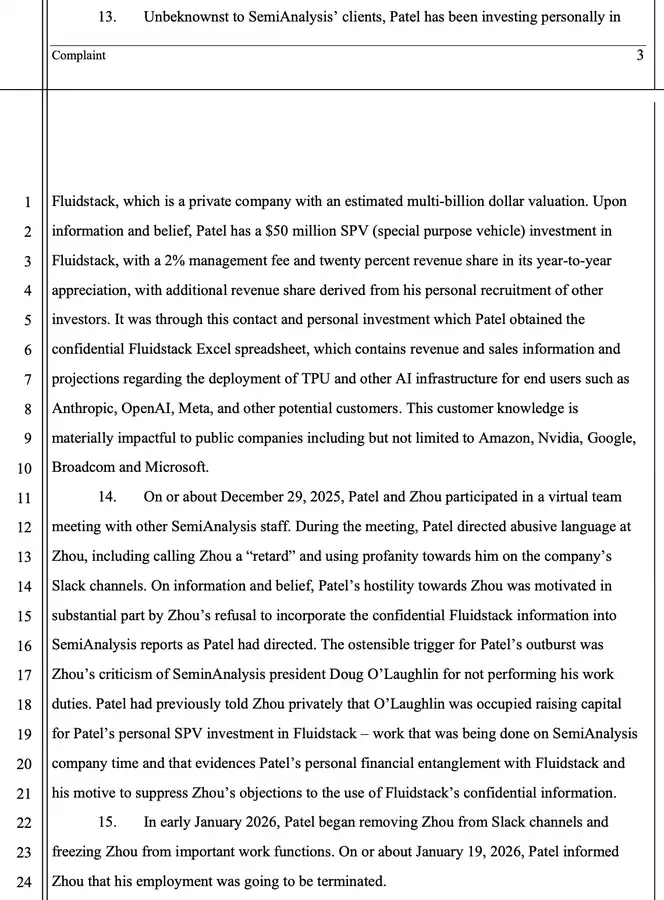
Former SemiAnalysis Employee Accuses Dylan Patel of Improper Information Access
The complaint states that SemiAnalysis's clients were not aware of Patel's personal investment in Fluidstack. Fluidstack is a private cloud services company reportedly valued at tens of billions of dollars. Zhou accuses Patel of investing in Fluidstack through a $50 million SPV (Special Purpose Vehicle). Patel could also receive a 2% management fee from this SPV, share in investment appreciation, and potentially earn additional income for introducing other investors.
More importantly, the complaint alleges that Patel obtained a confidential Excel spreadsheet of Fluidstack through this personal investment relationship. The spreadsheet includes Fluidstack's revenue, sales data, predictions surrounding TPU and other AI infrastructure deployments, and end customers including Anthropic, OpenAI, Meta, and other prospective clients.
Zhou's implication is that this customer demand and deployment information is not only Fluidstack's own trade secret but may also influence the judgment of a group of public companies such as Amazon, Nvidia, Google, Broadcom, Microsoft, and others. This is because these companies are all part of the industrial chain of AI cloud, GPU/TPU, network, and data center infrastructure.
Through these third-party insights, we can roughly see SemiAnalysis's research methodology, which is backed by a comprehensive intelligence gathering system, including forums, Discord, industry conferences, contacts, shipping records, government documents, supply chain data, data center site photos, benchmarks, models, and weekly internal briefings.
According to Dr. Ian Cutress, organizations like SemiAnalysis have a much more complex data collection process than the average person might imagine. For example, this involves submitting Freedom of Information Act (FOIA) requests, sifting through public shipping manifests, analyzing supply chain documents and government papers. In the realm of data centers, they even go as far as obtaining permits, flying drones over construction sites to capture high-resolution images of exactly what equipment is being installed.
SemiAnalysis's own product page is quite straightforward. Their AI data center model tracks over 5,000 data centers globally, sourcing data from property records, construction permits, power usage, FOIA requests, and satellite imagery. To process a vast amount of satellite photos, they have specifically trained a computer vision model, i.e., CNN, to automatically identify the scale, capacity, and construction progress of each data center. The goal is to extend this tracking capability to every data center in every country.
This approach, rather than being seen as a typical analysis organization, is more akin to an open-source intelligence company.
Interestingly, it reminds the author of that famous short seller research firm, Muddy Waters, and their investigative methods. Muddy Waters also gained prominence for targeting some Chinese companies.
For instance, in Muddy Waters' investigation of Orient Paper, it involved on-site visits to factories, observing the factory environment, machinery, and inventory, talking to workers and local residents, even covertly squatting outside the factory area to record the movement of vehicles in and out, along with capturing photographic evidence. Ultimately, they found that the so-called inventory was essentially a pile of waste paper.
When investigating China MediaExpress, Muddy Waters physically inspected over 50 buses to assess the terminal advertisements and discovered that the drivers preferred to play their own DVD programs, indicating weak control over the terminal content. While examining Duoyuan Global Water, they found one of the office locations to be essentially non-operational, with employees having no real work roles, humorously referring to it as an "adult daycare."
The most recent high-profile short report was aimed at Luckin Coffee that the author drinks every day. Muddy Waters mobilized 92 full-time investigators and 1,418 part-time investigators, stationed at over 620 stores in 38 cities nationwide, recording 11,260 hours of in-store surveillance footage, covering 981 business days and 100% of store operating hours. They also collected 25,843 consumer receipts, along with a vast amount of internal WeChat chat records using the guise of regular customers.
Relying on this firsthand data, Muddy Waters calculated that Luckin Coffee's individual store daily sales were inflated by at least 69% and 88% in the third and fourth quarters of 2019, respectively, and the actual customer spending was much lower than disclosed. After the report was released, Luckin Coffee promptly admitted to a $2.2 billion financial fraud, leading to a stock price collapse.
Of course, we currently have no evidence to prove that SemiAnalysis shorted the solar module stock before releasing the report. Based on existing information, its business model still mainly involves turning research results into products and selling them to hedge funds, semiconductor companies, and tech giants' internal teams.
However, we can see that SemiAnalysis's investigative approach has many similarities to Muddy Waters. The difference is that it operates in the AI era and the hardware track, with more sophisticated information gathering tools: from on-site visits, interviews, and receipts, they have upgraded to satellite imagery, supply chain databases, engineering tests, and algorithm models.
A $7 Million Token Spent in a Year
In an interview, Dylan himself mentioned that SemiAnalysis directly signed an enterprise contract with Anthropic, with this expenditure amounting to $7 million, compared to their annual employee salary expense of $2.2 million.
SemiAnalysis sees AI as a lever for information gathering and data production. Dylan's judgment is straightforward: they are in the information business, selling analysis, providing consulting services, and creating datasets. If they do not continually raise the bar, AI will quickly commoditize these things. The first batch of data products they plan to sell in 2023 is increasingly replicable today. If SemiAnalysis does not keep pushing forward, sooner or later, others will catch up using the same tools.
What best illustrates the issue is their foray into energy data services. Over the past year, SemiAnalysis has been eager to establish an energy model because AI data centers are increasingly constrained by power. Factors such as the power grid, substations, transmission lines, and regional power deficits will, in turn, determine where data centers are built, their size, and when they go online. Energy data services alone represent a market of nearly $9 billion, which SemiAnalysis has been keen to enter. However, after a year of work, progress has not been particularly swift.
Later, Jeremy, who is in charge of data center energy and industrial business, started becoming obsessed with using the Claude Code. Dylan said that in just three weeks, he was spending around $6,000 per day calling the AI tool, which was exorbitantly expensive. But the results were also astonishing: Jeremy captured every power plant in the U.S., every transmission line above a certain voltage level, and brought in a large amount of demand-side data, all from public sources. In the end, he put together a complete map and dashboard of the U.S. power grid.
This system can show the power shortages and surpluses in different microregions of the U.S.
SemiAnalysis showed it to some customers who both buy their data center data and engage in energy trading. Their immediate reaction was one of surprise: how long did it take you to create this? This is even better than some professional energy data companies. Digging deeper, those companies may have hundreds of employees and have been around for a decade.
Dylan also acknowledges that SemiAnalysis' product is not as mature or as robust as a traditional energy data company's. However, in some aspects, it is already faster, more detailed, and even better. This is the new form of SemiAnalysis' investigative approach: not relying solely on an analyst attending meetings, interviewing people, and going through documents, but instead stacking public data, engineering judgment, industry connections, and AI programming capabilities to quickly create something that would take a traditional data company years to build.
Ultimately, the most charming aspect of SemiAnalysis may lie in this hybrid nature.
On one hand, it is like a serious, almost ruthless intelligence agency, using satellite imagery, construction permits, shipping manifests, supply chain interviews, AI programming, and engineering tests to piece together the true map of the AI infrastructure world. On the other hand, its founder, Dylan Patel, always carries a hint of internet native playfulness.
When a reporter from The Information visited Dylan's San Francisco office, Dylan mentioned that he shares the office with Dwarkesh Patel. Dwarkesh is the host of the popular podcast "Dwarkesh Podcast," and the two are friends, roommates, and office mates. They also live in Noe Valley, San Francisco, with Anthropic researcher Sholto Douglas.
But Dylan quickly changed the subject, saying that there is a third person in the office as well. When asked who it was, he refused to say, "Let's play a game, you investigate on your own."
To uncover information, The Information reporter had no choice but to play this detective game with Dylan, and the final answer did not disappoint.
Sharing the office space with Dylan is also Leopold Aschenbrenner, the former OpenAI researcher who later founded his AGI investment fund, Situational Awareness. In one year, he turned $200 million into $5.5 billion, earning him the title of "AI Stock God."
You could say that the top-tier AI community is still too small.
References:
1. The Information, "Both an Analyst and an Investor: This 29-Year-Old Is Gaining Influence in AI";
2. Dr. Ian Cutress, "Dylan Patel's SemiAnalysis Is Being Sued", More Than Moore (Substack);
3. San Francisco County Superior Court public records, Case No. CGC-26-635328;
4. SemiAnalysis, "DeepSeek Debates: Chinese Leadership On Cost, True Training Cost, Closed Model Margin Impacts";
5. SemiAnalysis, "MI300X vs H100 vs H200";
6. EE Times, "GTC 2026 Keynote: Long Live the Inference King".
Welcome to join the official BlockBeats community:
Telegram Subscription Group: https://t.me/theblockbeats
Telegram Discussion Group: https://t.me/BlockBeats_App
Official Twitter Account: https://twitter.com/BlockBeatsAsia