Optical Module Surges, Why is NOK the Second Leader after MRVL?
TL;DR
· Nokia's stock price has surged nearly 170% since last October.
· AI-RAN is transitioning from validation to early commercial orders.
· Related Tickers: NOK (NYSE), NVDA (NASDAQ).
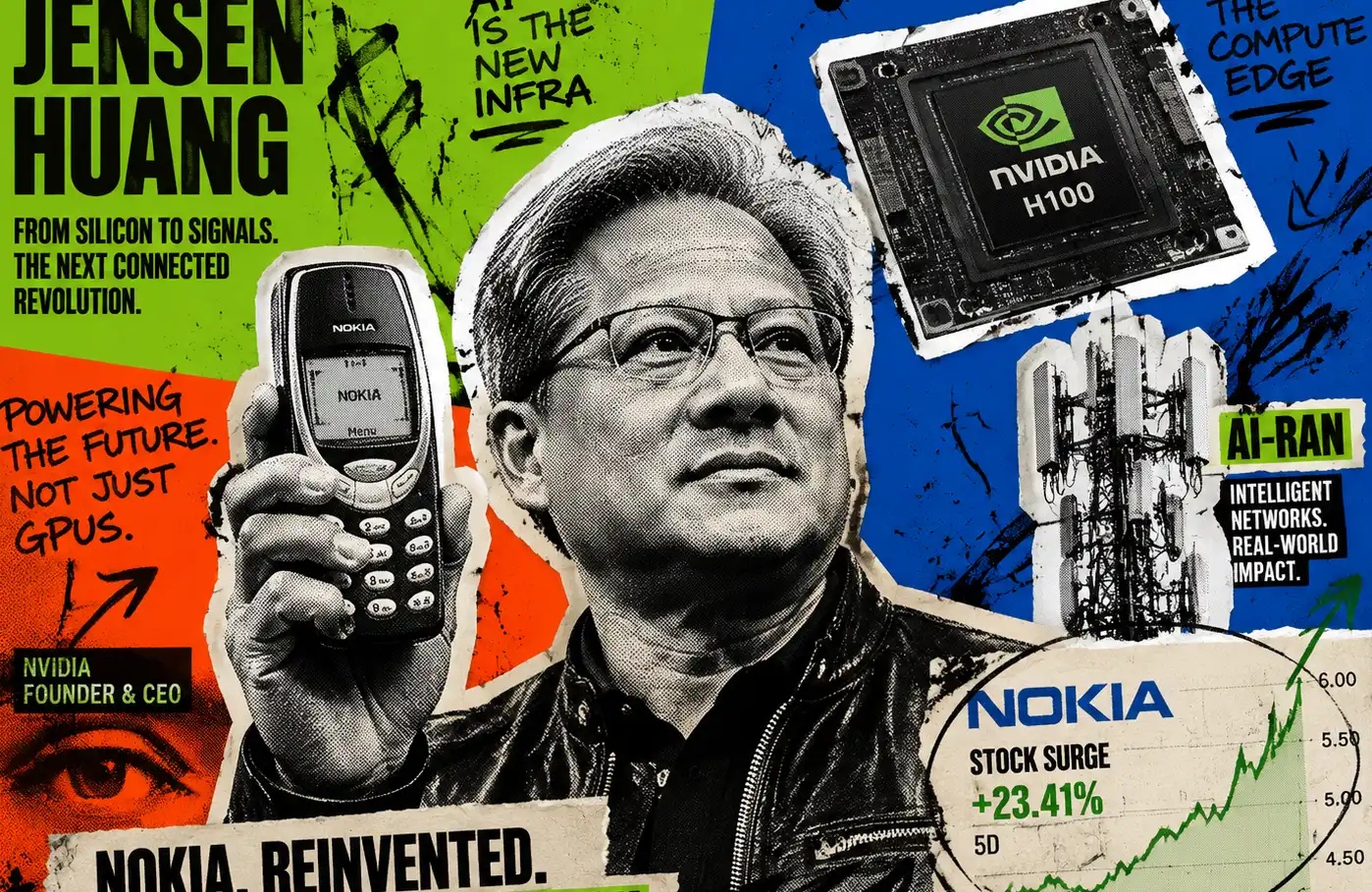
Nokia's stock price is currently around $16.8, almost 170% higher than when Nvidia subscribed for new shares at $6.01 in October 2025, adding about $60 billion to its market cap, hitting a 16-year high. The market no longer sees it as just a cyclical telco equipment vendor but rapidly reappraises it as an AI network and edge infrastructure player. Nvidia's equity investment and tech collaboration have been the most direct catalyst.
Behind this is a broad trend of AI capex moving from core data centers to telco edges, RANs, and optical networks. The question is, how far along this reassessment cycle is now and how much solid ground there is to support the stock price going forward?
Nokia's Stock Price Has Undergone AI Infrastructure Reassessment
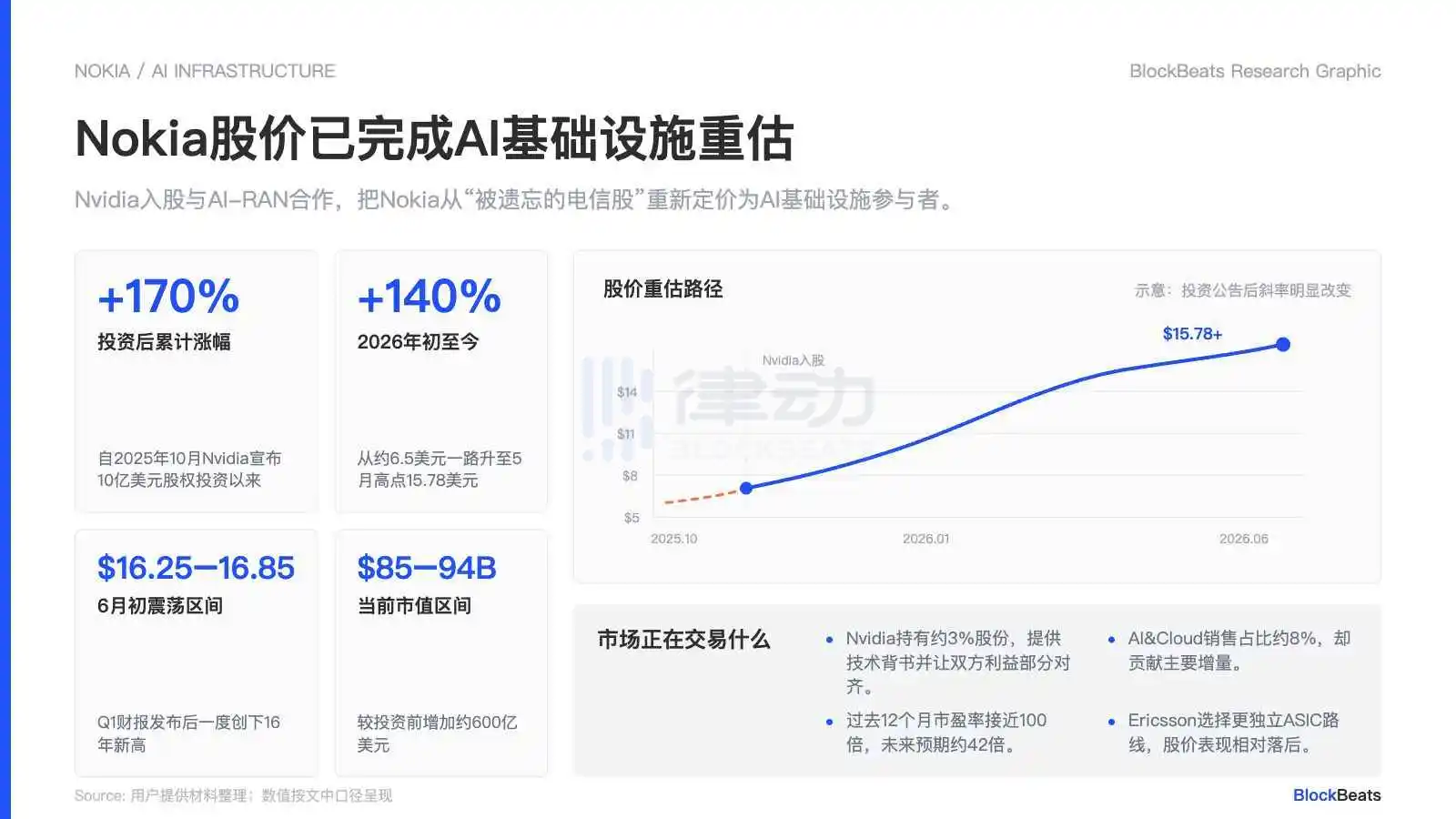
Since Nvidia's announcement in October 2025 of a $1 billion equity investment and the strategic AI-RAN collaboration, Nokia's stock price has surged by nearly 170%. The increase since the beginning of 2026 exceeds 140%, rising from around $6.5 to a high of $15.78 in May, oscillating in the $16.25-$16.85 range in early June, and hitting a 16-year high post-Q1 earnings release.
The current market cap is approximately $85-$94 billion, adding about $60 billion from pre-investment levels. The AI & Cloud business accounts for around 8% of group sales but drives most of the incremental growth. The trailing P/E ratio over the past 12 months is close to 100x, with a future expected P/E ratio of about 42x, significantly higher than traditional telco peers but still below pure-play AI infra companies. In contrast, Ericsson's stock lags due to opting for a more proprietary ASIC chip route.
These shifts indicate the market is now trading Nokia's transformation from a "forgotten telco stock" to an AI infrastructure player. With Nvidia holding around 3% stake, providing both tech endorsement and partial alignment of interests, along with the U.S. narrative pushing telcos back to the forefront, it has hastened this reassessment.
However, after a significant outperformance in the stock price, what the market truly trades on now is which business developments can materialize?
Q1 Order and Guidance Upside Validate Accelerated Transformation
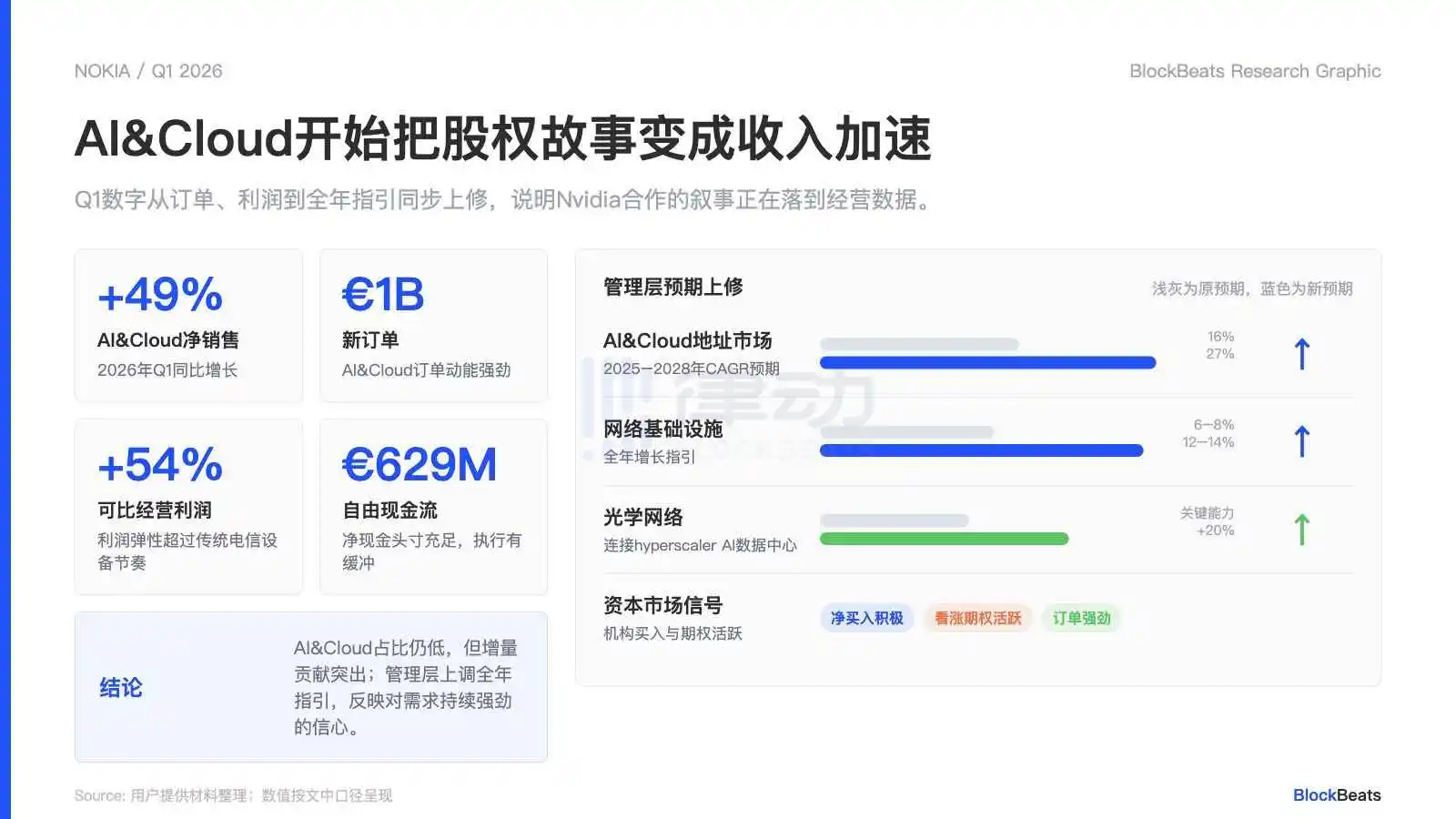
In the Q1 2026 financial report, Nokia's AI & Cloud net sales grew by 49% year-on-year, securing €1 billion in new orders and experiencing a significant 54% increase in comparable operating profit. As a result, the company raised its AI & Cloud addressable market CAGR expectation for 2025-2028 from 16% to 27% and increased the full-year growth guidance for its Network Infrastructure segment from 6-8% to 12-14%.
During the same period, the Optical Networks business grew by 20% and became a critical part of connecting hyperscaler AI data centers. Following the acquisition of Infinera, this capability was further strengthened. The strong new order intake led to a free cash flow of €629 million, with a strong net cash position, providing a buffer for future execution.
These figures indicate that the Nvidia partnership is shifting from an equity story to visible revenue acceleration. While AI & Cloud still represents a low proportion, its incremental contribution is significant. The company has raised its full-year guidance, reflecting management's confident outlook on sustained demand. Institutional net buying over the past 12 months has been positive, and the bullish option activity is above normal levels, further supporting this assessment.
MWC Testing and Innovation Lab Validate Early Commercial Pathway
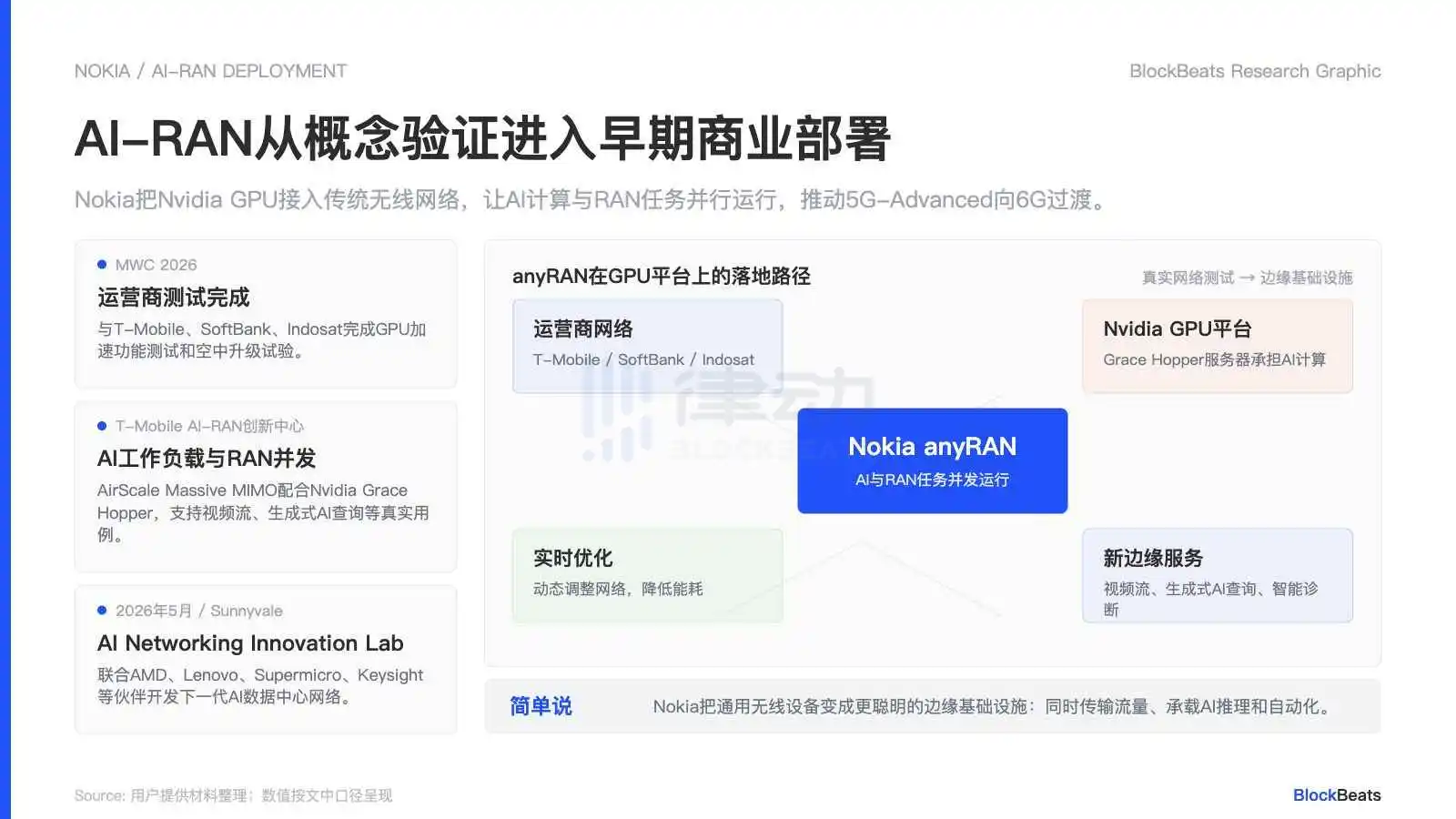
During MWC 2026, Nokia completed GPU-accelerated feature testing and over-the-air upgrades with operators such as T-Mobile, SoftBank, and Indosat. At T-Mobile's AI-RAN Innovation Center, they paired Nokia's AirScale Massive MIMO wireless equipment with Nvidia's Grace Hopper servers to successfully run AI workloads concurrently with RAN tasks, supporting real-world use cases like video streaming and generative AI queries.
In May 2026, Nokia established the AI Networking Innovation Lab in Sunnyvale, California, collaborating with partners such as AMD, Lenovo, Supermicro, and Keysight to develop the next-generation AI data center network. They also introduced AI capabilities for fixed broadband products to help operators automatically diagnose issues, reduce costs, and expedite fiber deployment.
These advancements indicate that Nokia's anyRAN software's acceleration path on the Nvidia GPU platform is now ready for implementation. AI-RAN (AI-optimized Radio Access Network) is no longer a conceptual idea but can achieve real-time optimization, energy efficiency improvements, and the creation of new edge services in live operator networks, offering a feasible pathway from 5G-Advanced to 6G transition. Nokia CEO Justin Hotard stated that the collaboration is shifting from validation to early commercial deployment.
In simple terms, Nokia has put Nvidia GPUs into traditional wireless network hardware to enable AI computation and network transmission tasks to run in parallel. This allows the network to be adjusted in real time, saves power, and enables the development of new services. This approach turns general-purpose devices into smarter edge infrastructure.
Deployment Scale under High Valuation as the Primary Constraint
Although Q1 data, test results, and ecosystem partner expansion have been relatively positive, the current P/E ratio is close to 100 times, with analyst consensus target prices around 9.4-12 euros (some investment banks raised to around 12-14 euros), significantly lagging behind the current stock price. This indicates that the market has already priced in more optimism ahead of time for the long-term penetration of AI-RAN and the expected 27% growth, leaving little margin for error.
In the next 12-24 months, the speed of actual deployment contract conversions by large operators, the overall pace of AI capital expenditure, and the divergence path from Ericsson (the latter insists on independent ASICs, avoiding deep binding to a single GPU supplier) will be the key variables. If subsequent orders fall short of expectations or AI spending slows down, the downside risk will significantly increase.
Institutional net buying and a preference for call options currently support stock price momentum, but these factors ultimately need to be validated by execution. Nokia's position as a representative of AI edge infrastructure has been recognized, and the integration of optical networks with wireless access further expands the overall market space. However, there is still a significant distance from current early orders to truly commercial deployments at hyperscale cloud provider levels.
We are still in the early acceleration stage, with overall execution signals being positive. However, the high valuation has squeezed the margin of error, and investors will now focus on real-world large-scale deployment progress rather than additional demonstrations to assess how far this trend of AI expanding to telecom edge can go.
Welcome to join the official BlockBeats community:
Telegram Subscription Group: https://t.me/theblockbeats
Telegram Discussion Group: https://t.me/BlockBeats_App
Official Twitter Account: https://twitter.com/BlockBeatsAsia