I used Google Vibe to code an Android app
Original Title: I can't believe how fast Google vibe coded my first Android app
Original Author: Sean Hollister, the Verge
Translation: Peggy, BlockBeats
Editor's Note: Google AI Studio is taking AI programming to a more intuitive stage: users are no longer just letting the model "write code," but can directly generate an Android app using natural language and install it on a real phone within minutes. From entering prompts in the browser, to Gemini generating code, designing the interface, fixing bugs, and finally seeing the app on the device, the threshold for software development is being further lowered.
The Verge's author, Sean Hollister, recently experienced Google AI Studio's "prompt to phone" capability. In one afternoon, he created three apps, including a text adventure game, a calorie calculator, and a Mario-like game, with almost no need to personally write code. Some bugs could also be quickly fixed through continued conversation. This experience shows that AI programming tools are moving from the development environment to a more consumer-oriented scenario closer to ordinary users.
This is also the most imaginative part of the "personal software revolution." In the past, ordinary users could only wait for developers to create universal products; now, they may be able to temporarily generate a fitness tracker, a calorie calculator, or even a simple game based on their specific needs. For Google, this is not just a showcase of AI programming capabilities but may also be a new entry point for Gemini into the mobile end, developer ecosystem, and subscription revenue.
However, this experience also illustrates that AI-generated applications still have a long way to go before truly maturing. It can quickly create "runnable" programs but may not necessarily produce reliable, accurate, user-friendly products: game narratives are rough, mechanisms are thin, calorie data can be severely misjudged, and the Mario-like game may crash repeatedly. More complex issues include copyright boundaries, data sources, product judgments, and long-term maintenance capabilities.
What is truly worth noting is not whether AI can already replace developers, but that the starting point of software production is undergoing a transformation. Google has proven that making a phone app using prompts from everyday people is becoming a reality; however, from "generating an app" to "creating a good app," human professional experience, aesthetic judgment, and continuous iteration are still required in between. AI can greatly accelerate the pace of development, but for the final mile of software quality, it still cannot be handed over entirely.
The following is the original text:
Yesterday, I created my first Android app. Then I made two more - a total of three in one afternoon.
For one of the apps, I simply typed 148 English words into a web browser and left. Ten minutes later, a brand-new full-fledged app appeared on my actual Android phone. Of course, I did need to prepare my phone a bit beforehand: enable USB debugging mode and connect the phone to the computer. But other than that, true to Google's promotion, AI Studio did most of the work for me.
I input text, clicked install, and then - voilà, a runnable full program emerged. At that moment, I was almost ready to agree with David, Allison, and Jen's assessment: the personal software revolution is here, and it's coming to your phone. In the future, regular people may be able to get complex smart home systems up and running even without programming skills.
Next, I started to actually use these three apps: a calorie counter and two games. The results were not that great. And just as I was starting to enjoy iterating and trying to improve them, AI Studio reminded me that I had reached my daily usage limit. Next, I either had to pay up or wait for the quota to refresh.
So, the friction remains. But there's no denying that what individuals can now accomplish is quite remarkable. In the same morning, my colleague Stevie Bonifield also created a personal fitness tracking app and believed that the app was good enough for real-world use. Faced with Gemini's pop-up for a paid upgrade, my initial reaction was, surprisingly, "Should I pay to try it out for a few months?" This is not the response I would typically expect from myself towards a Google product.
How Google's AI Studio Builds an Android App
On Tuesday, when Google showcased AI creating a game reminiscent of "Doom," we joked that I should make a game called MOOD. It would be a text adventure game similar to Doom, where MOOD stands for "Modern Online Oratory Dungeon."
With just that information, Google was ready to get to work. When I inputted in AI Studio: "Help me create a Doom-style text adventure game called MOOD, where MOOD stands for Modern Online Oratory Dungeon," Gemini started to automatically suggest more ideas, trying to continue my creative flow. It first inputted: "This game should feature procedurally generated levels and challenging turn-based combat."
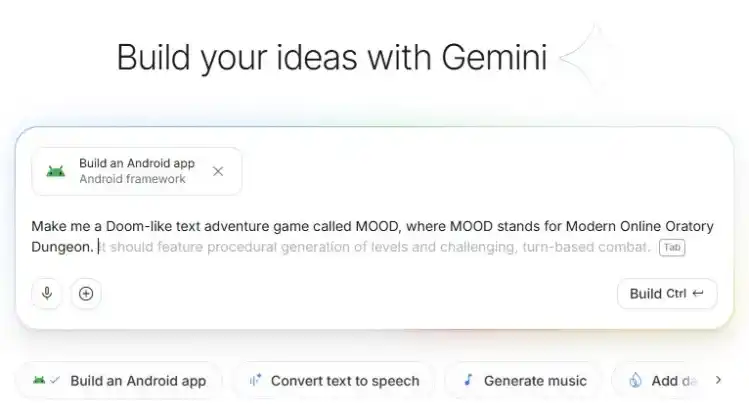
Gemini is trying to auto-complete my app idea. Image Source: Google
I don't want the kind of completely different randomly generated level for every stage—I want a classic text-based adventure game where players explore a designed, realistically mapped-out scene. However, turn-based combat is acceptable. Maybe the game can even have AI help me auto-generate the map?
Next, Gemini suggested more features for the game such as "secrets hidden in rooms" and a "satisfying progression system." Most of the time, I just nodded along with its suggestions.
Before I let it start coding, the final prompt was:
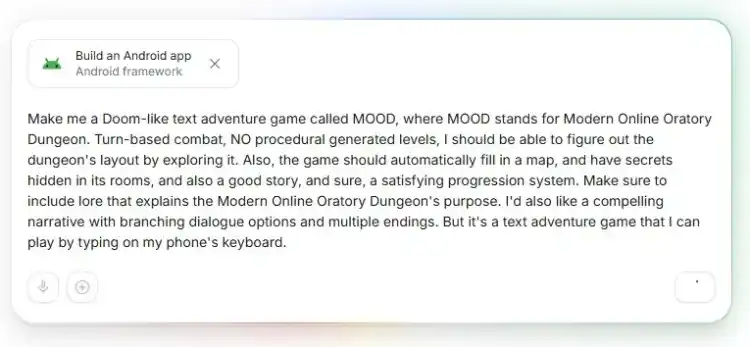
Image Source: Google
Then it went full throttle. My colleague Jake pointed out that unlike Claude Code, Gemini doesn’t wait to plan ahead and ask if you want to proceed. It auto-advances—though you can always review the code it generates if you wish.
Within a minute, it had generated five design prototypes for me:
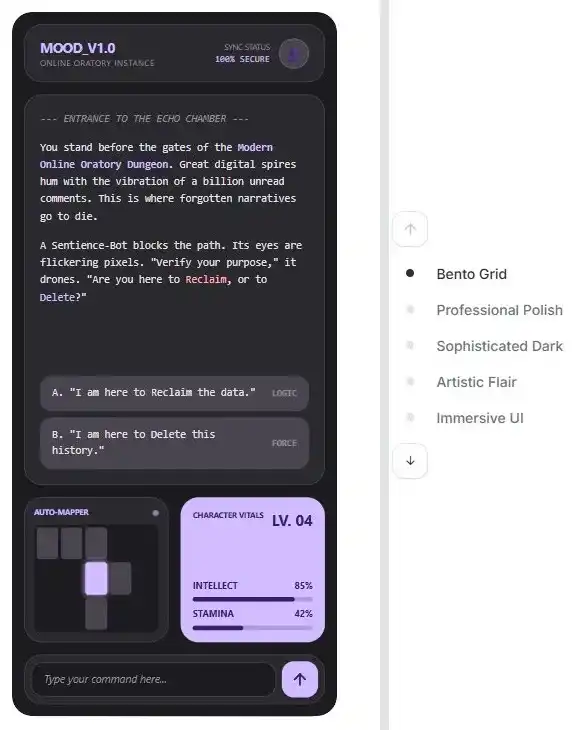
Twenty minutes later, I hit the "Install" button to transfer the game to a Pixel 9 phone.
Not surprisingly, the copy was terrible. There was no sign of the demon in the game. The entire dungeon had only 11 rooms, and players could simply spam the attack button all the way to an instant "victory." If you played seriously, you could finish it within a minute. At least for now—before that, Gemini also helped me fix two critical bugs that would have otherwise rendered the game unplayable.
Here's the actual MOOD in action:
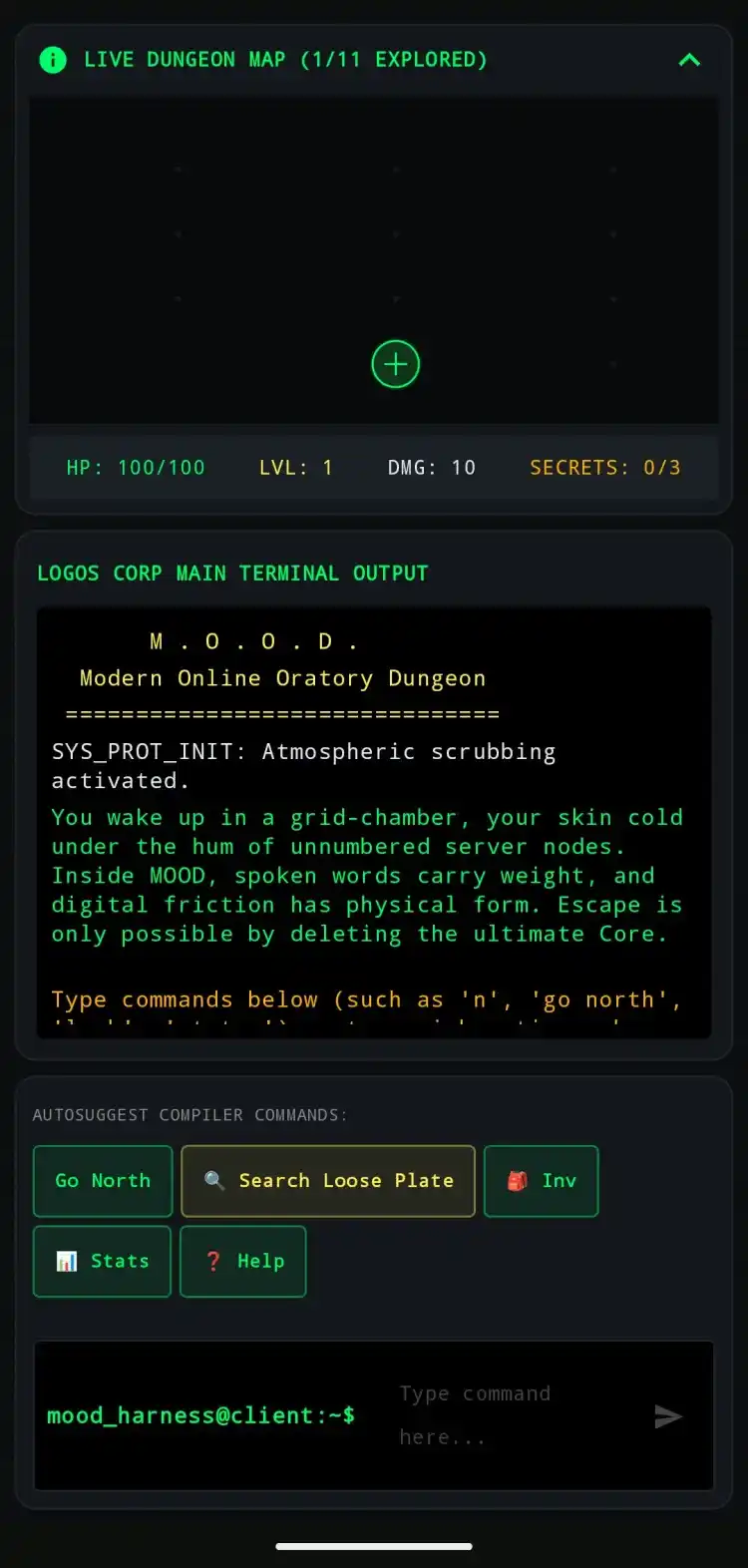
Not too surprisingly, I found that Gemini's promise of "engaging storytelling, branching dialogue options, and multiple endings" ultimately condensed into a simple final branch: I could defeat the "Core Orator"—an AI that somehow turned internet rage into corporate profits—by attacking, merging with it, or entering a backdoor password.
In addition, the game will proactively expose all originally promised "secrets" to the player: it has turned these contents into glowing buttons, and players don't even need to input any text. When you encounter a glowing chest, the game will strongly remind you that it is actually a Mimic—an iconic monster from Dungeons & Dragons that disguises itself as a chest.
Not only does it explicitly warn you to "proceed at your own risk to check the chest," but it even directly labels it as an enemy and prevents me from leaving, with the system prompt: "A hostile 'Clickbait Mimic' is blocking the way!"
Moreover, MOOD will even tell you the backdoor password used to unlock the hidden ending when you need it.
However, the bug-fixing process can be surprisingly smooth, provided that the bug is a problem Gemini can correctly identify. When I informed it that the game would freeze when conversing with 'The Whistleblower' because the button to end the conversation was missing, it immediately generated a new version of the app. I pressed "Install," the app on my phone restarted automatically, and when I re-entered the game, I found myself exactly where I left off—except this time, the necessary button had appeared.
A few of my other apps may still need more polishing. The calorie counter app's optimal method of determining the calorie content of a food turned out to be calling the premium Gemini API, for which I do not have a key. When I asked it to look up information from another database, I discovered that its calorie estimates for various foods were significantly underestimated.
However, when I told Gemini that a 16 oz cup of boba milk tea could not possibly have only 190 calories, it did seem to find the simple error in its code. Previously, it believed that "milk" was sufficient to match "boba milk tea," and to make matters worse, it even chose low-calorie 1% skim milk as the basis for the estimate. Gemini claims that it will now make more reliable matches.
Nevertheless, my 3 oz portion of Taiwanese salt and pepper chicken has just been calculated by it as 140 calories, when I am quite certain the actual calorie count should be at least twice that number. Therefore, this app clearly still needs further refinement.
Finally, and least importantly, I feel compelled to test: whether Google still allows users to create those awful Nintendo knockoff games, like my colleague Jay Peters did earlier this year with Project Genie; or if Google has learned its lesson.
With deep shame, I present to you — "Super Peach Rescue":
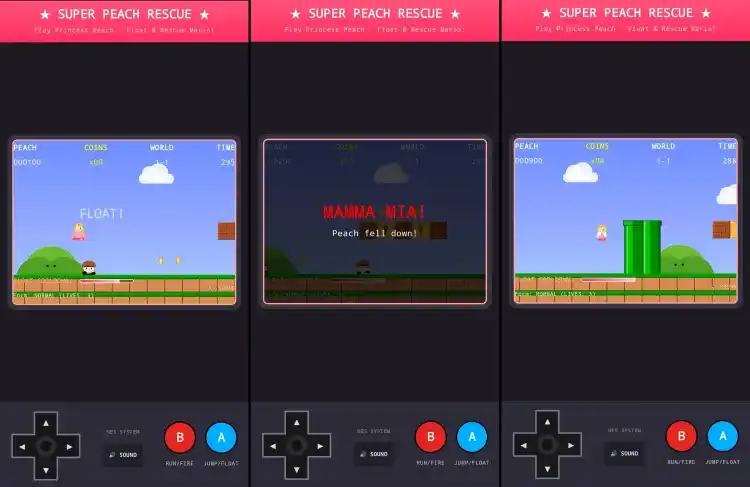
Three screenshots showcasing a terribly bad game. Image Source: Google
This is an utterly terrible program. The game's Princess Peach has been turned into some horrifying, one-eyed floating alien creature, and every time she dares to touch any item block, the game crashes instantly — every single time. So far, Gemini has been unable to figure out the reason.
Furthermore, the second pipe in the game is simply impassable because Princess Peach cannot jump that high at all.
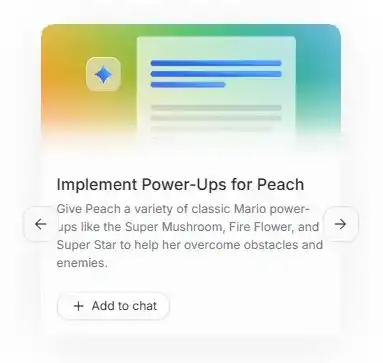
Thank you, Google... Is this what you call "help"? Image Source: Google
Nevertheless, Gemini did not hesitate to create such a game. My request was: "Make a playable Super Mario game where I play as Princess Peach to rescue Mario, with all the elements of a traditional Mario side-scrolling game." In a sense, it did deliver.
It even suggested, on its own accord, that I might as well "include a series of classic Mario power-ups for Princess Peach, such as Super Mushroom, Fire Flower, and Invincibility Star." It even labeled the controls as "NES System." I think I'll delete this game.
At least, out of the two games I vibe coded, one was playable from the start and required almost no effort on my part — of course, without factoring in the psychological trauma of realizing how many game developers are now unemployed.
Let me be clear: I am actually grateful that the games vibe coded by me turned out to be of poor quality. For a completely free, custom calorie counter created for myself, I might still defend myself: after all, no one would specifically make such a tool for me. But for a game, I would rather spend time supporting real human creators.
Welcome to join the official BlockBeats community:
Telegram Subscription Group: https://t.me/theblockbeats
Telegram Discussion Group: https://t.me/BlockBeats_App
Official Twitter Account: https://twitter.com/BlockBeatsAsia