From HYPE to ZEC: Understanding the 4 Narrative Threads Behind the Recent "Altcoin Frenzy"
Original Article Title: "Market Watch: From HYPE to ZEC, Grasping the 4 Narrative Threads Behind the Recent Altcoin Frenzy"
This week, the cryptocurrency market has shown some localized trends.
Although BTC dominance is still around 60% and the Alt Season Index is only at 35, far from the 75 threshold to confirm an alt season, if you are skimming through English crypto Twitter, you will find that funds are no longer waiting for macro signals.
Over the past week, at least four independent narratives have been running simultaneously:
1. Decentralized Perpetual Contract Exchange (perp DEX) hitting new highs,
2. AI public chain rotation,
3. Privacy coins repricing,
4. Meme coins starting to reignite.
The seven coins recently frequently mentioned—HYPE, LIT, NEAR, GRASS, WLD, ZEC, USELESS—are typical representatives, each corresponding to one of the four directions of market attention.
Let's first look at a performance chart to see their trends:
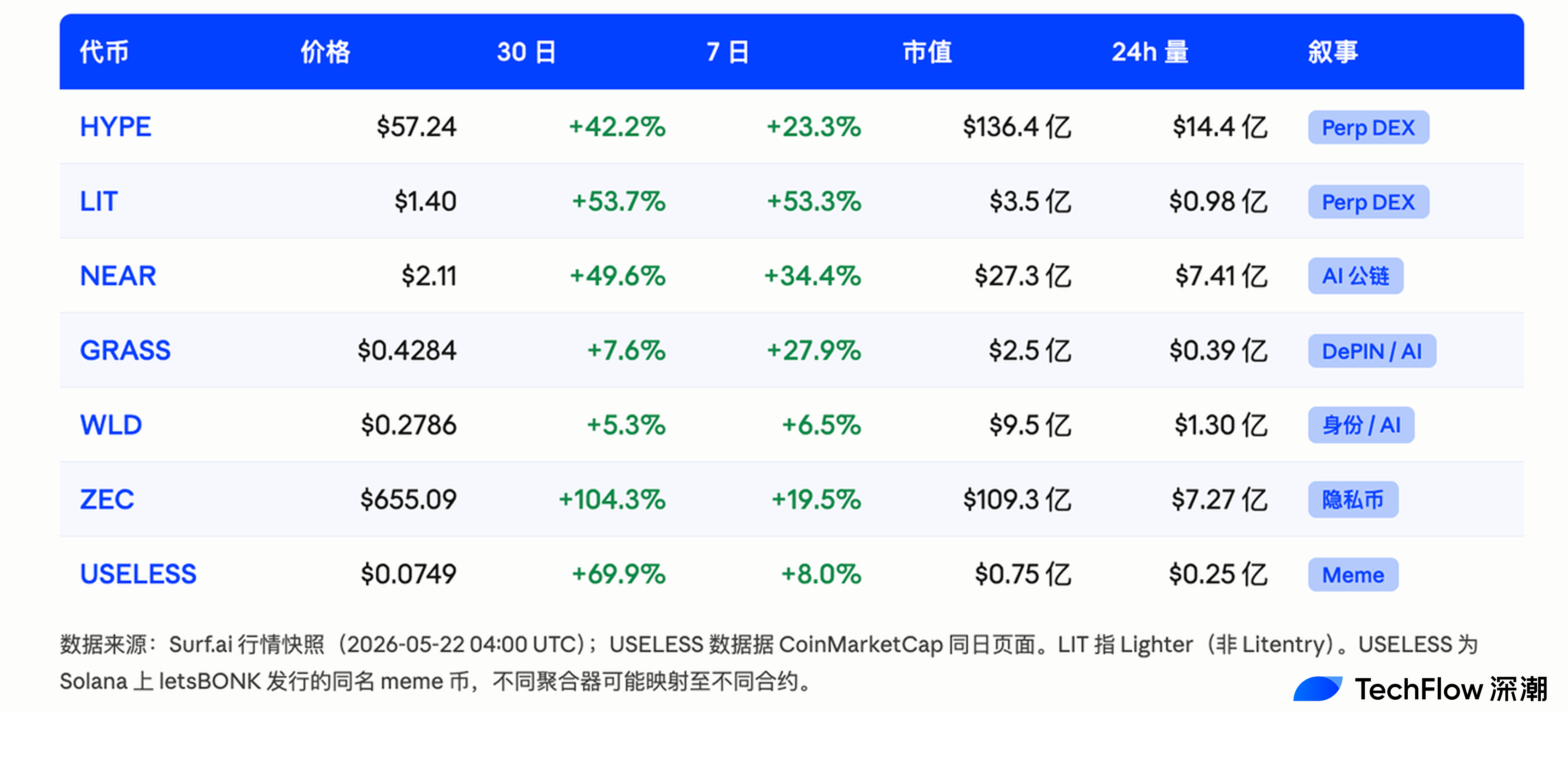
Several pieces of information can be gleaned from the table.
First, ZEC and HYPE have the strongest 30-day price gains and trading volume, with the most robust capital confirmation on their respective narrative threads; LIT leads in 7-day price gains, but its market cap is only 1/40 of HYPE's, showing high elasticity and a significant retracement;
USELESS has quietly risen by nearly 70% in the past 30 days, but with a market cap of only $75 million, it is not in the same league as ZEC's billion-dollar level;
WLD has hardly seen any gains and has the weakest price confirmation within this group, but there is still a substantial discussion in English crypto Twitter.
Next, we will deconstruct the logic behind each narrative one by one.
1. Perp DEX Thread: HYPE Hits New Highs, LIT Follows with a Rebound
The Perp DEX is the most complete capital chain in this round of altcoin frenzy. Within it, HYPE's protocol revenue, institutional holdings, ETF packaging have all materialized within the same month.
The foundation of HYPE is revenue. Hyperliquid holds about 70% of the open interest on the perp DEX, with weekly fees of $14 million, yielding over $600 million annually. 97% of protocol fees are used for automatic HYPE buybacks.
This flywheel has been spinning since the token launched at the end of 2024, and by May of this year, it had already burned millions of circulating supply. Arthur Hayes' Maelstrom Fund publicly stated that they have been selling off positions in ENA, PENDLE, and others to increase their HYPE holdings, setting a target price of $150, citing the revenue-buyback model.
Institutions are also following suit.
On-chain analyst @ai_9684xtpa tracked a wallet suspected to be associated with a16z, accumulating around 9.18 million HYPE tokens since mid-April, approximately $356 million (a16z unconfirmed). On May 12th and 15th, 21Shares and Bitwise's two HYPE spot ETFs were successively listed on Nasdaq and NYSE, with a total inflow of over $5.6 million in the first week.
The first-day trading volume of BHYP broke the record for the 2026 meme ETF listing premiere. Bitwise also allocates an additional 10% of management fees for buybacks. On May 21st, HYPE hit a new all-time high of $62.14, entering the top ten by market capitalization.
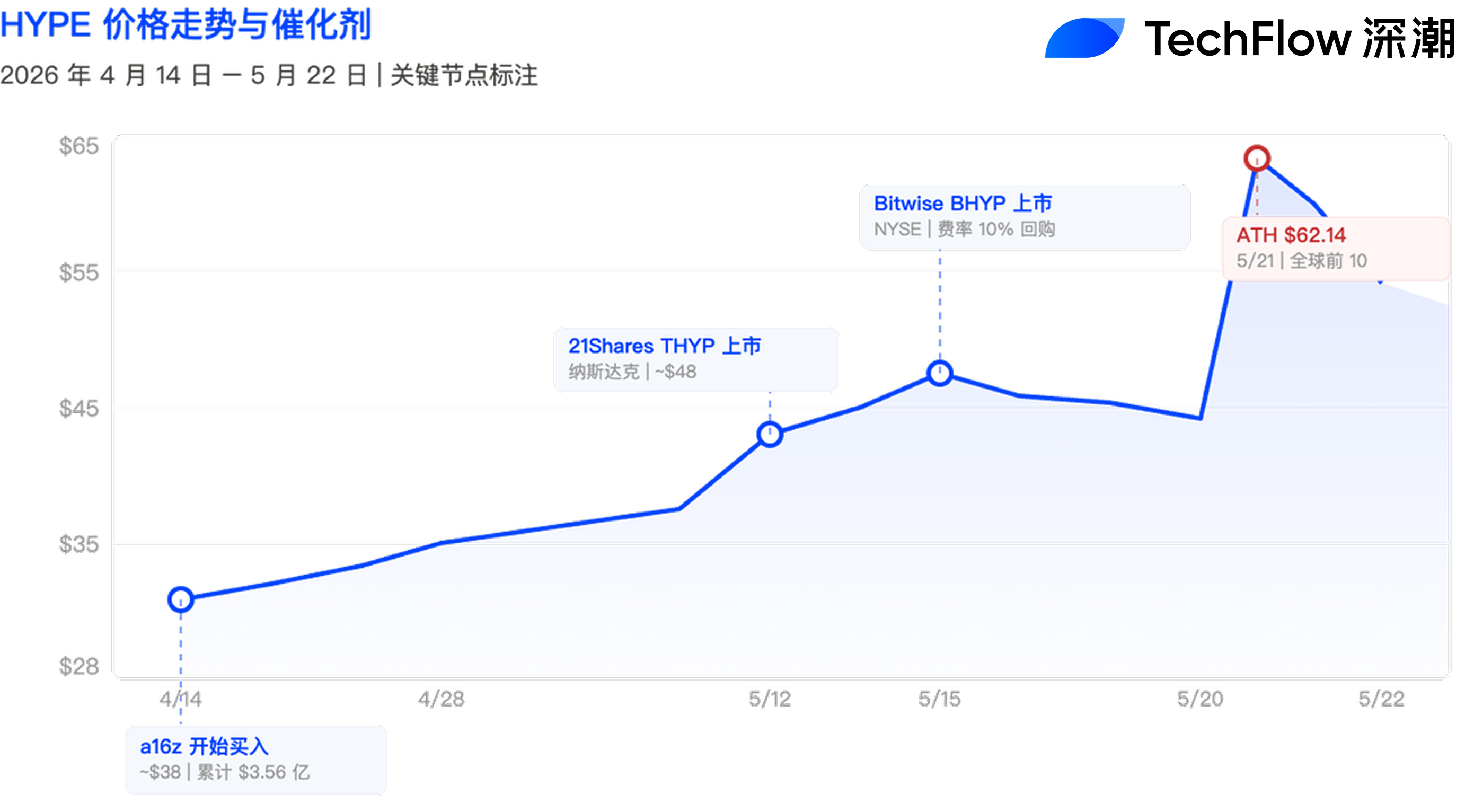
Revenue = Foundation, Institutions = Amplifier, ETF = Entry point. Having all three layers in place is indeed rare in meme coins.
The logic of hype overflowing into the same track is also straightforward. Lighter is the fourth player in the perp DEX track with about 10% market share, but its market cap is only 1/40 of HYPE's. When HYPE surged to a new high and entered the top ten by market cap, traders naturally looked for assets with more elasticity along the same narrative.
On May 18th, Vitalik mentioned in a public conversation that Lighter is a "relatively successful new project" in the Ethereum ecosystem, essentially giving this narrative of a price boost a celebrity endorsement. LIT then rose by 30% in the following three days. Lighter also made moves of its own: launching SpaceX pre-IPO perpetual contracts, integrating with the Tealstreet trading terminal, with an annual revenue of around $26.3 million and its own buyback mechanism.
However, LIT's risk is more clearly defined relative to the hype.
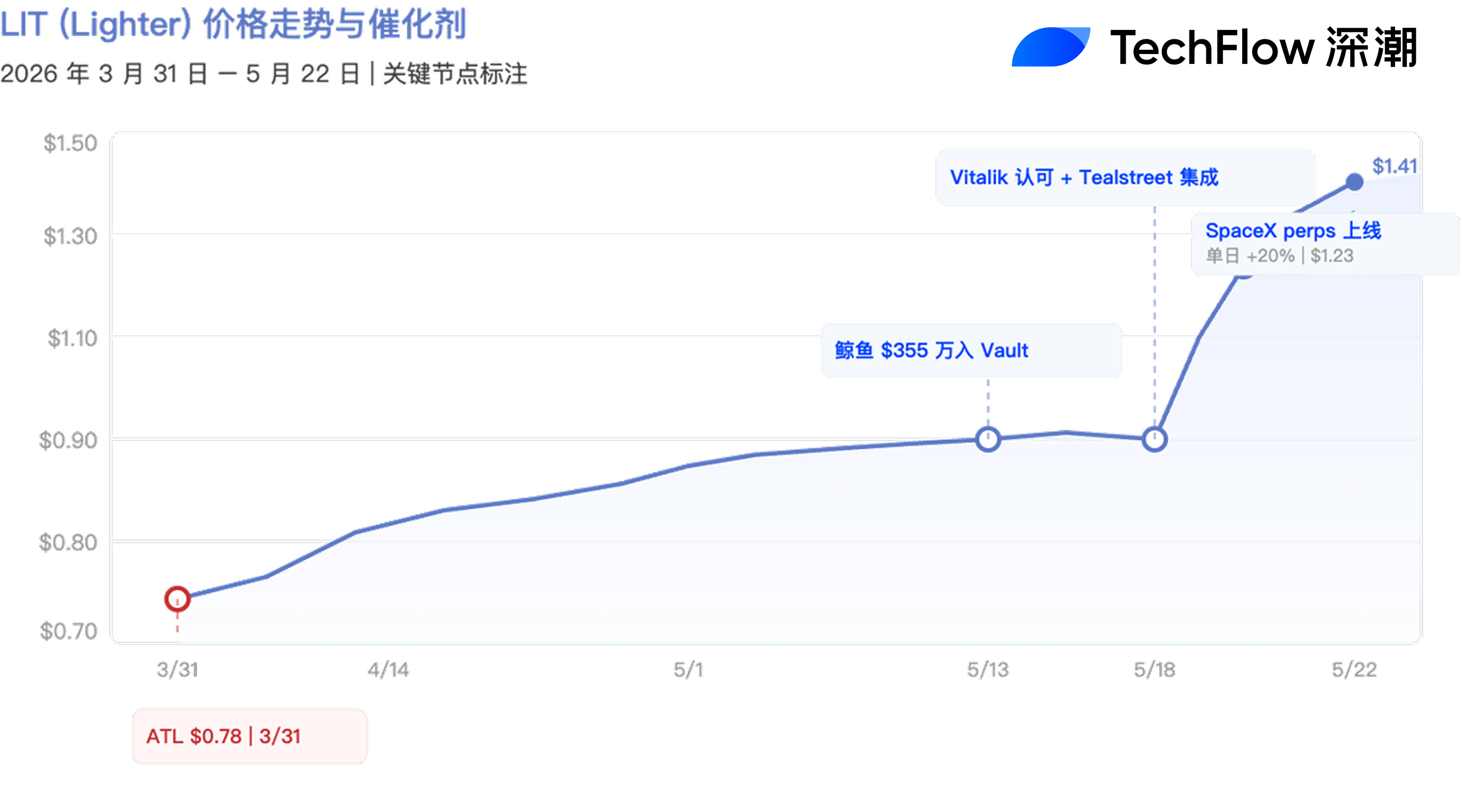
Previously, Lighter's high trading volume partly came from the incentive plan and zero-fee design. Some market analysis has pointed out that its trading volume/open interest ratio is relatively high, and the wash trading component needs to be observed. Only 25% of LIT's circulation is currently available, with the team's and investors' tokens starting to unlock at the end of the year, at a rate of approximately 13.5 million tokens per month.
On the flip side of the relief rally, once the hype cycle cools off, LIT's pullback will be faster and deeper.
The author believes that this narrative is likely to continue attracting attention and funds in the medium term. Points to watch include:
1. Whether the ETF inflows driven by hype can reach the previous scale;
2. Whether Hyperliquid's protocol revenue can expand into traditional asset synthetic trading (such as crude oil, stock perps) to bring in new volume (e.g., SPCX).
If both of these materialize, there is still room for the perp DEX narrative. However, if ETF inflows stagnate and revenue growth slows down, the buy/sell turnover pressure near ATH (All-Time High) will quickly transmit to LIT.
2. AI Line: NEAR Leading, GRASS and WLD Each Have Their Pain Points
The AI narrative is not new in the crypto market, but this round of funding has seen a change in attitude.
NEAR is up 50% in 30 days, GRASS is up 8%, WLD is up 5%. All three carry the AI label, but their price performance is ten times apart. The market is no longer homogeneous; it is starting to distinguish between new things and the different emotional values brought by catalysts.
$NEAR: Privacy + AI Narrative
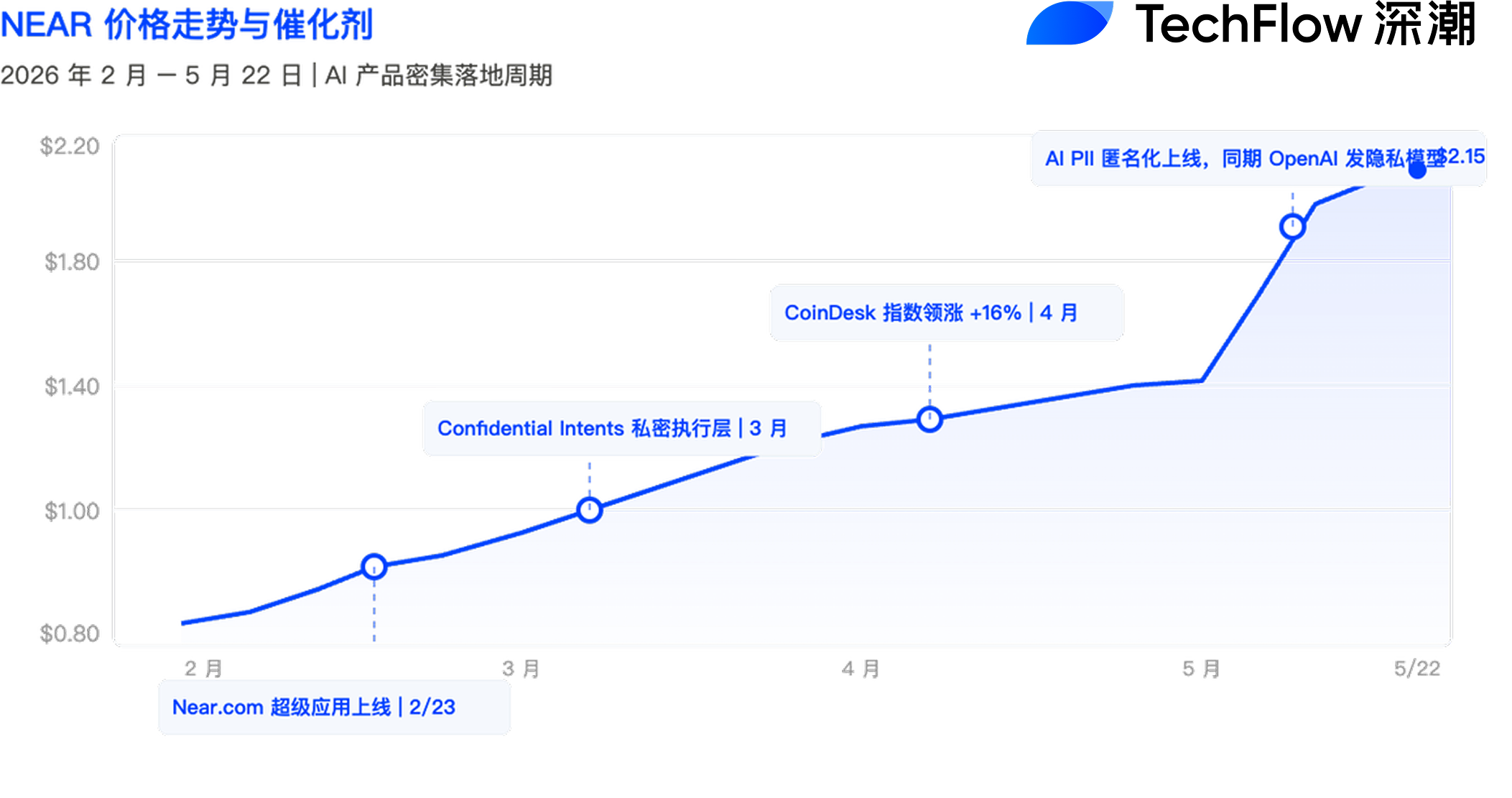
The reason NEAR is leading is directly related to its intense product actions in the past two months.
On May 19, NEAR launched a framework-level privacy feature for AI:
When users give prompts to external models like ChatGPT and Claude, the system automatically strips out passwords, API keys, and personal information, and developers can enable it with one header line.
This has evolved into a narrative of AI privacy identity, which is relatively practical. The overseas tech narrative has always emphasized privacy and rights, and this wave both involves AI and satisfies the emotion value of privacy first.
At the same time, the time window for this feature is also adding to the heat in the AI community. At the end of April, OpenAI just released its Privacy Filter model, and Microsoft also launched PII Shield at the same time.
NEAR is essentially doing the same thing but running on-chain, providing a reason for the funding frenzy.
Looking further back, the Near.com super app launched in February integrated wallet, cross-chain exchange, and confidential transactions, and in March, it introduced Confidential Intents, a private execution layer. These products are all converging on the same narrative:
Enabling AI agents to transact and coordinate on-chain while preserving privacy.
$GRASS: Application Exists, but Unlocking Hinders
But GRASS's situation is somewhat different.
On the product side, it is one of the few projects in the DePIN track with real paying customers, including an AI lab with a "seven-figure" level, whose revenue includes a portion for GRASS buyback.
On April 24, OKX listed the trading pair, improving liquidity access, leading to a 28% increase in 7 days.
What hinders price performance, in the author's opinion, is the unlocking issue on the supply side. Season 2 airdrop is releasing approximately 170 million GRASS tokens, coupled with team and investor unlocks, the short-term supply has been suppressing the price. Community discussions are also focused on this point. Grass's business is running, but the token is currently more in a state of supply-demand game, rather than a trending market.
$WLD: Identity+AI Narrative
Furthermore, WLD is the most easily misunderstood in this group.
Many people simply categorize WLD as "Sam Altman shadow trading" and then skip it, but in recent months, its narrative hype foundation is actually changing:
As AI becomes more pervasive, proving you are human becomes more valuable. In recent months, new variables around this logic have been intensively emerging.
1. The Nasdaq-listed company Eightco Holdings (ticker ORBS) holds 283 million WLD, accounting for 8.3% of the circulating supply, making it the world's largest publicly disclosed institutional holder.
2. At the same time, Eightco holds $90 million worth of OpenAI shares, with total assets of around $337 million, positioning itself as an "AI + Identity + Creator Economy" bundled exposure.
3. On May 1st, World officially entered the U.S. market, planning to deploy 7,500 Orb scanning devices within 12 months, which is several times the current global deployment.
The issue also lies on the supply side. With a total supply of 10 billion WLD, approximately 3.4 billion WLD are currently in circulation, and the team frequently deposits large amounts of tokens to Coinbase and Bybit. After July 24th, the unlock rate will decrease by 43%, which could be a potential turning point, but until then, the supply pressure remains significant.
3. Privacy Line: English Community Re-FOMOs Privacy Coin, ZEC Doubles in 30 Days
Regarding ZEC, there is no need for further elaboration. You can refer to our previous article: "Doubling in 30 Days, 15x Increase in a Year: Why is the English Community FOMOing into $ZEC Again?"
Apart from the hype, the English crypto Twitter is full of ZEC.
Previously, Naval Ravikant mentioned that ZEC is "Bitcoin's hedge insurance," Arthur Hayes at Consensus stated a long-term target price of "10% of BTC," Multicoin Capital publicly disclosed a heavy position and overturned its 2019 judgment that "privacy is not worth paying for separately"... Several solid catalysts behind this wave of declarations are materializing simultaneously:
· The SEC confirmed the end of a three-year investigation into the Zcash Foundation and did not recommend any enforcement action.
· On April 23rd, Robinhood launched ZEC trading nationwide, opening up retail access. The Grayscale ZEC Trust is applying to convert into a spot ETF (ticker ZCSH), which, if approved, will be the first U.S. privacy coin ETF.
The narrative of AI and privacy runs through the English CT, with ZEC exhibiting a significant lead.
4. Meme Line: USELESS doesn't need fundamentals but requires liquidity
USELESS has surged nearly 70% in the last 30 days, second only to ZEC.
During last summer's Solana launchpad melee (pump.fun, letsBONK, BelieveApp fighting for traffic), USELESS was one of the few survivors emerging from letsBONK, with the name itself being a talking point: "I'm utterly useless, and I don't pretend to be useful."
The logic behind this revival is unrelated to fundamentals, as meme coins typically disregard fundamentals. The key variable is the CEX entry: Coinbase, Bybit, Crypto.com have all listed trading pairs, with a 24-hour volume of around $25 million, providing enough liquidity for short-term trading. When meme funds rotate on Solana, an old meme coin with a CEX gateway, community memory, and a name with inherent virality is easily brought back into the spotlight.
However, the risks associated with meme coins are well known. Their popularity changes faster than any other type of asset, acting as an amplifier of market sentiment.
The all-time high of $0.43 is still far off, and attention should be paid to the token's chip structure and previous significant retracements. Also, a reminder that meme-named coins like USELESS often face issues with name collisions on different aggregators; therefore, it's essential to verify the contract address before trading.
In summary, these seven coins correspond to four storylines, with significant differences in the sources of hype and confirmation.
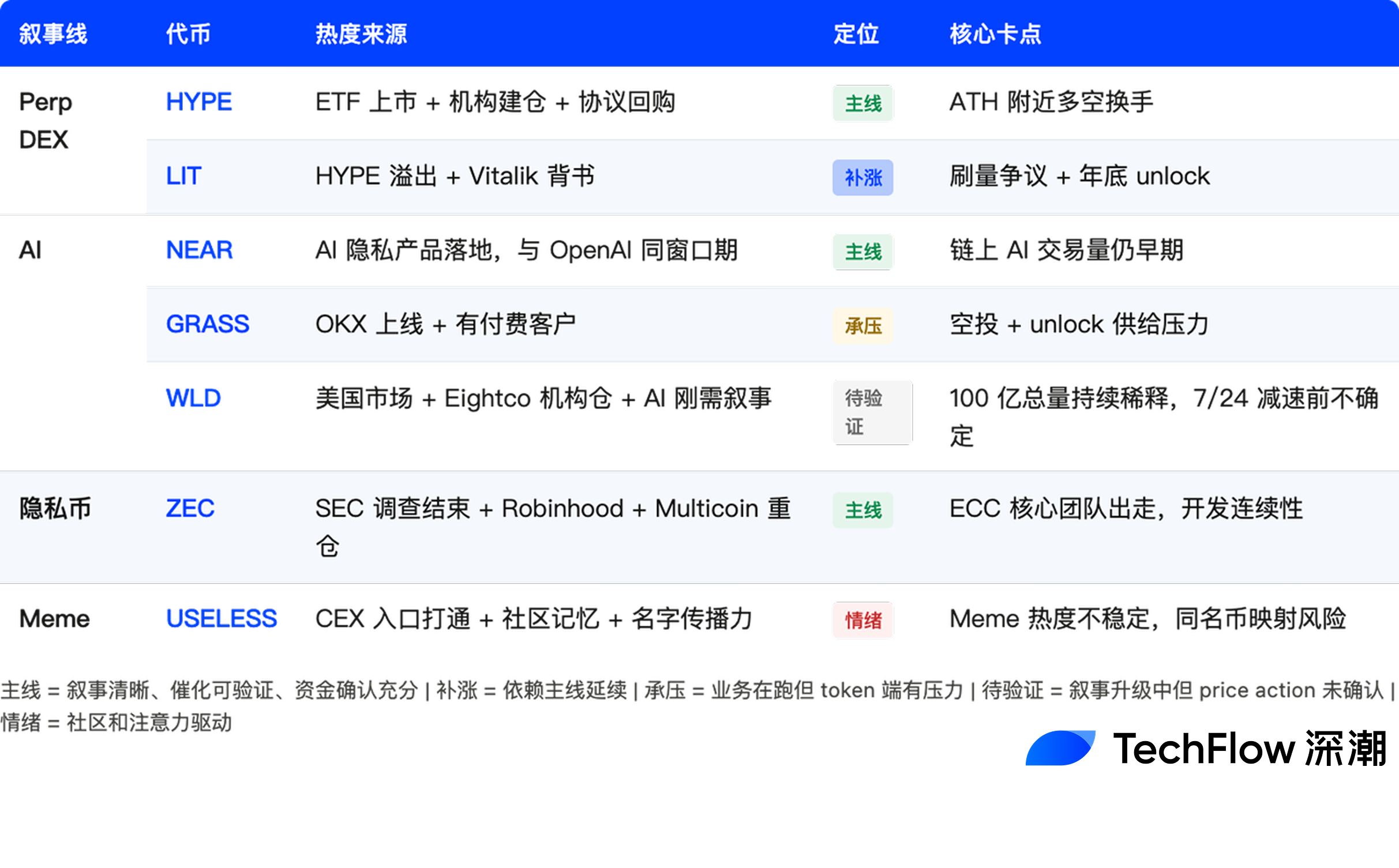
· HYPE, NEAR, and ZEC have the highest confirmation on their respective storyline, with verifiable catalysts and traceable funds.
· LIT and GRASS rely more on the continuation of the main storyline and the digestion of supply pressure, offering flexibility but a lower level of certainty.
· WLD's demand narrative is evolving, but the token's supply pressure remains in limbo until July, requiring further guidance. USELESS is purely a trade based on attention and emotions, not fitting into a fundamental framework.
For spot investors, understanding the rough outline of these storylines is a must. The current crypto market has limited price retracement possibilities, but several main trends will not change in the medium term;
For contract traders, timing is even more critical, requiring further examination of shorter timeframes (e.g., within 1-2 days) such as OI and funding rate changes.
Lastly, there are still structural opportunities in the market, and researching them remains a good way to find yields in the midst of neglect.
Original Article Link
Welcome to join the official BlockBeats community:
Telegram Subscription Group: https://t.me/theblockbeats
Telegram Discussion Group: https://t.me/BlockBeats_App
Official Twitter Account: https://twitter.com/BlockBeatsAsia