He Rejected NVIDIA's $6 Billion Stock Price Offer, Saying His Stock Trading Could Earn More

150,000 people across three continents, from retail investors to hedge fund managers, are copying the homework of a "Twitter Stock God."
And recently, he publicly expressed bullish sentiment on a stock, directly causing nearly a 90% surge over two days.
On February 17, 2026, at the London Stock Exchange, a small stock named Raspberry Pi within the FTSE 250 index saw its price surge by 27% in the first hour of trading. With a cumulative increase of nearly 90% over two days, the stock has maintained a gain of over 50% within a week.
This UK hardware company, with a market capitalization of over £5 billion, has seen its share price linger below the IPO price for the past six months.
No analyst had predicted it would become one of the hottest UK stocks at the start of 2026.
Reuters, Bloomberg, Financial Times, and The Register deployed reporters to retrace the steps, with all clues pointing to the same source.
The day before in the Eastern US time zone, an account on X platform with 58,000 followers posted a tweet titled "Fun trading idea, long $RPI."
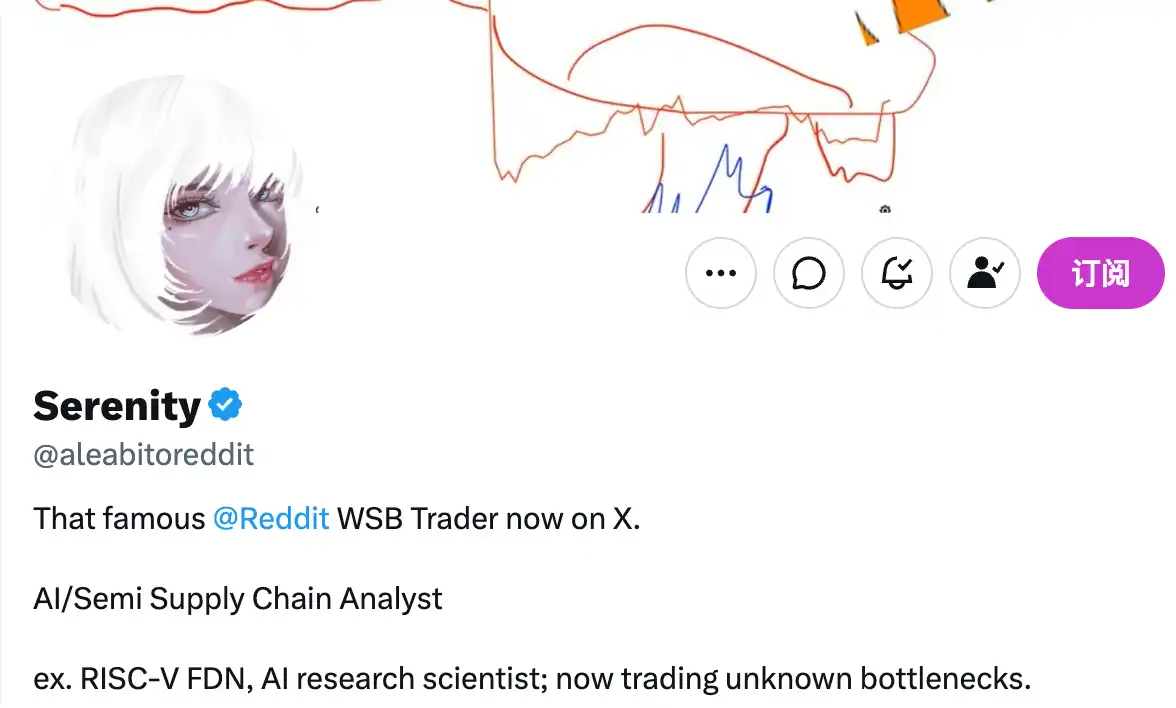
The account name is Serenity, with the handle @aleabitoreddit, using a female avatar.
The introduction of Bloomberg's article reads, "It all started on Monday when a user named aleabitoreddit on X posted a thread titled 'Fun Trading Idea.'"
Reuters' piece quoted Serenity's original argument about Raspberry Pi, and when asked about the stock price movement, a Raspberry Pi spokesperson responded, "There is no corporate information beyond what has been publicly disclosed."
But the story doesn't end here.
In late March, Raspberry Pi released its annual financial report showing a 58% revenue growth. Serenity's prediction two months earlier was 55%.
Bloomberg's compilation of sell-side analyst consensus was only 14% at that time. On the day of the financial report release, RPI's stock price surged by 44.76%, followed by another 27.43% increase the next day.
That's why over the past year, more and more Silicon Valley investors have added this Twitter account to their daily must-read list.
A single tweet triggered a 50% market cap swing in a FTSE 250 stock in one week, and two months later, a financial report confirmed his prediction.
The person who caused such a stir in the market, no one knows his real name.
The Banned User
The bio of the account Serenity reads, "AI Semiconductor Industry Research Institute," "Nature paper," "RISC-V Foundation member."
He once jokingly mentioned that back in 2018, NVIDIA had approached him to lead an AI team when NVIDIA's stock price was only around $6.
But he turned them down.
To understand the Serenity account, we have to go back to the banning incident four years ago.
In early 2022, the American retail investor forum, known as the world's largest casino on Earth, r/wallstreetbets, banned an account named AleaBito.
The reason behind this action was that the account had posted about a stock with a name that sounded like a pyramid scheme.
AXTI, with a market cap of just over two billion, focused on indium phosphide substrates, had a stock price of $12 at the time. The moderator felt the user was manipulating the discussion and swiftly banned the account.
AXTI later soared to $70. In his recent recount, Serenity mentioned this as his most legendary trade to date, with a single stock yielding a 1000% profit.
After the ban, he switched platforms directly. Moving from Reddit to X, he gave himself a new name, Serenity, meaning "peace" in English.
For someone kicked out of a forum, choosing such a name and including a sentence in the bio, "That famous WSB trader now on X," was quite bold.
He claimed to have been a former AI research scientist, RISC-V Foundation member, published a paper in Nature, and rejected NVIDIA's invitation to lead an AI team.
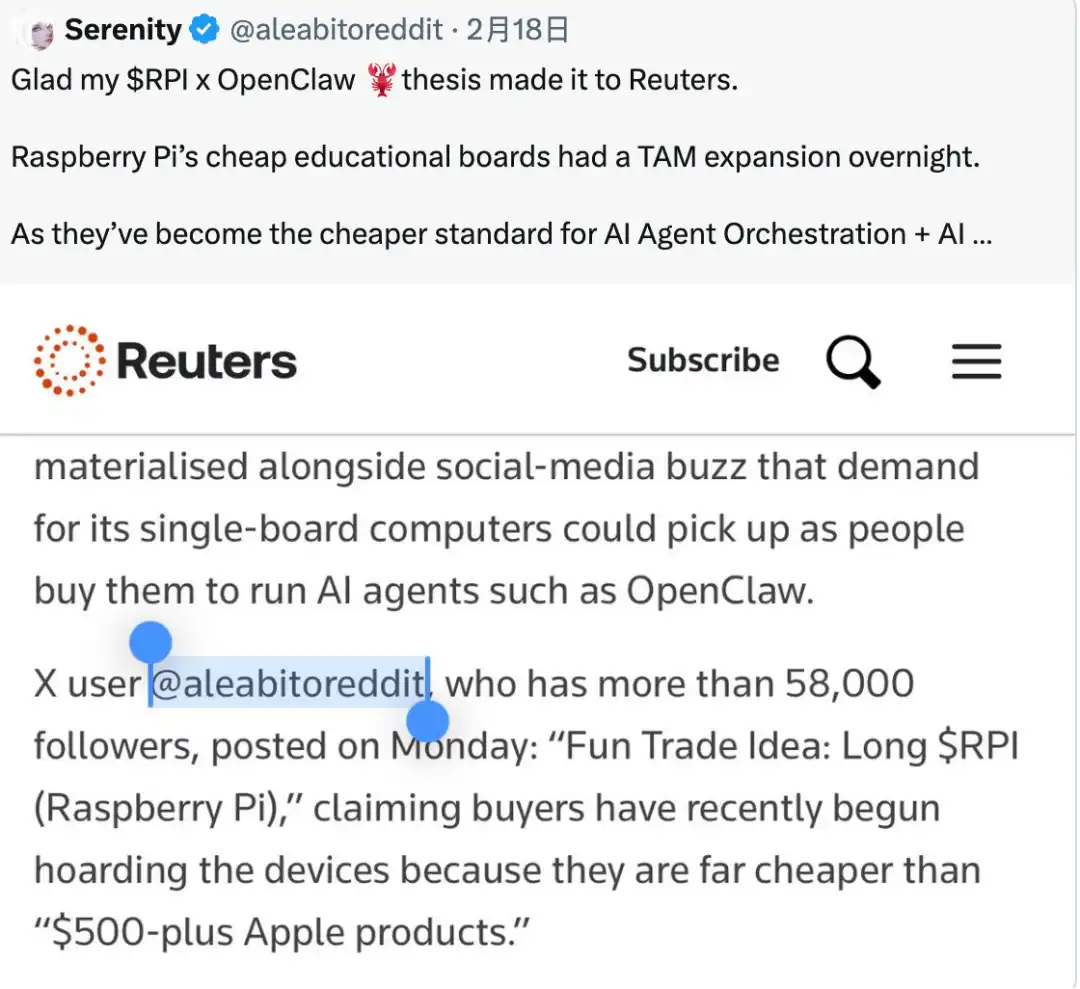
Research analysis once quoted by Reuters
Serenity's followers have rapidly increased this year, with people translating his posts in the U.S. stock market, Taiwan stock market, and European stock market communities. In the Chinese community, there are follower groups on moomoo, Xueqiu, PTT.
Some people create a dashboard to track their portfolio changes, while others use it to manage a hedge fund. His paid product is just an Excel sheet, jokingly referred to as the "One Dollar Idea." All core research is freely available on X.
The Ever-Victorious General
Calling out RPI is just one part of his track record. Serenity holds a string of similar cases, each following the same trajectory: initial callout, backlash, then validation.
The first one, AXTI. That's the asset that got him banned from WSB.
Indium phosphide substrate, the foundational material in AI data center optical modules. In February 2025, export controls were imposed on indium phosphide by the East. By January 2026, as licenses tightened further, AXT was forced to lower its quarterly revenue guidance.
Overnight, this small Fremont, California factory turned from a small-cap stock into a nationally significant strategic asset. He called out this company two years ago.
The second one, SIVE. Sivers Semiconductors listed in Stockholm, Sweden, focusing on CPO external optical source continuous wave laser, a core component of the next-generation 1.6T co-packaged optics.
The first wave after his public position, a one-day surge of 73.78%, skyrocketing the market value from $130 million to $230 million instantly. On April 15, 2026, Jabil announced a collaboration with SIVE to develop the 1.6T LRO optical module, boasting a 2.5x efficiency advantage. A month later, on May 19, the CHIPS Act Year 2 funding of $6.6 million was received.
The third one, Soitec. A French semiconductor company, a near-monopolistic player in CPO's SOI substrate, even Japan's Shin-Etsu has to get licensing from them.
In March this year, he unequivocally tweeted a change in perspective, establishing a position near 43 euros, referring to it as a "stealth monopoly for long-term holding." On that day, Soitec's stock price soared 16%.
Then there's a string of Taiwan stocks. FOCI (3363, micro-lens and fiber array), Win Semiconductors (3105, gallium arsenide foundry), TSEM (Tower Semiconductor).
These stocks have long been discussed in the local Taiwanese retail circle, but in the English-speaking world, he may be the first to systematically link them to the CPO narrative.
In terms of performance, he claimed to have achieved a 630% return in the year before entering X, exceeding 500% YTD at one point this year, and has recently experienced some drawdown.
Of course, these numbers have not been audited and should be considered as reference only.
However, one thing has been verified. Reuters and Bloomberg directly quoted his online alias in their reports.
150,000 followers across three continents translate his posts, and hedge funds mimic his trades.
Bottleneck
Understanding the investment logic of Serenity and what he got right requires first understanding the mainstream Wall Street narrative of the past three years.
From 2023 to 2026, retail investors worldwide were all chasing the same set of targets: AI
NVIDIA, AMD, Microsoft, Google, Meta.
Every sell-side report, every YouTube influencer, every financial headline was trying to predict whether these companies would exceed expectations in the next quarter.
Serenity took the opposite approach. He delved deeper, layer by layer, searching for the "screws" on NVIDIA.
He gave this concept a name: chokepoint, bottleneck.
This concept can be explained with an analogy.
The indium phosphide substrate to AI optical modules is equivalent to the Strait of Hormuz to global oil. 20% of the world's oil passes through that strait, and whoever controls it, controls everyone.
Here's a more everyday version. In a high-end kaiseki restaurant in Tokyo's Ginza, the most expensive item on the menu is the bluefin tuna belly, but what the entire restaurant cannot do without is the shiso leaf under the sashimi.
90% of Japan's premium shiso leaves come from a few households in Izu. If a typhoon hits and the farms shut down, all the kaiseki restaurants on Ginza Street will have to close for the day.
A bottleneck is exactly this kind of thing. No one mentions it in normal times, but if something goes wrong, everyone's in trouble.
Serenity's way of working is exactly the opposite of mainstream Wall Street analysts.
Sell-side analysts look at the big companies and drill down, but he reverse-engineers from the bottleneck. He draws his own supply chain map, starting from the NVIDIA H100 cluster and digging down layer by layer to the deepest narrow points. He uses AI to challenge himself, often saying, "I'll let Gemini challenge my argument," feeding the research paper to AI to play devil's advocate.
He created a comprehensive bottleneck map of the AI era using the targets of US stocks, Taiwan stocks, European stocks, and Japanese stocks.
Each node represents a potential Hormuz Strait. With every geopolitical event, every financial report, every export control, he can find the corresponding coordinates on the map and then vote with his positions.
Recently, he has extended his radar to rare earths and humanoid robots. The investment logic remains the same as before: find the narrow passage, find the monopoly, find the link that will bring everyone down.
This is something that most sell-side analysts on Wall Street cannot do. They are compartmentalized, with those focusing on TMT not looking at materials, those focusing on materials not looking at optics, and those focusing on optics not considering geopolitics.
The phrase he most often says is, "The earliest viewpoints are usually the most harshly criticized."
Is he truly a retail investor genius, or another gambler mythified?
As we've reached this point, let's shift the focus a bit.
All unverifiable information about Serenity, with a completely anonymous identity, no photos, real name, or institutional background that can be checked.
"Rejected a $6 NVIDIA stock price offer for the AI team," "Nature paper," "RISC-V Foundation member," are all self-proclaimed.
Self-reported performance, no audits, no third-party reconciliation. Highly concentrated positions, mostly in small to mid-cap non-consensus stocks with poor liquidity. Retail investors following blindly can easily enter the market at the wrong time.
Among the financial Key Opinion Leaders of the past decade, those with unverifiable identities, self-reported performance, and a culture of blind following, have mostly not ended well.
But there are a few things that set Serenity apart.
He currently does not sell courses, run a paid group, offer training, or charge high-price subscriptions. His core research on X is freely available. He does not take advertisements, drive traffic, or operate an MCN.
At present, he is not exactly a scammer. But one cannot consider him a deity either.
Of course, an anonymous individual banned from forums has managed to get over 150,000 people, including Wall Street hedge funds, to work for him for free, helping him validate arguments, disseminate research, and translate posts.
Truly legendary.
Welcome to join the official BlockBeats community:
Telegram Subscription Group: https://t.me/theblockbeats
Telegram Discussion Group: https://t.me/BlockBeats_App
Official Twitter Account: https://twitter.com/BlockBeatsAsia