440 assets, how did Gate TradFi make a come-from-behind victory?

Crypto users have long wanted more than just speculation.
Pre-IPOs, US stocks, gold, US bond yields for hedging, their desires are now highly aligned with traditional finance users. The only difference is that crypto users hold USDT and are accustomed to a 24/7 market. The most direct evidence is TradeXYZ, the most DeFi derivative protocol, whose trading volume of non-crypto assets has surged in the past few months, proving that the demand for 24/7 trading of traditional assets is real, substantial, and accelerating.
So imagine a scenario where a crypto user wants to short Tesla's earnings report, hedge their BTC with gold, take advantage of SpaceX's pre-IPO gains, engage in round-the-clock hedging with a silver perpetual contract, and then earn US bond yields by staking idle stablecoins in BlackRock BUIDL.
Following the traditional path, a user might need to use four or five platforms. Open a US stock brokerage account, register with an MT5 forex platform, find a compliant RWA protocol, and then return to crypto to open a perpetual contract. Different KYC requirements, three settlement currencies, two clearing systems, and cross-platform fund transfers may all take 3 days.
But today, all these functions can be realized in a single Gate app.
What TradFi Products Should Look Like
Gate's TradFi products consist of five main categories: CFDs, perpetual contracts, spot trading, Pre-IPOs, and ETFs. In addition, Gate is actively launching more TradFi features, including options, wealth management, Alpha, flash swaps, copy trading, DEX, quant robots, and more.
Among these, Gate's recent product line has been focused on TradFi CFDs.
CFD stands for Contract for Difference, a financial contract that does not involve holding the underlying asset but trades only on price differences. With USDT, users can long or short gold, US stocks, and forex. As of May 2026, Gate has listed over 440 CFD products, covering major forex currency pairs, precious metals (gold, silver, platinum, palladium), global stock indices (NAS100, SPX500, UK100, US30, HK50, JPN225), commodities (WTI crude oil, Brent crude oil, copper), as well as US and Hong Kong stocks. New products are still being launched at a rate of 10 to 20 per day, with daily trading volumes peaking at over $25 billion.
After users transfer USDT to the CFD account, the system automatically displays it as USDx at a 1:1 ratio, serving as a unified margin and pricing unit. USDx is an internal accounting unit that can be freely converted back to USDT at a 1:1 ratio without any conversion loss or fees. The significance of this design is that users no longer need to worry about cross-product fund allocation. All TradFi CFD businesses share the same margin pool, and the fund efficiency of cross-product hedging, rotation, and arbitrage has been elevated to the level of crypto perpetual contracts.
CFD serves as Gate's entry point into TradFi, embracing the most direct stock market logic in the industry. The global CEX spot trading volume in 2025 is approximately $19 trillion (CryptoRank data), which may sound large but appears cramped when compared to traditional market metrics. Data from Bloomberg and the World Federation of Exchanges show that the global stock market's annual trading volume is in the order of $150 trillion; the Triennial Central Bank Survey of Foreign Exchange and Derivatives Market Activity conducted by the Bank for International Settlements revealed a daily foreign exchange turnover of $7.5 trillion in 2022, with the latest institutional estimates surpassing $9 trillion.
Crypto is like a pond, while TradFi is the sea. "To be honest, we actually came in late. We felt itchy for a long time and felt the need to do TradFi," Gate's founder, Dr. Han, said in a previous interview with BlockBeats.
"Starting last year, we felt that products in the crypto space had become largely homogenized—spot, futures, wealth management, Web3 wallets—all more or less the same. We felt ready ourselves, with the business capabilities in place, so we started to expand. Only after doing so did we realize that this market space and user demand were far larger than we had imagined, and we regretted not starting a few years earlier."
For a top three Chinese-language trading platform like Gate, continuing to compete for user yield in the crypto pool is facing rapidly diminishing marginal returns. The launch of TradFi CFD with over 440 CFD underlyings is Gate's strategy to combat this industry's structural issue.
Another product line is traditional asset perpetual contracts.
Gate currently offers over 160 traditional asset perpetual contract trading pairs. For the same underlying asset, such as gold, users can choose to trade CFDs (traded during London and New York sessions with overnight fees) or perpetual contracts (traded 24/7 with funding rates). This dual-track design is a key differentiator for Gate among other trading platforms. Gate is the world's first platform to pair xStocks spot trading with tokenized stock perpetual contracts, opening up a product form that did not exist before.
error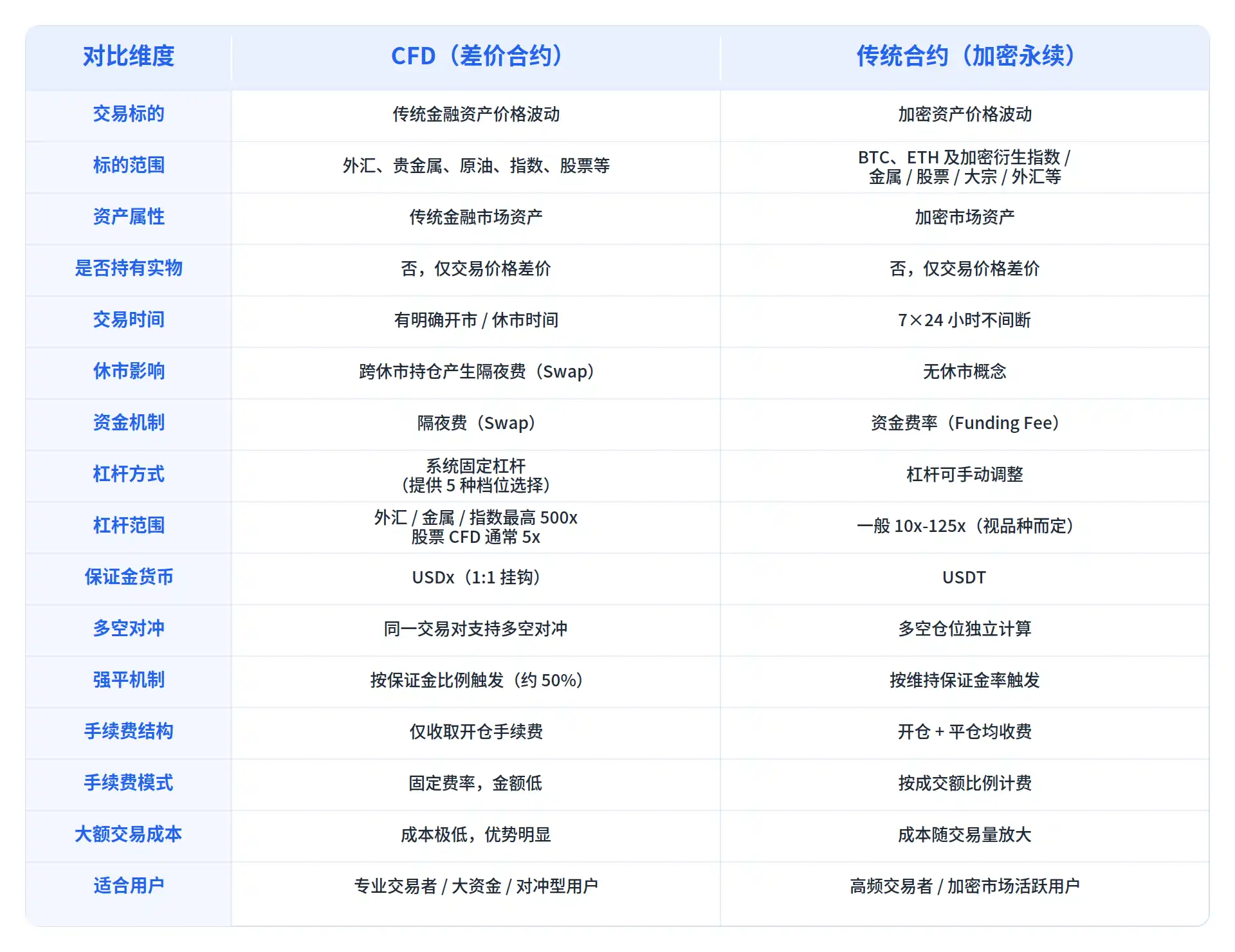
This means that Gate has extended the "adjustable leverage" logic of crypto perpetual contracts to the TradFi CFD side. For example, the adjustable leverage for gold and oil currently has 5 levels: 20, 50, 100, 200, and 500. Silver has 4 levels: 10, 20, 50, 100. Other assets without adjustable leverage still maintain a fixed maximum leverage of 500x. During periods of low market liquidity or high price volatility, all trading pairs will be subject to certain leverage restrictions.
The first batch of assets with adjustable leverage are the two precious metals, gold and silver. It will later expand to include oil (XTIUSD, XBRUSD), popular indices (NAS100, GER40, HK50, US500, US30), and major forex pairs (USDJPY, EURUSD). This expansion path reflects Gate's market judgment. It first focuses on assets like gold and silver, which have been the most familiar safe-haven assets for retail crypto traders in the past six months, and then gradually covers oil, indices, and forex. Retail traders who were initially attracted by the gold and silver market sentiment can now open positions in a familiar adjustable leverage manner when first encountering TradFi.
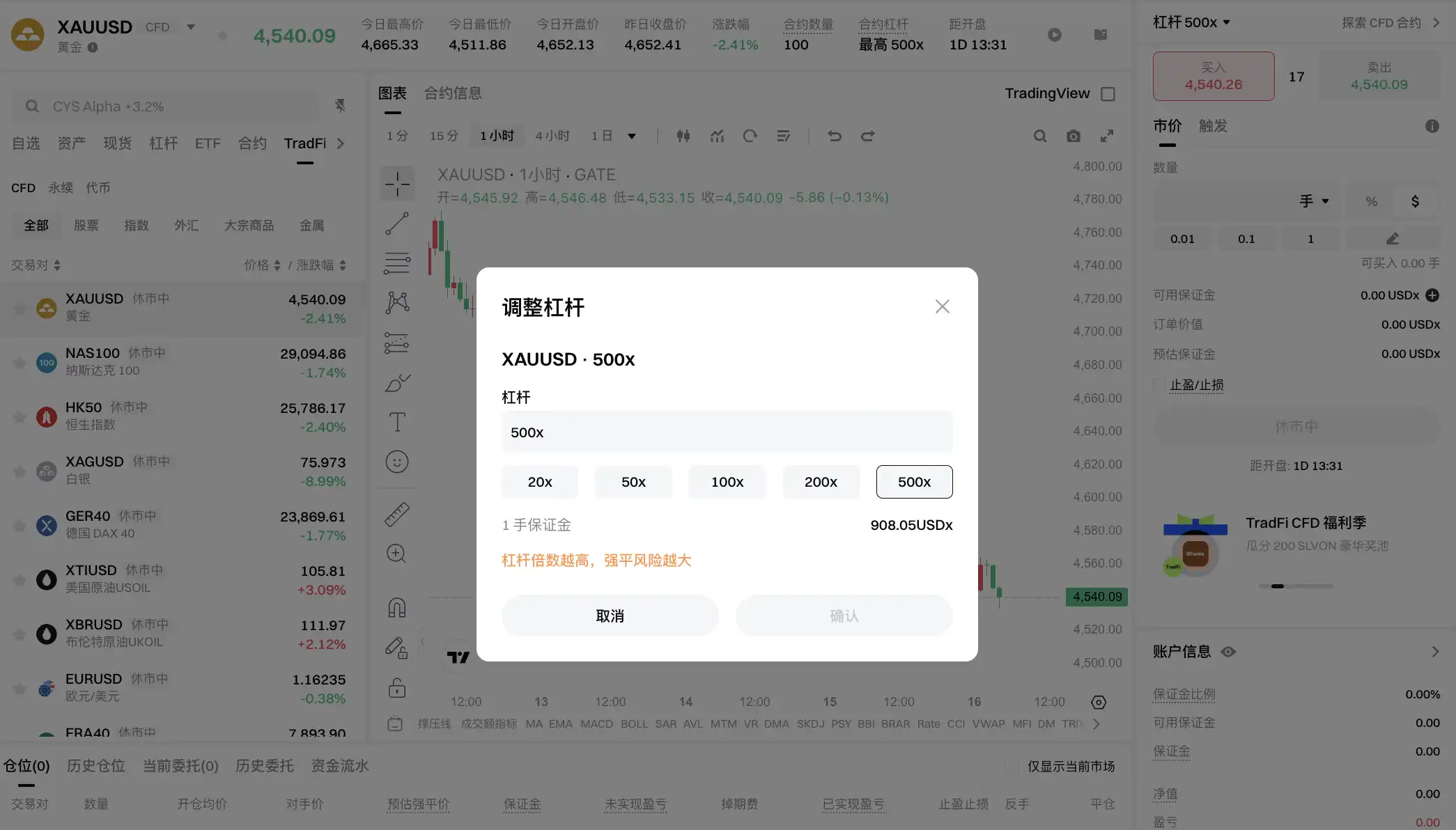
Compared to the traditional slider-based leverage adjustment model in the crypto asset space, Gate has made each leverage level into an independent trading pair. My initial reaction was "this design is a bit unfamiliar," but after placing two trades, my opinion changed. Because each level is a separate contract, I can simultaneously hold a high-leverage short-term position in XAUUSD200 and a low-leverage swing position in XAUUSD20. The liquidation prices of the two positions do not affect each other, providing users with a finer position management space.
Next is Gate's bidirectional synchronous experience in CFD functionality. If I place a limit order for TSLA in the app, I can immediately see it when I switch to the web platform at the price I set. Conversely, if I adjust the take-profit level on the web platform, the app platform immediately updates accordingly. The underlying integration with the MT5 matching system ensures execution quality, which is Gate's infrastructure choice for traditional asset trading.
This level of synchronization is essentially a default setting for native crypto users, but ensuring that both platforms offer full functionality is key. Actions such as take-profit, stop-loss, conditional orders, and additional margin can all be performed seamlessly on both the app and web platforms without the need to switch devices for an advanced feature.
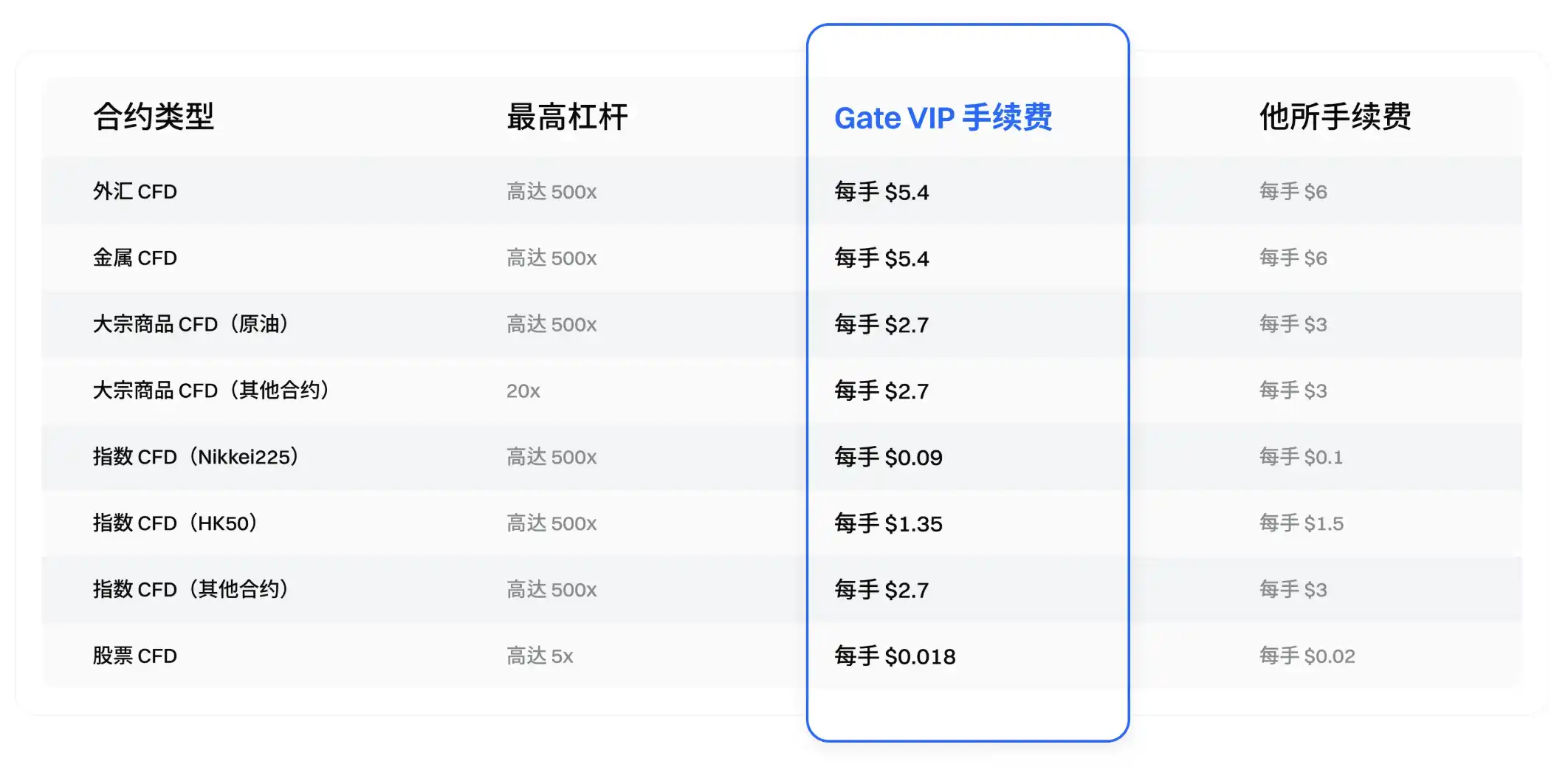
The fee structure is also a major selling point, with the minimum fee for a single US stock CFD trade set at $0.018 per lot, much lower than industry peers' quotes. Additionally, TradFi trading volume has been incorporated into the Gate VIP system. By trading CFDs, fee rebates can be stacked into the original VIP levels for spot and futures trading, significantly reducing costs for high-frequency users. Furthermore, the TradFi copy trading feature has also been launched; the API is open, allowing quant teams to plug in and run strategies.
After going through it all, my assessment of Gate TradFi is this: the product differentiation truly lies not in a single function, but in the logic and aesthetics of "using the habits of crypto users to realize the product form of traditional finance."
Beyond the Three Mergers, Gate's Path
Starting in 2025, centralized exchanges have collectively accelerated on the TradFi battlefield, with three iconic mergers outlining the industry's pace.
It all began in May when Ripple acquired Hidden Road for $1.25 billion, bringing under its wings a multi-asset prime broker serving over 300 global institutional clients, aiming to establish a crypto-native institutional clearing infrastructure. Following closely, Kraken acquired NinjaTrader for $1.5 billion, attracted by the latter's possession of a CFTC futures license, a compliance pass almost extinct among crypto exchanges. The heaviest deal came from Coinbase, acquiring the global crypto options leader Deribit for $2.9 billion, effectively complementing institutional options trading capabilities.
The three leading CEXs voted with their money: the fastest way to enter TradFi is through acquisition. But Gate chose to build from scratch.
There are only two dimensions to judge the quality of a product: product breadth and asset breadth.
In terms of product breadth, Gate is currently the only one in the industry capable of running more than ten product lines simultaneously, including CFDs, perpetual contracts, spot trading, Pre-IPOs, ETFs, options, wealth management, Alpha, flash swaps, copy trading, DEX, quant robots, and more.
In asset breadth, Gate covers commodities, precious metals, traditional stock markets, numerous indices, and forex, making it the most comprehensive among its peers.
Additionally, in terms of leverage, Gate is the exclusive provider of adjustable leverage. No other platform has achieved this.
In terms of compliance support, according to official disclosures from Gate and the legal/licenses page of Gate Group, the company currently holds licenses or registrations in over 81 jurisdictions and has been providing independent audit reserve proof since 2020.
However, the risks of building a proprietary path are also clear. Depth requires time to verify. The resilience of Gate's counterpart order flow, market maker system, and clearing and settlement stability over the long term will depend on the trading data for the next year. The M&A path acquires a mature system in existence, while the proprietary path obtains a new system from scratch. The former can be used immediately but incurs integration costs, while the latter takes time to develop but has stronger compatibility. Which path is superior will not have an answer until the end of 2026.
But Dr. Han himself has a more definitive view on this competition. When asked by BlockBeats, between traditional brokerages entering the crypto space (such as Futu and Tiger) and crypto exchanges entering the traditional asset space, which side has the advantage.
“I think the crypto industry will have much greater competitiveness,” he replied. “Traditional institutions are basically constrained, and the objective environment limits their way of doing things. Their customer acquisition cost is extremely high; acquiring a customer may cost several hundred dollars. It's different in the crypto industry, where the customer acquisition cost is very low, and both technology-driven and demand-driven forces are strong. So what you can see is that after Gate listed traditional assets, their growth was rapid. However, for traditional brokerages, even after entering the crypto space, the share of crypto in their overall business is still very low.”
Whether this assessment is accurate will ultimately depend on the changes in the proportion of crypto businesses on multi-asset platforms such as Futu, Tiger, and Schwab in the next 2-3 years. However, Dr. Han's honesty lies in not treating this structural advantage as Gate's exclusive moat; he acknowledges that this is a dividend for the entire crypto industry.
Gate has taken the first step, but to benchmark against traditional multi-asset platforms like Charles Schwab, Futu, Tiger, and Interactive Brokers, it will still require some time across all dimensions.
Welcome to join the official BlockBeats community:
Telegram Subscription Group: https://t.me/theblockbeats
Telegram Discussion Group: https://t.me/BlockBeats_App
Official Twitter Account: https://twitter.com/BlockBeatsAsia