Deconstructing the SpaceX IPO Prospectus: Rocket Company Transformed into an AI "Loss Vessel"

On May 20, SpaceX filed an S-1 registration statement with the U.S. Securities and Exchange Commission (SEC) for its IPO under the ticker symbol SPCX, aiming to debut on the NASDAQ. This is the largest IPO in history, targeting a valuation of approximately $17.5 trillion. The prospectus revealed the company's financials to the public for the first time, which turned out to be quite different from many people's impression.
Most people view SpaceX as a money-making machine. With the global coverage of the Starlink satellite Internet and near monopoly in the launch market, SpaceX's IPO documents disclosed that the company's projected 2025 combined revenue is $186.74 billion, with a net loss of $49.4 billion for the year. The aerospace company, often seen as highly profitable, is actually in the red on paper.
Where did the losses come from? It traces back to February of this year when Musk merged his AI company xAI into SpaceX through an all-stock deal. Since then, xAI operates as SpaceX's "AI division" in the consolidated financial statements. The latest S-1 filing marks the first complete financial disclosure post-merger and the first audited financials of xAI made public.
Let's look at where the money is coming from. According to the prospectus, SpaceX's 2025 revenue is divided into three segments. The Connectivity division, which includes Starlink, generated $11.4 billion in revenue, a roughly 50% year-over-year increase, comprising 60% of the company's total revenue. The launch business generated approximately $4 billion in revenue, and the AI division contributed $3.2 billion.
The key lies not in revenue but in profit and loss. Out of the three divisions, only Starlink is profitable. The launch business reinvested the majority of its revenue into the development of the next-generation Starship rocket, with R&D expenditure alone nearing $3 billion. The AI division, on the other hand, is a different story. Behind its $3.2 billion revenue is a $6.4 billion operating loss. In other words, for every $1 in business done by the AI division, it incurs a $2 loss.
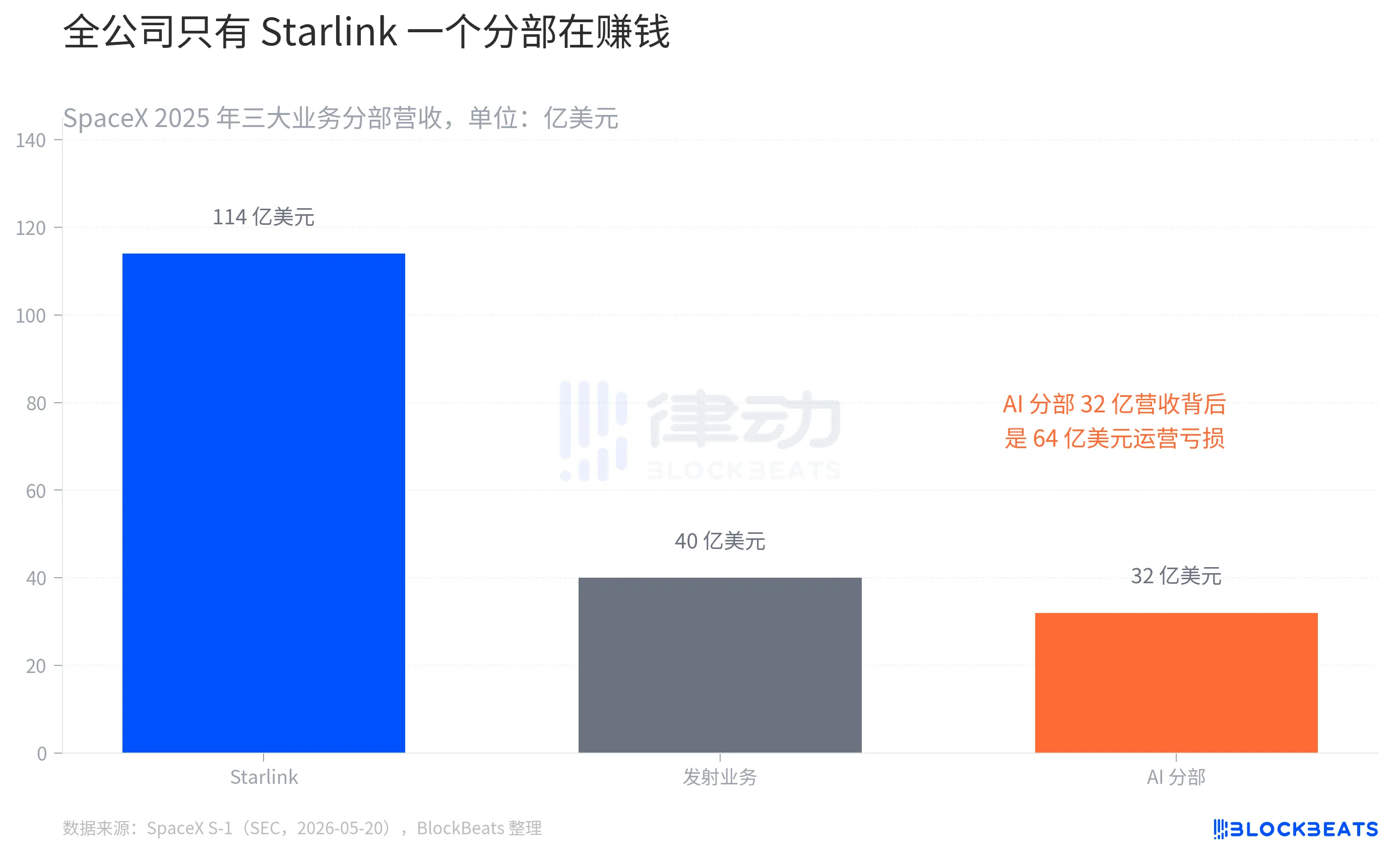
With three business divisions, only Starlink is profitable. The launch business is investing for the future, the AI division is losing money in the present, and the entire company's profit hinges on the Starlink pillar.
A stark contrast illustrates the speed of losses in the AI division.
According to the prospectus, the AI division had an operating loss of $2.469 billion in the first quarter of 2026. For the full year of 2025, SpaceX had an operating loss of $25.89 billion. The money lost by one division in three months is nearly equivalent to the total losses incurred by the entire company in the previous year.
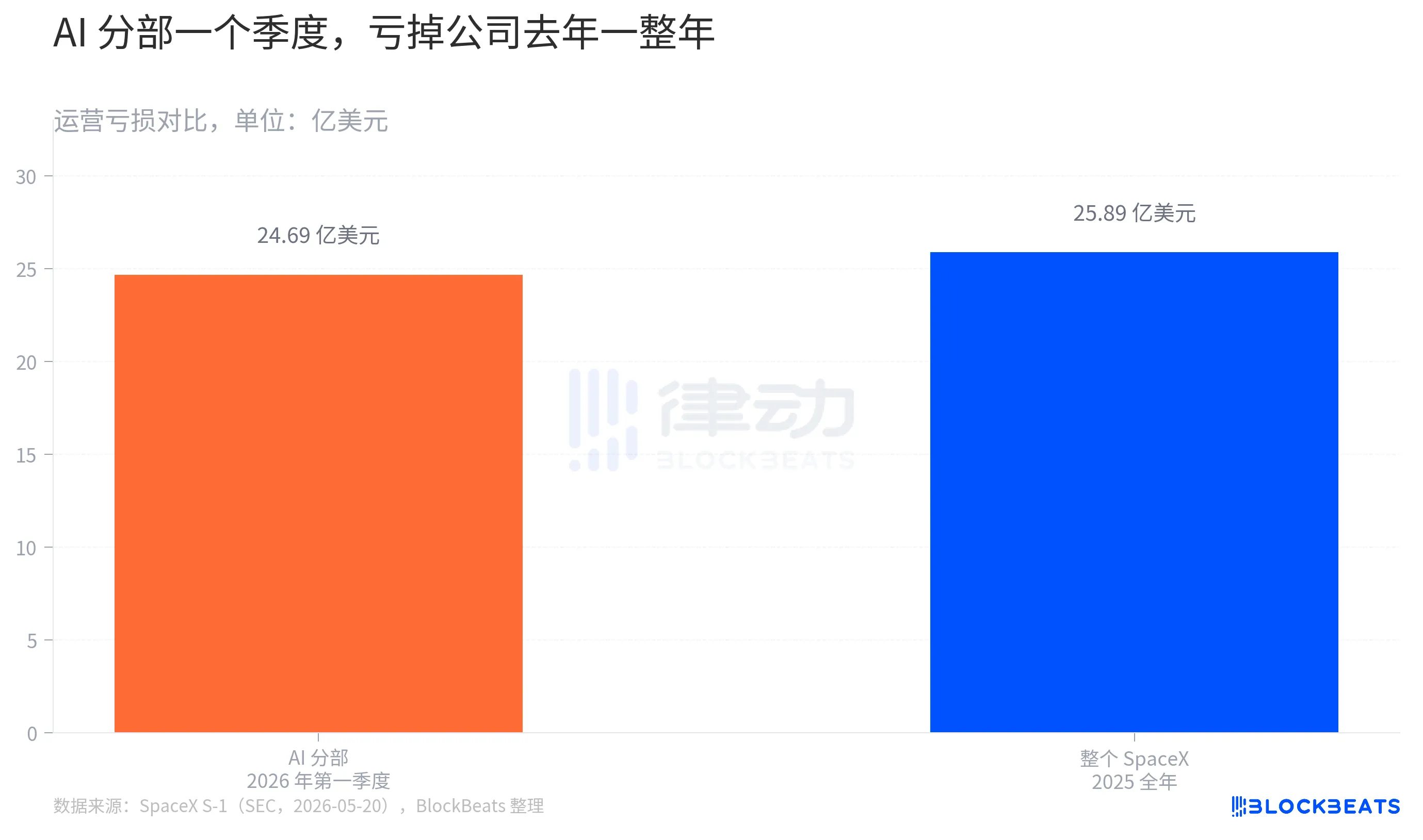
This comparison is made because xAI was only consolidated in February of this year. In the 2025 report, the AI division only reflected partial time, and the first quarter of 2026 was its first full entry into SpaceX's finances. The cost of full integration was to raise the company's quarterly net loss from $528 million in the first quarter of 2025 to $4.28 billion in the first quarter of 2026. In one year, the quarterly net loss expanded by more than seven times.
Musk chose to push the IPO at this point in time, a timing that speaks for itself. The losses of the AI division are still expanding, and the further we go in the reports, the worse it looks. Going public before the losses further magnify is like allowing the public market to participate sooner.
What fills this loss black hole of the AI division? The S-1 provides the answer: Anthropic.
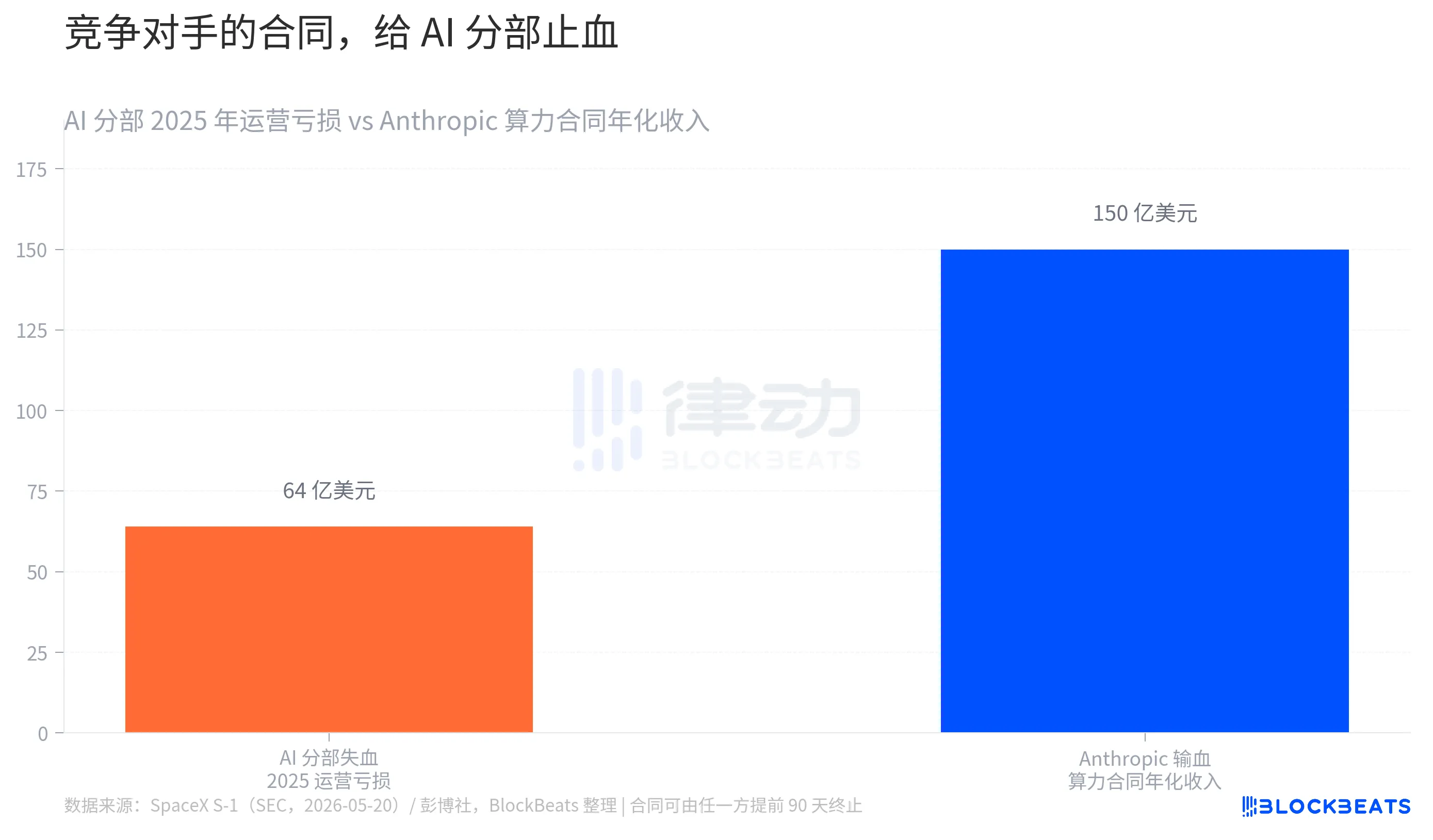
The prospectus disclosed a computational power service contract. Anthropic, the developer of Claude, pays SpaceX's AI division $1.25 billion per month to lease all the computational power of the Memphis Colossus 1 data center. This data center houses over 220,000 NVIDIA GPUs. The contract extends until May 2029, and based on monthly fees, the annual amount is approximately $15 billion. According to Bloomberg, the total amount over the entire period is around $45 billion.
Putting $15 billion and $64 billion together, the annual computational power payment made by Anthropic is more than twice the operational loss of the AI division in 2025. This contract is currently the main source of relief for this loss black hole.
The real highlight of this contract lies in the identities of both parties. Anthropic's Claude and xAI's Grok are direct competitors in the AI large model market. A competitor has become the AI division's largest computational power customer. In the S-1, SpaceX refers to this arrangement as "monetizing idle computational power" and states that more similar contracts will be signed. However, a detail about this lifeline is that the contract allows either party to terminate with a 90-day notice. The money that prolongs the life of the AI division is in the hands of a competitor.
Why is the market still willing to give a loss-making company a $1.75 trillion valuation? The answer lies in Starlink's growth trajectory.
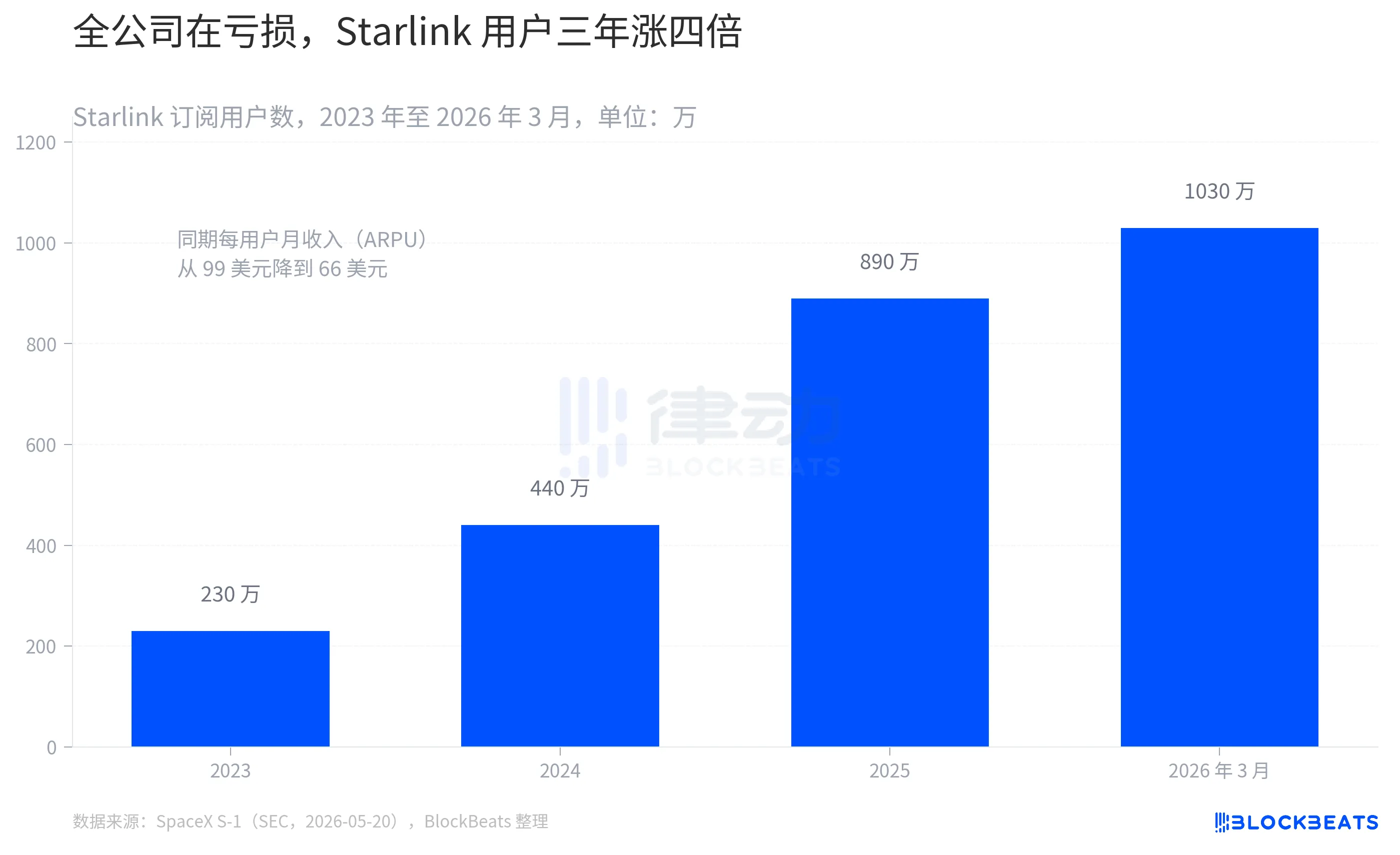
According to the S-1, Starlink's subscription base is projected to grow from 2.3 million in 2023 to 4.4 million in 2024, 8.9 million in 2025, and reaching 10.3 million by the end of March 2026. In three years, the user count has more than quadrupled. This is the only profitable division of SpaceX and the only one still on a steep growth trajectory. The market is betting on this trajectory, not on current profit.
Within this growth lies a shift. During the same period, Starlink's average revenue per user (ARPU) is set to decrease from $99 in 2023 to $66 by March 2026. As the user base expands, the revenue contributed by each individual user decreases. Starlink is acquiring more users at a lower price point. Whether this trajectory can sustain the valuation depends on whether the pace of scale expansion can continuously outpace the decline in unit price.
SpaceX's prospectus poses a multiple-choice question to the public markets. Investing in it means simultaneously acquiring a rapidly expanding Starlink and an AI division that could incur an annual loss in a single quarter. These two things are now bundled under the same stock ticker.
Welcome to join the official BlockBeats community:
Telegram Subscription Group: https://t.me/theblockbeats
Telegram Discussion Group: https://t.me/BlockBeats_App
Official Twitter Account: https://twitter.com/BlockBeatsAsia