USDC Strikes Back Against USDT, the Real Battle Happening on Hyperliquid
Original Article Title: How USDC Wins the Hyperliquid Deal
Original Author: David Christopher
Translation: Peggy
Editor's Note: In the stablecoin competition, the focus is shifting from "who is more compliant" to "who can capture more trading volume."
After the passage of the "GENIUS Act," USDC has indeed gained new growth momentum. Circle's U.S. regulatory background and compliance advantage have allowed USDC to begin catching up with and even surpassing USDT in trading volume. However, in terms of market share, the landscape has not significantly changed: USDT still holds the majority share of the stablecoin market and maintains a strong position outside the United States.
This is also the essence of Coinbase and Circle's partnership with Hyperliquid. On the surface, this is a stablecoin asset swap: USDC has become the primary quote asset for Hyperliquid, allowing Hyperliquid to receive a higher revenue share. However, at a deeper level, this is a battle for distribution channels.
Hyperliquid is the core platform of the on-chain perpetual contract market, and perpetual contracts naturally rely on stablecoins as the pricing and settlement assets. Whoever becomes the main quote asset for these markets can gain more trading volume, margin, deposits, withdrawals, and long-term usage scenarios brought by on-chain activities. Tether has already proven this path through Binance; Tether's strength comes not only from its issuance scale but also from its deep integration into the global trading system.
For Coinbase and Circle, Hyperliquid provides a global reach capability that they themselves find challenging to replicate. Due to regulatory constraints, Coinbase cannot cover a broader market like Binance or Hyperliquid, so embedding USDC into the underlying transactions of Hyperliquid may be a realistic path for them to counteract the network effects of USDT.
The most noteworthy aspect of this article is not whether Coinbase is making concessions or how much revenue share Hyperliquid is receiving, but that USDC is attempting to transform from a "U.S. compliant stablecoin" into a broader "on-chain trading base currency." As perpetual contracts continue to grow, the main battleground of the stablecoin war may increasingly focus on these high-frequency trading scenarios.
The original article is as follows:
Tether still dominates Binance, but Coinbase has just reloaded USDC into Hyperliquid. The stablecoin distribution channel battle is becoming increasingly intense.
Hyperliquid is becoming one of the most sought-after assets in the current crypto industry. Last week, the spot HYPE ETF launched by 21Shares and Bitwise went live on a U.S. exchange, with Grayscale and VanEck following closely behind. Behind the influx of institutional funds is an ongoing, longer race: who can get a share of the economic benefits of this trading platform.
Last fall, Hyperliquid initiated a public RFP to solicit proposals for its native stablecoin USDH, aiming to reclaim the revenue that had previously flowed to Coinbase and Circle. At that time, around $5.6 billion USDC was held in Hyperliquid's cross-chain bridge, generating approximately $200 million in annual interest income, but these earnings were flowing to its centralized competitors. The platform itself, the true source of demand, was not benefiting from it. Ultimately, Native Markets defeated Paxos, Ethena, and other bidders in a community vote, and USDH was subsequently launched.
Bankless previously reported on the bidding war around USDH at Hyperliquid.
However, just last week, Native Markets sold USDH to Coinbase and agreed to gradually phase out this stablecoin linked to Hyperliquid's interests, allowing USDC to once again become the primary pricing asset on the exchange. In exchange, 90% of the related revenue will flow back to Hyperliquid, although the specific revenue capture mechanism is currently unclear. The outside world generally interprets this transaction as a victory for Hyperliquid, with the cost borne by Coinbase and Circle. While this interpretation is understandable, it is not entirely accurate.
What Hyperliquid clearly gains from this transaction is significantly improved revenue sharing, approximately double that of the USDH model; by allying with one of the most influential voices in the U.S. crypto industry in Washington, it gains stronger regulatory resources; at the same time, it also reverts to the stablecoin experience originally built around it on the trading platform, which users already highly trust. Especially in the past six months, in the HIP-3 market that has brought a lot of attention to Hyperliquid, USDC remains the primarily used asset.
From the perspective of Coinbase and Circle, the outside world sees this transaction more as a branding opportunity: they are using it to form a closer relationship with one of the most crypto-native and successful projects from the previous cycle. However, when we compare USDC's current market position with the growth trajectory of the perpetual futures market, another beneficiary emerges.
What Coinbase and Circle truly gain is the distribution channel for USDC. This scalable distribution may be more important than any other part of this transaction.

How Has the Home Field Performed?
Since the passage of the "GENIUS Act," USDC has indeed shown strong growth momentum. Circle was well prepared for the new environment shaped by this regulatory framework: USDC is headquartered in the U.S. and has always been compliance-oriented. This positioning has translated into actual trading volume.
Data from Allium shows that in May 2026, USDC's trading volume reached $355 billion, surpassing USDT for the first time in recent months, reflecting an acceleration in growth since the passage of the "GENIUS Act" in July of last year.
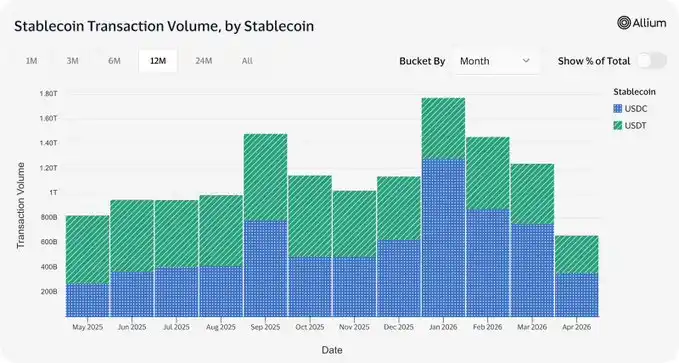
However, the structural dynamics of the stablecoin market have not changed.
In April 2025, on the eve of the "GENIUS Act," USDT held a 67% market share of the stablecoin market, with USDC at 27.6%. One year later, USDT's share was 67.3%, and USDC's was 28.1%. The change between the two is less than half a percentage point. In other words, although USDC's trading volume is accelerating, its supply share has hardly changed.
A report released by Artemis in October of last year shows that the U.S. is the most dominant market for USDC. Considering the correlation between USDC's growth post-"GENIUS Act" and the U.S. regulatory environment, it is relatively safe to conclude that the U.S. is also the primary source of USDC's growth.
However, the issue lies in the fact that the U.S. is also where new competitors are most heavily entering the market. Stripe has made a clear entry into the stablecoin business through Tempo and other acquisitions; major financial institutions are also launching their own domestically compliant stablecoins as required by the "GENIUS Act." They are all encroaching on USDC's most core market.
error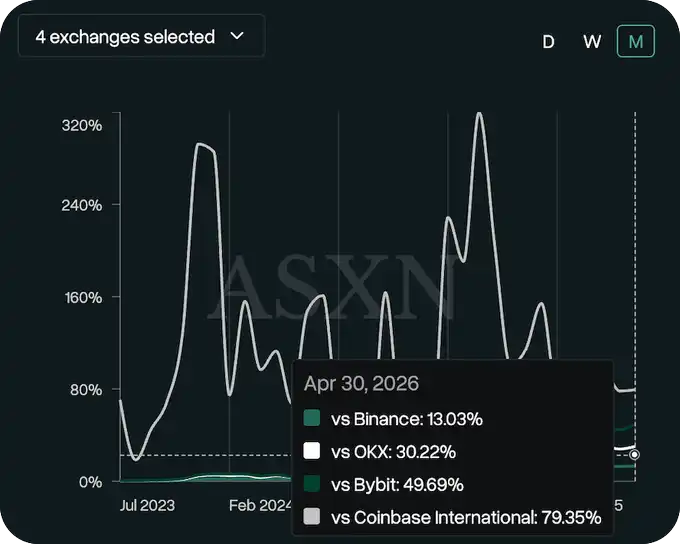
Despite still being in its early stages, Hyperliquid's dominant position in the on-chain perpetual contract market, and its performance that has been able to match, and even surpass at times, the trading volume of centralized exchanges, has given it a global reach close to Binance's coverage outside the United States. This has also opened up a new channel for Coinbase and Circle: they can leverage Hyperliquid to compete with Tether and turn it into a structural distribution channel for USDC.
Coinbase Chooses Its Own Battlefield
However, this also raises a question: why doesn't Coinbase further develop its own perpetual contract business directly and build this distribution channel itself?
The reason is that Coinbase is constrained by regulatory frameworks, with limits on the range of customers it can serve and the number of markets it can go live in. Currently, Coinbase covers about 100 countries, slightly more than half of the 180 countries covered by Binance. Hyperliquid, benefiting from a more "lenient" operating environment, can reach a broader market, giving it a certain advantage over Binance and Coinbase, an advantage that Coinbase itself would find hard to replicate.
Therefore, Coinbase and Circle have chosen to let Hyperliquid take on the role of global reach, while USDC enters these markets as the underlying asset. This transaction allows them to share the upside through the growth in USDC supply and the resulting revenue without getting directly involved in a jurisdictional battle that is bound to be difficult to win. They only get a part of the economic benefits, but it is a scale that Coinbase alone cannot reach.
Tether Is Also Replicating the Same Playbook
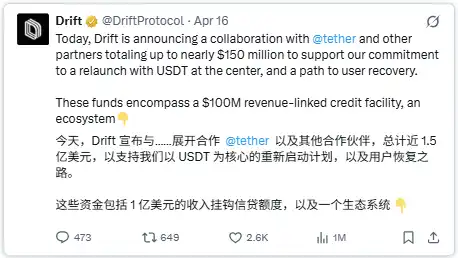
Tether is also doing its own version, albeit on a much smaller scale. After the April attack on Drift, Tether pledged to inject up to $147.5 million to support its recovery. This transaction made USDT Drift's settlement asset, while establishing a Tether-backed USDT limit for designated market makers and providing funding for the trading incentives layer.
In other words, Tether, leveraging Drift's crisis, changed the base currency of a major Solana perpetual contract DEX. Prior to this transaction, USDC's presence on Solana as a stablecoin was more than twice that of USDT, a dynamic that was prevalent throughout the entire Solana chain.
The two sides of the Stablecoin Wars have both realized the same thing: the perpetual contract market is a key battlefield in the stablecoin competition.
Overall, in order to capitalize on the growth momentum brought by the "GENIUS Act," Coinbase and Circle need more distribution channels, and this Hyperliquid transaction may be just such an entry point: enabling USDC to spread in the core on-chain trading scene, enter one of the fastest-growing categories in the crypto industry, and potentially compete on an equal footing with USDT and Binance.
This could also be a further opening of the bet on the U.S. domestic regulatory boundary. CFTC Chairman Selig has clearly stated his hope that perpetual contracts can be traded openly in the U.S., and the passage of the "CLARITY Act" may ensure this. Reports this week indicate that the SEC is preparing to launch an "innovation waiver" under its Project Crypto initiative, allowing crypto-native platforms to offer on-chain trading of tokenized U.S. stocks under lighter registration requirements.
Looking at CFTC under Selig's leadership and the regulatory direction of the SEC under Atkins, Coinbase seems to be laying the groundwork ahead of time: allowing Hyperliquid to gain distribution capabilities in the U.S. market with USDC already established as a core asset.
Bankless has reported on the window of opportunity for perpetual contract trading.
Of course, the above is still speculative. But it does align with how Wall Street and institutional players may view Hyperliquid: as their entry point into the future perpetual contract system. For an asset, this is almost one of the most attractive tailwinds.
Welcome to join the official BlockBeats community:
Telegram Subscription Group: https://t.me/theblockbeats
Telegram Discussion Group: https://t.me/BlockBeats_App
Official Twitter Account: https://twitter.com/BlockBeatsAsia