Got the right prediction but still lost money? Polyvaults aims to turn the prediction market into a configurable asset
The prediction market will soon be able to participate in pricing SpaceX.
Previously, Trade xyz used on-chain perpetual contracts to pre-price companies like SpaceX and Cerebras for their IPO expectations. Now, Polymarket has partnered with Nasdaq to launch a prediction market for non-public companies.
Polymarket and Hyperliquid are arguably the two most prominent and profitable projects in this round of the crypto market. One focuses on the prediction market while the other focuses on on-chain perpetual contracts. Although they seem to be heading in different directions, they are now both building a more efficient long-tail trading market around the US stock market, the world's largest financial market.
However, compared to perpetual contracts, the prediction market may be more like a dark forest.
Any trading market will have bots, high-frequency trading algorithms, market makers, and arbitrageurs, which goes without saying. The prediction market has an additional layer of complexity: domain-specific experts, insiders to specific events, and even those who can directly influence outcomes. Whether a company's funding round happens, a policy is delayed, or a personnel appointment is made, these events may be news to the average user but part of a known schedule to a select few.

A man used a hairdryer to "manipulate" a Polymarket market related to the temperature in Paris and made a profit
From this perspective, a prediction market that can be precisely priced in advance may not necessarily be naturally user-friendly to the general public. In such a scenario, are there other ways to participate in prediction markets?
If you lose money in the prediction market, it may not be because your judgment was wrong
If you have traded on Polymarket, you have likely encountered a very frustrating situation: your prediction was correct, but your account did not make a profit, and you may have even incurred a loss.
For example, if you thought BTC would be strong this month and it indeed rose, but the specific market you bet on did not trigger. You believed that a particular threat from Trump was likely just a negotiation tactic, and your direction was correct, but you entered the market when the price was already too high, so even if you won, the profit was minimal. You thought that a certain event would not happen, but the price fluctuated wildly midway, you panicked and sold, only to realize later that the event did not occur.
At this point, you would realize that the prediction market is not simply about making money by guessing correctly.
There is data to support this. According to an academic study jointly released in April 2026 by the University of Toronto, HEC Montréal, and ESSEC Business School, covering over 2.4 million Polymarket users, $67 billion in trading volume, and 5.88 billion transactions, the conclusion is that about 69% of users are in a long-term loss position, and the top 1% of users have taken 76.5% of all profits.
This highlights the most awkward aspect for ordinary users. For the average person, judgment is almost the only weapon when participating in a prediction market. But if you rely solely on judgment without an edge, how can you make money in the long run?
Mere event prediction is definitely not the edge in a prediction market. It should also include whether you can allocate positions across multiple related markets and whether you can manage exits or wait at settlement time.
Execution and structure ultimately determine how much money you end up with. Many people think they are losing due to their judgment, but they are actually losing because of the process of turning their views into positions. The prediction market may look like a multiple-choice question, but prediction is the 1, and structure and positions are the following 0s.
The answer provided by Polyvaults is to transform the prediction market from a single-point bet into configurable assets.
The Prediction Market Is Neither Spot Nor Perpetual Contract
Most people understand trading, and in their minds, there are only two things by default: spot and perpetual contracts. Spot trading involves buying the asset itself. If BTC rises by 10%, you probably make 10%. Perpetual trading involves leverage where getting the direction right allows you to earn more, but getting it wrong leads to quicker losses, along with facing liquidation, funding rates, and margin pressure.
The prediction market is different. It does not trade the asset itself or leveraged direction but rather whether a specific condition is met. For example, whether BTC will break a certain price this month or whether it will reach a certain level by month-end. When you buy a YES or NO token, you are essentially buying the probability of this outcome.
Therefore, the profit in the prediction market is not only related to BTC's price movement. If BTC rises by 8%, in spot trading, you only make 8%. However, if you buy a YES token for 0.35 USD in advance that will settle at 1 USD, your final profit may be much higher than in spot trading.
This is the uniqueness of the prediction market. It not only trades the direction but also the path, boundaries, and time windows. It is for this reason that the same bullish view on BTC can be divided into many different positions: betting on a high target, a mid-range target, no major drops, or diversified into multiple target prices. Judgment is just the first step; what truly determines profit is how judgment is transformed into structure.
This also explains why ordinary users easily lose money in the prediction market. You may think you are only judging events or price movements, but you actually have to deal with market selection, price selection, position allocation, and settlement pace. The prediction market provides users with a more detailed way to express themselves and conveniently hands users a higher level of execution difficulty.
Backtesting 8 months of data, there are other participation perspectives in the prediction market
If the prediction market is only seen as betting on YES or NO, it does look like a simple bet. However, when multiple price levels are combined, and positions are allocated based on the actual fund distribution, it becomes a set of outcome combinations.
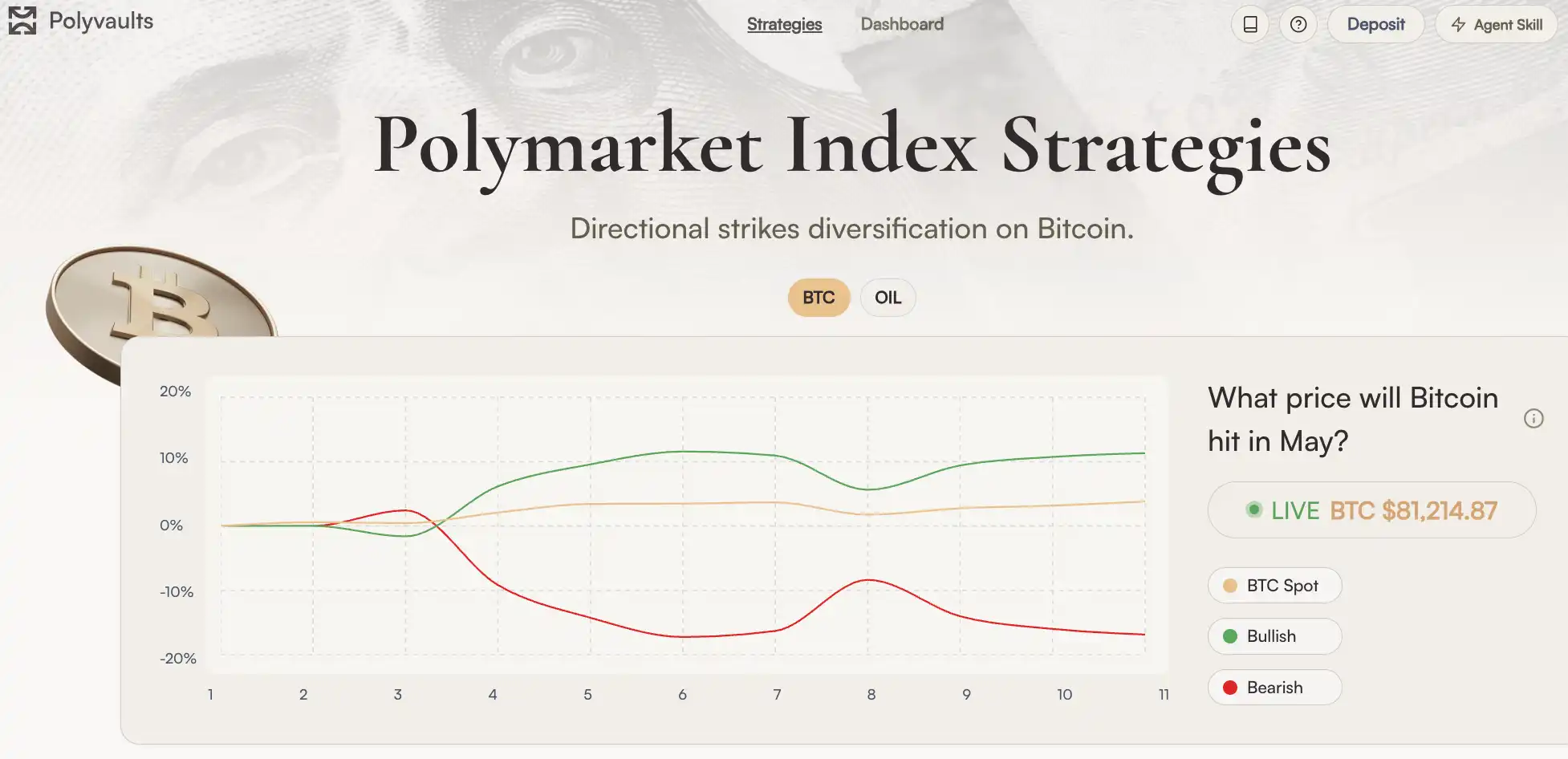
The backtest of Polyvaults used Polymarket's official CLOB historical data and Binance BTCUSDT closing prices to test the performance of the BTC prediction market from April 2025 to January 2026, a total of 8 months. The strategy was simple: simulate $1000 monthly funds and allocate positions based on the open interest ratio at each price level to construct both bullish and bearish combinations.
The results showed that the bullish combination was profitable for all 8 months, with an average monthly return of 32.1%, while the average monthly spot BTC return during the same period was only 0.8%.
Of particular interest are a few counterintuitive months. In July 2025, BTC rose by 8.0%, and the bullish combination gained 62.0% because some mid-range target prices settled from a low price all the way to $1, amplifying returns. In November 2025, BTC fell by 17.6%, but the bullish combination still gained 19.0% because some low target prices had already been triggered early in the month, locking in profits. In January 2026, BTC dropped by 10.2%, the bullish combination gained 49.0%, and the bearish combination gained 95.0% because the intra-month volatility was significant, allowing both directions to follow their respective profitable paths.
This demonstrates that the prediction market is not just about predicting price movements; it trades on conditions, paths, and time windows. Of course, with only an 8-month backtest, this is not a guaranteed profitable conclusion. What it truly shows is that there are indeed exploitable structures within the prediction market, but these structures are challenging to execute manually in the long term.
This is also where Polyvaults and Multi-Agent excel. Users are only responsible for expressing direction, and the system handles the rest. The Multi-Agent infrastructure from AWE enables multiple agents to collaborate within the same system, with one scanning the market, one filtering rules, one executing trades, one rebalancing, one settling, and tracking performance. The prediction market, with its multitasking and real-time changing environment, happens to be the ideal scenario for demonstrating the value of a Multi-Agent system.
Polyvaults: Packaging the Execution Layer into a Vault
To summarize what Polyvaults does in one sentence: it packages the most complicated execution phase in the prediction market into a vault.
For users, the participation process will become very simple. You just need to choose a direction, deposit funds into the corresponding Vault, and the rest of the execution work that originally required constant monitoring and handling will be completed by the system according to the rules. Users express their judgment, and the Vault is responsible for turning that judgment into a set of executable strategy combinations.
Among the strategies currently available on Polyvaults, the BTC Bullish/Bearish Index is responsible for taking on the monthly direction judgment of BTC. If a user is bullish on BTC, they enter the bullish strategy; if bearish, they enter the bearish strategy, but the trading involves a combination of results designed around the BTC price path.
The WTI Oil Bullish/Bearish Index applies the same structure to the oil market. Crude oil is naturally influenced by macro events and policy expectations, with strong event-driven characteristics, but the entry barrier for ordinary users to directly trade oil futures is very high. Through the Oil Vault, users can express their judgment on the direction of oil in a simpler way.
The TACO Index is another example with a more speculative nature.
TACO stands for Trump Always Chickens Out, specifically referring to Trump's public threats that always soften, get delayed, or never materialize. The TACO Index will filter out markets on Polymarket related to Trump's threats, in areas such as trade, military, territorial, personnel, and policy, systematically buying into the side that eventually concedes.
Of course, it's not about buying into any market related to Trump. According to the strategy design, a market must meet at least two types of conditions to enter the TACO basket. The first is to have sufficient liquidity, such as open interest reaching a certain scale, to avoid slippage and settlement risks overshadowing the strategy itself in small markets. The second is to truly fit the TACO scenario, meaning that Trump himself has made open, sustained threats significant enough to affect the market and the final outcome is mainly determined by whether he acts.
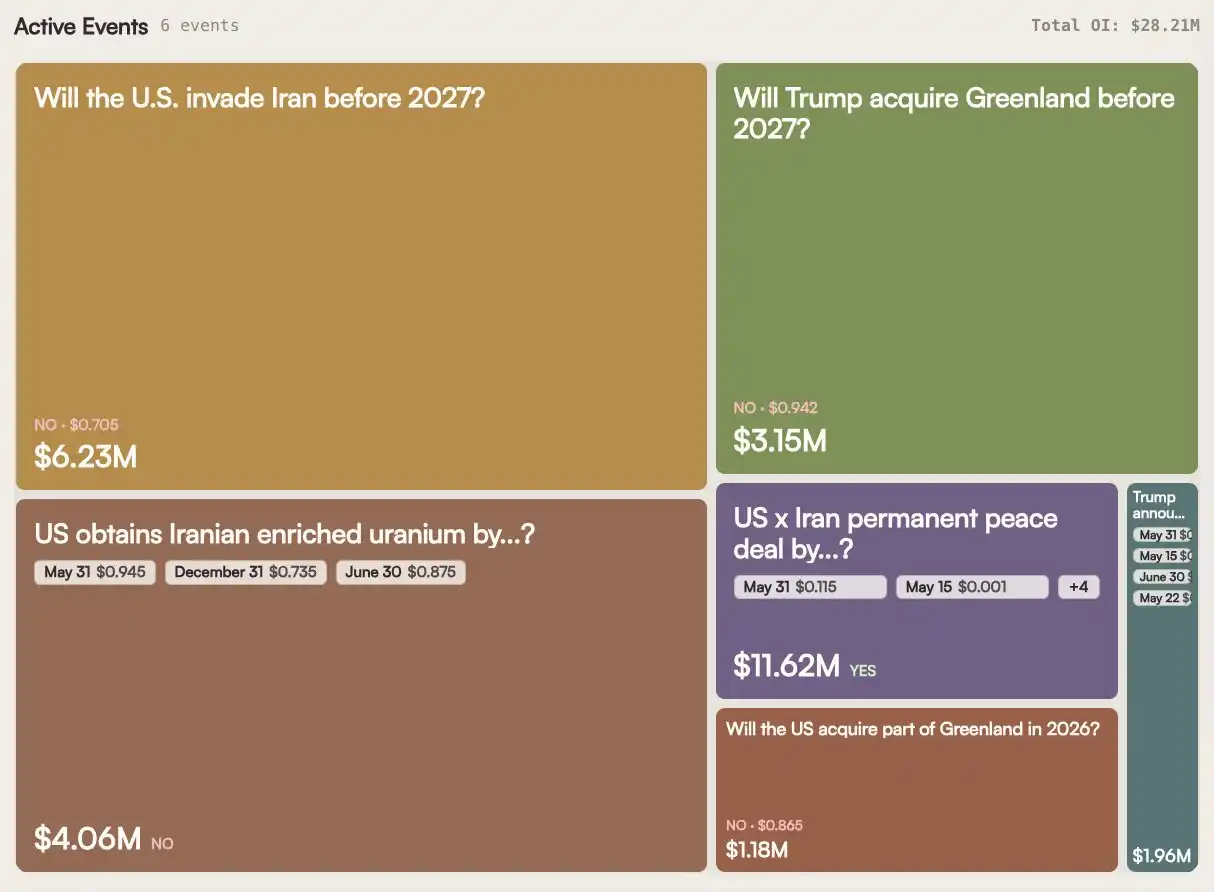
The value of TACO lies in the fact that it does not have users bet on whether Trump will concede in a particular instance, but instead turns this type of behavior into continuous exposure. Looking at a single threat, the result may just be a coin toss. But if this behavior pattern repeats across a sufficient number of events, it can be turned into a basket. If one market goes wrong, it doesn't mean the entire strategy has failed. As long as the overall pattern remains effective, the portfolio has the opportunity to capture this recurring structure.
This is also the product direction that Polyvaults aims to convey. Users transition from individual trades to selecting strategy configurations.
errorWelcome to join the official BlockBeats community:
Telegram Subscription Group: https://t.me/theblockbeats
Telegram Discussion Group: https://t.me/BlockBeats_App
Official Twitter Account: https://twitter.com/BlockBeatsAsia