The First Large-Scale Strike of the AI Era, Straight from an AI-Made Factory

Author | Sleepy
AI may redefine the future, but it has yet to be able to pay for the dignity that belongs to labor.
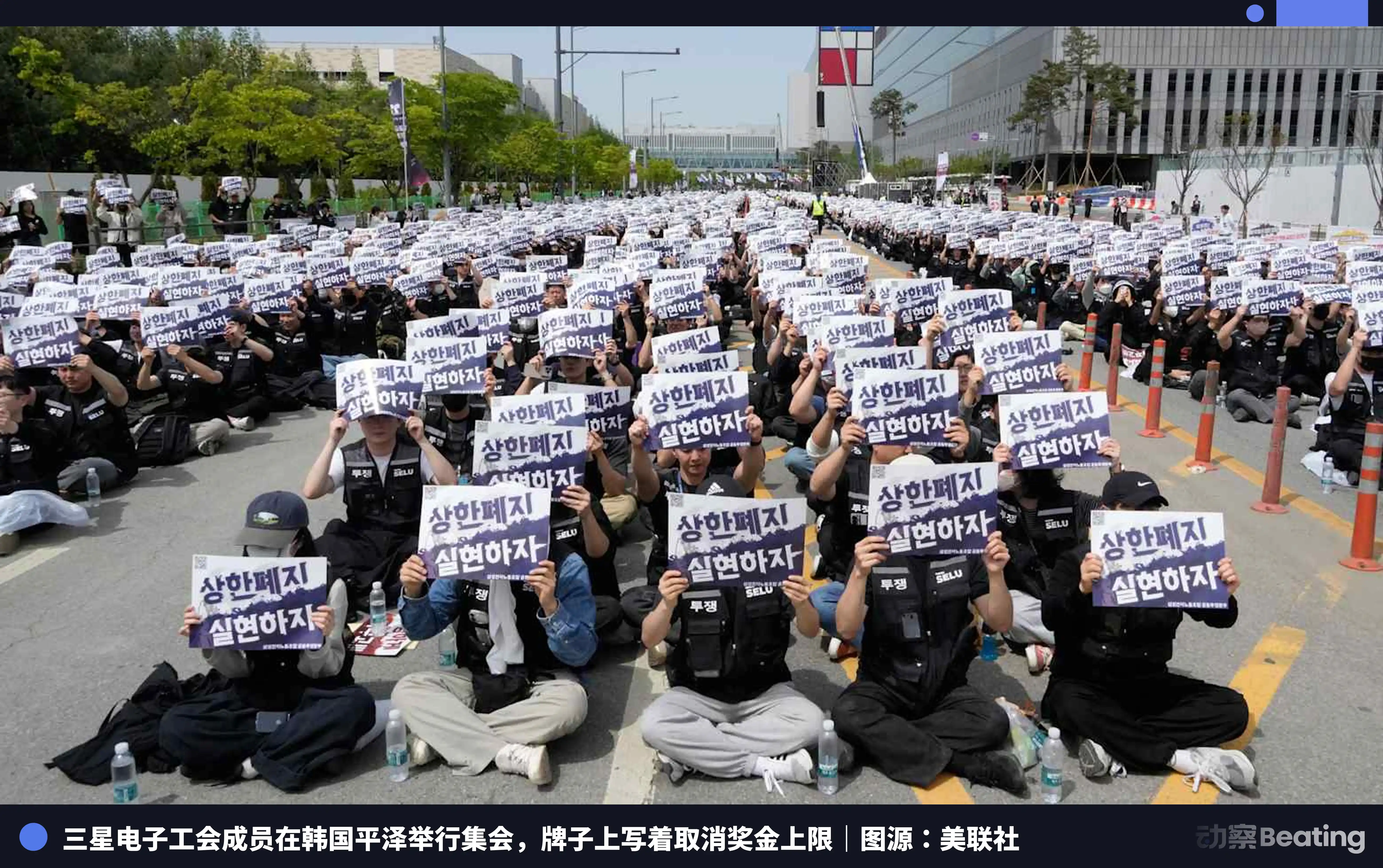
On May 20, Samsung Electronics' wage negotiations with the union reached the brink of collapse. The union was prepared to launch an 18-day strike starting on May 21. At the last minute, a temporary agreement was reached, pausing the strike temporarily, pending a vote by union members. However, the real issue has not disappeared.
The strike is not unfamiliar to us.
Those past events are equally weighty, some occurring in old industrial bases, some in the automotive supply chain, and some in export factories supported by cheap labor, always associated with low wages and arrears. Initially, people were taken for granted as durable consumables, settled in various plans named "overall situation." It wasn't until days were squeezed to the point of suffocation that everyone suddenly realized they hadn't degraded into iron parts. They then straightened their backs from that cold order and made a human sound.
But this time is different.
This time, it's the workers of Samsung Electronics who have stood up.
They are not workers who have no choice but to retreat in the tide of globalization; they are a group of people deep in the AI supply chain, closest to the "future." In Samsung's massive conglomerate machinery, this giant holding the global semiconductor lifeline is being paused by its own workers.
A Strike That Threatens the Global AI Industry
This strike is precisely aimed at the throat of the global AI industry chain.
Together, Samsung and SK Hynix produce approximately two-thirds of the world's memory chips.
While memory chips have always been important, it was not considered a glamorous business. It wasn't until AI arrived that it suddenly became a battleground. With large-scale model training, inference, data center expansion, having just a GPU is not enough; data needs to be rapidly fed in, stored, and retrieved, requiring high-bandwidth memory like HBM.
According to KB Securities analyst Jeff Kim's estimate, this 18-day strike could disrupt global DRAM supply by 3% to 4% and NAND supply by 2% to 3%. Although it is not Doomsday level, it is enough to make price expectations, customer scheduling, cloud provider costs, and tech stock nerves all tense up at once.
The South Korean government is feeling increasingly uneasy. Because Samsung is not just any company; it is more like a demonstration of South Korea's national strength.
Yonhap News Agency reported that semiconductor exports account for about 35% of South Korea's total exports. In the first quarter of 2026, South Korea's exports reached a record high of $219.9 billion, with semiconductor exports increasing by 139% year-on-year to reach $78.5 billion.
Samsung alone accounts for about a quarter of South Korea's KOSPI market value. In other words, when Samsung shakes, it is not just affecting the balance sheet of a single company, but also impacting South Korea's exports, stock market, exchange rate expectations, and the country's confidence in telling its story to the world.
More importantly, AI arrived too suddenly. In the past, when South Korea talked about being a technology powerhouse, it focused on smartphones, displays, cars, home appliances, and semiconductors. Now, the global narrative has been reshaped by large-scale models, with OpenAI, Google, Anthropic, a group of large-scale AI companies in China, and compute power giants like NVIDIA standing in the spotlight. South Korea also aims to develop its own sovereign AI, with the government promoting national-level AI infrastructure. NVIDIA has even announced plans to deploy over 260,000 AI chips in South Korea. However, South Korea is well aware that solely relying on models will not give it overwhelming international influence, especially in the midst of the U.S.-China rivalry.
What South Korea truly holds onto is the path that is harder, heavier, and less glamorous: memory chips, HBM, DRAM, NAND, advanced manufacturing, and the underlying supply chain that feeds AI data centers. This is why Samsung has become more important today than ever before.
As AI advances, the world is realizing that large models are not magical entities floating in the cloud. They require electricity, GPUs, and memory. South Korea may not be able to change the world with just one model, but it can make the entire world's models inextricably linked to its own through chips.
The AI industry often talks about computing power, models, and the power struggles of tech giants, discussing who outsmarted whom.
The Samsung strike suddenly brought everyone back down to earth. No matter how high the computing power, ultimately, it all comes down to factories, shifts, bonus schemes, and labor negotiations.
The future is not up in the clouds. The future also involves paying wages.
Why did they strike?
The core demands of the union include:
1. A 7% increase in basic wages;
2. Allocating 15% of Samsung's annual operating profit to create an employee bonus pool;
Remove the current 50% cap on annual bonuses, clearly outlining how bonuses are calculated, when they are paid, and whether they will be considered in the future.
Samsung disagrees. The company believes that the union's demands are excessive, especially if the high bonuses are extended to loss-making business units, which would break the rule of "those who make money get more bonuses."
Reportedly, a key point of contention in the final mediation was the division of bonuses between different business units within the semiconductor division. While the memory business is profitable, other businesses are under pressure or even operating at a loss. Should employees in the loss-making units also receive large bonuses?
In large modern companies, ordinary employees are increasingly less likely to discuss money directly with management. Money is stuffed into a pile of seemingly objective factors: performance, coefficients, costs, cycles, business units, profit criteria, and bonus caps.
Samsung's bonuses have always been tied to a complex formula, with the Korean media repeatedly mentioning a term called EVA. Essentially, profits must first deduct taxes, investments, and various capital costs, and only the remaining amount is considered for bonuses. The financial logic is sound, but it is difficult for people to accept. Employees don't understand: if the company's profit is increasing, why is my bonus not moving? Am I losing out due to performance, or is it this formula? Do my efforts count as contributions in the company's eyes?
The reason why Samsung employees' anger has accumulated and erupted today is because standing next to them is a mirror called SK Hynix.
SK Hynix has secured an excellent position in the AI storage sector and excelled in the HBM supply chain. More importantly, it knows how to translate this success into tangible numbers on employees' wage cards.
In September 2025, SK Hynix and the union negotiated a new rule: for the next ten years, the company will allocate 10% of its operating profit to employees annually and eliminate the previous bonus cap.
At that time, The Korea Economic Daily reported that under the new agreement, employees were expected to receive approximately 100 million Korean won each that year, about 450,000 Chinese yuan. By early 2026, according to the company's 2025 performance report, Seoul Economic Daily reported that around 34,500 SK Hynix employees would receive a performance bonus averaging about 140 million Korean won, approximately 630,000 Chinese yuan.
Furthermore, Seoul Economic Daily cited FnGuide's prediction that SK Hynix's 2026 operating profit could reach 23.00885 trillion Korean won, with a 10% allocation of approximately 2.3 trillion Korean won as a bonus pool. A simple division among 34,549 employees would result in an average of about 670 million Korean won per person, approximately 3.04 million Chinese yuan.
The neighbor has already served the meat from the pot. At this point, Samsung employees would naturally be annoyed to hear the company talk about EVA, cost of capital, and departmental differences.
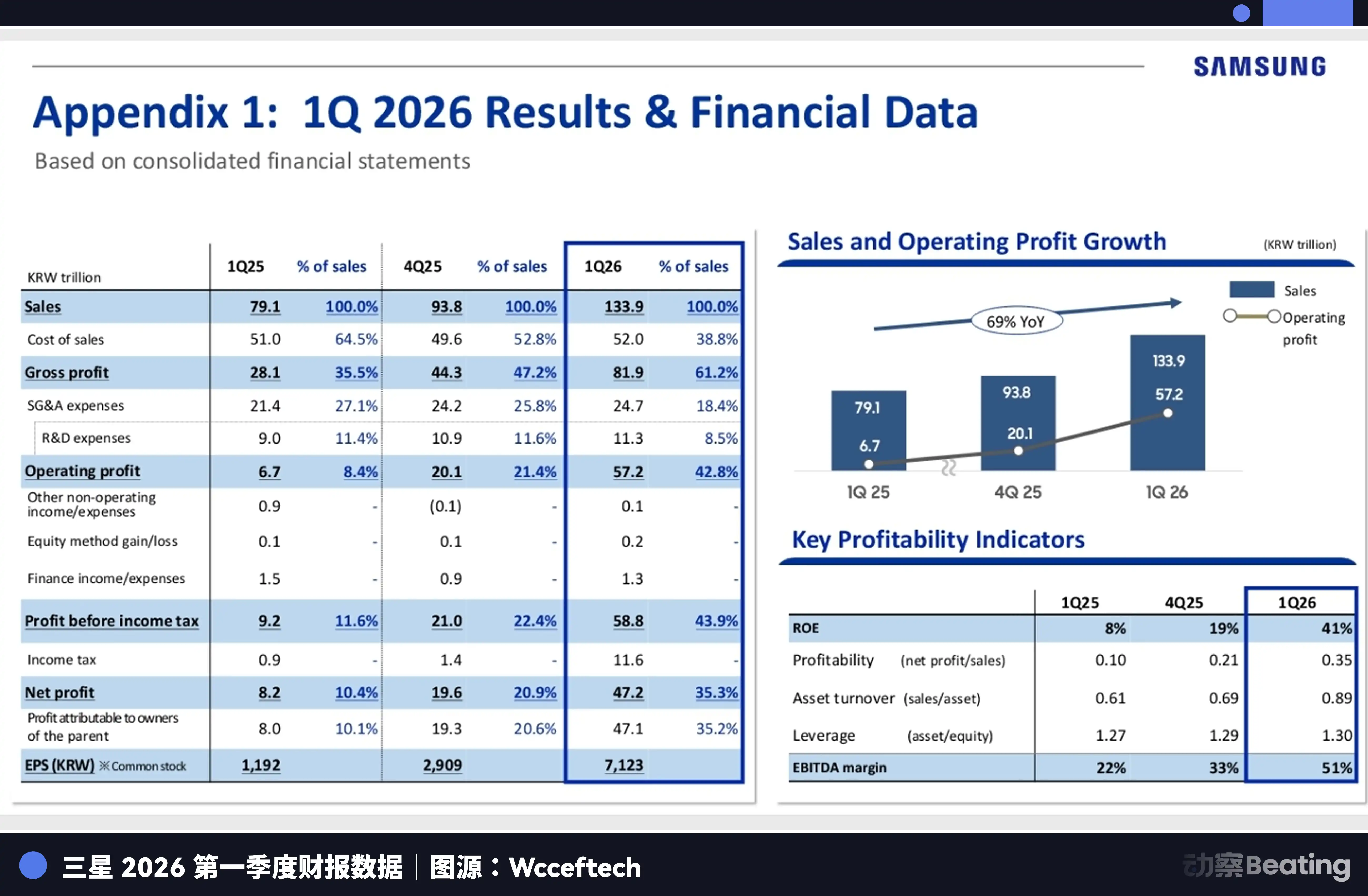
The official Samsung financial report shows that in the first quarter of 2026, the company's consolidated revenue reached 133.9 trillion Korean won, hitting a historic quarterly high; operating profit reached 57.2 trillion Korean won. The semiconductor division had first-quarter revenue of 81.7 trillion Korean won and operating profit of 53.7 trillion Korean won. The money mainly came from AI-related demand, such as high-value-added AI storage, industry storage price increases, HBM4, and AI data center expansion.
This situation is awkward, and the awkwardness lies here.
When the company is losing money and people have no bargaining chips in hand, the boss advises everyone to bear with it, saying the cycle will always turn around. Employees may not necessarily agree in their hearts, but indeed there is no visible profit on the books, so they just go along with it. However, when the company becomes prosperous again, the fat meat has already been placed on the table in a very tangible way. At this point, whoever picks up the chopsticks, whoever takes the main seat, and who can only stand aside and smell the aroma, can no longer deceive anyone with sentimentality.
Root of the Problem
To understand why Samsung is making its employees so angry today, one cannot just look at a paycheck; one must also look back at the long-standing tense relationship between South Korea's chaebols and workers.
South Korea's modernization process is more like a rapid march led by the state. Large companies are pushed to the front, with workers following closely behind. This vehicle indeed runs very fast, but the allocation of seats has never been negotiated by everyone sitting down together.
Post-war Korea was extremely poor. Starting from the Park Chung-hee era, the state became the overall commander of industrialization, vigorously supporting the chaebols to chase orders, build factories, and catch up on technology. Samsung, Hyundai, SK—these names gradually became the face of the country. They were predetermined as standard-bearers who must win because Korea needed this victory. For this, the state provided resources, banks provided loans, and society gave endless patience, leaving only ironclad discipline in the factories.
In this system, the role of the workers is very clear: first, build up the country, first, make the company big, first, endure. Pay can be delayed, rights can be delayed, unions can be delayed, and dignity can be compromised. Before the car even starts moving, don't ask if the seat is comfortable.
1987 was a watershed year. The rigid order cracked, and workers walked out of the factory through the cracks. Large enterprise unions began to take root, workers were no longer willing to remain a vague background in the grand narrative of an "economic miracle." They stepped forward, demanding wages, demanding safety, and more importantly, demanding to be treated as a living creator, not a part that is discarded once worn out.
errorThe locomotive represents order, technology, and the future; the caboose embodies congestion, silence, and a preordained destiny. The most bitter part of this story lies not in the fact that the train cars have been forcibly divided hierarchically, but in the fact that everyone has accepted one premise: the train must never stop.
As long as the train must keep moving forward, then wherever you are in whichever train car enduring hardship, even if you are eating cockroaches, it all becomes the "necessary cost" of keeping the system running. For the sake of that grand momentum, individual human beings always seem to be expendable.
Samsung's strike is likewise stuck on a train that "cannot stop".
Wafers cannot be damaged, production lines cannot falter, AI servers cannot wait, South Korea's export data cannot decline, and global tech companies do not want to see memory chip prices rise again. Every reason is so right that it is unassailable, and stated emphatically. From the standpoint of the national economy, Samsung cannot stop; in front of the global supply chain ledger, Samsung cannot stop; in the undecided AI race, Samsung absolutely cannot stop.
The less a machine can afford to stop, the more the people inside are likely to be asked to endure.
Endure a production line pause, endure a cycle delay, endure a performance review, endure a company strategy, endure global competition. Endure until, eventually, people will find that they are always making way for something bigger. From the enterprise to the industry to the future.
In the face of these grandiose terms, the lives of ordinary people seem very small, as small as a screw. But even a screw has its own metal fatigue.
What the Samsung union has done this time is not to overthrow the benefits that AI has brought to the world, nor to deny the semiconductor industry, nor to say that technological progress is unimportant.
It is not the age-old story of the poor rebelling against the rich, nor is it the small story of high-paid employees receiving higher bonuses.
It actually hits upon one of the most unsettling propositions of the AI era: as technology advances, will labor become increasingly silent? As machines grow larger, is the bargaining power of ordinary people destined to shrink? As growth becomes more dazzling, will the certainty of our lives weaken?
We like to talk about the future, and indeed the word "future" is very useful. It is like a high-wattage spotlight that can always illuminate the blueprints at a conference, the ambitions in a financing plan, and the pulsating company valuations. But the future cannot only illuminate the locomotive; it must also shift towards the caboose, shedding light on the grueling night shifts, the ID badges on our chests, the resumes in the hands of graduates, and on those who are constantly told to "embrace change" but are shown the door when it's time to distribute rewards.
The Samsung strike may eventually end with compromises, arbitration, partial concessions, or a new bonus formula. Labor negotiations often play out this way, starting dramatically but ultimately settling into a series of percentages, a legal agreement, and a few carefully worded announcements. The news buzz will fade, stock prices will continue to fluctuate, AI companies will still release new models, and servers will consume even more chips.
However, some issues will not be resolved at the negotiation table.
In the AI era, the most pressing question is not just how powerful the computing power is, how fast the model runs, or how expensive the chip is. We must also consider deeply whether those who have personally brought the "future" into reality will ultimately secure a share of that future.
While this may sound modest, what ordinary people desire is inherently modest. They simply want their work to be meaningful, their income to be just, their lives to be hopeful, and when the era takes a sudden turn, they do not want to be easily left behind.
Of course, the future must move forward. But a train that truly heads toward the future cannot just have its headlights on.
Welcome to join the official BlockBeats community:
Telegram Subscription Group: https://t.me/theblockbeats
Telegram Discussion Group: https://t.me/BlockBeats_App
Official Twitter Account: https://twitter.com/BlockBeatsAsia