New Protocol Tacit, Zcash of Bitcoin Ecosystem

The Bitcoin ecosystem has long been forgotten. Especially when the once largest Bitcoin ecosystem exchange, Magic Eden, stopped supporting the Bitcoin ecosystem and ceased the service of Magic Eden Wallet, it gave players who had long ignored the Bitcoin ecosystem a feeling that "the Bitcoin ecosystem has come to an end."
However, not only are established Bitcoin ecosystem infrastructures such as UniSat and Xverse still actively developing, but after Magic Eden, new marketplaces like SatFlow and ord.net have also filled the void. And recently, the emergence of a new Bitcoin asset protocol has once again brought the Bitcoin ecosystem into everyone's view.
This new protocol is called Tacit.
What is Tacit?
First, we need to classify Tacit into the category of "meta-protocols" such as BRC-20 and Runes, all of which rely on an indexer to handle asset confirmation. If there is any difference, Tacit's indexer runs directly in the user's browser, eliminating the need to trust any centralized server (indexer). As long as two computers run the same code, view the same Bitcoin block data, they can derive consistent balance results.
The unique aspect of Tacit is that it is a new Bitcoin asset protocol that focuses on "privacy." Many players directly use analogies like "ZEC on Bitcoin" when promoting this new protocol. While there is some merit to this analogy, it is not entirely accurate because Tacit can hide only the token amounts (including the total supply specified at the deployment of a new token and the specific amount of each transaction), not the on-chain address graph.
In other words, Tacit hides the flow amount of funds but does not hide the flow direction of funds.
Nevertheless, it is still a privacy asset protocol native to the Bitcoin mainnet. Here, we use a simple metaphor to explain how it achieves this on the Bitcoin mainnet.
A regular Bitcoin transaction is like a transparent ledger where everyone can see a transaction and how much fund is involved. Tacit is equivalent to stuffing the transaction into a "black box" (Pedersen commitment).
Everyone can still see the transaction. Although you cannot see the amount of the transaction, you can prove to everyone that "the money I put in, plus the money I take out, adds up."
Pedersen commitment, along with Bulletproof, is used to hide the transaction amount while proving to the entire network that you did not create tokens out of thin air (e.g., proving that the amount you transferred is not negative and that the total amount is conserved).
A Mimblewimble-style signature scheme ensures that the outgoing transaction amount is equal to the incoming amount, thus preventing malicious inflation of the token.
When a sender transfers tokens to a recipient, the amount information is encrypted using ECDH and written on the blockchain. Only the sender and recipient can decrypt and see the actual amount using their private keys, while others see this data as just a bunch of gibberish.
Finally, the indexer embedded in the dApp (user's browser) reads the data on the Bitcoin blockchain, independently verifies the cryptographic proof mentioned above, and calculates your true balance accordingly.
Since its launch on May 7th, developer ross.wei (@z0r0zzz) has been updating Tacit rapidly. The current version of Tacit now supports a fair launch, has a marketplace, enables token swaps, and includes a mixer.
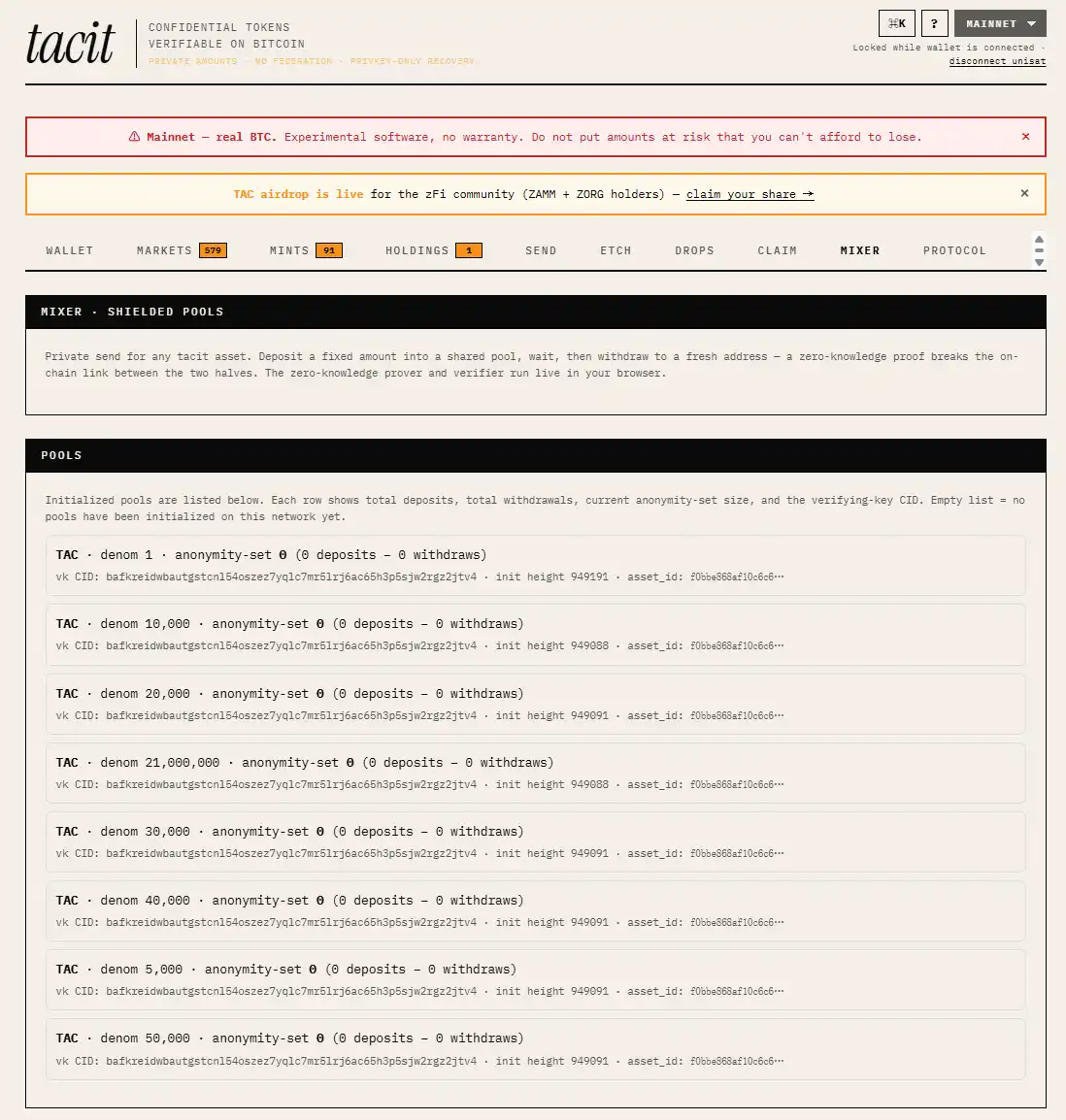
This mixer is somewhat similar to Tornado Cash, where greater participant numbers lead to increased privacy (making it harder to determine which addresses correspond to the set). However, Tacit's mixer does not rely on smart contracts. It encodes the deposit proof in a Taproot transaction output, while the withdrawal zero-knowledge proof is handled by the browser's indexer.
It even has a slight advantage over Tornado Cash in some aspects since Tornado Cash cannot conceal the amount of mixed coins. Nevertheless, Tacit's mixer cannot mix native bitcoins as concealing the mix amount itself requires an initial wrapping of the bitcoins.
Of course, privacy comes at a cost. According to statements on GitHub, due to the large witness data required for privacy, the transfer cost corresponds to a mainnet fee rate of about 10 sat/vB, meaning each transfer costs approximately 25,000-30,000 satoshis, roughly 10 times the cost of transferring Runes.
Who Built Tacit?
Developer ross.wei (@z0r0zzz) is a relatively well-known developer in the Ethereum space. He previously created ZAMM, which provided a single contract for creating new tokens, managing LP, farming, and swapping, significantly improving gas efficiency and user experience.
$ZAMM was also a prominent project on Ethereum in the past, with a market cap reaching the multi-million dollar level and receiving endorsements from crypto KOL Ansem.
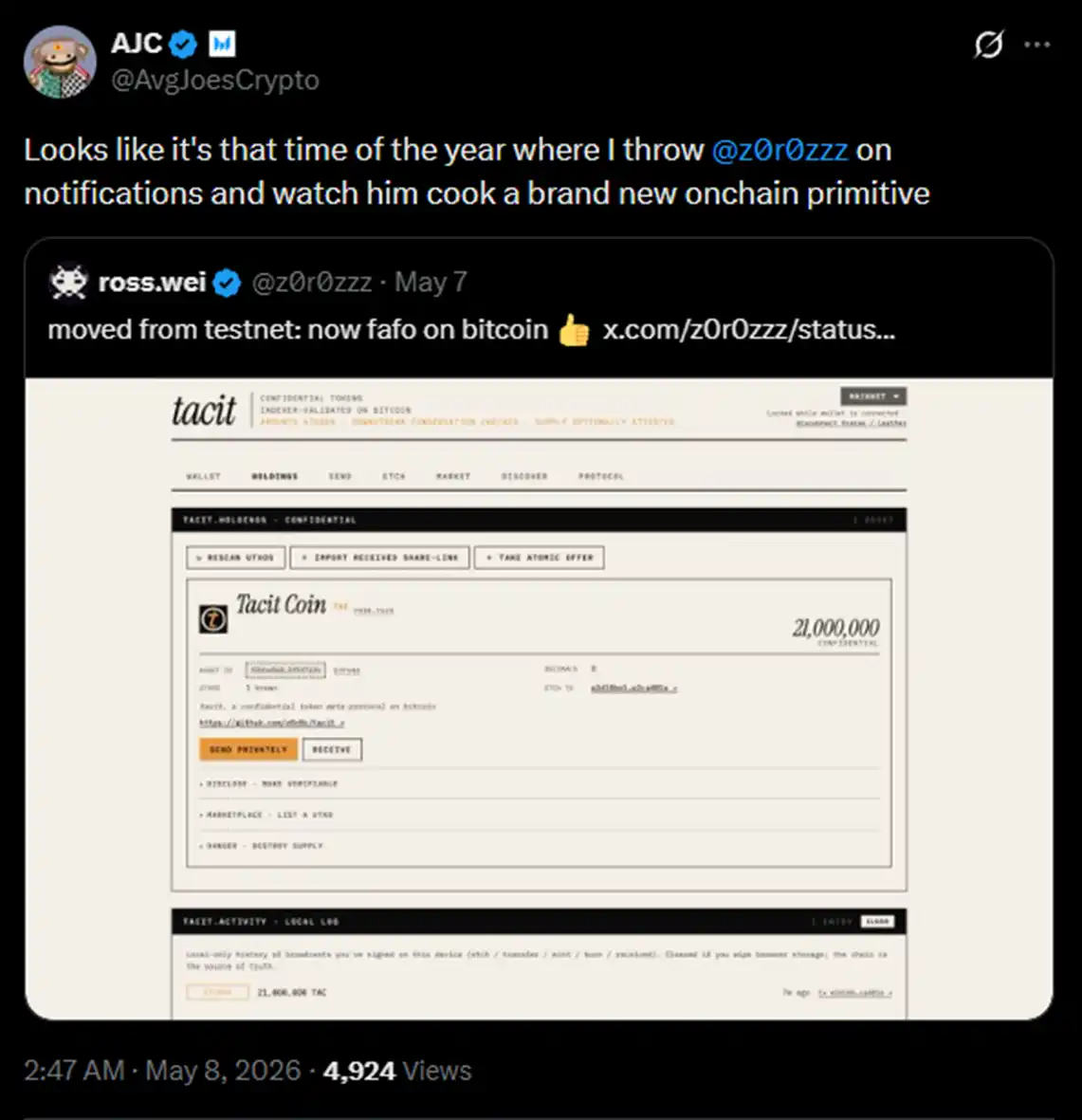
Tacit was not something he came up with on a whim, as he has been interested in Bitcoin technology for some time. This new protocol has also caught the attention of @AvgJoesCrypto, a research analyst at Messari.
In the future, the author also plans to achieve privacy wrapping of native Bitcoin (cBTC), silent receipt (a unique new address is generated for each received transfer), and obfuscation of the transferred asset.
Related Assets
Currently, the token with the largest trading volume in the market is $TAC, which the protocol's author personally deployed and recently airdropped based on the holdings of the $ZORG staking token on Ethereum. It currently has a market value of about $4 million and is undoubtedly the leader.
The first fair launch coin is $FAIR, but the market has not yet opened trading for this coin.
Conclusion
This is indeed an innovative Bitcoin asset protocol. Compared to BRC-20 and Rune, it has already achieved amount privacy and plans to achieve more. Unlike RGB, Taproot Assets, and Liquid CT, it does not use off-chain client proofs or exist in the form of a sidechain; it operates entirely on-chain.
By restructuring its own protocol components into a mixer, it has also complemented the obfuscation of the on-chain address graph.
Although the use cost may be relatively high, this is truly an innovative feature in the Bitcoin ecosystem that has not been seen for a long time and is quite impressive.
Welcome to join the official BlockBeats community:
Telegram Subscription Group: https://t.me/theblockbeats
Telegram Discussion Group: https://t.me/BlockBeats_App
Official Twitter Account: https://twitter.com/BlockBeatsAsia