A 120% Weekly Gain: Why Did These Altcoins Experience Such a Surge?

The financial market has been less affected by the US-Iran war, and most assets have been rising in the first week of May.
BTC has repeatedly tested the $80,000 level, reaching as high as $83,000. The S&P 500 hit a new high, and semiconductor stocks showed a parabolic move. Strategy's STRC saw a pre-dividend rush that is still ongoing.
Looking deeper into the crypto world, the rising assets are more extravagant, with many seemingly unrelated coins seeing gains, unlike in the past when a specific vertical saw a general increase. For example, ZEC doubled in a week, reaching a peak of $600, briefly surpassing a $100 billion market cap. TON surged 120% in a week, with a market cap of $7.6 billion briefly surpassing LINK to enter the top 20. ONDO rose 50% after news from the DTCC working group, jumping from $0.18 to around $0.4. LAB achieved a fully diluted valuation of $4.5 billion. SKYAI multiplied by 10 in a month. Even smaller-cap coins like LUNA, BIO, STRK, JTO, PENDLE are also following suit.
It looks a bit like alt season is here, but in fact, the Altcoin Season Index has been stuck at 39 for a long time, with BTC dominance at 58.8%. Only about half of the top 100 are above the 50-day moving average. In other words, the significant gains are only in a very limited number of assets. Many older DeFi coins and protocol tokens relying solely on TVL data that no one is shilling are still in a sideways trend.
In this article, the rhythm editorial team dissects ONDO, ZEC, BIO, and TON, four representative tokens, analyzing the reasons for their rise.
ONDO Breaks into Wall Street
Let's start with ONDO. ONDO is a leader in the RWA track and has risen by 57% in the past week, currently around $0.4.
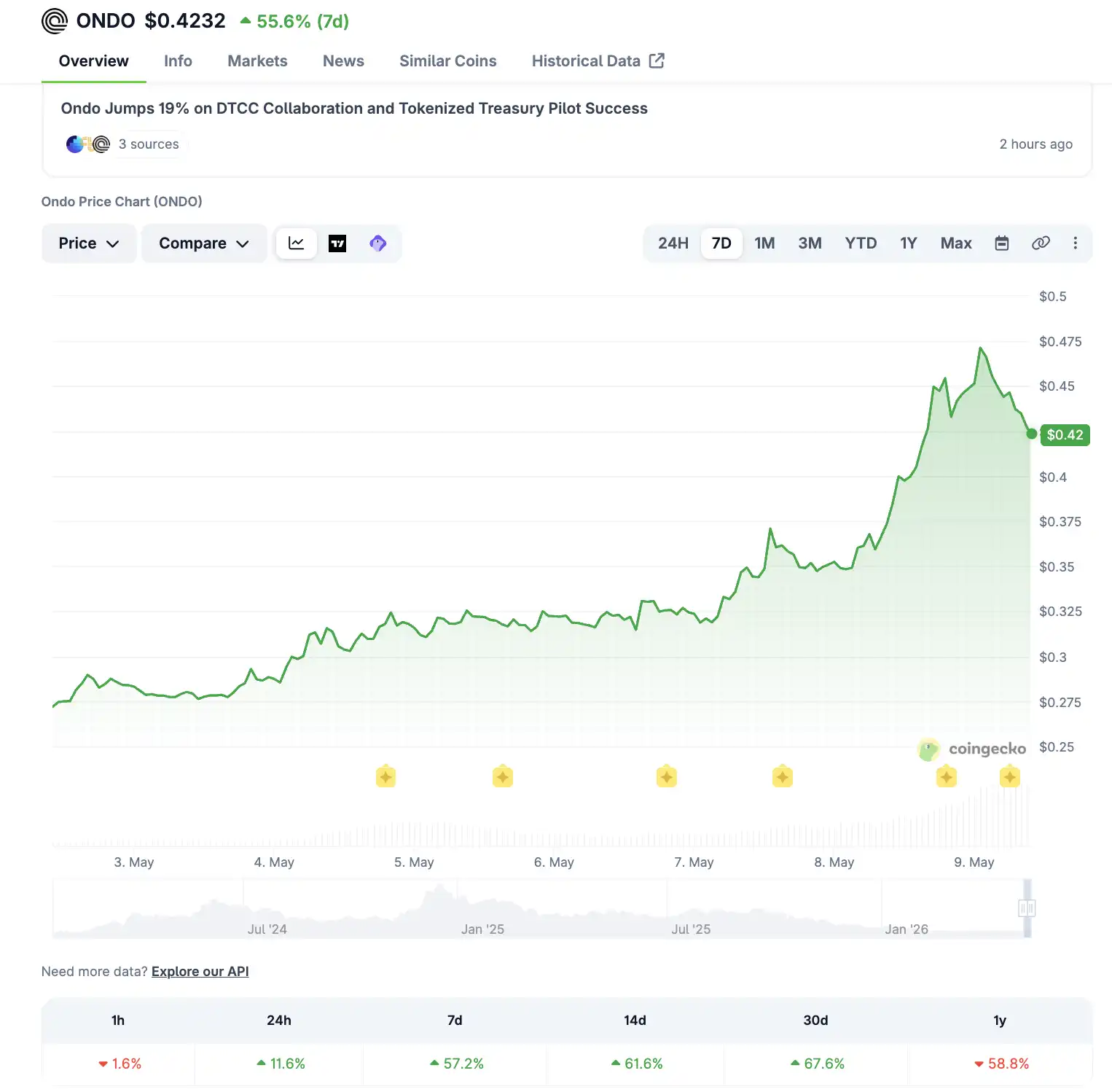
The main reason for its rise this time is the landing of two key partnerships.
On May 4, Ondo was selected to join the DTCC (Depository Trust & Clearing Corporation) Industry Working Group.
This working group also includes financial giants such as BlackRock, Goldman Sachs, JPMorgan, Franklin Templeton, Morgan Stanley, Bank of America, Citadel Securities, NYSE Group, Circle, Fireblocks, and Robinhood.
What is the scale of DTCC? It custodies $114 trillion in assets, with an annual clearing volume of $37 trillion, serving as the almost universally traveled path behind the U.S. securities market. By the end of 2025, the SEC issued a no-action letter to a DTC subsidiary, clearing the regulatory path. DTCC's own tokenization service plan is set to launch in July 2026, with a limited release, followed by a full launch in October, initially covering stocks from the Russell 1000, major ETFs, and U.S. Treasury bonds. Ondo's entry into this working group means it has the opportunity to participate in defining the token layer interface in this future standard.
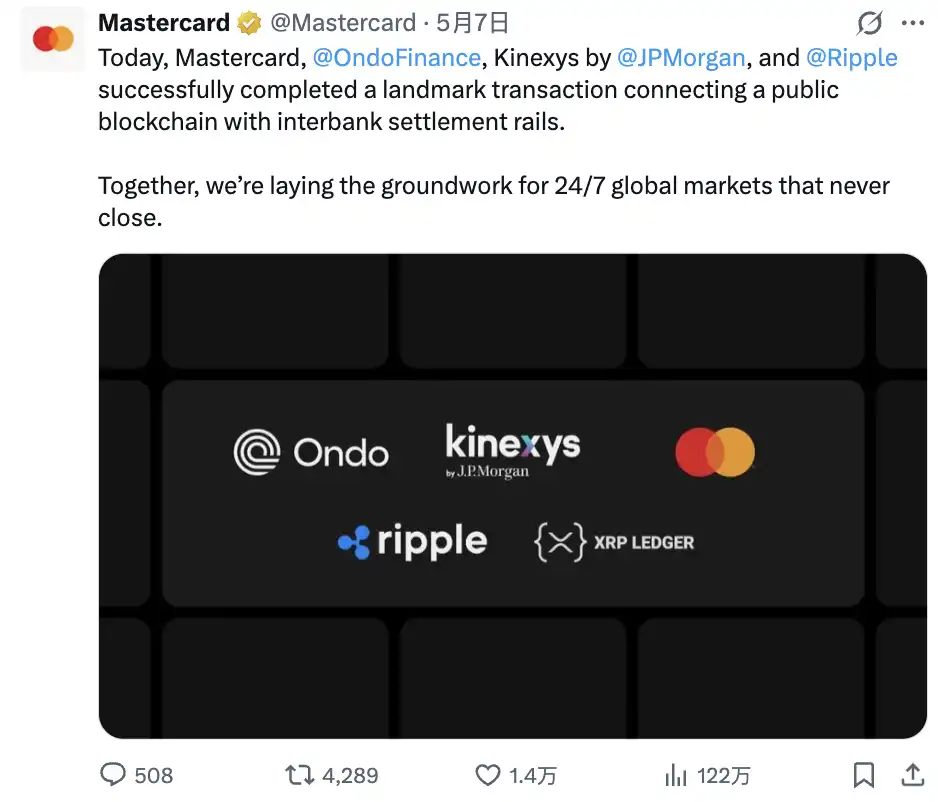
Ondo + JPMorgan + Mastercard + Ripple Achieve Cross-Border Settlement Collaboration
Next, on May 6th, Ondo, together with JPMorgan's Kinexys, Mastercard's MTN network, and Ripple, successfully completed the first cross-border tokenized government bond redemption. The entire process unfolded as follows: Ripple redeemed a portion of its OUSG (Ondo's short-term U.S. Treasury bond token fund), the redemption instruction was issued on the XRP Ledger, Mastercard's multicurrency network provided routing, JPMorgan's Kinexys facilitated fiat settlement, and the funds were transferred to Ripple's bank account in Singapore. The entire process was completed within 5 seconds outside traditional banking hours, whereas conventional cross-border settlements typically take 1 to 3 business days.
DTCC CEO Frank La Salla explicitly stated in a public forum, "Tokenization will fundamentally change the market's operation." BlackRock's Larry Fink had earlier defined tokenization as the "next evolution of the market." Statements from such high-profile figures are a world apart from Twitter pump-and-dump schemes.
Aside from the benefits of the political window and collaboration with traditional financial giants, on the data front, Ondo's business is indeed up and running.
Ondo now controls approximately 70% of the tokenized stock market, with TVL increasing from $26 billion to $35.3 billion, and protocol revenue in Q1 2026 reaching $13.26 million. The tokenized stock market segment has grown from $375 million in May 2025 to $12.1 billion in May 2026, more than a threefold increase in a year.
Multicoin, DCG Increase ZEC Holdings
ZEC has seen the most significant surge. It has risen by 90% in the past 30 days, with a 30% increase in a single day on May 6th, reaching above $580. Its market cap has exceeded $10 billion, making it the highest-valued token in the privacy coin race.
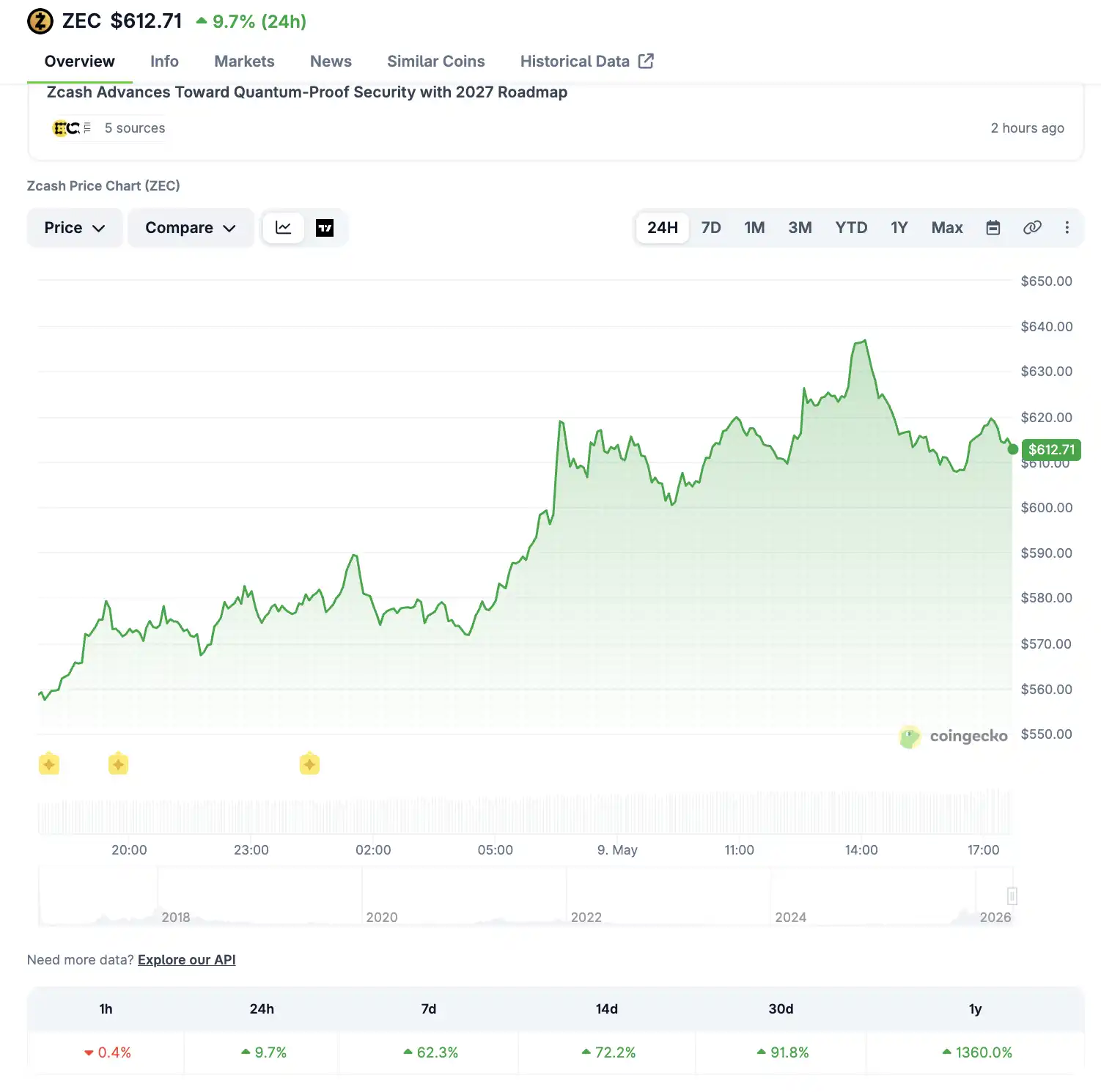
The catalyst is very clear. On May 6th, Multicoin Capital's managing partner, Tushar Jain, revealed during a panel at Consensus Miami that shortly after, he posted a long thread on Twitter, publicly disclosing that Multicoin had been quietly accumulating ZEC since February. The logic he provided was very straightforward: ZEC is "the cleanest way" to hedge against one particular thing, which is the increasing visibility and confiscation capabilities of private wealth by various governments. He used terms like wealth tax, censorship resistance, and surveillance hedge.
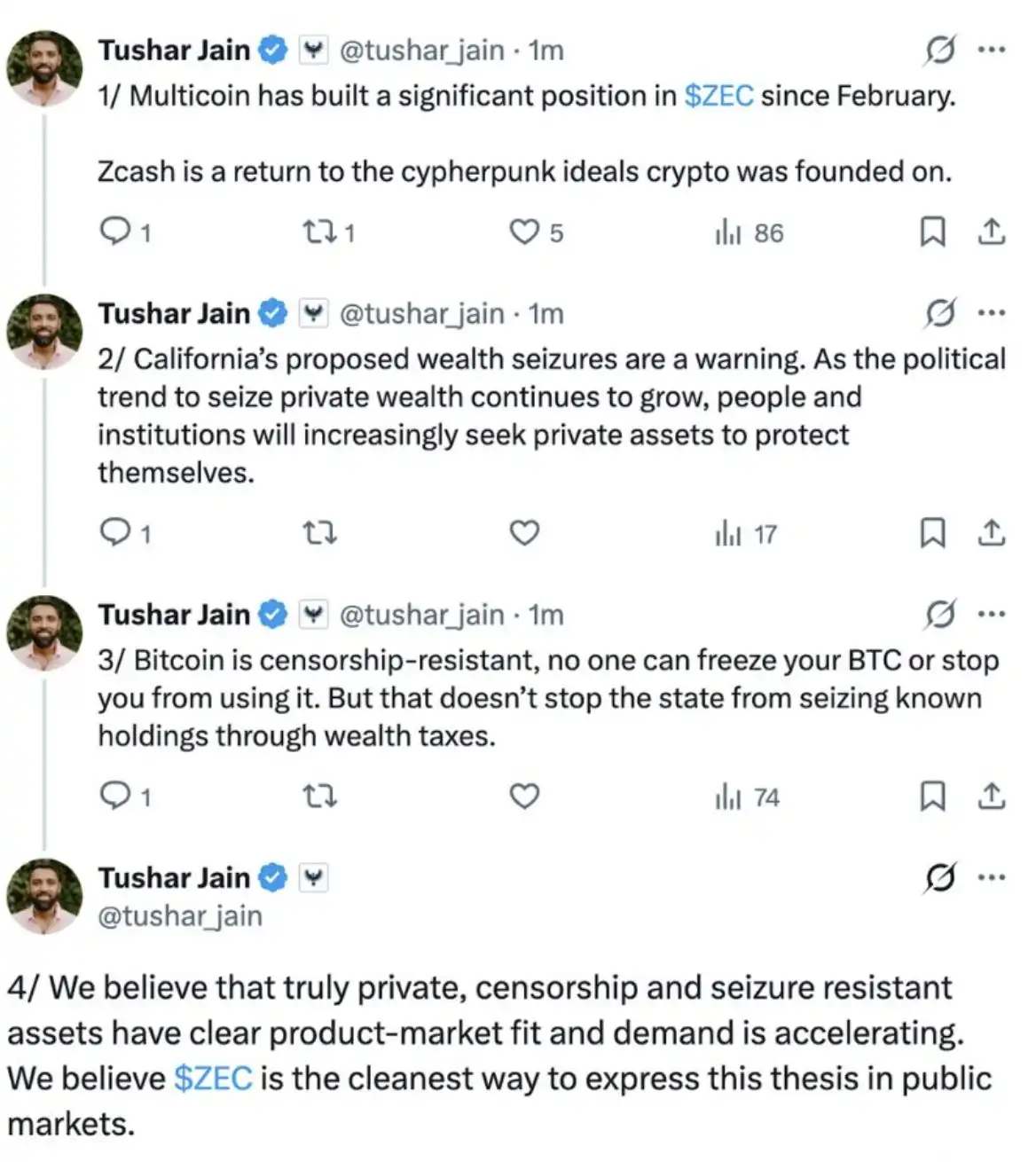
Multicoin Capital's managing partner, Tushar Jain, publicly disclosed that Multicoin had been quietly accumulating ZEC since February.
The original statement also mentioned a one-time 5% wealth tax targeting residents with a net worth exceeding $1 billion, expected to raise $100 billion. Jain's argument is that while Bitcoin is censorship-resistant at the protocol level and no one can freeze your BTC, tax authorities can still confiscate what they can see on the blockchain. This framing is similar to how Bitcoin was initially defined as "anti-inflation currency," but now the hedging target has shifted from money printing to surveillance.
A more macro observation is that the combination of the Trump administration's fiscal, tariff, immigration, and surveillance policies has caused some funds to worry again about the idea that "being seen equals being taken away." BTC has already been defined as an ETF wrapper and digital gold, leaving a vacant position for "anti-surveillance money." ZEC is more suitable than Monero to fill this position because it supports selective disclosure, allowing for optional transparency. Under the MiCA and AML frameworks, ZEC can still exist on compliant exchanges like Coinbase and Gemini. Monero has already started to be delisted in Europe.
When Multicoin Capital's Tushar posted this thread, it set off a chain reaction for ZEC.
Within 24 hours, $62 million worth of ZEC futures shorts were liquidated, causing the price to surge from $400 to over $580. The institutional side had already set the stage. Tyler Winklevoss's Cypherpunk Technologies had accumulated 290,000 ZEC by the end of 2025, representing about 1.76% of the circulating supply, and publicly stated a target of 5%. Arthur Hayes has long referred to ZEC as the "next asymmetric bet after BTC."
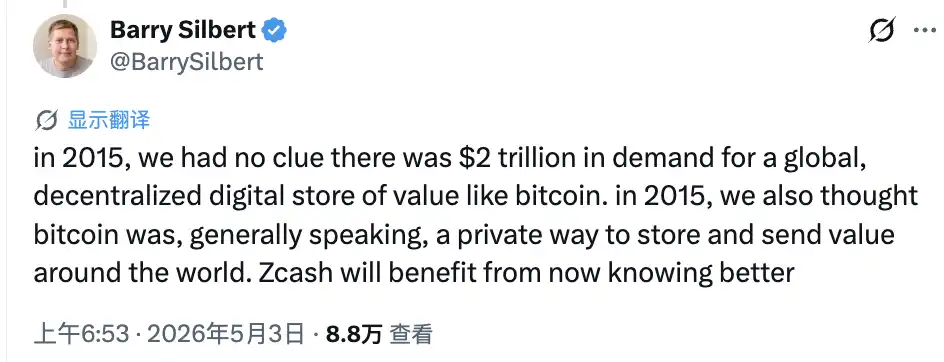
DGC founder Barry Silbert, the actual controller of Grayscale, has been clear since Bitcoin Investor Week in February that "5% to 10% of Bitcoin's market cap will flow into privacy coins" in the coming years, suggesting a 500x potential for ZEC. On May 2, he compared ZEC on Twitter to the "2013 to 2014 BTC playbook, with the next step being 2015 to 2020." Naval Ravikant, an early Zcash investor, was part of the relay with Hayes during the ZEC rally from $50 to $700 at the end of 2025.
Additionally, the other good news for ZEC during this period is that Robinhood listed ZEC on April 23, exposing it to millions of retail accounts that previously had no access to it. Grayscale's Zcash Trust has applied to convert to a spot ETF and is awaiting SEC approval, which may not be far off.
Narration alone is not enough; there must be structural supply absorption. ZEC's shielded pool now holds 30% of the circulating supply, an all-time high. Just the Orchard pool has increased from 1.92 million ZEC to 4.55 million over the past year. This means that roughly a third of ZEC has entered a black hole where it will not be sold, making the remaining float smaller and smaller. On an asset with a shrinking circulating supply, any marginal buying pressure will be magnified.
Then there is the short squeeze. For the past three years, the market has treated ZEC as a perpetual short target, with the funding rate consistently negative. When Tushar Jain posted the thread, the squeeze began. CoinDesk's liquidation data shows that ZEC's liquidation volume on that day was second only to Bitcoin's. A squeeze combined with thin order books resulted in a single-day 30% surge.
This is why ZEC has the triple bullish combination of institutional buying pressure (Multicoin, Cypherpunk Technologies), retail access (Robinhood, Grayscale ETF application), and regulatory arbitrage (compliant privacy coin).
BIO Ignites the Launchpad, Oversubscribed 5.9x in 30 Minutes
BIO is the smallest in scale and most volatile of the four, currently with a market cap of $100 million. In mid-April, it surged 96% over two days, from 0.018 to 0.044, and is currently fluctuating around 0.05, with a 176.8% increase in the past month.
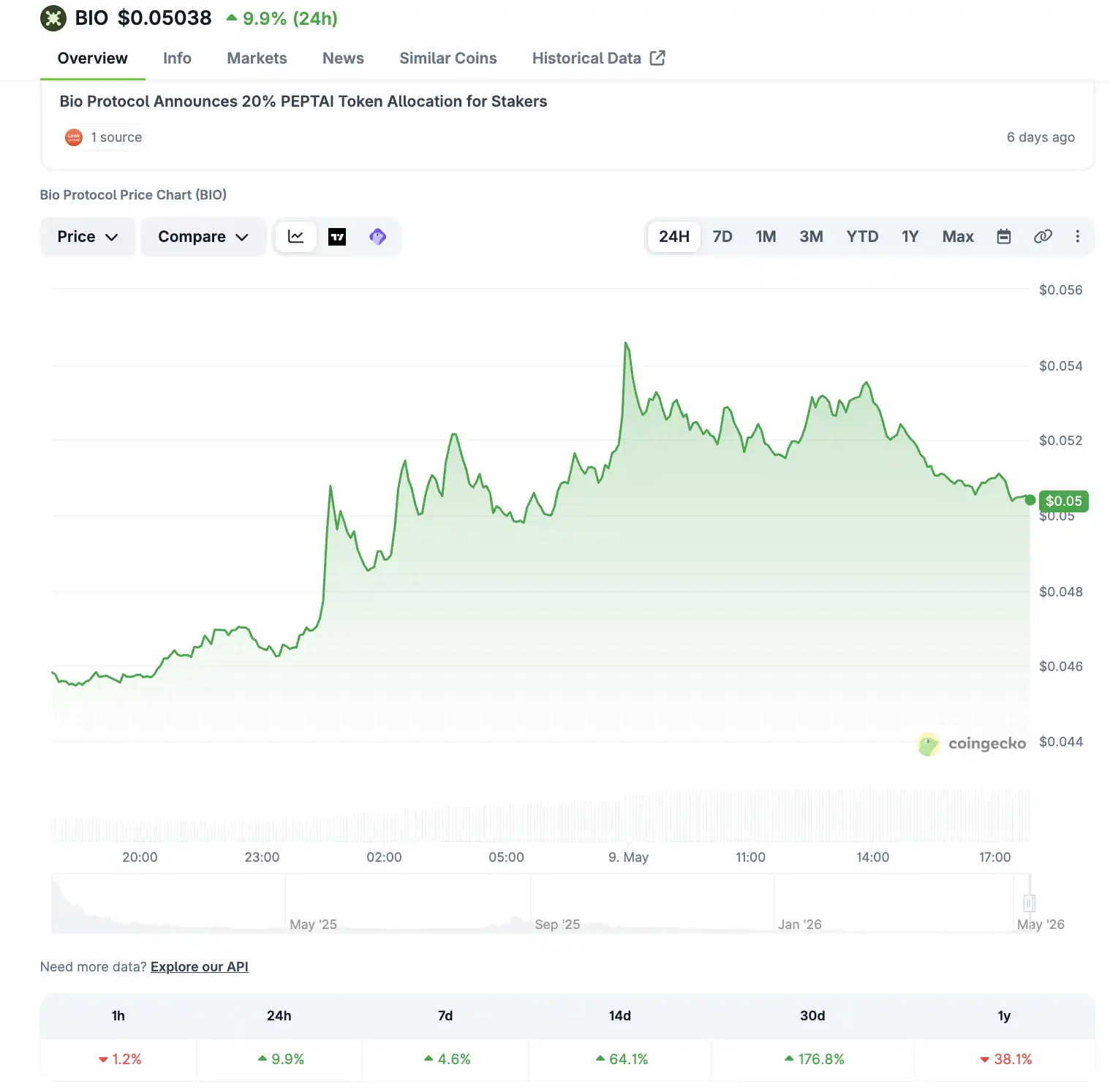
To be honest, the story behind BIO's recent surge involves a mechanism-level synergy of "narrative resurgence + low float + short squeeze."
Let's start with the narrative layer. There have been calls for DeSci in this track since 2024. In December 2024, BIO launched on Binance Launchpool, skyrocketing by 240% in the first two minutes. In January 2025, Arthur Hayes published the famous "degen DeSci" article on his blog, explicitly turning Maelstrom's risk dial towards DeSci, publicly holding seven tokens: BIO, VITA, PSY, CRYO, ATH, GROW, NEURON. In September of the same year, Maelstrom led a $6.9 million seed round for Bio Protocol, with co-investors including Mechanism Capital, Animoca Brands, Zee Prime Capital, Foresight Ventures. As early as November 2024, Binance Labs (now YZi Labs) made its first investment in the DeSci track, specifically in BIO. The institutional thread has always been there.
However, from the second half of 2025 to Q1 2026, BIO experienced a brutal downturn, plummeting from a high of $0.88 to $0.0157. On January 9, 2026, Binance delisted the BIO/BNB trading pair, coupled with liquidity contraction, causing another sell-off. The entire track seemed almost dead in the market's eyes.
What truly ignited the secondary market was the launchpad side. In late April, BIO Protocol completed the BioXP V2 upgrade, enabling a brand-new ignition sale mechanism. BIO holders earn BioXP points through staking, and pledging BioXP grants them priority participation in the ignition sale. The mechanism itself is standard launchpad gameplay, but BIO's implementation was quite aggressive: all funds from the ignition sale were 100% injected into liquidity pool (LP). After the sale, not only did BIO holders receive the new project's tokens, but their BIO holdings were also partially burned due to the new project's liquidity needs.
BIO Protocol's CEO, Paul Kohlhaas, shared a data point in a Bankless interview. PeptAI, a peptide AI project in the BIO ecosystem, used AI to design a novel peptide candidate compound for ADHD, completing the process from hypothesis to identification within 24 hours at a validation cost of around $1,500. This information comes from BIO's official statement and lacks third-party independent verification, serving as a sufficient narrative catalyst.
As the first ignition sale after the V2 upgrade, PeptAI was oversubscribed 5.9 times within 30 minutes, with 20% of the token allocation going to BIO stakers. The actual effect of this mechanism was a direct reduction in BIO's circulating supply because participants locked their tokens to await the next ignition event. Consequently, BIO saw an 18.57% price increase within 24 hours, a 697% surge in trading volume, and a daily trading volume peak of $223 million (more than triple its $70 million market cap at the time). The market interpreted this as a successful launchpad implementation.
One crucial point to clarify, due to significant misinformation in the crypto media: On April 14th, Eli Lilly announced the acquisition of CrossBridge Bio, a Houston-based biotech company specializing in ADC antibody-drug conjugates, for up to $300 million. While this acquisition is factual, CrossBridge Bio has no relationship with BIO Protocol or vitaDAO. It is a purely traditional biotech company founded by Michael Torres in 2023, deriving its technology from UTHealth Houston. In November 2024, a seed round was led by TMC Venture Fund and CE-Ventures, followed by a $15 million grant from the Cancer Prevention and Research Institute of Texas in November 2025. All investors and board members come from the traditional biotech industry. Some crypto media outlets mistakenly portrayed this acquisition as the "DeSci's first nine-figure exit," which is inaccurate. This event cannot be considered a true fundamental catalyst for BIO.
One indirect connection between BIO and traditional pharma is that in December 2022, Pfizer Ventures participated in a $4.1 million funding round for vitaDAO, becoming the first traditional pharma to invest in BioDAO. vitaDAO is focused on longevity research within the BIO Protocol ecosystem, so BIO holders indirectly hold influence over vitaDAO through meta governance. This event has been referenced repeatedly over the past three years but strictly speaking, it is an old catalyst from 2022, not a new event from 2026.
So why did BIO's recent surge happen? It can be summarized by three key mechanistic factors:
Firstly, the DeSci narrative plateaued for 16 months after reaching its peak at the end of 2024, and market expectations for this track had already hit rock bottom. As long as someone is willing to reiterate a narrative, coupled with the high certainty direction of the AI + Bio crossover in 2026, the rebound potential is opened up.
Secondly, the circulating supply is extremely small. BIO has a market capitalization of less than $100 million, and the 24-hour trading volume is often 1.5 to 7 times the market cap. On a low-float token, any narrative catalyst will be amplified exponentially. The BioXP upgrade further locks more BIO into staking, reducing circulation.
Thirdly, the short squeeze. BIO's funding rate has been negative for a long time, similar to ZEC, and has been a target for shorts in the market over the past year. When the narrative returns, shorts are forced to cover, resulting in a 50% increase in a single day.
A word on risk here. Among the four, BIO carries the highest risk. It has dropped 96% from its high of $0.88, and the current rebound is largely driven by the narrative and short squeeze overlap. A daily trading volume to market capitalization ratio consistently exceeding 1.5 is a typical speculative activity signal. For this coin to truly undergo a re-rate, a project like PeptAI needs to genuinely produce an exit on the scale of Eli Lilly, successfully demonstrating the BioDAO's "tokenized research + real IP publication" model. Until that happens, every price increase is a narrative trade, not a fundamental trade.
However, even when viewed as a narrative trade, BIO's position is clear. It is one of the few targets in the DeSci track that has a token, a real protocol, and institutional trust tokens (direct investments from Maelstrom and Binance Labs, indirect endorsement from Pfizer Ventures through vitaDAO). And DeSci itself is a direction that has not yet been fully priced in for 2026.
TON Founder Returns, Durov Puts Entire Reputation at Stake
TON Skyrockets by 120% in a Single Week, surging from 1.35 to 2.89, briefly crossing $7.6 billion in market cap to enter the top 20, overtaking LINK.
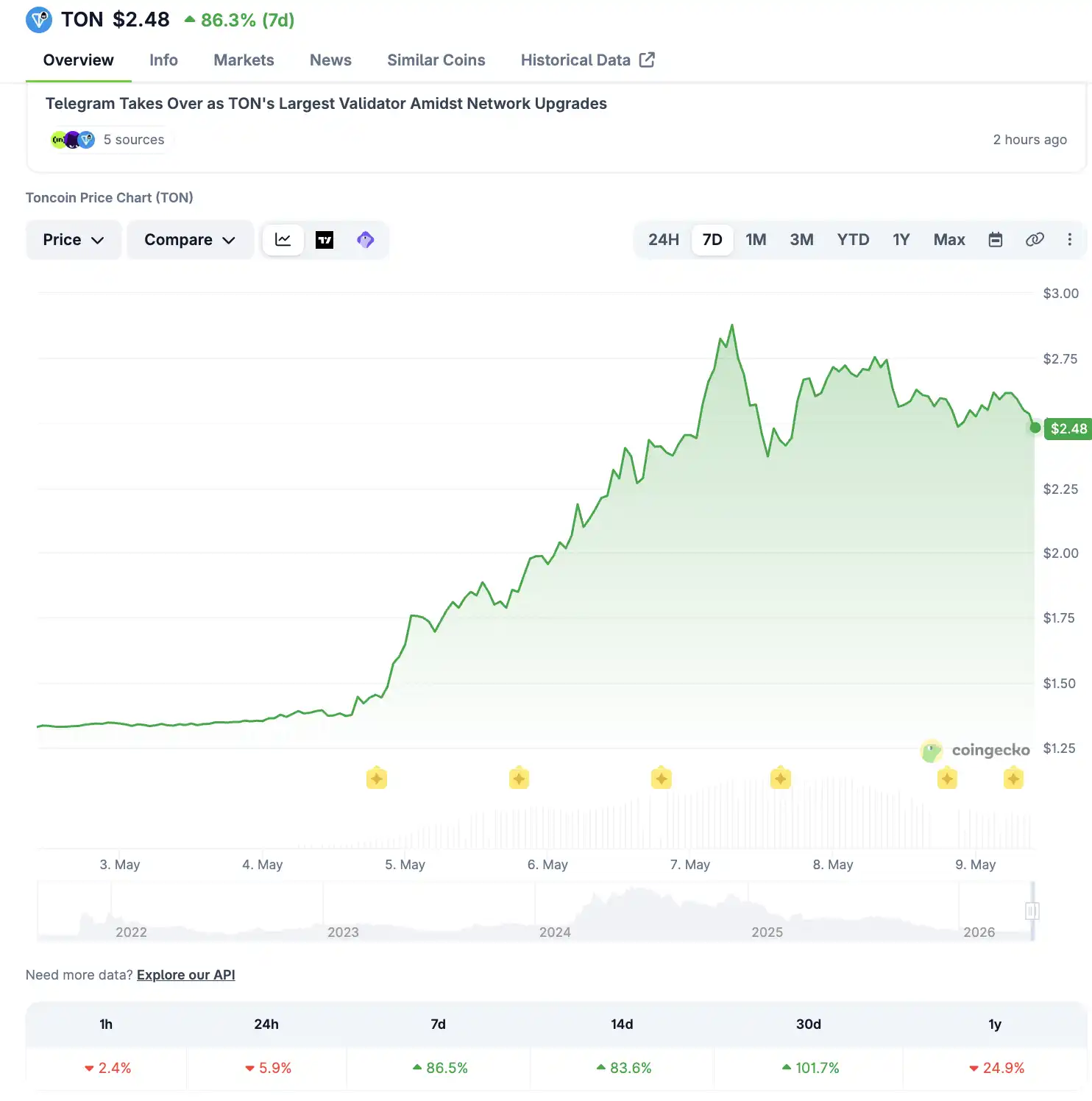
The logic behind this surge is very simple: it revolves around one person, Telegram founder Pavel Durov.
On April 23, Durov announced on X that the TON on-chain transaction fee would be reduced by 6 times to 0.00039 TON per transaction, approximately $0.0005, with a fixed rate unaffected by network load. The market did not react much to this news initially as many thought it was just a routine optimization.
On May 4, Durov posted a second message, which proved to be the real trigger. He declared that Telegram would replace the TON Foundation as the main driving force behind the TON network and become the largest validator. He named this solution MTONGA, short for Make TON Great Again.
To grasp the significance of this announcement, one must go back to 2018 when Telegram raised $1.7 billion through the Telegram Open Network (TON) project, which was one of the world's largest ICOs at the time. In 2020, the SEC sued Telegram, forcing Durov to return $1.2 billion to investors, pay a $18.5 million fine, and commit to no longer participating in the TON project. Since then, the TON project has been taken over by the community, rebranded as The Open Network, and operated independently. Telegram and TON were in an awkward state of "we are actually not related" for a long time.
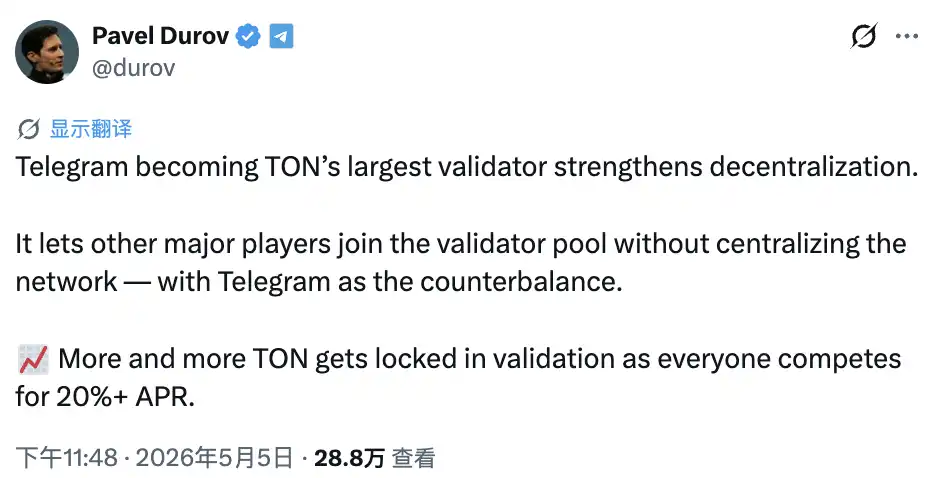
The May 4 announcement was akin to Durov publicly tearing down this facade. In his own words, "Telegram becoming TON's largest validator strengthens decentralization. It lets other major players join the validator pool without centralizing the network, with Telegram as the counterbalance. More and more TON gets locked in validation as everyone competes for 20% plus APR".
This means that Telegram staked 2.2 million TON as a validator, explicitly linking its 950 million monthly active users to TON. This was legally impossible in 2020 but became compliant in 2026, driven by the overall regulatory easing under the Trump administration, the progress of the CLARITY Act, and the SEC's shift in enforcement stance toward crypto projects.
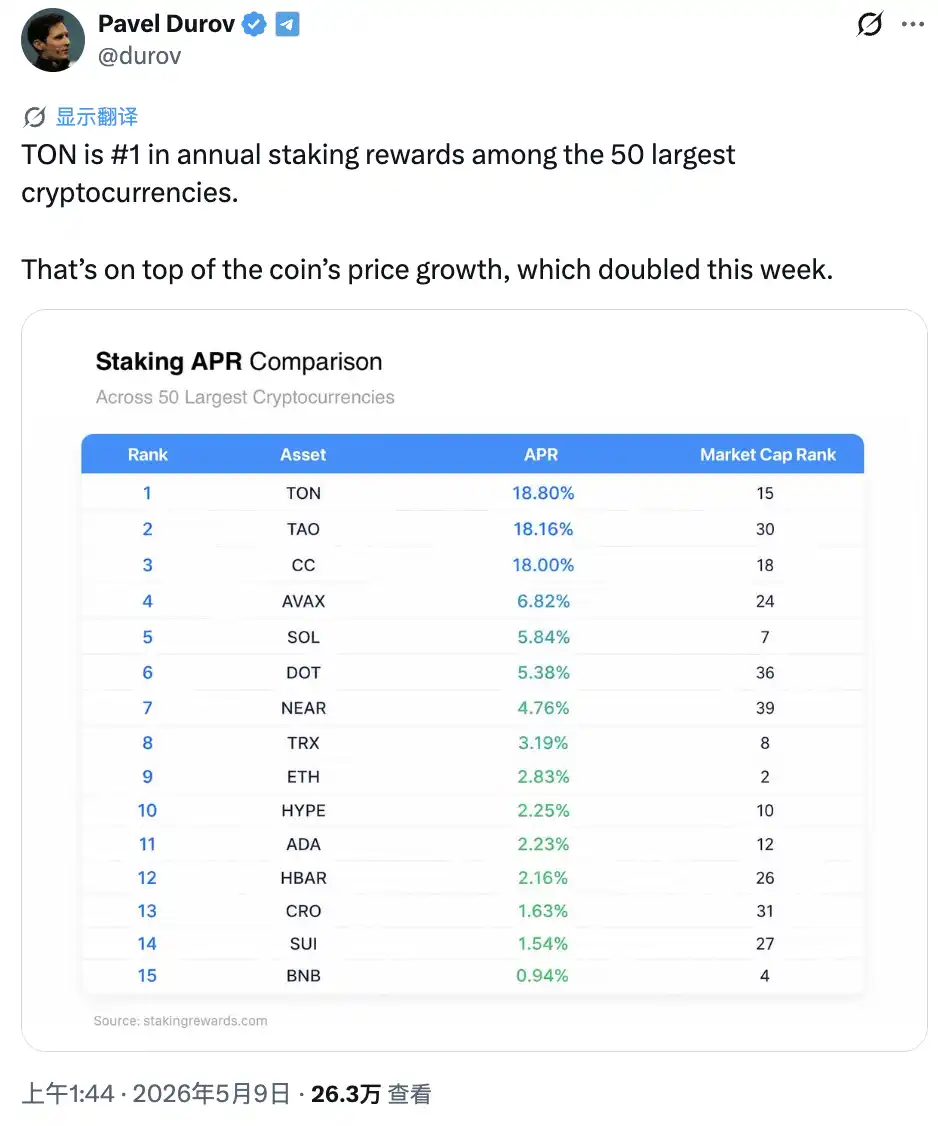
Durov's recent tweet highlighted TON ranking first in annual staking rewards among the Top 50 cryptocurrencies
On the business front, the TON network processed 1.5 billion transactions in Q1 2026, reaching a TVL of $1.2 billion in April. STON.fi, the largest DEX on TON, saw its daily swap volume surge from $1.5 million to $40 million in a week, a 26x increase. The Telegram Wallet's perpetual futures monthly trading volume broke $1 billion.
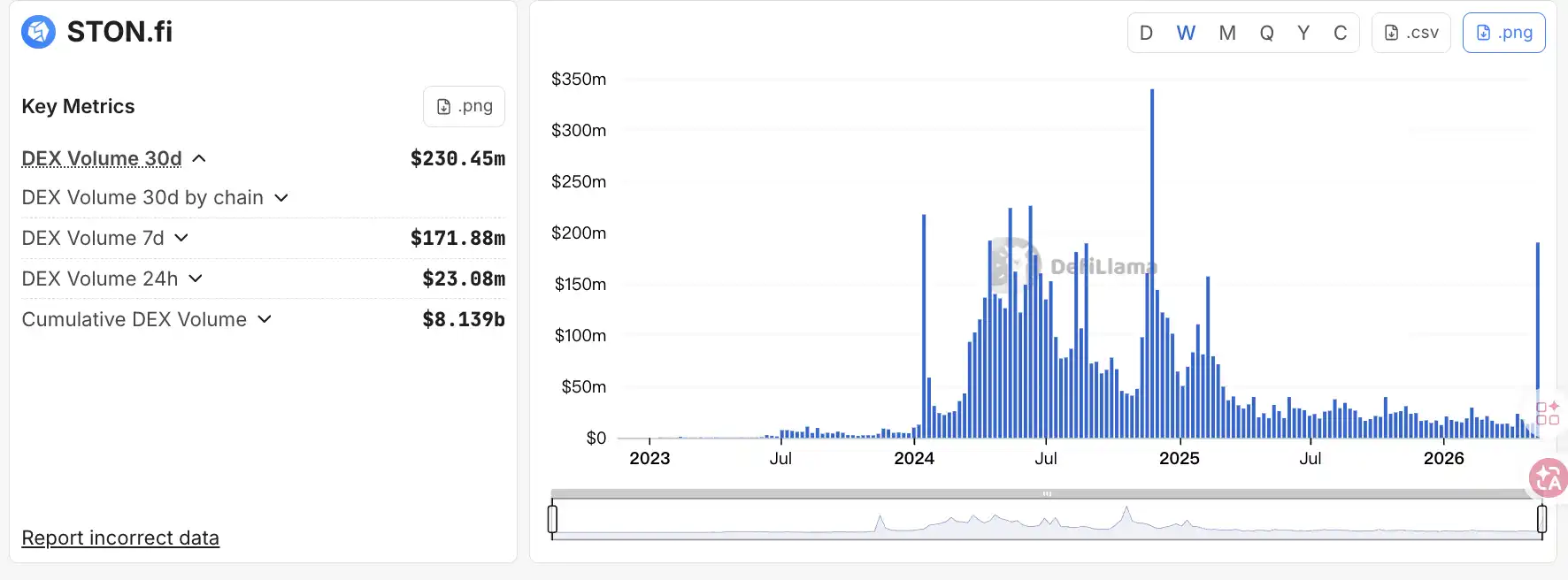
STON.fi Transaction Volume Growth
Overall, since Trump took office, Telegram's return to TON has shifted from compliance risk to compliance viability. This represents a very specific political window.
Telegram staked 2.2 million TON, with a validator APR of over 20%, continuously attracting whales to lock up their tokens for validation. This mechanism is akin to ZEC's shielded pool, reducing the circulating supply.
The narrative and fundamentals are coming together. Telegram is not treating TON as a partner but as a rewiring of its own economic infrastructure. Once this framing is accepted by the market, TON's valuation anchor shifts from "an L1 project" to "a consumer-facing payment layer with 950 million users."
Fundamentally, the market is reacting to the signal that "Durov has put his entire reputation on the line."
The Spring of Circulating Supply Black Holes
Looking back at these four coins, perhaps the biggest common point is that each asset has a "circulating supply black hole."
Without new retail investors entering, the market can only compete within the existing chips. As the float of a coin truly decreases, any marginal buying pressure can cause an oversize rally.
ONDO's DTCC partnership implies institutional custody and long-term holding, OUSG's tokenized treasuries are locked within traditional asset management frameworks. ZEC's shielded pool has absorbed 30% of the circulation, a historical high, and Orchard's pool has increased from 1.92 million to 4.55 million in a year. BIO's original low market cap and small circulation, coupled with the BioXP upgrade locking another batch, await ignition. TON's staking APR is over 20%, with Telegram itself staking 2.2 million as a validator, siphoning coins into the validator pool.
These four mechanisms are different, but the effect is the same. The circulating supply is decreasing, and the elasticity of marginal buying pressure is increasing.
The second common point is perhaps that each asset has a short squeeze backdrop.
From last year to early this year, the market's consensus on alts was "can only be shorted," with a long-term negative funding rate, targeted by shorts as perpetual short targets. As soon as a catalyst arrives, short squeezes on top of thin books lead to daily gains of 30% to 50% being the norm.
ZEC saw $62 million in short liquidations in a week, TON's trading volume surged 650% in a week, and BIO's daily volume ranged from 1.5 to 7 times its market cap. These numbers don't represent ordinary long positions but rather shorts being forced to cover + a combination of FOMO inflows.
Additionally, all these coins have one or several "narrative figureheads."
Behind ONDO are the DTCC, BlackRock, and JPMorgan forming an entire institutional alliance, with Frank La Salla and Larry Fink endorsing publicly. Behind ZEC are Multicoin's Tushar Jain, Tyler Winklevoss, Arthur Hayes, Naval, Balaji, representing the cypherpunk VC line. BIO is backed by a direct investment from Arthur Hayes, early trust from Binance Labs, and followers of DeSci like Moonrock. TON is backed by Durov himself.
The difference between these narrative holders and KOL shillers is that they will not retreat just because of a pullback. Their position, reputation, and career are already tied to this asset. This is a necessary condition for reflexivity to work, as some people will buy the dip when the price falls, and shorts dare not press down. The "group liftoff" in 2021 relied on a large number of new retail investors entering the market, while the "individual liftoff" in 2026 relies on thesis holders not retreating.
Lastly, at a macro level. After all, standing in the wind, even a pig can take off.
The S&P 500 hitting a new high and the parabolic rise of semiconductors are textbook examples of risk-on sentiment. However, this is combined with two opposing political anxieties.
ONDO is the process of hedge compliance after regulation, Wall Street is ready to enter. ZEC focuses on hedge surveillance and asset visibility, causing retail investors to exit. BIO addresses the inefficiency of traditional hedge research capital, with AI rewriting drug discovery. TON deals with a platform economy under review, and Durov himself has been arrested in Paris once.
Therefore, in a context without new money and a broad altseason, the market only rewards assets that have the three elements in place: specific individuals or institutions willing to back its narrative, a decreasing circulating supply, and a short interest still on the asset.
The author would like to refer to this surge as the "Spring of the Circulating Supply Black Hole".
Welcome to join the official BlockBeats community:
Telegram Subscription Group: https://t.me/theblockbeats
Telegram Discussion Group: https://t.me/BlockBeats_App
Official Twitter Account: https://twitter.com/BlockBeatsAsia