Bull Market Engine Running Out of Steam, Is BTC Set to Crash Next Week?

Previous Article, we introduced how Strategy brought new marginal buying pressure to Bitcoin through STRC.
However, two events occurring in the new dividend cycle have made some traders begin to feel uneasy about the "new supply-demand dynamic" that STRC brings to Bitcoin.
Saylor Backtracks
After hours on May 5th, during MicroStrategy's Q1 2026 earnings call, Saylor publicly acknowledged for the first time that the company might sell some Bitcoin to pay dividends.
There are three ways to interpret Saylor's statement.
The first interpretation is that Saylor is trying to let the market know in advance and digest this possibility to avoid a strong reaction if it actually happens. This is a "PR" move to provide price cushioning for BTC.
The second interpretation is straightforward: Saylor's "never sell Bitcoin" commitment underpins the premium of MSTR and the entire Bitcoin treasury narrative. Once Saylor himself opens a hole, the market will reevaluate the stability of the entire system.
The third interpretation is that MicroStrategy's previous financing was mainly based on two tools: issuing MSTR common stock and issuing convertible bonds. Preferred stock has only become mainstream in the past year, but the issuance ceiling is still limited by the secondary market's ability to take up the shares. The only tool left that can create no future obligation and has a large enough scale is the issuance of MSTR common stock through an ATM (at-the-market) program. The issue is that MSTR's mNAV needs to be at least 1.22 times for new common stock issuance not to dilute the per-share BTC content, and the current MSTR's mNAV is not far from this threshold. Saylor attracted market attention with the relatively mild statement of "possibly selling Bitcoin" to make the continued issuance of MSTR common stock appear more acceptable in terms of cost.
From the balance sheet perspective, MicroStrategy's total annual dividend and interest payments this year amount to about $1.5 billion, with monthly dividends and interest totaling about $125 million. Of this, STRC accounts for approximately $978 million, or 65%. As of Q1 this year, the company has about $2.25 billion in USD reserves, which, according to management, can cover 18 months of dividend payments.
If STRC issuance stalls, advanced reserves are almost depleted, and the only option left is to sell BTC to pay dividends. Based on an $80k BTC price, annual interest and dividend payments of $1.5 billion, Strategy would need to sell approximately 18,519 BTC per year, equivalent to 2.3% of the total position.
As long as BTC appreciates by at least 2.3% annually, this sell-side pressure can be absorbed through position appreciation. When looking at the long term, BTC's compound annual return is usually in the double or even triple digits, so 2.3% is hardly a constraint.
However, BTC has experienced annual drawdowns of -77% in 2018 and -65% in 2022. If the Strategy sells 2.3% of its BTC position at the bottom, the company's balance sheet will deteriorate significantly.
MicroStrategy has accumulated approximately 77,000 BTC through net purchases via STRC from 2026 to date. In a selling scenario where BTC retraces to around Strategy's average cost of 75,537 triggering, the 2.3% of the total position would be equivalent to 25% of this year's incremental acquisition.
In other words, Saylor's one year of selling can offset four months of buying.
STRC "Softness"
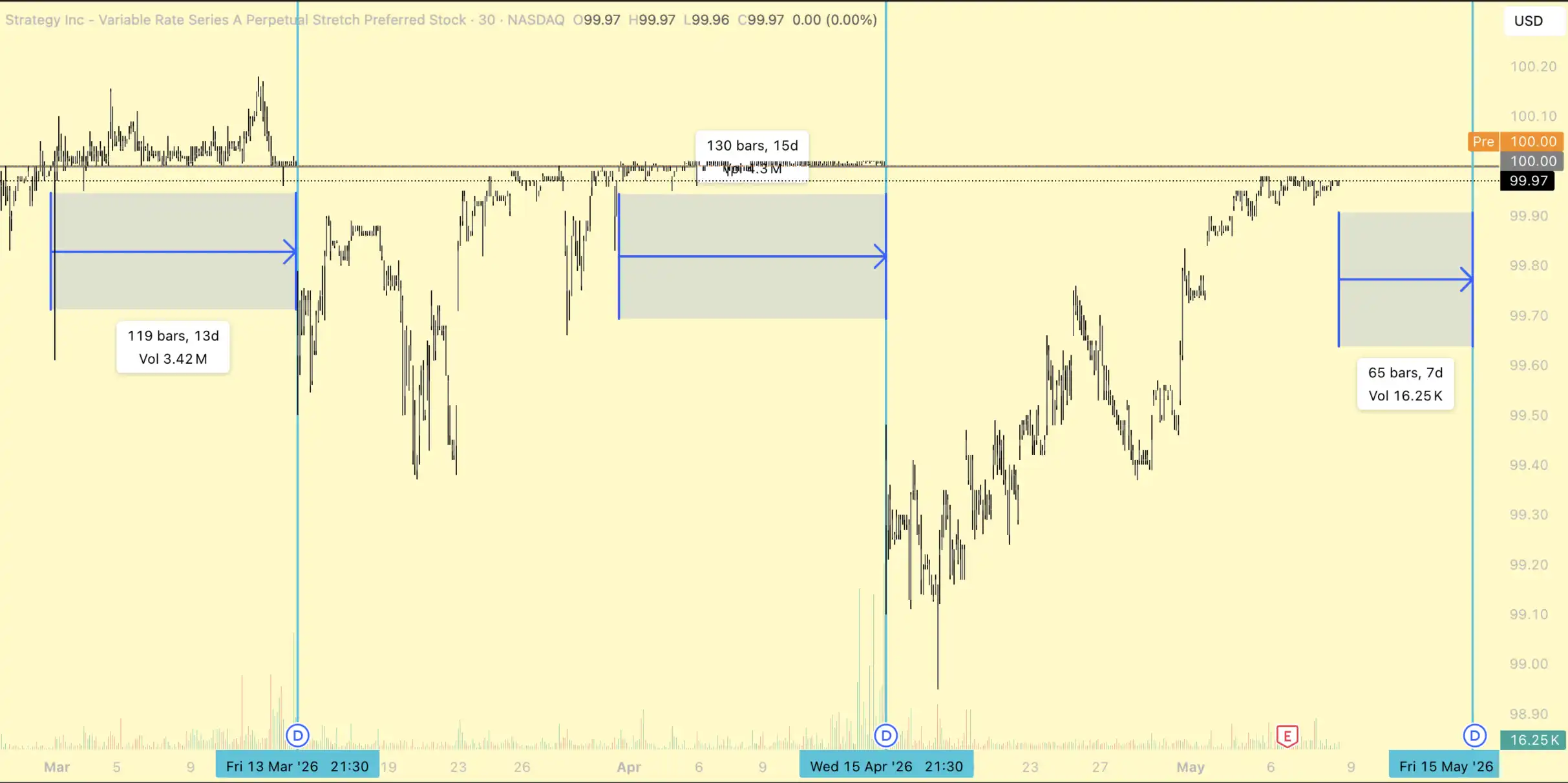
The duration when STRC price exceeds $100 before the ex-dividend date
During the March ex-dividend period, STRC saw 13 days where the price was above $100 before the ex-dividend date, with a total trading volume of 3.42 million shares, corresponding to approximately 22,000 BTC purchased. In the April ex-dividend period, approximately 47,000 BTC were brought in through STRC.
With only 5 trading days left until the ex-dividend date on May 15th, during the May ex-dividend period, STRC has not returned to a face value of $100, indicating zero BTC purchases.
To understand why this ex-dividend period has suddenly diverged, the buyers of STRC can be divided into four categories:
· The first category consists of arbitrageurs who rushed in days before the ex-dividend date. They buy STRC before the ex-dividend date to capture the dividend and then sell. The peak trading volume on the ex-dividend date mainly comes from this type of capital, and their sell orders are the main driving force behind the post-ex-dividend price drop of STRC.
· The second category includes arbitrageurs who enter after the ex-dividend date. STRC usually drops to the range of 99.20 to 99.50 after the ex-dividend date, and they buy and place sell orders around 99.95 to 99.99, waiting for STRC to return to face value. These funds can profit without waiting for STRC to truly return to 100; their sell walls are the primary reason STRC repeatedly struggles below face value.
· The third category consists of medium- to long-term holders who see STRC as a wealth management product. They do not actively arbitrage but will redeem small amounts when needed. These occasional sell orders, together with the second category traders, will place sell orders in the price range near $100.
· The fourth type of participant is a true long-term holder who will not sell. Their actions have little to no impact on the price dynamics during each dividend cycle.
If the source of funds causing the issuance of additional STRC tokens is arbitrage traders, the behavior of the entire market will lean towards "selling near the $100 face value."
This is what happened last month.
In March and April, Strategy raised close to $5 billion through STRC, and the influx of funds of this magnitude can only be attributed to arbitrageurs because long-term holders would not suddenly increase this much.
This also led to arbitrageurs in April having stronger selling pressure than ever before.
Strong selling pressure means that the price of STRC dropped more significantly after the April dividend date than ever before, and the speed of returning to the $100 face value was slower than in the past. A considerable portion of the first type of funds did not manage to exit in time and got trapped at the bottom. This portion of funds that suffered losses may not participate in arbitrage in May.
Furthermore, the external environment is also changing.
The S&P 500 continues to hit new highs, changing the opportunity cost for fixed-income funds to purchase STRC, especially since many sectors of the U.S. stock market can achieve daily gains that surpass STRC's annual return rate (11.5%).
The Strategy management team has anticipated this issue and submitted an amendment on April 17 for STRC to distribute dividends twice a month. Bi-monthly dividends can reduce the drop on each dividend date and distribute arbitrage gains. However, this amendment will not take effect until July 15, and the dividend date next week will still follow the monthly rules.
Reverse Flywheel
The previous article discussed Strategy's flywheel: money used to purchase STRC is leveraged three times and flows into BTC, BTC's rise enhances the quality of STRC collateral, and more funds flow into STRC. Each cycle drives the next one higher.
What if the flywheel turns in the opposite direction?
If STRC cannot return to the face value, Strategy's At-the-Money (ATM) issuance window closes, no new cash purchases BTC, BTC loses marginal buying pressure, prices are under pressure, STRC's collateral base weakens, fixed-income investors demand a higher credit spread. As the spread widens, MicroStrategy either slightly increases the dividend yield to increase interest expenses, or investors continue to sell STRC to make it even harder for the price to return to the $100 face value.
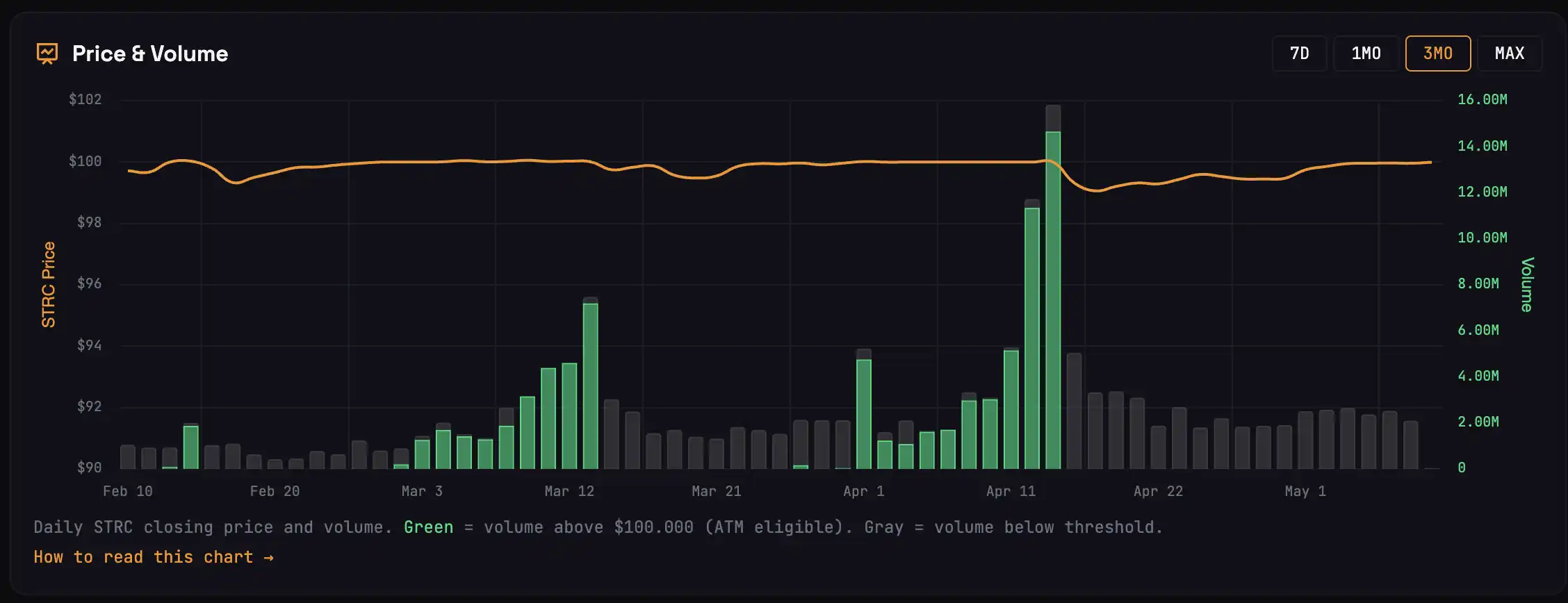
Each link in the chain drives down the next.
Saylor's statement "might sell some BTC" is essentially an early pricing of the end of this downward cycle.
In numbers: In April, Strategy made a net purchase of approximately $4.1 billion worth of BTC through STRC. If the May issuance scale of STRC falls to the $1 billion range, and if the BTC appreciation does not reach the critical value of 2.3%, Strategy will initiate a coin-selling interest payment plan. The monthly net contribution may plummet from $4.1 billion to a few billion dollars, with a contraction exceeding 90%.
In the past few months, the market has regarded the "STRC buying pressure" as the argument for BTC's bottom support, but this will be refuted, and BTC's price will face a severe correction.
It is necessary to acknowledge that this is just one possible scenario. If STRC successfully returns to $100 next week with a substantial issuance scale, all previous concerns will be postponed.
Optimistic Signal
During pre-market trading on May 8, STRC saw the first issuance of this round's dividend cycle, corresponding to a purchase of 0.4 BTC.
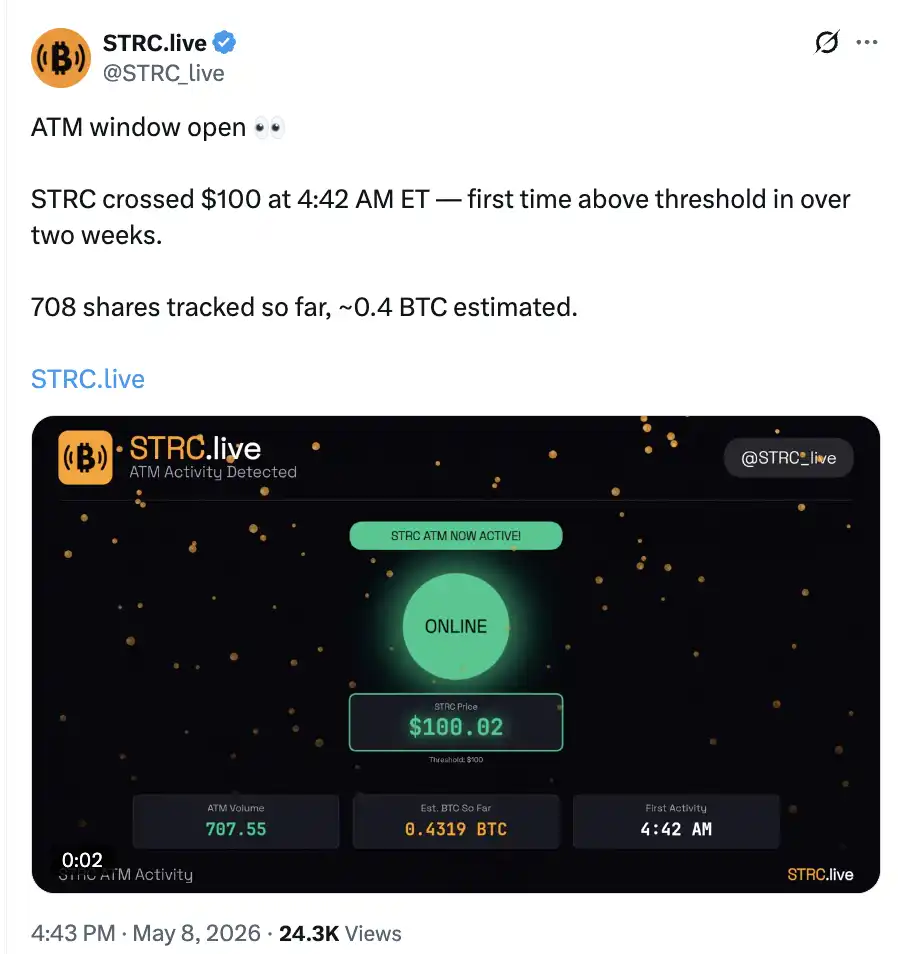
The absolute scale is insignificant, but the significance lies in the shift from zero to one.
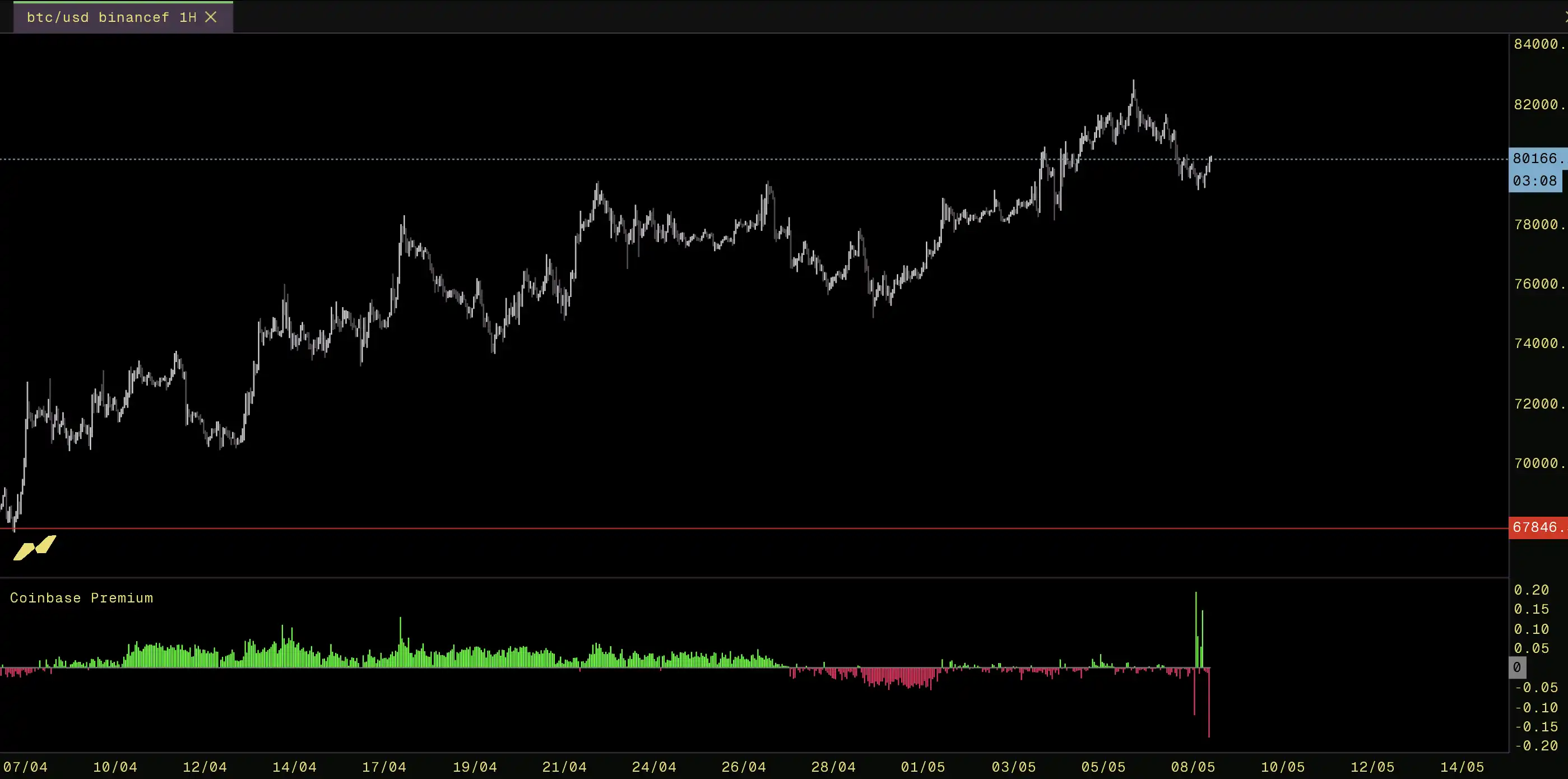
At the same time, Coinbase's premium briefly turned positive and returned to April levels.
It remains to be seen whether BTC, which seems to be losing its upward momentum, will fall back to the February range or advance to $90,000. The performance of STRC next week will be crucial.
Welcome to join the official BlockBeats community:
Telegram Subscription Group: https://t.me/theblockbeats
Telegram Discussion Group: https://t.me/BlockBeats_App
Official Twitter Account: https://twitter.com/BlockBeatsAsia
 Related Articles