Balancing Yield Farming Returns and Security: Can DeFi Revolutionize the Emerging Markets?

The Darkest Hour of DeFi
Just over two-thirds into April, over $600 million in on-chain assets had already been stolen.
These security incidents have exposed a grim reality: the slogan once preached by DeFi Maximalists has now become a charm stuck to the face of DeFi.
「Code Is Law」 signifies contract vulnerabilities exposed under AI scanning, multisigs easily compromised through social engineering; 「DeFi Lego」 means that with each additional protocol integration, each added chain, each added layer of nested collateral, the attack surface of the entire system simultaneously expands, with each added protocol forming another link in the propagation chain post-exploitation.
Audit can cover the code but not governance; multisig can raise the bar but cannot withstand six months of offline infiltration; composability is a feature of DeFi, but it also allows risks to freely move between protocols. In this structure, the defense is always playing catch up to the attack.
Shifting the revenue source from on-chain to off-chain regulated traditional financial assets is the key to breaking the deadlock.
Assets are custodied and managed by licensed institutions, on-chain tokens correspond to real fund shares, net asset value is reconciled daily, and issuance and redemption follow standard processes. Even if the contract has vulnerabilities, there will be no absurd drama of collateral disappearing into thin air or instantly going to zero.
However, the challenge lies in the most common destination on this path being U.S. Treasuries. A 3% to 5% yield may be attractive for bank deposits, but for a DeFi user accustomed to double- or triple-digit returns, it holds no appeal.
Assets that truly satisfy both compliance and yield have always existed but are not within the U.S. dollar system. They come from another area tightly guarded by institutions, where retail investors can hardly find an entry point.
The Cake Unreachable for Retail Investors
If you follow the market, you will surely remember the crash in early August 2024. On August 5, the S&P dropped 3% intraday, the Nikkei Index plummeted 12% intraday, and Bitcoin saw a staggering 20% decline.
Many market newcomers learned a new concept during the position retracement: Carry Trade.
After 1995, following the bursting of the Japanese economic bubble, the Bank of Japan implemented a super low-interest rate policy. Investors borrowed low-interest currencies (usually the Japanese Yen), exchanged them into high-interest currencies through the foreign exchange market, and bought local short-term bonds, taking advantage of the interest rate differential. This arbitrage operation is known as Carry Trade.
The U.S. Bureau of Economic Analysis characterized carry trade in a 2008 research report as an excess return source that is stable across periods and markets.
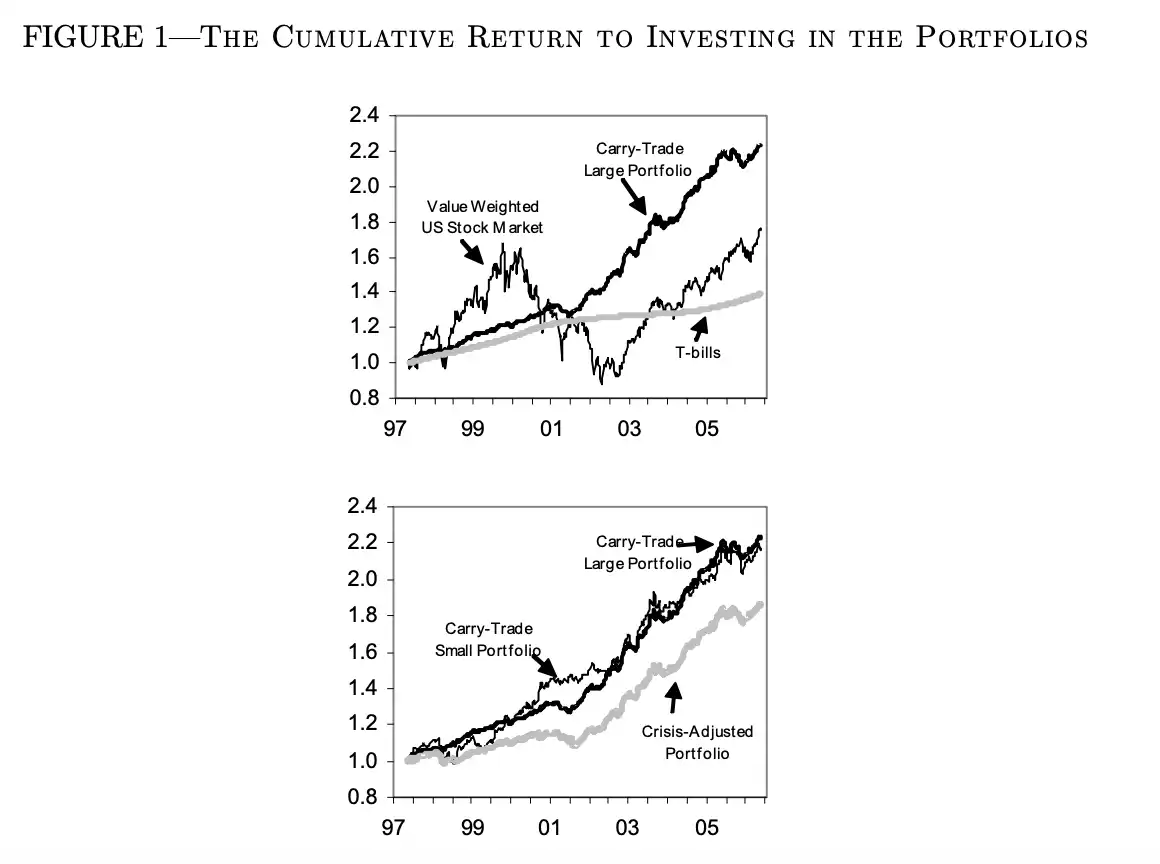
Portfolios utilizing carry trade exhibited significantly higher returns than the control group.
The interest rate market is much larger than the crypto industry. A three-year survey released by the Bank for International Settlements in September 2025 showed that the global average daily turnover of over-the-counter interest rate derivatives reached $79 trillion in April 2025. According to J.P. Morgan's estimation, the investable emerging market bond universe exceeded $31 trillion as of September 2025.
In the field of carry trading, Turkey is an unavoidable name. Its central bank raised the one-week repo rate to 50% in March 2024, which remained at 46% in April 2025 and was still at 37% by January 2026. This made Turkish lira's short-term interest-bearing assets a delicacy in carry trading.
ING disclosed in its November 2025 Cross-Border Carry Outlook that its lira asset position once reached around $47 billion. Allianz Global Investors specifically mentioned a bullish view on Turkey in its 2026 Emerging Market Bond Outlook.
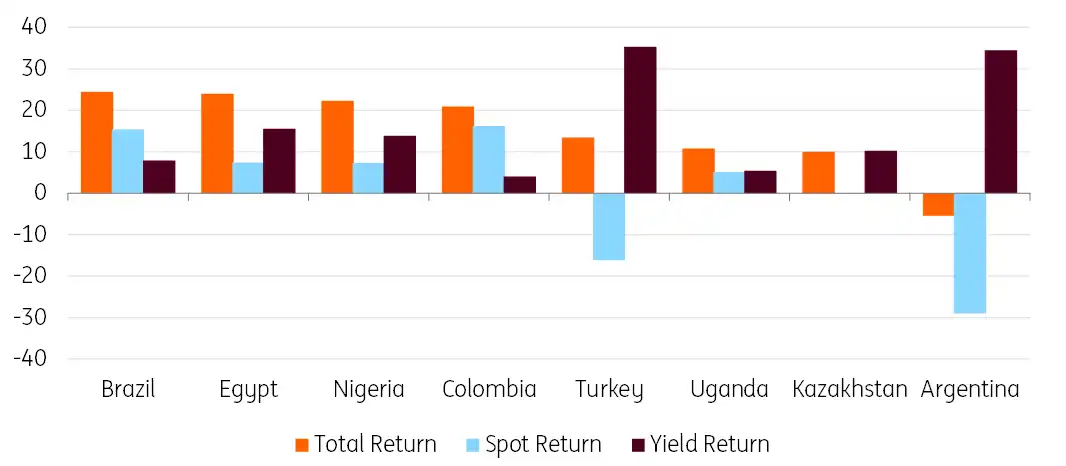
How profitable is carry trading? A sustainable emerging market bond fund under Franklin Templeton saw a one-year return of 26.76% as of the end of 2025. J.P. Morgan Asset Management wrote in its first-quarter 2026 viewpoint that the overall return of local currency emerging market bonds in 2025 was 19.3%.
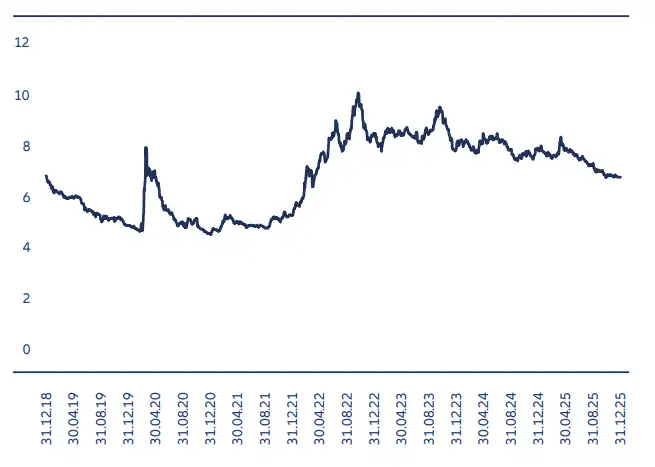
J.P. Morgan Emerging Markets Bond Index Yield
While on-chain players repeatedly reposition for less than a 10% borrowing rate, enduring contract vulnerabilities and cascading liquidations, these emerging market bond funds earn double-digit returns in a year solely by holding short-duration bonds.
Why hasn't this large and stable income source been brought onto the chain today?
The answer lies in the extremely stringent entry barriers.
To make the most basic Turkish lira money market fund subscription domestically, one needs to go through the following procedures: open an account denominated in the local currency provided by a local financial institution, submit complete KYC documentation (Turkey's compliance requirements for non-citizens have always been quite strict), place an order through a licensed distribution channel (funds are not directly sold to retail investors), and meet a certain minimum investment amount.
This pipeline has been operating within the local Turkish financial system for decades. Traditional institutions were able to make it work thanks to the well-established infrastructure of the global banking network, credit lines, derivative trading desks, and mature custody relationships.
For retail investors, breaking through this path is as difficult as reaching the sky.
What Brix has done is encapsulate the profit path of this arbitrage trading into an on-chain accessible product.
“Superb Encapsulation”
BRIX announced a $5.5 million seed round financing earlier this month.
Looking closely at the investor lineup, in addition to Circle Ventures, ConsenSys, and Borderless Capital, prominent names are also part of the core investors.
FRWRD Ventures, the VC arm of one of Turkey's largest private banks, Yapı Kredi, and more impressively, İş Asset Management, the asset management subsidiary of İş Bank, Turkey's largest bank by asset size.
For most RWA projects claiming to "partner with banks," such partnerships often only scratch the surface with a custody agreement. The bank itself has no equity, no operational synergy, and there is no clear legal recourse path in case of project failure.
FRWRD and İş Asset Management are not only investors in BRIX but also the initiators, managers, and custodians of the iTRY underlying fund.
If a flaw occurs at any point in BRIX, it would impact not only the on-chain users' principal but also the brand reputation and interests of two banks accumulated over decades.
BRIX has already launched the first phase on the MegaETH mainnet, releasing $500,000 USDm equivalent worth of wiTRY on World Markets daily until the project's TVL reaches $5 million.
Users can swap USDm for wiTRY on World Markets and use it as interest-bearing collateral for lending or to be incorporated into other strategies. The underlying iTRY will be opened for subscription and redemption to qualified institutions in subsequent stages.
iTRY itself is pegged to a share of a Turkish lira money market fund. The on-chain token is just a share certificate, and the interest earned by the underlying fund is distributed proportionally to the holders.
In addition to aligning with the interests of banks, Brix also has inherent security in its revenue source.
The currency market fund behind iTRY holds mainly reverse repurchase agreements, money market instruments, bank deposits, and public and private sector short-term debt instruments, all with terms not exceeding 184 days and a weighted average maturity not exceeding 45 days. The custody is managed by a portfolio trustee regulated by the Turkish Capital Markets Board, with the entire chain falling within the local Turkish financial regulatory framework.
Furthermore, iTRY's interest comes entirely from the actual yield the underlying fund earns in the currency market. As long as the Turkish lira maintains a high interest rate, the revenue has a fulcrum. There is no leverage, no token issuance, and no reliance on TVL. The on-chain protocol is only responsible for encapsulation, and the revenue is generated by off-chain funds.
Turkey is just the first stop for Brix. According to the Brix team's plan, future revenue sources will gradually expand to several emerging markets, including the UAE, Egypt, Mexico, Brazil, and South Korea.
Thinking Outside the Box
In recent years, what emerging markets have mainly brought to the chain is the demand for hedging. Local residents hedge the depreciation of their currencies such as the lira and peso with stablecoins, and the penetration rate of stablecoins in these markets has been steadily increasing.
The channel is not one-way.
USD assets on-chain can also be encapsulated by compliant institutions to access these markets' interest rate systems in reverse, sharing the structural returns from the economic growth of emerging markets.
The security anxiety in DeFi will not disappear in the short term. For on-chain users, what is truly worth considering is not when the next accident will occur, but whether there is a class of revenue that was never on this attacked chain in the first place.
Welcome to join the official BlockBeats community:
Telegram Subscription Group: https://t.me/theblockbeats
Telegram Discussion Group: https://t.me/BlockBeats_App
Official Twitter Account: https://twitter.com/BlockBeatsAsia