When Wall Street Meets Crypto, Here's Your "Stock Market Beginner & Advanced Guide"
Article Source: MSX
If in past cycles, the biggest concern of on-chain users was "missing out on the next price surge," in 2026, this anxiety is quietly taking on a different form:
More and more people are starting to worry not about missing out on a new coin, but about finding themselves stuck in an old market that smart money is abandoning.
This is a subtle but important shift.
On one side, the Crypto altcoin myth has been completely shattered, with liquidity diluted to exhaustion in various narrative bubbles; on the other side, the US stock market is rapidly sucking everything in at an unprecedented pace: retail investors are flowing in, the media is increasing coverage, centralized exchanges are fully embracing TradFi, familiar KOLs and traders are also starting to more frequently discuss indices, individual stocks, macro, and financial reports.
This article also aims to answer the most fundamental questions: Why now of all times? And, how should new users start investing in US stocks as a first step?

I. In 2026, Retail Investors Accelerate Exodus from Crypto to US Stocks
In 2026, we may be witnessing the most bizarre divergence in Crypto history.
Not long ago, market maker Wintermute, in collaboration with JPMorgan, released their latest research on retail fund flows, marking the first time that Crypto and US stock retail investor behavior data has been systematically presented side by side, and the results were unsurprising.
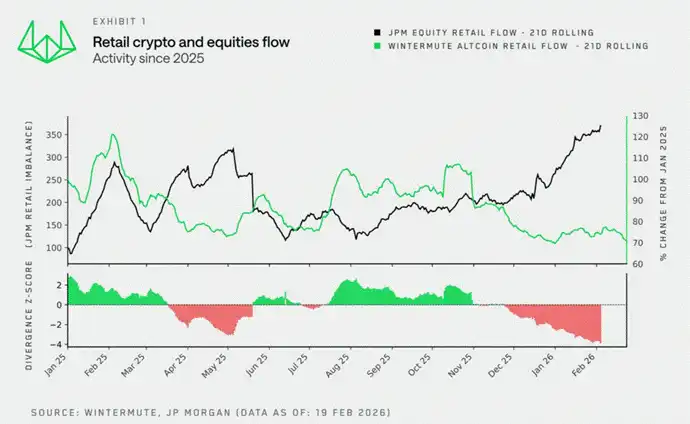
From early 2025 to mid-2025, the two lines were essentially in sync, indicating a rise in risk appetite with retail investors buying into both sides simultaneously, which had been the normative logic for the past few years. Even with a brief deviation for about two months starting in April, it corresponded closely to the macro event of Trump announcing "Liberation Day" retaliatory tariffs on April 2.
Of course, to some extent, this indirectly indicates that against the backdrop of a synchronous "black swan" pullback, the US stock market indeed demonstrated more resilience and recoverability compared to Altcoins.
However, starting from the end of 2025, this kind of synchronous risk preference link was completely decoupled, and it can even be said to be the most extreme deviation recently. The deviation Z value plummeted to around -4, hitting a new low in a year, representing funds voting with their feet, and the destination is the U.S. stock market.
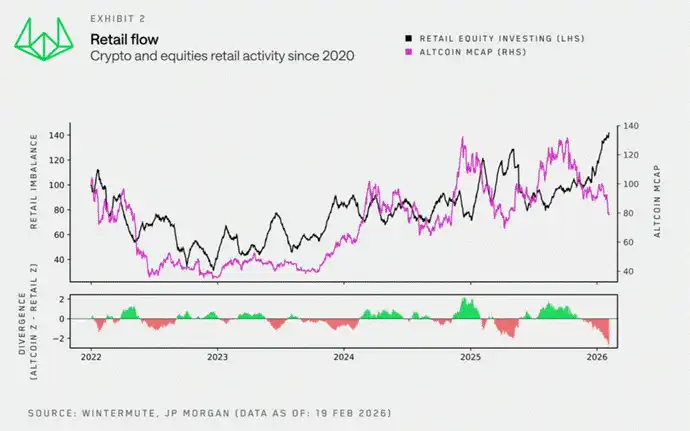
If we extend the time frame to since 2022, a more vivid change can be observed (the pink line represents the total market value of altcoins, and the black line represents retail investor funds flowing into U.S. stocks), that is, from 2022 to the end of 2024, both moved in lockstep, with retail investors treating them as the same type of asset: high risk, high elasticity, rising and falling together.
However, the decoupling at the end of 2024 is particularly striking in the entire chart. Subsequently, the behavior pattern of crypto retail investors has become more short-term, emotional, and lacking in structure; while the funds flowing into U.S. stocks have not retreated but instead continued to reach new highs.
Two markets, the same group of retail investors, have made completely different choices.
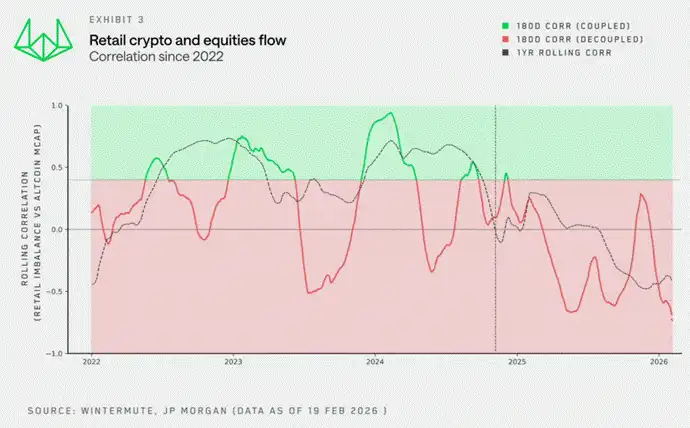
The last chart is the statistical confirmation of the above phenomenon. The rolling correlation coefficient shows that the fund behavior between retail investors in Crypto and U.S. stocks had long maintained a positive correlation (green area, coefficient> 0.4). But after the dividing line at the end of 2024, this relationship turned negative. Retail investors no longer simultaneously buy on both sides but are making an "either-or" allocation.
Each red area signifies that a portion of funds that may originally have flowed into crypto have diverted to U.S. stocks, this is a structural fund migration, and the trend is continuing.
In fact, this migration not only occurred at the fund level but also simultaneously at the media and attention level.
If you now open a top-tier Web3 media outlet in the Chinese-speaking world, you will find that more and more front-page space is being occupied by individual U.S. stocks, macro variables, and traditional market events. On the surface, it seems to be a media coverage adjustment, but at a deeper level, it is actually the result of user attention shift.

The media will always amplify existing demands that have begun to form, rather than arbitrarily dress up a market that lacks interest.
In other words, even "Web3 media" is now reporting on U.S. stocks more frequently, which in itself indicates one thing: The emotional cycle of Crypto has reached a stage where it is enough to compel users to actively seek new exits.
2. Why Now?
This is a question worth answering seriously.
The notion of "keeping an eye on the US stock market" is not new. What is truly fresh is the year 2026 — a time when the system is loosening up, and the relative value of assets is being reassessed, two rare events coinciding.
Firstly, the wall between Wall Street and the on-chain world is being actively torn down.
For many years, the US stock market has not been unattractive to most ordinary users, but rather too troublesome. After all, every step, from account opening, currency exchange, deposit, selling with settlement wait, to withdrawal, is not impossible to complete, but tedious enough to psychologically make most users always see it as "another system."
However, starting this month, this situation is accelerating in its change.
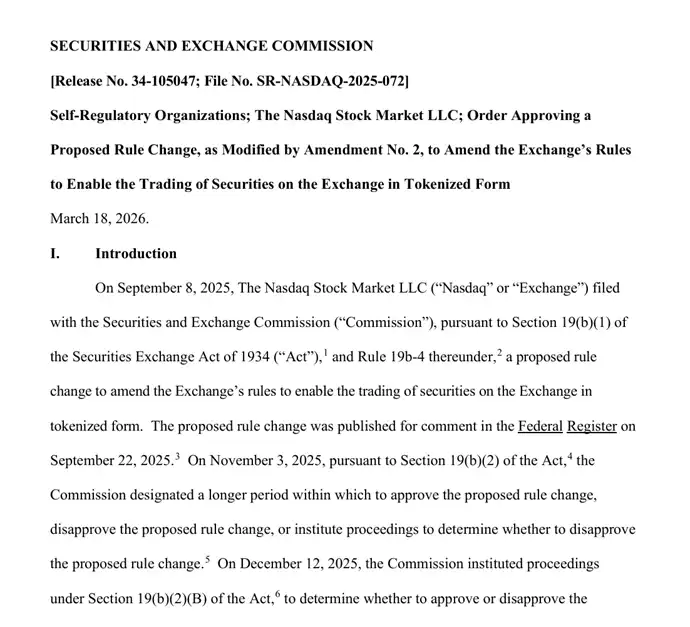
On March 18, the US Securities and Exchange Commission (SEC) officially approved Nasdaq to conduct a security tokenization trading pilot, which means that the familiar wallet, on-chain logic, stablecoin settlement path you are accustomed to will no longer only serve Crypto-native assets but will also start to lead to global core equity assets such as Apple, Nvidia, and Tesla.
In the past, the US stock market was a system that required you to actively adapt to it. But now, for the first time, it is starting to approach you in a way that is more in line with Web3 user habits. Maybe we are not far from the day when buying a share of Nvidia is as simple as buying a meme coin.
Ultimately, tokenization has liberated US stocks from the three great mountains of "account opening, deposit, withdrawal," turning it back into an asset form that can be accessed by a wider range of users with low barriers to entry — for those familiar with on-chain operations, it may just be a new experience, but for users who have long been locked out, this is true liberation.
The second point is that against the backdrop of global liquidity tightening, funds are repricing the risk-return ratios of Crypto and US stocks.
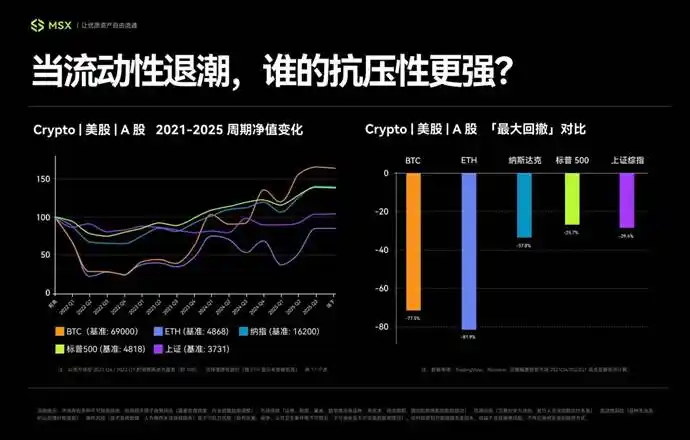
The US stock market is essentially a "liquidity-profit" dual-cycle market. When liquidity is loose, valuations expand; when liquidity tightens, valuations compress. However, unlike more sentiment- and narrative-reliant Crypto assets, its more fundamental support lies in corporate profits. In other words, it will certainly fall, and may even experience a deep retracement due to macro pressures, but as long as corporate profits, cash flow, and industry logic remain, the market will eventually find a point of recovery.
As a result, the U.S. stock market always exhibits a very typical characteristic: it may not drop lightly, but the drop makes sense; when it rises, it often recovers even faster.
Crypto, on the other hand, is different. It is more like a high-leverage risk appetite amplifier. During times of abundant liquidity, its gains far exceed those of most traditional assets, but when liquidity shrinks and risk appetite decreases, the retracement is usually deeper, faster, and more bottomless. Especially as the institutionalization process deepens with the advent of ETFs, Bitcoin is increasingly becoming the core asset recognized by mainstream funds, while many Altcoins gradually lose their ability to sustain continued support after a liquidity ebb.
In other words, the grassroots era that relied on "sector rotation + universal rise of altcoins" to seek excess returns in the past is accelerating its end. This "institutionalization" has not made it easier for ordinary retail investors to make money; instead, it has led to an increasing concentration of Alpha, causing marginal returns to converge more and more towards the top assets.
This, in turn, has elevated the attractiveness of the U.S. stock market.
Compared to most Altcoins, U.S. stocks are more deterministic. They do not guarantee profits, but most of the time, you can clearly explain what you are buying, why it is falling, and the logic behind its rise. For Crypto users who have experienced multiple rounds of on-chain high volatility baptism, this "explainability" is undoubtedly the most scarce value at present.
3. What Makes Learning About U.S. Stocks Difficult for New Users?
When you see this, your first reaction might be: "I have indeed wanted to get into U.S. stocks for a long time, but just haven't started."
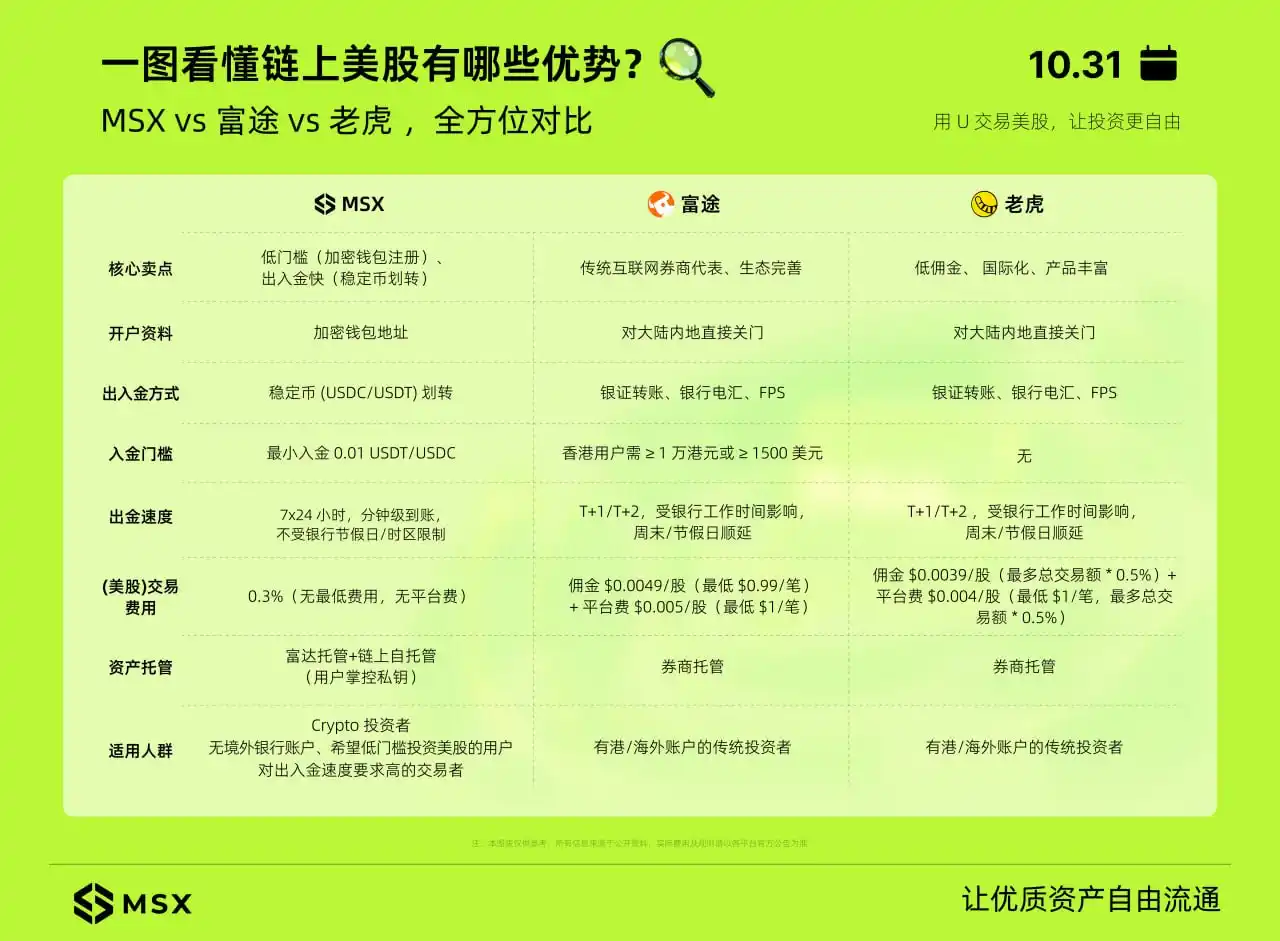
This "haven't started" is often not due to a lack of willingness. After all, for most users, the traditional path to enter the U.S. stock market has never been user-friendly from the start. Requirements such as overseas or Hong Kong/Macau identification, address verification, cross-border remittance, T+1/T+2 settlement, holiday extensions, and so on may not be individually fatal, but what really discourages people is the friction cost formed when these steps are stacked together.
Therefore, many people are not unwilling to learn about U.S. stocks; it's just that every time they are about to start, they are pushed back to a vague idea by this process. That's also why the emergence of on-chain U.S. stocks is not just "an additional option" for everyone, but the first time it has truly cleared the path:
Zero-threshold account opening, direct entry and exit with stablecoins, on-chain self-custody, 7x24-hour transactions... These features, when taken individually, may not be revolutionary innovations, but when combined, they precisely address every pain point that most users face when entering the U.S. stock market.
It's not simply about moving the old world onto the chain, but using the chain to make the idea of "wanting to learn about US stocks" something that can truly begin immediately for the first time.
Having solved the problem of "how to get in," another roadblock emerged: where to start learning about the US stock market?
In fact, Crypto users have an advantage that most people are not aware of. Through your years of hands-on experience on the chain, you have unconsciously completed the most difficult part of investment education, such as how to make judgments in an information-deficient situation, how to manage the psychological aspects of holding high-volatility assets, and how to identify the gap between narrative hype and fundamentals.
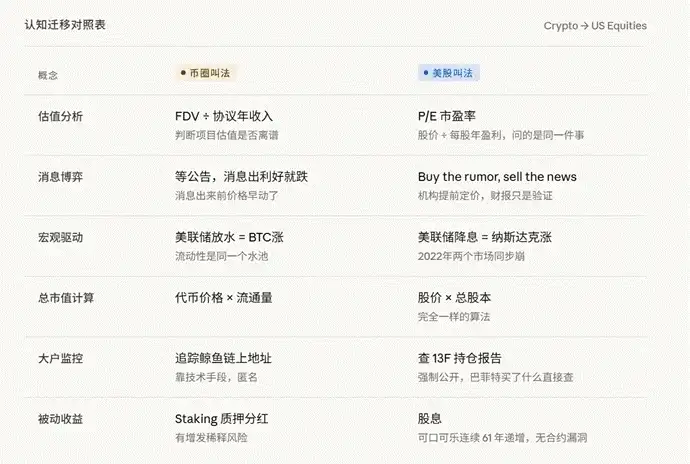
These abilities are equally applicable in the US stock market, just using a different set of terminology:
FDV divided by protocol annual revenue and P/E ratio are asking the same question; selling off when the news is announced and "Buy the rumor, sell the news" follow the same game logic; the Fed's liquidity injection driving BTC up is similar to interest rate cuts propelling the Nasdaq higher, as they draw from the same pool of money.
What everyone lacks is not investment thinking but a translated dictionary written in a language you are familiar with.
Based on this assessment, MSX has specifically launched the "US Stock Market Learning" event for everyone — not a generic introduction to US stocks but a systematic path starting from basic US stock market awareness, breaking down core US stock concepts, covering a complete framework from the underlying mechanisms of US stocks, the three major indices, the logic of earnings seasons to valuation methods.
There is only one purpose: to help you spend the shortest amount of time establishing a basic judgment framework for US stocks from scratch, and then truly take action, rather than letting the idea of "learning about US stocks" continue to gather dust in your bookmarks.
After all, the wall separating the ordinary user from the US stock market is being torn down, and US stocks will enter more people's lives faster and more thoroughly than anyone expected.
Those who learn how to cross over first are often the first to stand firm next, so before it completely collapses, make sure to catch up on the lessons that need to be learned.
This thing, starting now, is not too late.
This article is from a contributor and does not represent the views of BlockBeats.
Welcome to join the official BlockBeats community:
Telegram Subscription Group: https://t.me/theblockbeats
Telegram Discussion Group: https://t.me/BlockBeats_App
Official Twitter Account: https://twitter.com/BlockBeatsAsia