WLFI at it Again? Banking License Controversy Amid $500M Investment
Original Title: US regulator scrutinised over bank licence sought by Trump crypto venture
Original Authors: Martin Arnold and George Steer, Financial Times
Translation: Peggy, BlockBeats
Editor's Note: When crypto capital intertwines with political power on the same regulatory track, controversy often has more penetrating power than the technology itself.
The controversy surrounding the Trump family's crypto venture, World Liberty Financial (WLF), applying for a US banking license has rapidly evolved from a routine financial approval to a political issue involving conflicts of interest, foreign capital influence, and national security. A $500 million investment from a member of the Abu Dhabi royal family, a potential AI chip export arrangement, stablecoin business deployment, and the president's disclosure of tens of millions of dollars in income have made this hearing far beyond the industry standard, becoming a stress test of institutional boundaries and regulatory independence.
The OCC emphasizes it will "process by the book," while Democratic lawmakers question transparency and review standards. In the current environment where stablecoins are increasingly seeking a "bank-like" path, WLF's application not only concerns the compliance process of a company but also reflects how the US is seeking a balance in digital financial competition, geopolitical capital games, and political ethics.
Below is the original text:
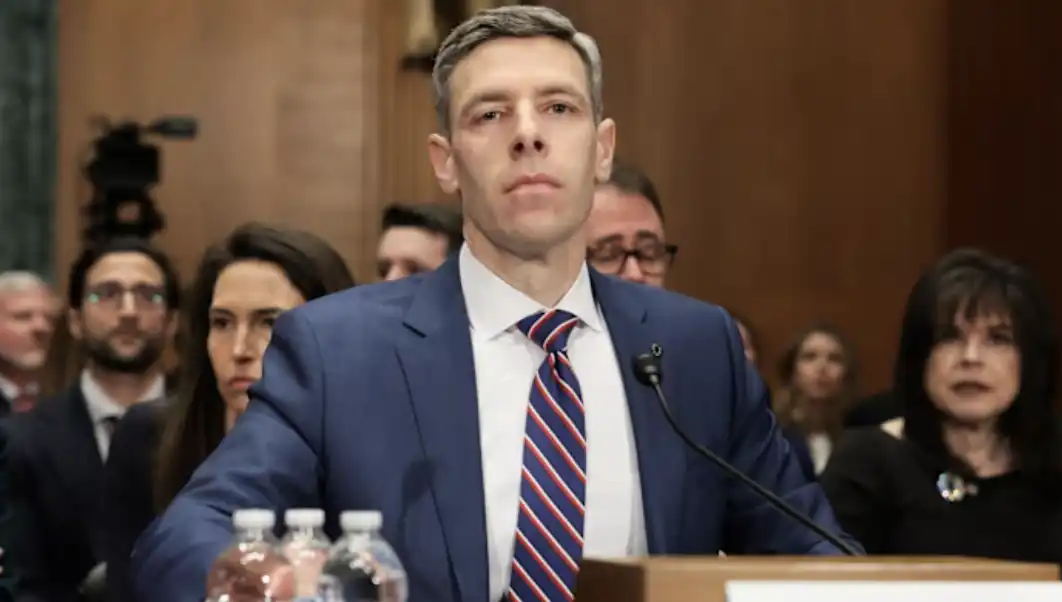
On Thursday, Jonathan Gould appeared before the Senate Banking Committee for questioning on the Trump family's crypto venture applying for a bank charter.
A US banking regulator has refused to disclose specific information regarding the Trump family's crypto venture's application for a US banking license. The enterprise had previously received a $500 million investment from a member of the Abu Dhabi royal family.
The head of the Office of the Comptroller of the Currency (OCC), responsible for issuing federal bank charters, refused to disclose World Liberty Financial's (WLF) application details as requested by lawmakers during a Senate Banking Committee hearing on Thursday and denied that President Donald Trump had exerted any influence on the approval process.
Democratic lawmakers asked the OCC to explain whether WLF had disclosed in its application documents the sale of a 49% stake to Sheikh Tahnoon bin Zayed Al Nahyan, the UAE national security adviser and controller of a vast commercial empire.
The above transaction has further raised questions from the public: Did the UAE receive policy "favoritism" for investing in the Trump family's holding company, including being allowed access to U.S. AI chips, and whether there is a risk of technology transfer to China.
WLF denies any link between this $500 million investment and any chip acquisition arrangement. According to the company's website, Trump is listed as an "Honorary Co-Founder." In its latest financial disclosure covering the 2024 fiscal year, Trump declared $57.3 million in personal income from WLF.
Democratic progressive stalwart Elizabeth Warren challenged OCC Director Jonathan Gould during a hearing on WLF's application, citing a clear conflict of interest risk given the Trump family's ownership stake.
WLFI applied for a banking license in early January through an entity named World Liberty Trust Company. Details of its equity transaction with the UAE (finalized days before the inauguration) were disclosed earlier this month by the media.
Warren questioned Gould on whether WLF disclosed that Sheikh Tahnoon had become a "key shareholder in the proposed bank." Gould responded that he would not comment on any specific applications. Warren further warned that if the license is ultimately approved, it would constitute "one of the most shameful corruption scandals in American history."
In response, Gould stated that the OCC will "review all applications according to established procedures" and sarcastically noted that the only "political pressure" he feels comes from Warren herself.
Democratic Senator Chris Van Hollen also inquired whether the Abu Dhabi investment firm MGX's $2 billion contribution last year, through using WLF's stablecoin in acquiring shares of the crypto exchange Binance, would be considered in the OCC's approval process. Another Democratic member, Andrew Kim, asked whether the OCC has a strengthened review mechanism for applications involving foreign government officials that may affect national security. Gould said he would provide a written response later.
WLF responded by stating that Democrats are "politicizing this matter" to smear a U.S. private company undergoing rigorous regulatory scrutiny with "baseless accusations." The company emphasized that World Liberty Trust Company has submitted all necessary disclosure documents as required by regulations. Currently, five companies are in line for an OCC national bank charter, with WLF being one of them; crypto companies Coinbase and Laser Digital are also among the applicants.
If approved, WLF will be able to issue and hold the inventory of its USD1 stablecoin. The USD1 is a cryptocurrency token pegged 1:1 to the dollar, and the current custody and issuance services are provided by third parties. According to disclosures, WLF will not engage in lending or accept public deposits in the future.
The proposed management team includes WLF co-founder Zack Witkoff, whose father is current U.S. Special Envoy for the Middle East and real estate billionaire Steve Witkoff, as well as Integrity Automotive Holdings CEO Jeffrey Weiner. The latter heads the automotive dealership group's operations in New York, New Jersey, and Connecticut.
Earlier this week, some co-founders' social media accounts were hacked, causing USD1 to briefly unpeg. WLF later stated that USD1 was "completely secure" and has since restored stability.
Welcome to join the official BlockBeats community:
Telegram Subscription Group: https://t.me/theblockbeats
Telegram Discussion Group: https://t.me/BlockBeats_App
Official Twitter Account: https://twitter.com/BlockBeatsAsia