Why Most Cryptocurrencies Are Designed to Be Non-Reinvestment Assets
Original Title: Tether retreats from $20bn funding ambitions after investor pushback
Original Author: Jill R Shah, Financial Times
Translation: Peggy, BlockBeats
Editor's Note: Against the backdrop of a volatile market, this article focuses on a fundamental question: whether crypto assets have a true compounding mechanism to create long-term wealth. The author contrasts tokens with traditional equity, pointing out that most tokens resemble highly volatile "yield assets," lacking reinvestment and capital allocation capabilities. True value accumulation often comes from enterprises leveraging blockchain and stablecoin infrastructure to reduce costs and enhance efficiency.
This is not a denial of blockchain technology but a pragmatic examination of the current tokenomics structure. Capital is more likely to flow towards equity in companies with cash flow and compounding capabilities before protocols can retain and compound value like corporations. The core conclusion of the article is straightforward: technology will first proliferate, and wealth belongs to those who are the earliest to turn technology into a compounding machine.
The following is the original text:
I am penning these words as the crypto market undergoes a round of collapse. Bitcoin briefly dropped to $60k, Solana revisited the price range of the FTX liquidation from that year, and Ethereum hovered around $1800. I won't delve into the arguments of "perma bears" here.
This article focuses on a more underlying question: why tokens fail to achieve compounding growth.
Of course, prices will bounce back from here. Some will say I'm "dancing on a grave." The core argument is likely to be overshadowed by short-term price fluctuations. But let's say it anyway.
Over the past few months, I have been emphasizing (even if that meant being labeled as a "centrist"): fundamentally, crypto assets are overvalued; the Metcalfe's Law is not sufficient to support the current valuation levels; adoption and price can continue to diverge for many years.
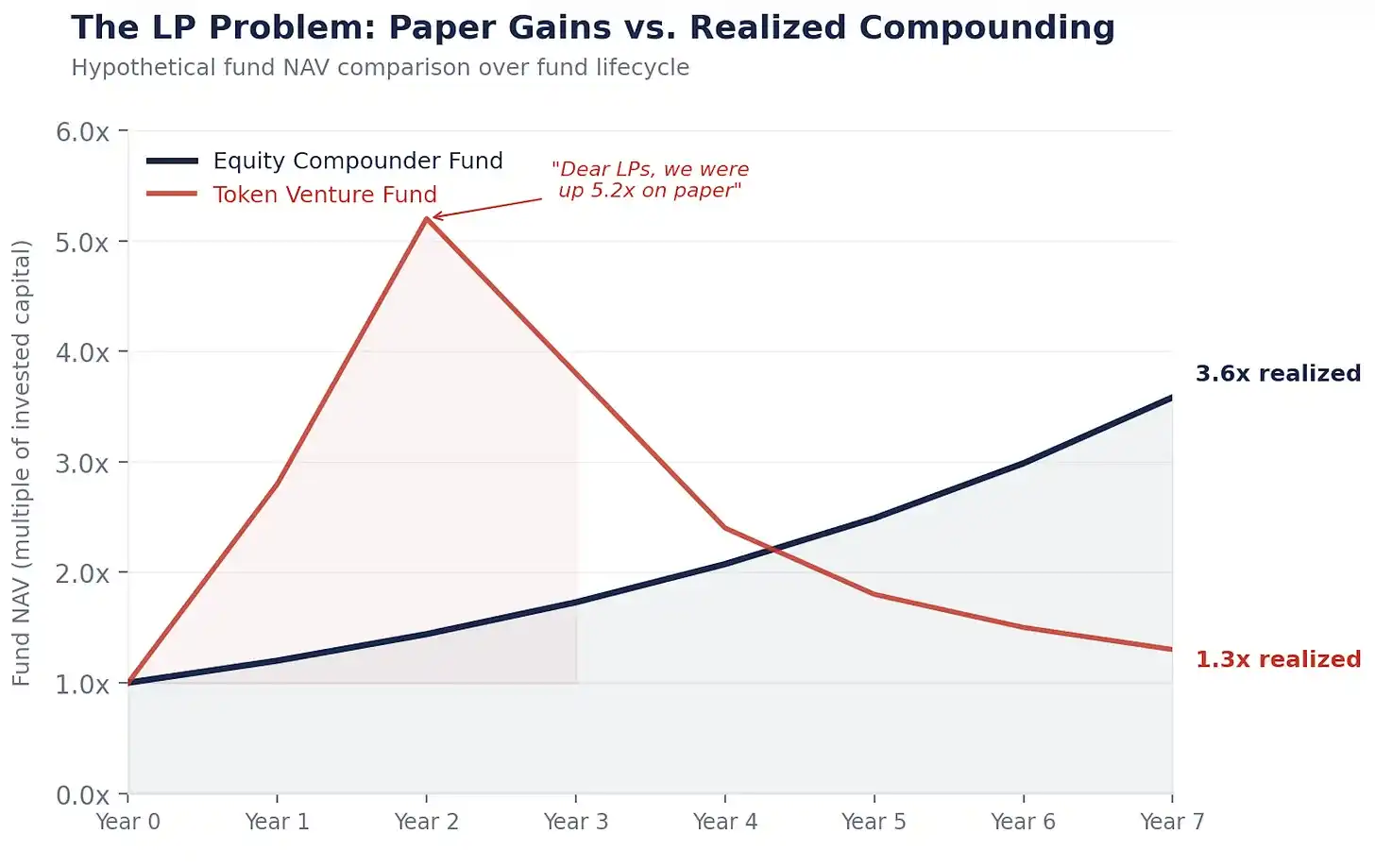
"Dear LPs, stablecoin trading volume has grown 100 times, but our return has only been 1.3 times. Thank you for your trust and patience."
What is the strongest and most common rebuttal?
"You are too pessimistic. You don't understand what tokens represent at all. This is a whole new paradigm."
I am very clear on what a token represents. The issue lies precisely here.
Compounding Machine
Berkshire Hathaway has a market cap of around $1.1 trillion.
This is not because Buffett times the market perfectly every time, but because—it compounds.
Every year, Berkshire reinvests the money earned into new business, expands profit margins, acquires competitors, enhances intrinsic value per share. Price is just the outcome, catching up inevitably as the underlying economic engine continues to grow.
This is the essence of equity. It is a claim on a "reinvestment machine."
Management takes profits, does capital allocation: invests in growth, reduces costs, buys back shares.
Every right decision becomes the basis for the next, compounding incrementally.
$1 compounding annually at 15% for 20 years = $16.37
$1 compounding annually at 0% for 20 years = $1
Equity turns $1 profit into $16. Tokens turn $1 fee into $1 fee.
Taking the Machine Out
When a private equity (PE) fund acquires a business generating $5 million in annual free cash flow, what happens internally?
Year 1: $5 million FCF. Management reinvests: R&D, stablecoin treasury channels, debt repayment. Three decisions.
Year 2: These decisions start to bear fruit, FCF becomes $5.75 million.
Year 3: Earnings keep rolling into the next set of decisions, FCF becomes $6.6 million.
This is a business growing at 15% compoundingly.
$5 million becomes $6.6 million, not because of market exuberance, but because someone is making capital allocation decisions, and each round of decisions feeds into the next.
Persist for 20 years, $5 million will turn into $82 million.
Now, look at what happens internally to a protocol with a $5 million annual fee agreement:
Year 1: $5 million fee, distributed to stakers. Gone.
Year 2: Maybe another 5 million. If users stick around. They won't.
Year 3: Depends on if there's still anyone in the casino.
Nothing compounds. Because Year 1 didn't actually reinvest, there is no Year 3 flywheel. Subsidies and grants are far from enough.
The Token Was Designed This Way
This is not an accident but a legal strategy.
Going back to 2017–2019, the SEC was hunting everything that "looked like a security". Almost every lawyer advising protocol teams would say the same thing: don't let the token look like equity.
Thus, this whole set of design principles emerged:
No claim to cash flows — avoid looking like dividends
No governance over the Labs entity — avoid looking like shareholder rights
No retained earnings — avoid looking like a corporate treasury
Staking rewards framed as "network participation" — not yields
This design worked. Most tokens successfully avoided being classified as securities. But in doing so, they also avoided any mechanism that could generate compounding.
The entire asset class was intentionally designed to be unable to do the one thing that truly creates long-term wealth.
Labs Holds Equity, You Hold "Interest"
Almost every major protocol has a for-profit Labs company alongside.
Labs is responsible for: coding, controlling the frontend, owning the brand, holding enterprise partnerships
And what do token holders get? Governance votes + a fluctuating claim to fees.
The pattern is the same everywhere: Labs takes talent, IP, brand, enterprise contracts, strategic decision-making; token holders get fluctuating "interest" with network usage and a voting right on proposals that Labs cares less and less about
It's not surprising.
When someone acquires a protocol ecosystem (like Circle acquiring the Axelar team), they are buying Labs' equity, not the tokens.
Because equity compounds, tokens do not.
Regulatory agnosticism will inevitably lead to distorted outcomes.
What Do You Really Own?
Peel back the narrative, peel back the price volatility, and look at what a token holder actually receives.
Take ETH for example: stake ETH, earn 3–4% annually, earnings come from network inflation schedule that adjusts dynamically with staking participation. More stakers, less yield; fewer stakers, higher yield.
What is this? A floating rate coupon bound by protocol rules.
This is not equity. This is debt.
Yes, ETH could go from $3,000 to $10,000. But junk bonds can double on a spread compression. It does not make it equity.
The real question is: how does your cash flow grow and through what mechanism?
Equity: management reinvests and compounds
Growth = ROIC × Reinvestment Rate
You participate in an expanding economic engine
Token: Cash flow = Network utilization × Fee rate × Staking participation rate
You receive a coupon that fluctuates with block space demand, no reinvestment, no compounding engine, price volatility that tricks you into believing you have equity.
The economic structure makes it clear: you are holding fixed income, just with 60–80% volatility.
This is the worst of both worlds.
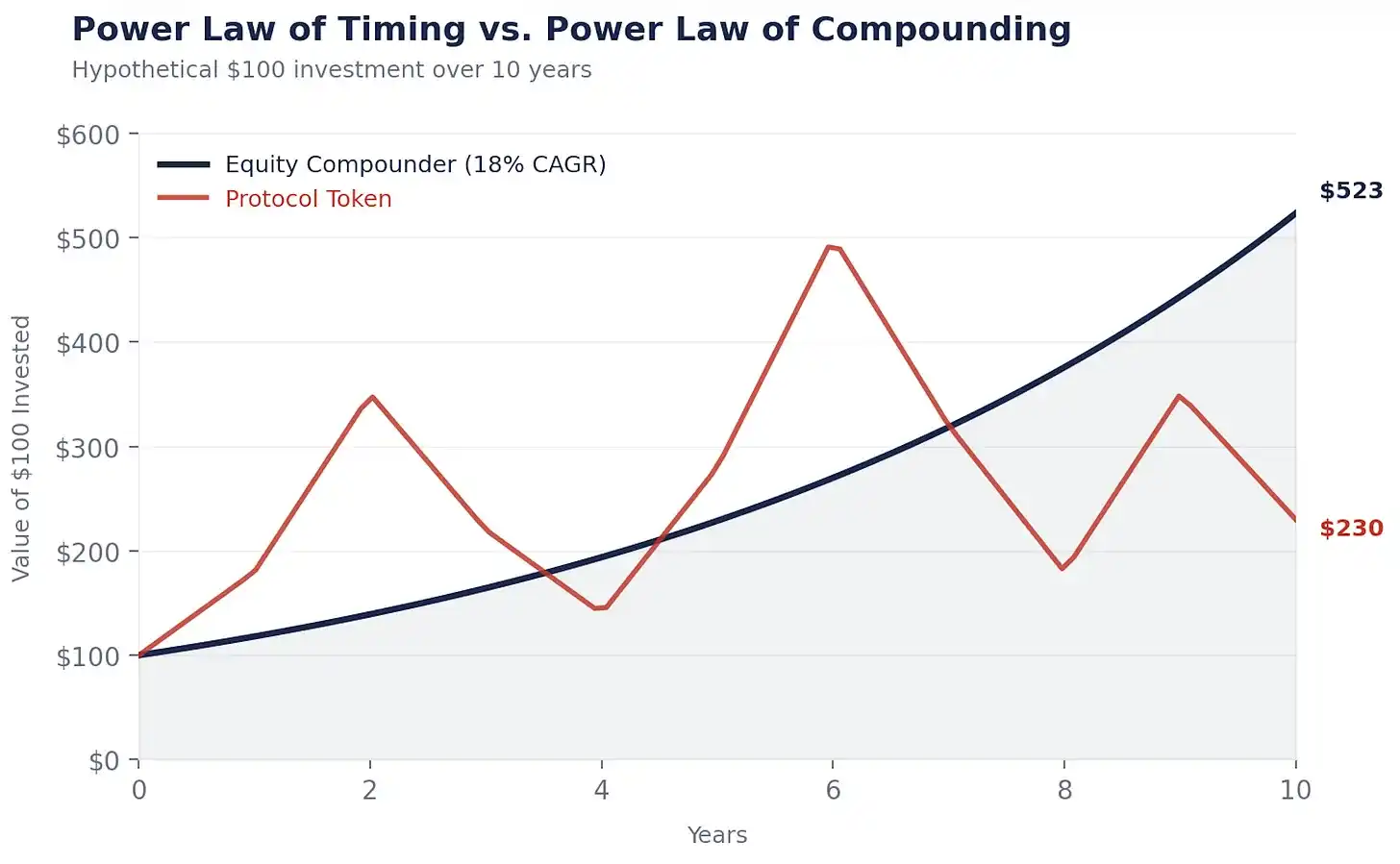
Timing the Power Law vs Compounding the Power Law
This is why, in its current state, tokens cannot accrue value sustainably, cannot compound. The market is waking up to this.
It is not stupid, so it begins to shift towards crypto-native equity assets: first DATs (more on this later), then these companies that truly leverage the tech for cost savings, revenue increases, compounding.
The wealth creation in crypto follows "timing the power law."
Those who make money, buy early, sell accurately. My personal investment portfolio works this way too, we call it liquid venture for a reason.
The wealth creation in equity follows "compounding the power law."
Buffett didn't time the market buying Coke, he bought and then compounded for 35 years.
In crypto, time is your enemy: hold too long and gains evaporate. High inflation curve, low float high FDV, undersupply, blockspace glut, all erode returns
Hyperliquid is one of the few exceptions.
In equities, time is your friend: the longer you hold a compounding asset, the more math works in your favor
Crypto rewards traders, equities reward holders.
Yet reality is: wealthy holders are far more numerous than wealthy traders.
Why "Just buy ETH" isn't the answer
The reason I rerun these numbers is because every LP asks: "Then why not just buy ETH?"
Pull up a true compounding machine: Danaher, Constellation Software, Berkshire.
Then pull up ETH's chart.
Compounding companies, curve stable sloping up-right, as the engine grows each year.
ETH: Spike, crash, spike again, crash again.
The final cumulative return entirely depends on when you get in, when you get out.
Both charts may end up at the same place eventually.
But: one lets you sleep, the other demands you be a prophet. "HODL beats timing," everyone gets it. The question is: can you really HODL through.
Equities make that much easier: cash flow floors price, dividends pay you for waiting, buybacks compound while you hold
Crypto markets, however, are brutal: fees bleed; narratives shift; no floor, no yield; only faith (HODL)
I'd rather be a holder than a prophet.
This Trade
If a token can't compound, and compounding is the core mechanism of wealth creation, then the conclusion is already written.
The internet created trillions of dollars of value. Where did that value ultimately flow?
Not in TCP/IP, not in HTTP, nor in SMTP.
These protocols are all common goods: extremely important, extremely useful, but with little investable return at the protocol layer itself.
The value ultimately flows to Amazon, Google, Meta, Apple—those that build on the protocols and can sustainably compound.
The crypto world is echoing this rhyme.
Stablecoins are becoming the “TCP/IP of Money”
Stablecoins are becoming the TCP/IP of the monetary world: extremely useful, widely adopted, but the protocol itself may not necessarily capture value proportionally.
Tether is an equity-owned company, not a protocol. The answer lies therein.
Those that will truly become “compounding machines” are the companies embedding stablecoins into their operations—they use stablecoins to reduce payment friction, improve working capital, and cut forex costs.
For a CFO, if switching to stablecoin for cross-border payments saves $3 million annually, that $3 million can be reinvested in sales, product, or debt repayment. That $3 million will compound.
And what about the protocol that facilitated the transfer? It took a fee. It doesn't compound.
“Fat Protocol” Theory is being debunked by the market
The “Fat Protocol” theory once believed: the value captured at the crypto protocol layer would surpass that of the application layer.
Seven years later, looking at reality: L1 occupies about 90% of the total market value, but its fee share dropped from ~60% to ~12%; applications generated about 73% of fees, yet only represent less than 10% of the valuation
The market is not foolish. But it still clings to the “Fat Protocol” narrative out of inertia.
Next Chapter: Equity Empowered by Crypto
The next stage of crypto will be defined by equity empowered by crypto: owning users, generating cash flow, having a management team
Being able to leverage crypto tech to reduce costs, increase revenue, and accelerate compounding
These enterprises will outperform tokens by a long shot in the long run.
Think of this mix: Robinhood, Klarna, NuBank, Stripe, Revolut, Western Union, Visa, BlackRock
This "company basket" outperforming a "token basket" is almost deterministic.
The reason is simple: these companies have real bottoms: cash flow, assets, customers, tokens do not. When tokens are betting future income at a very high multiple, the downside is brutal.
Be long technology itself. Be very selective with tokens. Very bullish on equity of companies that can compound this infrastructure advantage.
The Most Uncomfortable Part
All efforts to "fix" this issue inadvertently confirm this point.
Once DAOs start attempting true capital allocation (MakerDAO buying treasuries, setting up SubDAOs, appointing domain teams), they are slowly re-creating corporate governance.
The more protocols want to compound, the more they have to start looking like a company. DATs, tokenized equity wrappers do not solve the issue. They just create a second-layer claim on the same cash flows, competing with the native token. Wrapping does not make the protocol more composable; it just shifts economic interests from "non-DAT holding token holders" to "DAT holders."
Burn ≠ Buyback.
ETH burning is more like a thermostat with a set temperature.
Apple's buybacks are reading the weather, making judgments.
What can truly compound is intelligent capital allocation. Rules do not compound. Decisions do.
Regulation, Ironically, Is the Most Interesting Variable
Why tokens do not compound today fundamentally: The protocol cannot operate like a company. Cannot formalize, cannot retain earnings, cannot make enforceable commitments to token holders.
The "GENIUS Act" has shown: Congress can bring them into the financial system without suffocating tokens.
When we have a framework for the first time allowing protocols to use "enterprise-grade capital allocation tools," that will be the biggest catalyst in crypto history—bigger than an ETF.
Until then, smart money will flow to equity. And the "composability gap" will only grow year by year.
This Is Not Bearish on Blockchain
Let me be clear about one thing: Blockchains are economic systems. They are immensely powerful and will become the foundational rails for digital payments and "agent-based commerce."
We are building a chain at Inversion precisely because we believe deeply in this.
The issue is not technical. The issue is in tokenomics. Today's networks are built around "value transfer" rather than "value accrual."
This will change. Regulation will evolve, governance will mature, and eventually, there will be a protocol that learns to retain and reinvest value like a great business.
When that day comes, tokens will be economically equivalent to equity. The compounding machine will truly kick in.
I am not betting this future won't happen. I am betting—it hasn't happened yet.
Until that day comes, I will buy into companies that compound faster with crypto.
I might be wrong on the timing.
Crypto is a highly adaptive system, and that's one of its most valuable attributes. But I don't need to be entirely right.
I just need to be right in direction: the compounding machine will win out over the long run.
That's the beauty of compounding.
As Munger said: "It is remarkable how much long-term advantage people like us have gotten by trying to be consistently not stupid, instead of trying to be very intelligent."
Crypto makes infrastructure cheap. Wealth will flow to those who leverage this cheap infrastructure for compounding.
The internet taught us this lesson 25 years ago.
Now, it's time to act.
Invert.
——Santiago
Welcome to join the official BlockBeats community:
Telegram Subscription Group: https://t.me/theblockbeats
Telegram Discussion Group: https://t.me/BlockBeats_App
Official Twitter Account: https://twitter.com/BlockBeatsAsia
 Related Articles