From 0 to $1 Million: Five Steps to Outperform the Market Through Wallet Tracking
Original Title: Grow from $0 to $1M with wallet tracking.
Original Author: @maxxexee, On-chain Researcher
Original Translation: AididiaoJP, Foresight News
People always fail to appreciate things that come for free. And today, I am going to give you, without holding back, years of hard work, countless sleepless nights, wholehearted dedication, and the secrets I wish I knew earlier. So, make sure to make good use of it and don't be just another person who wastes opportunities.
Beginning
Before we get started, you need to have the following tools ready to use right now:
· Ray purple Wallet Tracking Bot
· MevX (for Sniping Trades)
· GMGN AIDEX Screener
· Exclusive Music Playlist to get you in the zone
· Whale Watch by Moby (Remember to enable push notifications)
Mindset Shaping | Your Thoughts Define Who You Are

Placebo Effect
When I say "Grow from $0 to a million dollars through wallet tracking," the protagonist may not necessarily be me but could be you, the one reading this passage.
Science has proven that the placebo effect demonstrates that simply "believing" alone can trigger real, measurable outcomes—altering your performance, perception, and decision-making without any direct external cause. I have witnessed this law in action time and time again in my life.
I hereby solemnly remind you to take this seriously.
If you lack patience, seek shortcuts, act without conviction, settle for mediocre dreams, lack discipline, or simply don't believe in yourself—then you shouldn't be here. Go back and play those rug-pull games on Pump.fun.
I am not trading to survive. I push myself to delve into systems that can make me a better trader so that survival and an improved quality of life naturally become rewards that follow.
If you are trading purely to make money and survive, the immense pressure is likely to make you crumble. But if you can understand the system and see trading as a byproduct of building a better life, your chances of success will be much higher.
There will always be people telling you that these strategies are all fake, everything is a scam, and only insiders can win. This is usually an excuse made by those lacking depth and self-esteem.
Listen to me, someone who has tracked/dealt with a GRIFFAIN whale holding over $40 million in an internal position. Lying serves me no purpose.
Trading is a game. Wallet tracking is a maze, where every profitable wallet proves that someone has found the way out.
Well, let's get started.
Beginner's Lesson One
Welcome to this "preschool" without diapers. After warming up, your first real case study is: identifying tokens being promoted by KOLs or organized small groups. These are usually visible on the Dex Screener's real-time top gainers list.
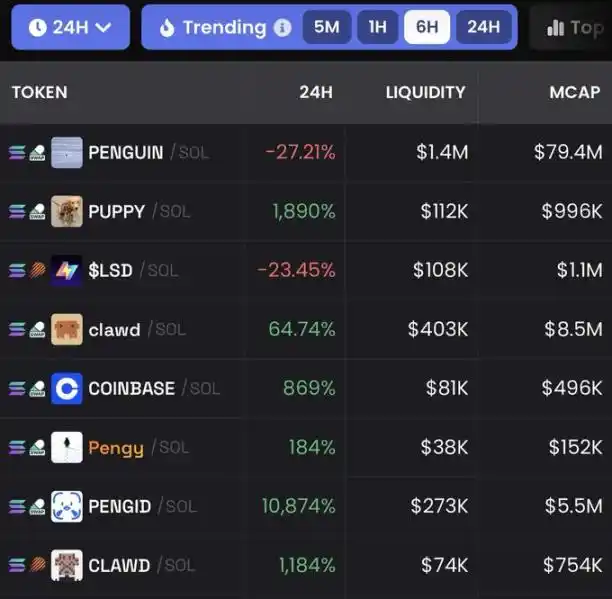
DEX SCREENER: See Every Move Clearly
When checking tokens, I highly recommend using a computer for the clearest view.
I set the chart to a 1-minute candle and a daily time frame.
· The 1-minute candle can precisely show the timing of buys and sells.
· The daily time frame illustrates the token's entire performance from issuance: every pump, every dump, and the secret accumulation phase.
I usually keep the candle period at 1 minute or 5 minutes, and the time frame matches the token's "age." If the token was issued 2 days ago, I set it to 2 days; issued 3 days ago, set to 3 days. This way, all historical data is clear and nothing is missed.
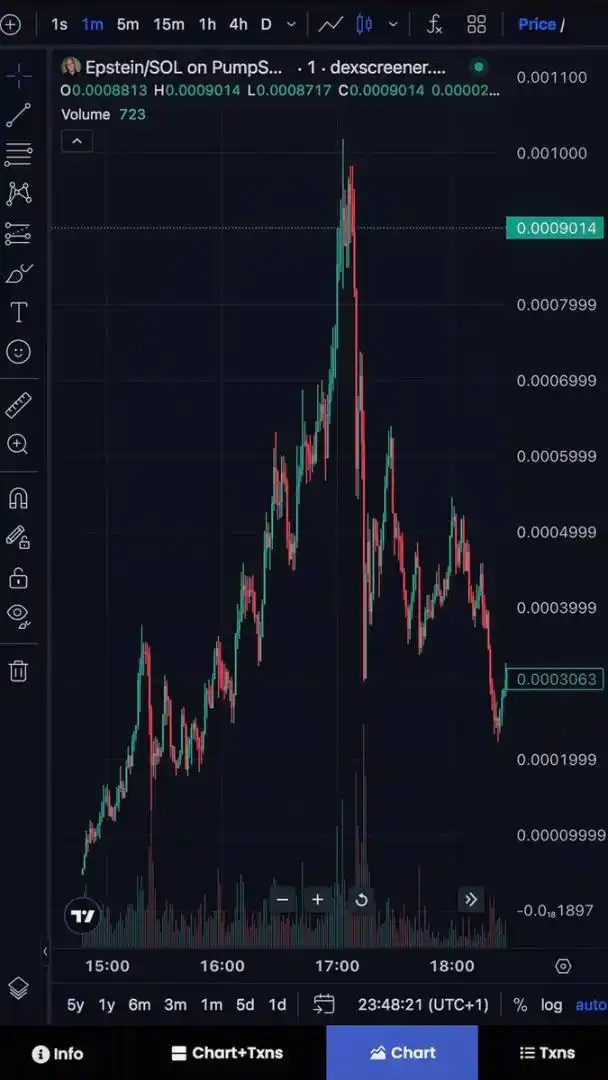
Performance Analysis Using EPSTEIN as an Example
Step Two: Interpreting Charts
After setting the filtering criteria, we begin to observe the token. I mainly focus on two types:
· Coinbase: Tracking wallets that bought in at token issuance and held. This type is high risk, high volatility, but also high potential reward.
· Pump and Dump / Second Launch / Front-Running: Tracking wallets that buy into reset or rock bottom old coins (possibly insider information holders or early participants in a specific event) and sell at a peak.
Today, we are focusing on option 2, based on past experience, I believe this is more prudent. Many times, KOLs or insiders will shake out hesitant retail investors through a sell-off, accumulate enough tokens, and then drive up the price, leaving you behind to continue being scammed on Pump.fun.
By observing EPSTEIN's chart, we can identify 3-4 key support and resistance levels, which are the areas of significant buying and selling.
· Support Level - Buy, Pump, Green Candlesticks
· Resistance Level - Sell, Dump, Red Candlesticks
Your tracking should start from the absolute bottom, right near the resistance or buy zone. Why? Because this represents the point where the token has already "died," been abandoned, and completely bottomed out.
When someone enters at this position, it is never random. They either have insider information, heard rumors, or are front-running an event you have no idea about.
I know things you don't.
Real-Life Example: Smart Money Moves
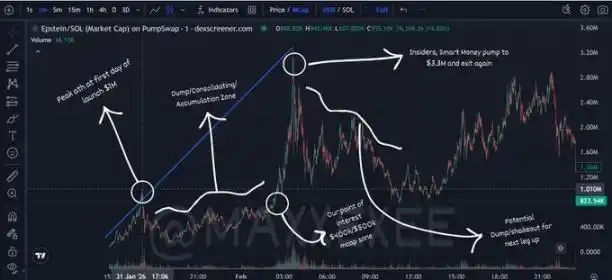
Look at EPSTEIN: It skyrocketed to a $1 million market cap on its first day, then, like your ex, dumped you, plummeting to $100,000... Don't be sad; that's how the market works. High risk, high volatility, which is why I said not to touch new coins. Wait until you have more experience.
After the crash, it ranged around a $100,000 market cap, slowly accumulated until reaching $400,000-500,000, and finally violently surged to $3.3 million.
Is it insiders manipulating? Smart money involved? Maybe. But that's not important. What matters is that some wallets bought in the $100,000 bottom range, held all the way to $500,000 (this is our key observation point), and then watched it surge to a $3.3 million market cap. Well done.
That's an 8x return, not astounding, but a substantial profit.
Some people are always chasing the next "from $5k to $1 million" miracle coin. Remember, quality is far superior to quantity.
I'd rather invest $100,000 in a high-certainty 2.5x opportunity to earn steadily than risk $100,000 on an uncertain 10x opportunity and end up losing it all.
Your Task
We've now identified a key point of interest—the area where significant buy-side liquidity was absorbed before a markup. Your next task is to filter out the wallets that bought into that area.
It's a tough job because you might end up feeling cross-eyed, getting a headache, or even hearing things. I suggest you take breaks and walk around from time to time.
I love using Dex Screener because it provides comprehensive information: wallet entry time, volume traded, market cap, and more, giving you enough analytical depth.
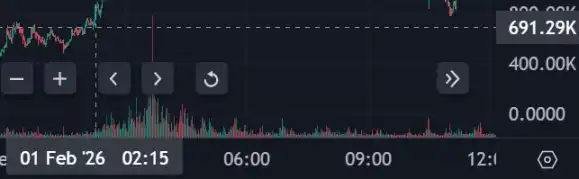
According to Dex Screener, the main buying activity occurred around 2:15 AM on February 1st, with the market cap in the range of about $600,000 (note that time zones may vary).
Now that you know when and where the activity took place, proceed with the following:
Set your filtering criteria:
· Set the date to the specific date of the event (e.g., February 2nd).
· Set the time window to around the event (e.g., 2:10-2:30).
· Add an additional 20-30 minutes of overlap to ensure full coverage.
· Filter the transaction type to Buy only.
Analyze Buy Transactions
Once filtered, you'll need to hover over each transaction one by one. It's tedious and stressful, similar to a miner digging for gold. By hovering, you can see who bought, how much they spent, when they bought, and what their eventual return was.
For example, a wallet starting with "26o" bought in for $415 and eventually sold out with a 5.6x return. This may pale in comparison to the large transactions we're tracking, but it's still noteworthy. While this alone cannot be deemed insider or smart money, it's worth adding to your watchlist.
Repeat this process, noting down wallet addresses in a notepad, organize your observations, and scrutinize the patterns carefully. Over time, the noise fades away, and the truly significant trends emerge naturally.
Step Three: Leveraging "Unrealized Gains"
This strategy is particularly suitable for new coins or tokens slowly gaining momentum. I like to approach it from a psychological perspective. Unrealized gains refer to profits that have not yet been realized on paper, as holders choose not to sell in anticipation of further asset appreciation.
Operation Steps:
· Find a mid-cap coin pair (e.g., $200k, $500k, $1m).
· Look for coin pairs with an issuance time between 30 minutes and 1 hour (or longer).
· Check if the trading volume is reasonably matched with the market cap. Abnormally high or erratic volume usually indicates the token has been overhyped, with heavy selling pressure to avoid.
· If the token meets the criteria, go to the "Top Trader" section, switch to the Unrealized Gains view, then hover over to view the holders. This can give you insight into who holds, how much, and their mindset... all silent signals that most people overlook.
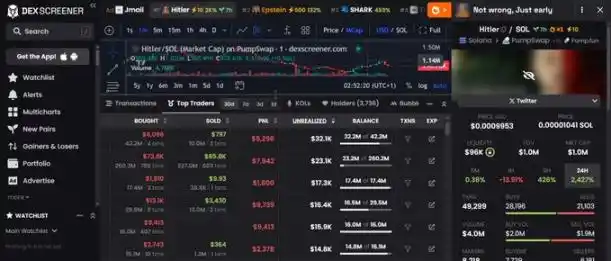
Using HITLER as an Example
This chart may look enticing, filled with crazy buy and hold records, but believe me, there is often more than meets the eye.
We repeat the same process, carefully noting wallet addresses and unusual activities. For example, someone only spent $50 to buy on HITLER but shows $6000 in unrealized gains—why haven't they sold yet? What do they know? It's intriguing.
The only way to find answers is to use them as signals and advantages, quietly building your own observation profile.
Learn to filter out delusions from the strategy. Not everyone holding unrealized gains is smart money; some are just aimless, holding without a plan. Don't mistake blind hope for strong belief.
Step Four: MOBY's Whale Watching
This is an insightful tool designed specifically to track whale activity and fund movement between different tokens.

Usage Tips:
Follow some reliable whale tracking accounts, turn on push notifications, and then patiently observe for 1-2 weeks. Don't be impatient; patterns won't show on the first day.
My Operation Process:
I will scan every token alerted by the Whale Watching, especially those with realistic market caps (usually below $1 million). I look at each one, observe their price action, market performance, and background.
For each token, I ask myself:
· Why Did the Whale Buy It?
· Does Its Story or Narrative Hold Up?
· Who Bought Before the Whale?
· Who Followed After the Whale?
· How Did the Token Perform Afterwards?
If you record these questions every day, a pattern will slowly emerge. It takes time, but it will definitely show up.
I've discovered a pattern (was hesitant to share at first): Some whale wallets play the role of an "attention vessel."
Their purpose is not necessarily early positioning, but rather to generate attention and FOMO (fear of missing out). Typically, there will be a small group of insider wallets quietly entering first. Then the whale quickly buys in, driving up volume and market attention.
The same logic applies to CEX perpetual contract markets. A high-market-cap token gets listed, like PENGUIN (for example). A few small wallets will quietly accumulate positions in advance to hide tracks or create distractions. Once the positions are set, the whale enters, volume spikes, and the longs in the perpetual contracts start profiting. The real profit may not necessarily be in the spot market but in the opportunities created by spot volatility for other markets (such as futures).
A question that I have completely thought through is:
Why do whales always buy tokens that have already pumped? Old coins, coins near their all-time highs, coins with already high market caps that are difficult to double.
It wasn't until I realized that price appreciation is not the only way to profit.
Your job as a trader is to find loopholes, flawed systems, or hidden mechanisms and exploit them. If you can trace wallets that always buy in before whale actions, you can position early, set up your long positions, manage leverage properly, and let the system work for you. Once you identify this pattern, you can even front-run the whale's next potential target token.
This is just one of many perspectives.
I'll stop here.
Either question everything or become part of the herd.
Wallet Tracking Checklist
This is the final and most crucial step in the entire process. This checklist will tell you if you've found a goldmine or wasted months on trash.
I use GMGN AI for the ultimate analysis.
Paste the wallet address into GMGN and carefully verify the following:
· Holding Period
· Win Rate (Please use with caution)
· Average Buy Value Distribution — Where they usually enter in terms of market value
· Transaction and Transfer Records (More important than most people think)
· How many are tracking the same wallet
The Trap of "False Win Rates"
As I delved into wallet tracking, I realized a key point: looking only at the win rate is almost meaningless; it's just surface-level data.
I've seen win rates as low as 20% or even lower, yet the wallet consistently participated in organized pumps. Their modus operandi is as follows: buy into a token with one wallet, then transfer the token to another wallet for selling. This is why sometimes you see wallets on Dex Screeners with sell records but no corresponding buy records.
Once, I tracked a wallet with an extremely low win rate. It bought into a token when the market value was around $100,000, then transferred most of the tokens out, leaving only a small portion behind. At first glance, it seemed like they were stuck in a losing position. However, within 30 minutes, the token's market value shot up to $9 million. Hours later, the price crashed, but the tokens in their original wallet remained untouched.
If I hadn't delved into the transfer records, I would have thought they lost money. What was not visible was that they sold the tokens through another wallet, concealing their profit-taking.
This is the difference between "seeing" and "truly seeing."
This game rewards curiosity and insight, not shortcuts. Don't just look at the surface; dig deeper, track behaviors, and uncover patterns for yourself.
The advantage lies in the "dirty work" that most people aren't willing to do.
Case Study
Here is a wallet that seems to have a decent win rate. From the image, you can see that it has a solid holding period, with most token purchases falling in the $10,000 to $100,000 range and a few exceeding $500,000. This entry position seems quite reasonable.
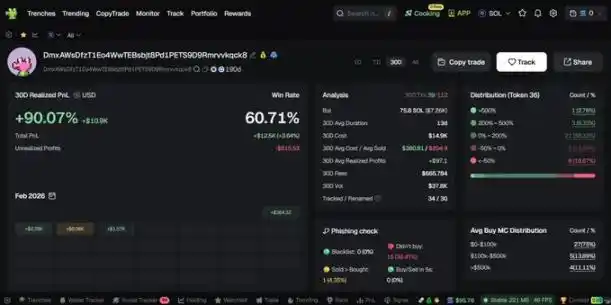
Key points to note:
· The average holding period is crucial here, more important than most people think. A longer holding period signifies patience and intent, indicating that this wallet was not set up to attract followers or engage in quick rug pulls.
· Transaction and Holding Analysis gives you space to observe the type of tokens they are buying, their behavior during volatility, and whether their entry point aligns with the accumulation phase by whales.
· I also pay close attention to how many people are tracking the same wallet. If there are too many trackers, I usually steer clear. Because at this point, its value has already been "diluted" — too many eyes watching, too many copycats, almost always distorting the entry timing and disrupting the original pumping structure.
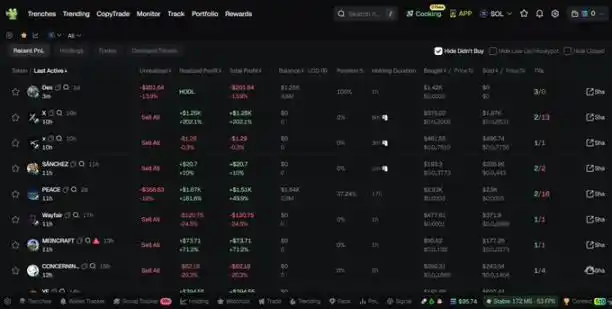
Crowd-following trades bring a lot of market noise. People FOMO into positions without understanding the background, easily panic too soon, overleverage, and start "farming" the token instead of letting it naturally evolve. This behavior completely ruins organized manipulation and clean trends.

That's why I don't follow the crowd; I only study behavioral patterns.
Don't be a follower, be a detective.
Just having this mentality already puts you one step ahead.
Do's and Don'ts
· Don't: When you see insiders buy, don't immediately jump in. Observe first, wait for a clear entry signal.
· Do: Before committing funds, be sure to observe price action and market performance.
· If you find a wallet with strong profit potential, don't share it publicly. Once the advantage becomes common knowledge, it becomes ineffective.
· Never spend money buying so-called "guaranteed win wallet" addresses from others. The seller is either a beggar, a storyteller, or simply trying to scam you.
· Never buy an amount that exceeds that of insiders. That's greed, not belief.
· Do not sell all your position at once to take profits. It should be planned and done in stages.
· Once you confirm a high-quality wallet, activate it on the wallet tracking bot and then wait for trade alerts.
· If, like me, you are both prepared and lucky enough, you might eventually catch those excellent opportunities for "turning 5K into 500K." These opportunities do exist, but they usually come from precisely targeting newly issued tokens.
Conclusion
This guide ends here
Next time you envy those "Degen" traders driving luxury cars and living large, remember: they know what you don't, and they put in the effort you don't see.
If you've read this far, I wish you discipline and HODL strength on your wallet tracking journey.
Welcome to join the official BlockBeats community:
Telegram Subscription Group: https://t.me/theblockbeats
Telegram Discussion Group: https://t.me/BlockBeats_App
Official Twitter Account: https://twitter.com/BlockBeatsAsia

 Related Articles