Token Cannot Compound, Where Is the Real Investment Opportunity?
Original Article Title: Why Tokens Can’t Compound
Original Article Author: Santiago Roel Santos, Founder of Inversion
Original Article Translation: Luffy, Foresight News
As I write this article, the crypto market is going through a sharp decline. Bitcoin has touched the $60,000 mark, SOL has dropped back to the price level from the FTX liquidation event, and Ethereum has also fallen to $1,800. I won't dwell on those long-standing bearish arguments.
This article aims to explore a more fundamental question: why tokens cannot achieve compound growth.
Over the past few months, I have held onto a viewpoint: fundamentally, crypto assets are severely overvalued, and the Metcalfe Law cannot support the current valuations. The disconnect between industry adoption and asset prices may continue for several years.
Imagine this scenario: "Dear liquidity providers, stablecoin trading volume has increased 100-fold, but the return we bring to everyone is only 1.3 times. Thank you for your trust and patience."
What is the most vehement argument among all these opposing views? "You are too pessimistic, you don't understand the intrinsic value of tokens, this is a new paradigm."
I am acutely aware of the intrinsic value of tokens, and this is precisely where the crux of the problem lies.
Compounding Engine
Berkshire Hathaway's market value is now about $1.1 trillion, not because of Buffett's precise timing, but because this company has the ability to achieve compound growth.
Every year, Berkshire Hathaway reinvests its profits in new businesses, expands its profit margins, acquires competitors, thereby increasing intrinsic value per share, and the stock price rises accordingly. This is an inevitable result because the economic engine behind it is constantly growing.
This is the core value of a stock. It represents ownership of a profit-reinvestment engine. After management earns profits, they engage in capital allocation, layout expansion, cost reduction, stock buybacks - every correct decision becomes the cornerstone of the next growth, forming compounding.
$1 growing at a 15% compound rate over 20 years becomes $16.37; $1 sitting at a 0% interest rate for 20 years remains just $1.
Stocks can turn $1 of earnings into $16 of value; whereas tokens can only turn $1 of fee into $1 of fee, with no appreciation.
Show Your Growth Engine
Consider what happens when a private equity fund acquires a $5 million annual free cash flow company:
Year 1: Achieve $5 million in free cash flow, reinvested by management into R&D, building a stablecoin custody channel, and debt repayment, which are three key capital allocation decisions.
Year 2: Each decision generates returns, increasing free cash flow to $5.75 million.
Year 3: Previous gains continue to compound, supporting the implementation of new decisions, leading to free cash flow reaching $6.6 million.
This is a business with a compounding growth of 15%. Starting from $5 million, it grows to $6.6 million, not due to market sentiment, but because every capital allocation decision made by people empowers each other, progressing layer by layer. By persisting for 20 years, $5 million will eventually become $82 million.
Now, look at how a crypto protocol with $5 million in annual fee revenue would develop:
Year 1: Earn $5 million in fees, all distributed to token stakers, funds completely exiting the system.
Year 2: Perhaps earn another $5 million in fees, provided that users are willing to come back, and still all distributed, funds exiting again.
Year 3: The earnings depend on how many users this "casino" still has.
There is no compounding at all because there was no reinvestment in the first year, naturally leading to no growth flywheel in the third year. Relying solely on subsidy programs is far from enough.
Token Design Is Intentional
This is not accidental but a strategic design at a legal level.
Looking back at 2017-2019, the U.S. Securities and Exchange Commission scrutinized all assets that appeared to be securities. At that time, all lawyers advising crypto protocol teams gave the same advice: tokens must not resemble stocks. Tokens must not grant holders the right to claim cash flows, allow tokens to possess governance rights over the core development entity, retain earnings, and must be defined as utility assets, not investment products.
So, when designing tokens, the entire crypto industry deliberately aimed to distinguish them from stocks. No claim to cash flow rights to avoid resembling dividends; no governance rights over a core development entity to avoid resembling shareholder rights; no retained earnings to avoid resembling corporate treasuries; staking rewards were defined as network participation rewards, rather than investment returns.
This strategy worked. The vast majority of tokens successfully avoided being classified as securities, but at the same time, they also lost all possibilities of achieving compounding growth.
This asset class was deliberately designed from the very beginning to be unable to perform the core action of creating long-term wealth — compounding.
Developers Hold Equity, You Only Hold "Dividend Tokens"
Behind every top crypto protocol is a for-profit core development entity. These entities are responsible for developing software, controlling the frontend interface, owning the brand, and accessing corporate partnership resources. And what about token holders? They can only get governance voting rights and a fluctuating claim to fee income.
This pattern is ubiquitous in the industry. Core development entities hold talent, intellectual property, brand, corporate partnership contracts, and strategic decision-making power; token holders can only obtain a fluctuating "dividend" linked to network usage, as well as the "privilege" to vote on proposals that the development entity increasingly ignores.
It is therefore not difficult to understand why, when Circle acquires protocols like Axelar, the acquirer is buying equity in the core development entity, not tokens. Because equity can compound, tokens cannot.
The lack of clear regulatory intent has given rise to this distorted industry outcome.
What Exactly Are You Holding?
Setting aside all market narratives, ignoring price fluctuations, take a look at what token holders truly receive.
Stake Ethereum, and you can receive about 3%-4% in returns, and this return is determined by the network's inflation mechanism and dynamically adjusted based on the staking rate: the more stakers, the lower the returns; the fewer the stakers, the higher the returns.
This is fundamentally a fluctuating interest-bearing token linked to the protocol's established mechanism, not a stock, but a bond.
Indeed, Ethereum's price may rise from $3000 to $10000, but the price of junk bonds may also double due to a narrowing yield spread, which does not turn it into a stock.
The key question is: What mechanism drives your cash flow growth?
Cash flow growth from stocks: Management reinvests profits to achieve compounding growth, where growth rate = return on capital × reinvestment rate. As a holder, you participate in an ever-expanding economic engine.
Token Cash Flow: Completely dependent on network usage × fee rate × staking participation, what you receive is only a dividend fluctuating with block space demand, with no reinvestment mechanism in the entire system, and no compounding engine.
The significant price volatility makes people mistakenly think they are holding stocks, but from an economic structure perspective, what people actually hold is a fixed-income product, accompanied by a 60%-80% annualized volatility. This is simply a lose-lose situation.
For the vast majority of tokens, after deducting inflation dilution, the actual yield is only 1%-3%. No fixed-income investor in the world would accept such a risk-return ratio, but the high volatility of such assets always attracts wave after wave of buyers, which is a true portrayal of the "greater fool theory."
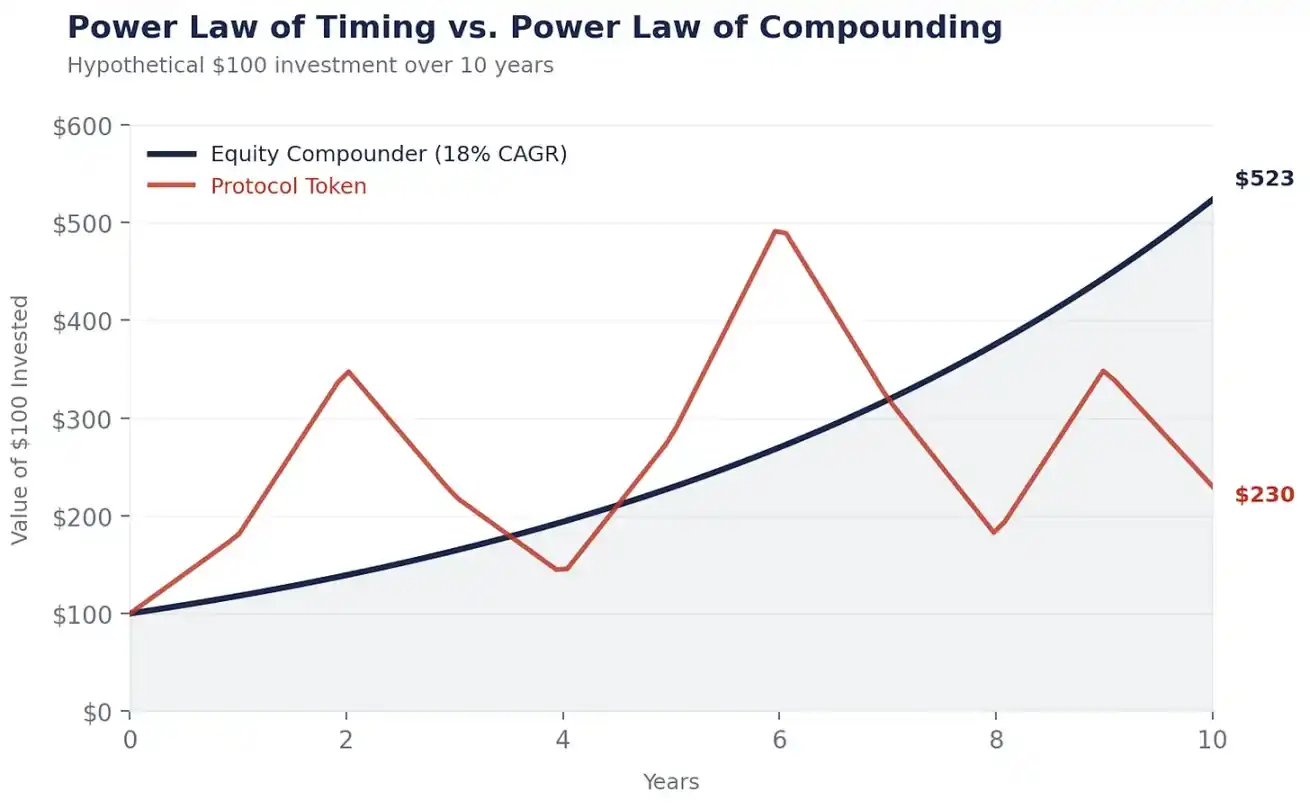
Power Law of Timing, Not Compound Interest
This is why tokens cannot achieve value accumulation and compounding growth. The market is gradually realizing this point, not being foolish, but starting to turn to crypto-related stocks. First, digital asset bonds, and then more and more funds are flowing into enterprises that use crypto technology to reduce costs, increase revenue, and achieve compounding growth.
The wealth creation in the crypto field follows the power law of timing: those who have accumulated wealth have all bought early and sold at the right time. My own investment portfolio also follows this rule, and crypto assets are called "liquidity venture capital" for a reason.
The wealth creation in the stock field follows the power law of compounding: Buffett did not rely on timing to buy Coca-Cola but held it for 35 years to let compounding take effect.
In the crypto market, time is your enemy: hold too long, and your returns will evaporate. The high inflation mechanism, low circulation, high fully-diluted valuation, along with the current market situation of insufficient demand and excessive block space, are important reasons behind this. Ultra-liquid assets are a few exceptions.
In the stock market, time is your ally: the longer you hold compounding growth assets, the more substantial the returns due to mathematical laws.
The crypto market rewards traders, the stock market rewards holders. In reality, there are far more people who have become rich by holding stocks than by trading.
I must repeatedly reassess these data because every liquidity provider will ask, "Why not just buy Ethereum directly?"
Take a look at the trend of a compounding growth stock - Danaher, Constellation Software, Berkshire - and then compare it with the trend of Ethereum: the curve of a compounding growth stock steadily rises to the right because its underlying economic engine grows stronger each year, while Ethereum's price experiences sharp rises and falls, going back and forth, and the cumulative return ultimately depends entirely on your entry and exit timing.
Perhaps the ultimate benefits of both are comparable, but holding stocks allows you to sleep soundly at night, while holding tokens requires you to be a market prophet. "Holding long-term is better than timing the market" is a concept everyone understands, but the challenge lies in truly sticking to it. Stocks make long-term holding easier: cash flow supports the stock price, dividends make you patient, and buybacks continue to compound during your holding period. The crypto market, on the other hand, makes long-term holding incredibly difficult: fee revenue dries up, the market narrative constantly changes, you have no reliance, no price floor support, no stable dividends, only unwavering belief.
I would rather be a holder than a prophet.
Investment Strategy
If tokens cannot compound, and compounding is the core way to create wealth, then the conclusion is self-evident.
The Internet has created trillions of dollars in value, but where did this value ultimately go? Not to protocols like TCP/IP, HTTP, SMTP. They are public goods, immensely valuable, yet unable to provide any return to investors at the protocol layer.
The value ultimately flowed to companies like Amazon, Google, the Metaverse, Apple. They built businesses on top of the protocol and achieved compounded growth.
The crypto industry is repeating this pattern.
Stablecoins are gradually becoming the TCP/IP of the currency realm, highly practical, widely adopted, but whether the protocol itself can capture value commensurate with it remains to be seen. Behind USDT is an equity-holding company, not a mere protocol, and therein lies an important insight.
Entities that integrate stablecoin infrastructure into their operations, reduce payment friction, optimize working capital, and cut forex costs are the true compounding entities. A CFO who saves $3 million in costs annually by switching cross-border payments to a stablecoin channel can reinvest that $3 million in sales, product development, or debt repayment, and that $3 million will continue to compound. As for the protocol that facilitated this transaction, it only earned a fee, with no compounding in sight.
The "Fat Protocol" theory posits that crypto protocols will capture more value than the application layer. However, after seven years, public chains hold about 90% of the crypto market's total market cap, yet their fee share has plummeted from 60% to 12%; the application layer contributes about 73% of the fees but holds less than 10% in valuation. The market is always efficient, and this data speaks volumes.
Today, the market still clings to the rhetoric of "Fat Protocols," but the next chapter of the crypto industry will undoubtedly be written by crypto-empowered stocks: those companies with users, cash flow, management able to use crypto tech to optimize operations and achieve higher compounding speeds will outperform tokens by far.
Robinhood, Klarna, NuBank, Stripe, Revolut, Western Union, Visa, Blackrock, the performance of these companies' portfolios will certainly outperform a basket of tokens.
These companies have a real price floor: cash flow, assets, customers, which tokens do not. When a token's valuation is pushed to absurd multiples based on future income, the severity of its subsequent drop can be imagined.
Long-term bullish on blockchain technology, carefully select tokens, and heavily invest in stocks of companies that can leverage the crypto infrastructure to gain a competitive advantage and achieve compounded growth.
The Frustrating Reality
All attempts to address the compounding issue of tokens inadvertently confirm my point.
Decentralized autonomous organizations attempting practical capital allocation, such as MakerDAO buying government debt, establishing sub-DAOs, appointing domain-specific teams, are gradually reshaping corporate governance models. The more a protocol aims for compounded growth, the more it has to converge towards the form of a corporation.
Digital asset treasury bonds and tokenized stock packaging tools also fail to address this issue. They only create a second claim on the same cash flow, competing with the underlying token. Such tools cannot make the protocol better at compounding growth, they merely redistribute returns from non-holders of that tool to holders.
Token burning is not stock buyback. Ethereum's burn mechanism is like a thermostat set at a fixed temperature; Apple's stock buyback is a flexible decision made by management based on market conditions. The core of compounding lies in smart capital allocation, the ability to adjust strategies based on market conditions. Rigid rules cannot generate compounding, only flexible decisions can.
And regulation? This is actually the most worth discussing part. The reason tokens cannot compound now is that the protocol cannot operate in a corporate form: it cannot incorporate a company, retain earnings, or make legally binding commitments to token holders. The "GENIUS Bill" proves that the U.S. Congress can bring tokens into the financial system without stifling their development. When we have a framework that allows protocols to operate using corporate capital allocation tools, it will be the biggest catalyst in the history of the crypto industry, far surpassing a Bitcoin spot ETF.
Until then, smart capital will continue to flow into stocks, and the compounding gap between tokens and stocks will widen each year.
This Is Not a Bearish View of Blockchain
Let me make one thing clear: Blockchain is an economic system with limitless potential that will undoubtedly become the foundational infrastructure for digital payments and smart contract-based businesses. The company I work for, Inversion, is developing a blockchain precisely because we wholeheartedly believe in this.
The issue is not the technology itself but the tokenomics. Current blockchain networks simply transfer value without accumulating and reinvesting to achieve compounding. However, this situation will eventually change: regulations will continue to improve, governance will mature, and at some point, a protocol will figure out how to retain and reinvest value like a great corporation. When that day comes, tokens will essentially become stocks in everything but name, and the compounding engine will be formally ignited.
I am not bearish on that future, just cautious in my timing.
Someday, blockchain networks will achieve compounding of value, and until then, I will choose to invest in companies leveraging cryptographic technology to achieve faster compounding growth.
I may mistime the market; the crypto industry is an adaptable system, which is one of its most valuable traits. I don't need to be perfectly accurate; I just need to be right in the big picture: the long-term performance of compounding assets will ultimately outperform other assets.
And that's the beauty of compounding. As Munger said, "It's amazing how much long-term advantage people like us have gotten by trying to be consistently not stupid, instead of trying to be very intelligent."
Cryptographic technology dramatically lowers the cost of infrastructure, and wealth will flow to those who use this low-cost infrastructure to achieve compounding growth.
Welcome to join the official BlockBeats community:
Telegram Subscription Group: https://t.me/theblockbeats
Telegram Discussion Group: https://t.me/BlockBeats_App
Official Twitter Account: https://twitter.com/BlockBeatsAsia

 Related Articles