Why Bitcoin Keeps Dropping

The Bitcoin, which was expected to quickly reach $100,000, suddenly dropped back to the $80,000 range.
But what's even more frustrating for the crypto community is that outside the crypto world, everything is flourishing. Gold and silver have hit new highs again, with gold surpassing $5,000, the Russell 2000 Index outperforming the S&P 500 for 11 consecutive days, and the ChiNext 50 Index in A shares seeing a monthly gain of over 15%.
The mockery of the "Anything But Crypto (ABC) Investment Strategy" continues in reality. Why is everything except the crypto market going up? Why has the post-Trump crypto market been in a continuous decline?
From macro to micro, from external to internal, the market seems to be brewing a larger storm: the White House facing another shutdown, Japan's ongoing monetary tightening, uncertainty surrounding Trump and his policies, and capital flight and meme-draining within the crypto market.
The Macro "Three Mountains"
The White House is Facing Another "Shutdown"
The U.S. government is once again on the brink of a shutdown. Due to another fatal shooting involving federal law enforcement officers in Minnesota, Democratic senators collectively opposed the funding package that includes funding for the Department of Homeland Security, causing the shutdown risk for January 30 to skyrocket to 80% according to Polymarket.
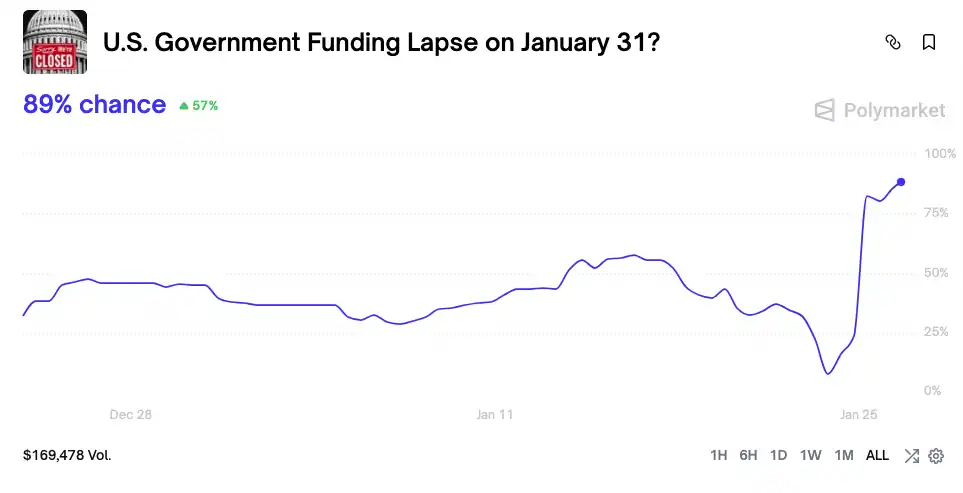
A government shutdown means a freeze in spending, with billions of dollars locked in the Treasury General Account (TGA) unable to flow into the market. The TGA becomes a one-way financial black hole, sucking liquidity out of the market. The shutdown in October 2025 withdrew over $200 billion from the market in just 20 days, comparable to multiple rounds of rate hikes.
As the reserve balances of banks are heavily drained into the TGA, the market's funding cost surges. The crypto market, always the most sensitive to liquidity, is the first to feel the chill.
Looking back at the 43-day shutdown in October 2025, Bitcoin's trajectory was quite dramatic:
• Early Shutdown Period (October 1-10): Bitcoin hit a historical high of $126,500 on October 6. The market generally believed that the government shutdown would highlight the value of decentralized currency.
• Mid-Shutdown Period (October 11-November 4): The duration of the shutdown exceeded everyone's expectations. During the policy vacuum period when everyone thought the shoe was dropping, the crypto market experienced the 1011 liquidity black swan event, plummeting to $102,000, a drop of over 20% from the peak.
• Shutdown Late Stage (November 5-12): The price fluctuated around $110,000 and did not immediately bounce back as the shutdown was about to end.
Once bitten, twice shy, this time the market's reaction to the government shutdown was more direct and swift. Within 24 hours of the escalating shutdown risk, Bitcoin plummeted from $92,000 to below $88,000. The market seemed to have learned its lesson from the last time, no longer seeing the government shutdown as a positive development, but rather pricing it directly as a liquidity negative.
Japan's "Butterfly Effect"
Another straw that broke the camel's back came from Tokyo. On January 19-20, 2026, Japan's 10-year government bond yield surged to 2.330%, hitting a 27-year high.
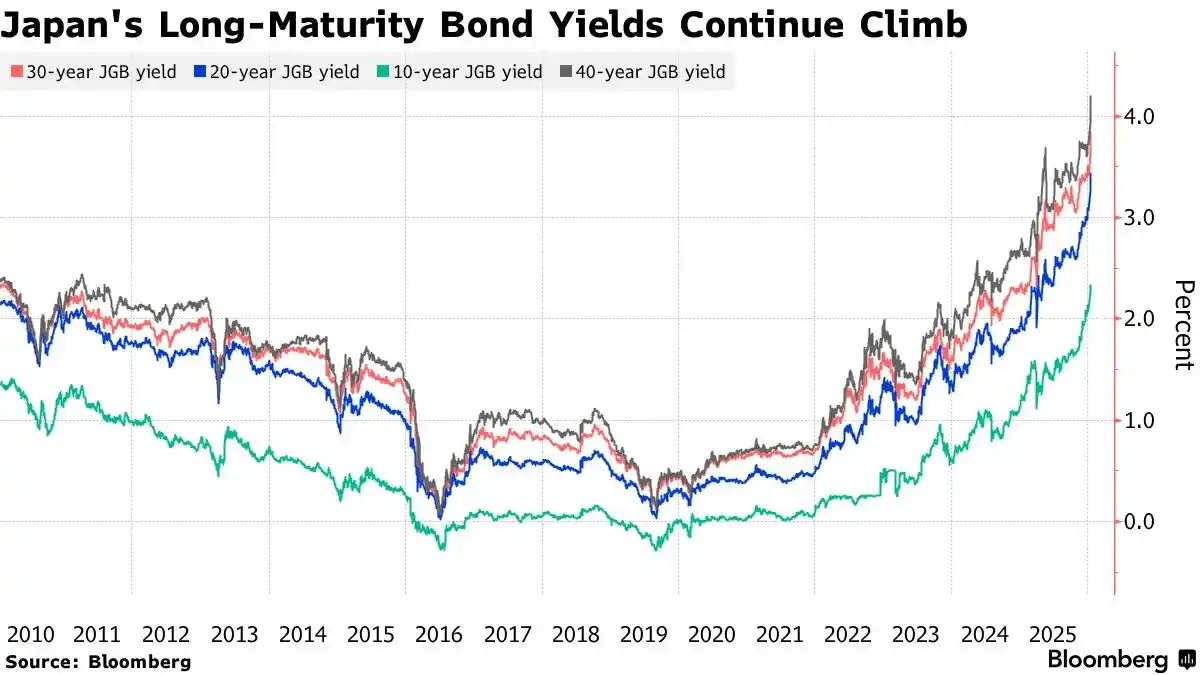
BOJ Rate Hike and Fiscal Expansion Expectations Drive Bond Yields to Highest Since 1999
This was driven by a reversal in the yen carry trade. Previously, investors borrowed low-interest yen, exchanged it for dollars, and invested in high-yield assets (such as U.S. bonds and Bitcoin).
However, the Bank of Japan has now started raising rates (increased to 0.75% in December 2025), and the new Prime Minister, Sanae Takai, announced an end to fiscal austerity, planning large-scale investments and tax cuts. This has sparked serious concerns about Japan's fiscal situation, leading to a sell-off of government bonds and a surge in yields.
More importantly, the fundamentals of the Japanese economy are now supporting this high-interest-rate environment as a long-term trend. Data from the Japanese Ministry of Internal Affairs and Communications shows that in November 2025, Japan's unemployment rate remained stable at 2.6%, maintaining a "full employment" status for 59 consecutive months. The strong labor market has given the Bank of Japan confidence to continue raising rates. This Friday (January 31), Japan will release the unemployment rate for December, with the market generally expecting it to remain low, further reinforcing rate hike expectations.
The surge in Japanese bond yields has raised global borrowing costs and further squeezed the interest rate differential of the yen carry trade. Carry traders have been forced to unwind their positions, selling off dollar assets to buy back yen, triggering a global market liquidity crunch that seems poised to persist.
Pre-Key Data "Risk-Off Period"
On Thursday at 3 a.m. (Beijing time), the Federal Reserve's FOMC will announce its rate decision, and Fed Chair Powell will hold a monetary policy press conference; on Friday, Japan will release its December unemployment rate, and the U.S. will release its December PPI data.
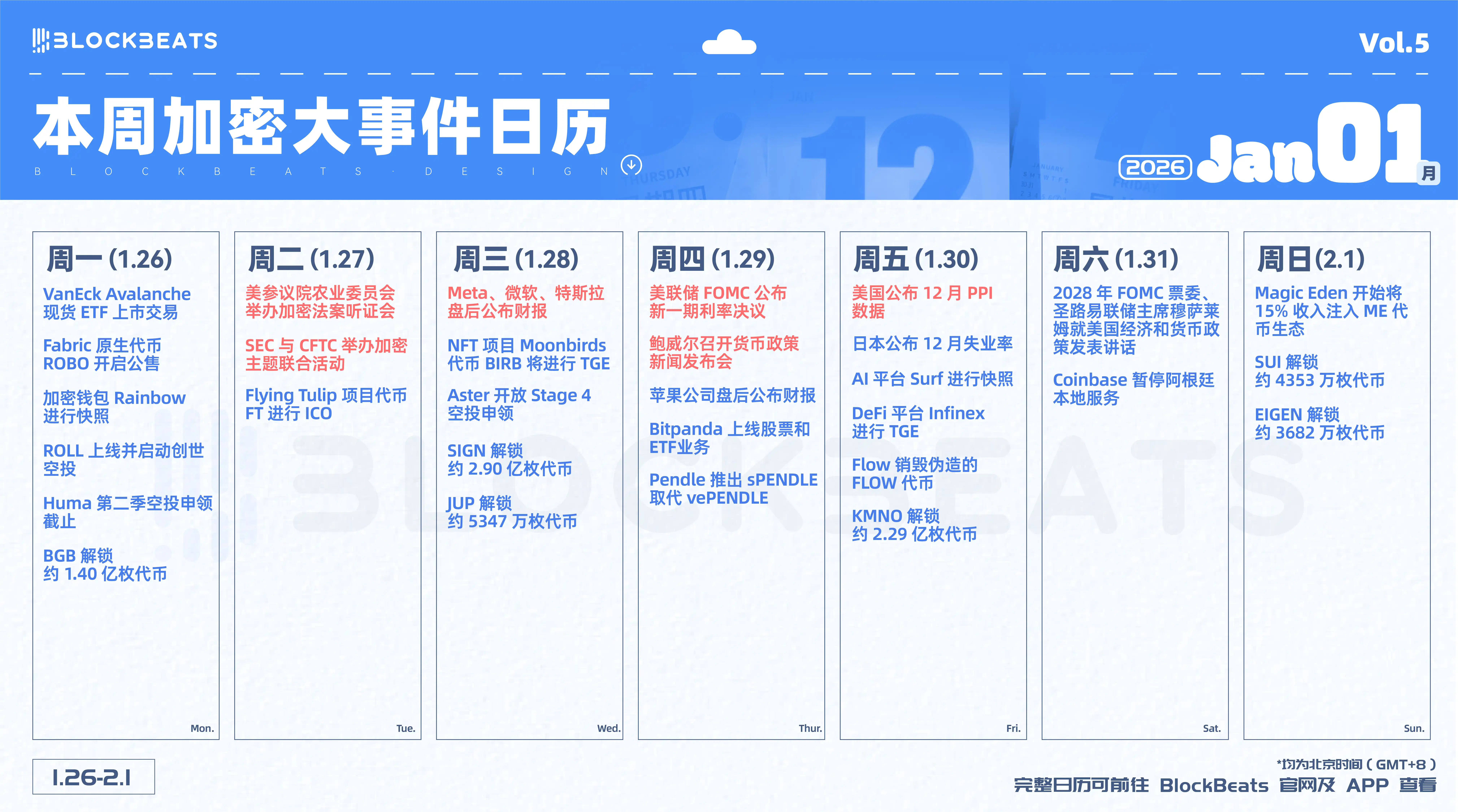
In a key data release week, large funds generally choose to enter a "quiet period" to reduce risk exposure, waiting for uncertainty to dissipate. This risk-averse sentiment has further intensified selling pressure in the market.
Historical data shows that in the 5-7 days leading up to the FOMC announcement, the price of Bitcoin often exhibits weakness, following a pattern of "pre-meeting decline." For example, ahead of the FOMC meeting in December 2025, Bitcoin retraced from a high of $94,000 to around $90,000. Similarly, prior to the October 2025 meeting, Bitcoin dropped from $116,000 to below $112,000.
Behind this pattern is the risk mitigation strategy of large institutional investors. Prior to the clarity of Fed policy, they tend to reduce their exposure to risk assets to prepare for potential unexpected policy changes.
Liquidity "Seesaw"
Without incremental macro liquidity, both the global market and the crypto market face a liquidity game of existing stock, with the crypto market's liquidity being siphoned by all markets, and mainstream coins like BTC being meme-siphoned.
Bitcoin ETF vs Gold ETF
If macro factors are considered long-term concerns, then fund flows are a more direct short-term worry.
The approval of a Bitcoin spot ETF in early 2025 was seen as the "engine" of the bull market. However, data shows that since mid-January, the inflow of ETF funds has significantly slowed down, with even 5 consecutive days of net outflows totaling as much as $1.7 billion.
Meanwhile, gold and silver ETFs have been consistently attracting funds. In 2025, gold ETFs saw their strongest inflows since 2020, with total holdings increasing by over 220 tons.
As we enter 2026, this trend continues, with the net inflow into gold, silver, and other precious metal ETFs in the first three weeks of January reaching as high as $4 billion.
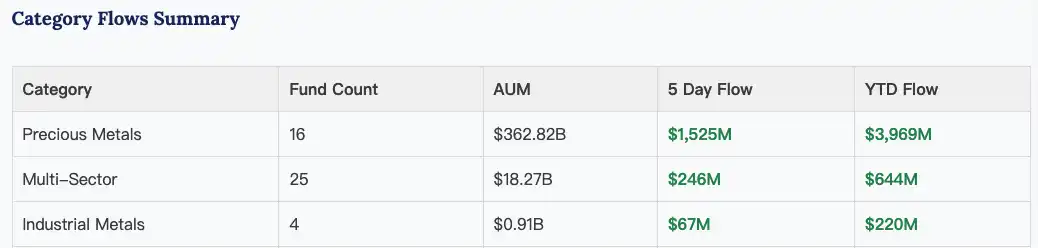
Precious Metal ETFs Have Seen a Total Inflow of About $4 Billion Since January|Source: ETF Action
This stark contrast reflects a fundamental shift in market risk appetite. Against the backdrop of heightened macro uncertainty, funds are flowing from high-risk assets like Bitcoin to traditional safe-haven assets like gold and silver.
The Return of Memes
While facing a macro winter, the crypto market is experiencing a split between ice and fire. On one side, Bitcoin continues its downward trend, while on the other side, Meme coins are having a blast.
A Solana Meme coin called the "Nietzschean Penguin" ($PENGUIN) skyrocketed by a hundredfold in just 2 days due to an AI-generated image of Trump with a penguin posted on the official White House Twitter account, briefly reaching a market cap of $170 million.
Behind this phenomenon lies an extremely suppressed market sentiment.
When the macro narrative fails, value investing underperforms, incremental fund flows from ETFs slow down post-1011, the wealth effect in the crypto space diminishes, and existing funds start pouring into Meme coins in search of short-term wealth accumulation opportunities.
This is a mentality of both "doomsday celebration" and "desire to break even": if value coins don't rise, then why not speculate on meme coins.
However, investors' "chasing gains" and "breaking even" emotions are often more easily captured and exploited by the "players." The "Nietzschean Penguin" received endorsements from A16Z, Solana's official account, the White House, and Musk's accounts within two days, showing that this was not an unexpected event.

The White House tweeted three "penguin"-related tweets within two days
Looking back, every time emotions ran high, followed by a strong background in the meme market, it seemed to be accompanied by a sharp decline in the overall market. This spread of sentiment further drains liquidity from mainstream coins, creating a vicious cycle.
The current liquidity in the crypto space is much lower compared to December 2024 and October 2025, so the White House and various Twitter influencers are actively retweeting to boost engagement. The current upper limit of the "Nietzsche Penguin" is also staying at less than 200M.
Will the Storm Continue?
While the debate about Bitcoin's "four-year cycle" continues, since Bitcoin dropped below $110,000 on October 11, 2025, the crypto market seems to have entered a bear market, and liquidity has become increasingly scarce during a three-month-long period of turbulence.
However, this time, the situation we face is more complex. The short-term market trend will depend on Washington's political maneuvering, the Federal Reserve's policy signals, and the tech giants' earnings reports.
In the longer term, the global economy seems to be on edge due to geopolitical tensions, stuck in a cycle of debt printing and economic bubbles.
And Trump is still like a "bomb" waiting to go off at any moment.
On January 17, the Trump administration threatened to impose a 10% import tariff on eight European countries, including Denmark, Norway, Sweden, France, and Germany, to pressure them to make concessions on the Greenland issue. Although Trump temporarily abandoned the tariff threat after meeting with the NATO Secretary-General on January 21, the "art of the deal" is still full of uncertainties.
On January 24, Trump once again threatened to impose a 100% tariff on all Canadian exports to the U.S. to prevent Canada from reaching a trade agreement with China.
No one can predict what other "crazy" moves he will make next for his midterm reelection.
For investors, now may not be a good time to chase gains in other assets. In the "January Siege," exercising patience and caution, waiting for the macroeconomic fog to clear, may be the only choice.
Welcome to join the official BlockBeats community:
Telegram Subscription Group: https://t.me/theblockbeats
Telegram Discussion Group: https://t.me/BlockBeats_App
Official Twitter Account: https://twitter.com/BlockBeatsAsia