Freeze of Payments! An Article to Help You Understand the All-New OKX C2C Upgrade

“At first, I was quite annoyed when my card was frozen, but later I got used to it,” a crypto user named Long said. The first time his card was limited, he held a thick stack of bank statements, transfer screenshots, identification documents, and other files, shuttling between the bank and the police station to explain, almost missing his mortgage payment. Over time, he treated it as a “routine matter.” For newcomers, sudden card freezes can easily cause anxiety; whereas experienced users will conduct strict self-checks and pay more attention to secure transactions.
Crypto C2C is a user-driven peer-to-peer transaction. Fiat currency is mostly transferred outside the platform through banks or payment tools, while the crypto is held in custody on the platform, released only after the receipt confirmation. Since the counterparty is self-selected, users need to judge the counterparty's credibility and compliance by themselves, being wary of fake credentials, third-party payments, and funds from unknown sources. While compliant platforms can reduce risks, they struggle to entirely isolate the upstream abnormal fund flows, which, when severe, may trigger account risk control measures or even card freezes.
To address these real pain points, leading industry platforms are enhancing the trading experience through risk control systems and post-event safeguards. As a top-tier product in the industry, OKX C2C, leveraging its vast trading volume and user base, has been exempting transaction fees in the long term; its merchants maintain an average order completion rate of over 95%, with decreasing fraud and freeze rates, having recovered funds for users from loss-making orders totaling tens of millions of dollars. Behind these metrics lies the platform's systematic investments in identifying illicit activities, verifying fund flows, and managing merchant admissions.
Building upon this foundation, OKX C2C continues to innovate. It has officially launched the “Freeze Compensation” system, further integrating risk mitigation into the user experience: users engaging in transactions with merchants bearing the “Freeze Compensation” label in the C2C trading zone will still enjoy fee waivers; if their receiving accounts are frozen due to the counterparty's payment, they can receive fund compensation according to platform rules, with a maximum compensation rate of 100% and a single transaction limit of 30,000 USDT. Compared to existing industry safeguards, this compensation amount is higher, showcasing the platform's determination and capability in safeguarding user funds.
Next, this article will take you deeper into OKX C2C, starting from the basics, to uncover what efforts it has made to facilitate secure trading for users.
How can a user fall into a trap of non-verification and a “Rug Pull” scam in a C2C transaction?
Marry (alias) is an OG user in the crypto industry, and C2C trading has always been her forte. However, a recent transaction plunged her into an unexpected turmoil. It all started with a routine transaction. During the operation, the merchant suddenly claimed that the “payment account balance was insufficient” and requested to use a friend's account for payment, assuring Marry that it was just a temporary measure and would not impact fund security. Out of trust, Marry agreed to this arrangement and smoothly completed the transaction. However, just a few hours later, she was informed that her bank account had been frozen. The bank's customer service feedback stated that the fund was flagged as “high-risk source,” triggering the bank's risk control mechanism.
This incident forced Marry to temporarily halt her daily transactions, plunging her into a lengthy and complex unfreezing process. She realized that the core reason for the issue was the merchant's inducement for her to accept non-real-name payment. Fortunately, Marry promptly contacted OKX C2C customer service for help. The OKX C2C customer service team promptly intervened, assisting her in communicating with the merchant, requesting cooperation to provide proof of funds. With the strong support of OKX C2C, Marry finally completed the unfreezing process, while the merchant was permanently banned from trading for violating transaction norms.
On the other hand, Tom's (pseudonym) experience was slightly different, as he went through a more severe form of a "Rug Pull" transaction (referring to an investment scam that exploits emotions or trust). Tom (pseudonym), who had just entered the crypto world, initially planned to complete a regular transaction through C2C. However, what seemed like a simple operation this time turned into a nightmare for him. After reaching an agreement with an OKX C2C merchant, the merchant suggested adding WeChat for "easier future transactions." Out of trust, Tom accepted the invitation. A few days later, the merchant enthusiastically shared market analysis with him during the chat and recommended a smaller exchange with "higher returns." The other party sent a registration QR code and promised to provide step-by-step guidance. Under the merchant's guidance, Tom registered and made a deposit at the exchange. Shortly after, the funds on the exchange became unwithdrawable, and the merchant completely disappeared. It was only then that he realized he had become a target of a "Rug Pull" scam.
Tom reached out to OKX C2C for assistance. Despite the issues caused by individuals and other platforms, the OKX C2C team promptly set up a dedicated group to conduct an investigation. On one hand, the group assisted Tom throughout in collecting and organizing key evidence for support to relevant institutions or banks; on the other hand, following the merchant behavior rules, decisive account banning measures were taken against the violative merchant.
Some merchants take advantage of users' trust to involve them in illicit transaction chains. OKX C2C has repeatedly reminded users to remain vigilant during transactions, avoid engaging in off-platform transactions with unknown merchants, refrain from accepting non-real-name payments, and avoid using payment methods not supported by OKX C2C. Otherwise, users are highly likely to incur losses within Rug Pulls or fall into high-risk funds.
User Bob (pseudonym) frequently engages in Bitcoin transactions through OKX C2C. Once, Bob placed a sell order for 10,000U worth of Bitcoin. A verified merchant promptly accepted the order and agreed to pay via bank transfer. However, when Bob received the payment, he found that the received amount was 10% less than expected. Despite the system showing the transaction as completed and the Bitcoin being transferred out, Bob's receipt was significantly off. This left him feeling helpless and questioning the merchant's integrity. Bob immediately submitted an issue feedback to OKX C2C, attaching the bank transfer screenshot and order details. When it comes to user loss-related issues, the OKX C2C customer service team initiated an investigation promptly.
Just under 24 hours later, OKX C2C customer service provided a solution. The merchant had made an operational error during the transfer, failing to send the full amount. The merchant was now requested to make up the difference and their account would undergo further review and education. In the end, Bob smoothly received the remaining payment and received an apology from the OKX C2C merchant.
If a user encounters a negative trading experience as described above, such as non-real-name payments and fraudulent transactions, they can seek help from OKX C2C customer service or report it immediately.
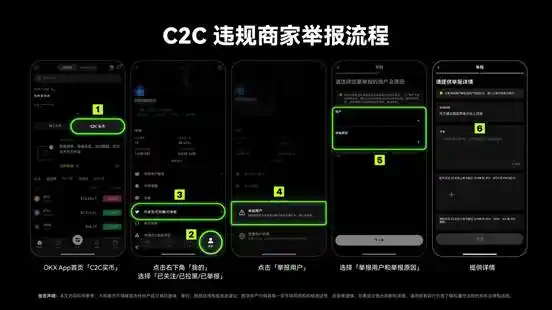
Image: OKX C2C Violation Merchant Reporting Process
Risk Prevention and Control, Strengthening Merchant Review and Transaction Monitoring
"When I first started using OKX C2C, I almost gave up," Evan admitted. The process of becoming an OKX C2C merchant was more rigorous than any platform he had experienced before. Submitting personal identification, and even needing to provide proof of merchant transaction validation, were required. But it was this "trouble" that ultimately led Evan to choose OKX. "Although the verification process is strict, it made me confident in OKX's professionalism and security. After all, the stricter the rules, the more high-quality users it attracts, which also means lower risks."
Over the past few years, C2C merchant Evan has encountered phishing buyers and fraudulent activities several times on other platforms. "Once, a buyer quickly reversed a transfer after payment, causing me to lose tens of thousands," Evan recalled. However, since switching to OKX C2C, this situation has not recurred. "OKX C2C's risk control system is very intelligent," Evan mentioned. OKX C2C not only monitors suspicious accounts but also ensures the authenticity of every transaction through manual review. "Once, a buyer's payment was delayed for a few hours, and I thought I was being scammed. However, the OKX C2C customer service team promptly intervened, confirming that the buyer was indeed delayed in payment due to a network issue. This made me feel very reassured."
Evan observed that OKX C2C's strict review and risk control mechanisms not only protect merchants but also enhance users' trading experience. "When users know they are trading on a secure platform, they naturally are more willing to use it long term. This trust is irreplaceable." Now, Evan has become a high-quality OKX C2C merchant, easily completing several transactions every day. He mentioned that he rarely considers other platforms anymore. "OKX's rigor has saved me a lot of trouble, allowing me to focus on improving the quality of my service."
"Sometimes, strict rules may seem inconvenient, but in the long run, they are the guarantee that C2C products can go further," Evan summarized. In his view, OKX is not just a trading platform, but also a reliable choice for C2C merchants.
How has OKX C2C continuously reduced fraud transactions and frozen card rates? Unveiling the high threshold to become an OKX C2C certified merchant.
One of the main reasons for C2C acceptance being frozen is that during the transaction process between users and merchants, funds of unknown origin or suspected of being illegal (i.e., so-called "black money") flow into user accounts. In accordance with anti-money laundering requirements, banks or relevant institutions may intercept suspicious transactions or freeze accounts for investigation. Therefore, in C2C transactions, the qualification and behavior of merchants are a key link to ensuring transaction security.
Based on the specific market situation, OKX C2C has formulated the "OKX Platform Certified Merchant Trading Code of Conduct," which clarifies the code of conduct and boundaries for merchants in C2C transactions, covering norms for payments, account anomalies, order disputes, and other aspects, making merchant behavior traceable. Once violations occur, merchants will face penalties ranging from warnings to frozen accounts or even permanent removal. At the same time, through locking and risk control mechanisms, user rights are prioritized.
OKX's screening of certified merchants begins before the application process. Initially, a rigorous account filtering and risk control strategy is implemented, which prioritizes the exclusion of potential high-risk users to ensure the reliability of applying merchants' qualifications. For example, in terms of application requirements, a specialist conducts a one-on-one review, including identity verification, order completion rate, order volume, and other specific requirements. Merchants are also required to deposit a security deposit to ensure their understanding and acceptance of the platform's code of conduct. Additional filtering measures are taken for new applicants to prevent unqualified merchants from entering.
Passing the initial merchant threshold is just the beginning; to upgrade to a certified merchant, more stringent conditions must be met. For example, requirements include trading for more than 16 days, serving over 50 users, and not triggering risk controls.
Even after certification, merchants face ongoing risk control monitoring and strict management. The OKX C2C risk control team conducts real-time monitoring of merchants through multi-dimensional data analysis to build dynamic risk models, analyzing behavior patterns, transaction amount fluctuations, and other dimensions. By utilizing big data and artificial intelligence technology, risk identification is preemptively carried out before transactions. The system accurately captures abnormal factors that could lead to issues by analyzing transaction behavior patterns, fund flow paths, and account historical data, thereby reducing risk exposure at the source.
To provide users with a safer and more convenient experience, the OKX C2C risk control team also dynamically adjusts risk control strategies by introducing machine learning algorithms to adapt to complex and changing trading scenarios. Immediate intervention is taken upon detecting abnormal behavior, reducing potential fraud risks.
OKX C2C not only provides free services to merchants, but also offers comprehensive education and support to ensure that merchants understand and comply with the rules.
"Compared to a simplistic risk control approach, OKX focuses more on balancing user experience and security, with their goal being to create a more transparent and trustworthy trading environment for users," said Key, an OKX C2C merchant who chose to remain anonymous. Key has earned recognition from users and peers for his conservative operating style. In an interview, he admitted that although the digital asset trading market is profitable, he has always held a belief: "Safety first. No matter how much money unreliable orders offer, I won't take them."
"Freeze Compensation" Merchants Go Live, Up to 100% Compensation Ratio
To further integrate risk hedging into the user experience and reduce the risk of frozen funds, OKX C2C has officially launched a new "Freeze Compensation" system. Simply put, moving forward, when users trade in the OKX C2C trading zone with merchants marked with the "Freeze Compensation" label, they will not only enjoy fee-free transactions, but also be eligible for corresponding fund compensation according to the platform's rules if their receiving account is frozen due to the counterparty's payment: with a maximum compensation ratio of up to 100% and a single compensation limit of up to 30,000 USDT. This compensation amount is much higher than the protection previously offered by other platforms, fully demonstrating OKX's determination and strength in ensuring the security of user funds.
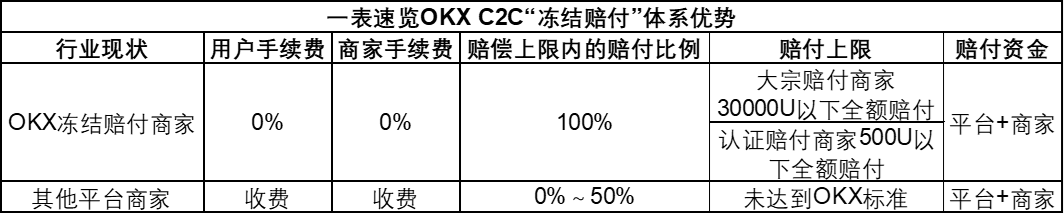
The compensation funds from OKX are supported by both the platform and merchants, rather than solely relying on merchant margins. This means that even in the event of large-scale compensation, the platform has sufficient funds to back it up, so users do not need to worry about merchants being unable to compensate them. OKX's move is aimed at "creating the most trustworthy trading environment and making every transaction worry-free." For traders who have been plagued by frozen funds, OKX C2C is currently one of the safer and more worry-free platforms for fund transfers.
Another pleasant surprise for users is that OKX has promised that all C2C trading orders will not incur any transaction fees. Regardless of the order size, users trading cryptocurrency with "Freeze Compensation" merchants will enjoy fee-free transactions. In the current situation where OTC trading fees are commonly charged by various platforms, this undoubtedly significantly reduces users' transaction costs, demonstrating OKX's sincerity in rewarding users with real benefits.
OKX's recently announced "Freeze Compensation" rules are very detailed, aiming to be fair and transparent. According to the official explanation, the compensation amount will be calculated in tiers based on order size and merchant type (see table below). In short:
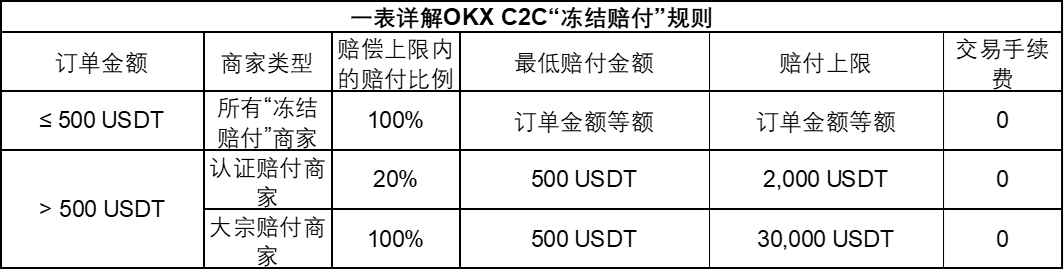
In contrast, bulk compensation merchants provide 100% compensation within the compensation limit for large orders, with a minimum compensation of 500 USDT and a maximum of 30,000 USDT. This means that if a user transacts 10,000 USDT with a bulk compensation merchant and faces a freeze, the maximum compensation is 10,000 USDT; even if the transaction amount is higher (e.g., 50,000 USDT), the maximum compensation limit is 30,000 USDT. This limit basically covers the common scale of a regular trader's single acceptance, sufficiently addressing most risk situations.
Of course, "Freeze Compensation" is not unconditionally applicable. Only when transacting with an "OKX-certified Freeze Compensation" merchant can this guarantee be enjoyed. These merchants have undergone strict screening by the platform in multiple dimensions and are either bulk compensation merchants with outstanding performance and large security deposits or high-quality merchants certified by the platform who have pledged to provide compensation according to the rules. They will have a prominent "Freeze Compensation" label on their accounts, making it clear to users when placing orders.
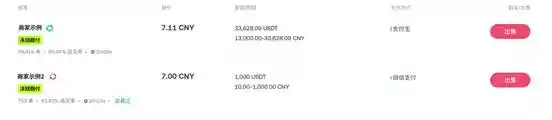
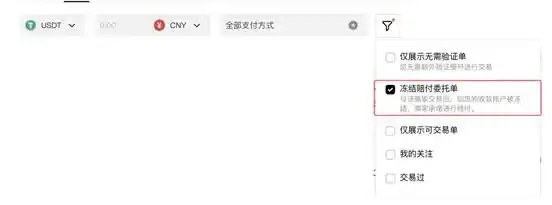
Furthermore, to facilitate user selection, OKX has added a dedicated filtering function on the C2C trading interface. Users can also directly choose to transact with "Freeze Compensation" merchants in the filtering function, making it quicker and more reassuring.
After becoming a compensation merchant, OKX also conducts ongoing supervision. For example, merchants are required to comply with the "Freeze Package Compensation" service guidelines and are prohibited from using false promises to induce transactions. Once a user complaint arises and is verified as the responsibility of the merchant, the platform has the right to take measures against the merchant based on the situation, such as deducting points, imposing fines, freezing accounts, or even canceling compensation eligibility. For merchants who actively fulfill their compensation obligations and demonstrate outstanding performance, OKX provides rewards such as traffic tilt and exclusive ranking to incentivize them to provide even better services.
Through this strict admission and management mechanism, OKX aims to transform "Freeze Compensation" merchants into the "benchmark merchants" of the platform's C2C trading. They not only provide a good trading experience and speedy transactions but, more importantly, provide insurance for user funds. For merchants, obtaining compensation qualifications also means a higher endorsement of credibility and platform support, helping attract more users to trade with them.
At the same time, OKX also reminds users: During the trading process, it is still necessary to comply with the platform's risk control rules, such as verifying the receiving account information and promptly confirming receipt of payment, to avoid unnecessary disputes. If suspected fraud or fund anomalies occur, users should immediately request customer service intervention, and the platform will assist in handling the situation and take strict measures against non-compliant merchants, including compensation.
Risk Control Team Collaboration, OKX C2C Provides 24/7 Appeal Channel and Locking Mechanism
What to Do If Your Card Is Frozen? How Can Users Apply for Compensation?
When a user discovers that their account is frozen, they should first contact their bank to confirm if it is a legal freeze and the duration of the freeze. If it is indeed a legal freeze, the user needs to contact customer service to initiate an appeal and submit relevant documents for platform review. Upon approval of the appeal, the merchant must complete the compensation within 30 working days after receiving the notification. If the compensation is not made in time, the platform will directly deduct it from the merchant's security deposit upon receiving the user's appeal. If the security deposit is not replenished within 3 natural days after being forcibly deducted, the platform will suspend the merchant's order placement rights until the security deposit is fully topped up.
How Should Users Handle Disputes?
When user Alice was engaging in a C2C transaction on OKX, the merchant clicked the "Payment Made" button without completing the payment.
"My immediate reaction was to contact the other party, but they did not respond positively," recalled Alice. "Even though I am a long-time user, I was still a bit anxious this time." Upon realizing the anomaly, she promptly used the 24/7 appeal channel provided by OKX C2C and submitted relevant transaction records and evidence.
Upon receiving Alice's appeal, the OKX C2C customer service team promptly initiated a verification process, confirmed through transaction records that the merchant had not uploaded a valid payment voucher, and contacted the merchant to verify the situation, urging them to complete the genuine transfer as soon as possible. Simultaneously, they froze the merchant's account privileges to prevent similar situations from affecting other users' normal transactions.
The customer service team also collaborated with the risk control department to conduct in-depth analysis of the transaction. Through an IM chat monitoring system, they reviewed the merchant's communication records, noticed multiple communication disruptions, and identified abnormal language content. Building on this, the OKX C2C risk control team utilized a big data analysis system to comprehensively investigate the fund flows of the merchant and related accounts. Although no connection to other risky accounts was found, as the merchant failed to provide a valid payment proof, further evidence of their misconduct emerged.
However, as the merchant still did not fulfill the payment obligation on time, OKX C2C relied on the locking transaction mechanism to promptly refund the funds to Alice, ensuring her trading rights were not compromised. At the same time, based on the "OKX Platform Certified Merchant Transaction Code of Conduct," OKX C2C froze the implicated merchant's account to prevent similar incidents from impacting other users' trading experience.
Alice acknowledges the processing result and appreciates OKX C2C's swift response and thorough investigation at a critical moment.
The head of OKX C2C stated, "We have always prioritized user rights, not only ensuring the security of funds for each transaction through technical means but also restraining and managing certified merchants through strict behavioral norms. In the future, we will continue to optimize our service process to create a more secure and efficient trading environment for users."
OKX C2C is continuously enhancing its risk control system. On one hand, through a strict merchant control mechanism that covers the entire transaction process from application review to behavior monitoring; on the other hand, OKX C2C actively encourages users to report suspicious activities and provides rewards to incentivize participation. Additionally, OKX C2C will alert users to potential transaction risks before each transaction and regularly conduct security education activities to increase user awareness of risk prevention.
End-to-End Support and Product Innovation
The C2C business team covers modules such as customer service, risk control, and product, with over a hundred dedicated professionals responsible for the secure operation and service of the product, providing round-the-clock support for merchants and users.
In addition to customer service, merchant operations, and the risk control team, OKX C2C has implemented a series of upgrades on the product side to provide a more secure and transparent trading environment for users and merchants. Key shared that he is not only an OKX C2C merchant but also a heavy user of OKX options, Earn, and other products, thus achieving better income and risk hedging.
Since its launch, OKX C2C has gradually expanded from providing basic digital asset trading services to a trading product that fully supports various payment methods and currencies. Initially, OKX C2C supported a limited number of currencies, mainly including mainstream currencies such as USDT, BTC, and ETH. With the diversification of market demand, the supported currencies have been further expanded, including stablecoins like USDC, to meet the trading needs of different users. In addition, the diversification of payment methods has increased trading flexibility and now supports various common payment methods such as bank transfers.
With the continuous improvement of user experience demands, OKX C2C has carried out multiple iterations to optimize its interface, operation process, and response speed, aiming to enhance trading convenience and efficiency. It has also introduced a price protection mechanism to address the impact of extreme market fluctuations on transaction prices, ensuring that users can still obtain fair trading conditions in an unstable market. Additionally, OKX C2C has enhanced the user experience of its mobile application, allowing users to trade anytime, anywhere.
To improve trading efficiency, OKX C2C has introduced an intelligent matching system that automatically matches suitable buyers and sellers based on user needs, increasing the success rate of matching. For large trades, there is a dedicated OTC trading area allowing verified merchants to conduct large-volume transactions, providing market depth and liquidity. To allow users to better compare buy and sell order book prices and trading depth, a book mode has been launched. Furthermore, OKX C2C offers a zero-fee trading policy, further attracting a large number of users to participate. To ensure the security of trading funds, OKX C2C has also introduced a merchant "verification order" function, allowing merchants to verify the counterparty's payment flow to ensure stable fund movement.
The global digital asset trading ecosystem is gradually transitioning from "disorderly expansion" to "secure standardization." OKX's C2C risk control strategy is particularly prominent in this trend, achieving end-to-end security management through dynamically adjusting merchant verification rules and introducing intelligent risk control algorithms, implementing "preventive measures, ongoing monitoring, and retrospective accountability." Importantly, these measures not only protect ordinary users but also enhance the overall market transparency and trust.
Disclaimer:
This article is for reference only. The views expressed in this article are those of the author and do not represent the position of OKX. This article does not intend to provide (i) investment advice or investment recommendations; (ii) an offer or solicitation to buy, sell, or hold digital assets; (iii) financial, accounting, legal, or tax advice. We do not guarantee the accuracy, completeness, or usefulness of such information. Holding digital assets (including stablecoins and NFTs) involves high risks and may experience significant volatility. Past performance does not represent future returns, and historical performance does not represent future results. You should carefully consider whether trading or holding digital assets is suitable for you based on your financial situation. For your specific circumstances, please consult your legal/tax/investment professional. You are responsible for understanding and complying with local applicable laws and regulations.
This article is contributed content and does not represent the views of BlockBeats.
Welcome to join the official BlockBeats community:
Telegram Subscription Group: https://t.me/theblockbeats
Telegram Discussion Group: https://t.me/BlockBeats_App
Official Twitter Account: https://twitter.com/BlockBeatsAsia

 Related Articles