Institutional FOMO Propels BNB to New Heights, How Can Retail Investors Get in on the Action?

Original Title: "Under the Institutional Accumulation Wave of BNB, How Can Retail Investors Participate?"
Original Author: @viee7227, Biteye Core Contributor
Recently, BNB has experienced a remarkable round of structural rallies. After reaching an ATH in July, it once again broke through the ATH of $865.68 today. Along with several publicly traded companies heavily buying BNB as asset reserves, as well as ETF applications and other positive news, BNB, once seen as a "exchange platform coin" + "public chain ecosystem token," is now evolving towards being viewed as an "institutional reserve asset."
The rally behind this may not be just a temporary hype, but rather a reassessment of BNB's value and a shift in positioning. This article will delve into the path of BNB's "institutionalization" and explore various opportunities for retail investors to participate.
1. Review of BNB's "Institutionalization" Evolution Path
Over the past two months, three major events have occurred around BNB:
· Several U.S. publicly traded companies have included BNB in their asset reserves: Since July, multiple U.S. publicly traded companies have successively announced the purchase or funding allocation of BNB: for example, CEA Industries, with the support of Yzi Labs, plans to raise $500 million (expandable to $1.2 billion) to create the largest BNB reserve; Liminatus Pharma intends to invest up to $500 million for long-term BNB investments; Windtree Therapeutics has approved up to $700 million in funds for acquiring BNB; Nano Labs plans to invest $1 billion to gradually hold 5% to 10% of the circulating BNB supply, with 128,000 BNB already purchased over-the-counter. This series of actions indicates that some institutions are now viewing BNB as a reserve asset akin to Bitcoin.
· ETF Trend: In early May, the well-known asset management company VanEck officially submitted a BNB ETF application to the U.S. SEC, including collateral and additional income. If approved, BNB is expected to become the focus of the next round of cryptocurrency ETF competition after Bitcoin and Ethereum.
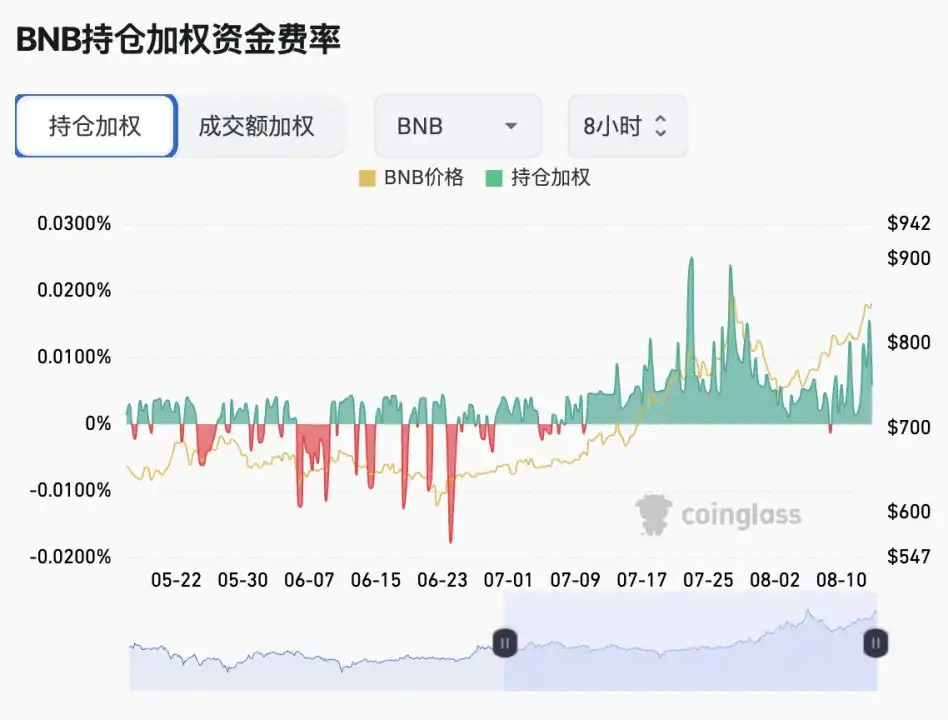
· BNB Price Breaks All-Time High: Buoyed by the above positive developments, BNB continued to strengthen and surged to a historical high of $865.68 on August 14th. The chart below shows that since mid-July, BNB's funding rate has continued to rise from negative to positive, reaching approximately 0.015%-0.03% every 8 hours between 7/23 and 8/14, rising in sync with the price. During the pullback phases, it did not stay negative for long, indicating a bullish dominance, with spot and leverage jointly driving the price up. The upward momentum is strong, and the structure is relatively healthy.
Source: Coinglass
The above event reflects BNB's institutionalized transformation, shifting from its previous reliance on the Binance ecosystem for internal value support to a new stage actively allocated by traditional institutions. With the influx of "Wall Street-style" buying pressure, BNB's value center has gained structural upward momentum, with a more long-term and stable source of demand. For retail investors, it is necessary at this point to reevaluate BNB's long-term potential and explore various ways to share the benefits of BNB's rise.
II. Retail Investor Opportunity 1: BNB Chain On-chain Strategies
For retail investors, actively participating in the BNB ecosystem on-chain is an important way to gain value increment, allowing participation in the dividends of the BNB Chain through various means such as DeFi, RWA, and Meme.
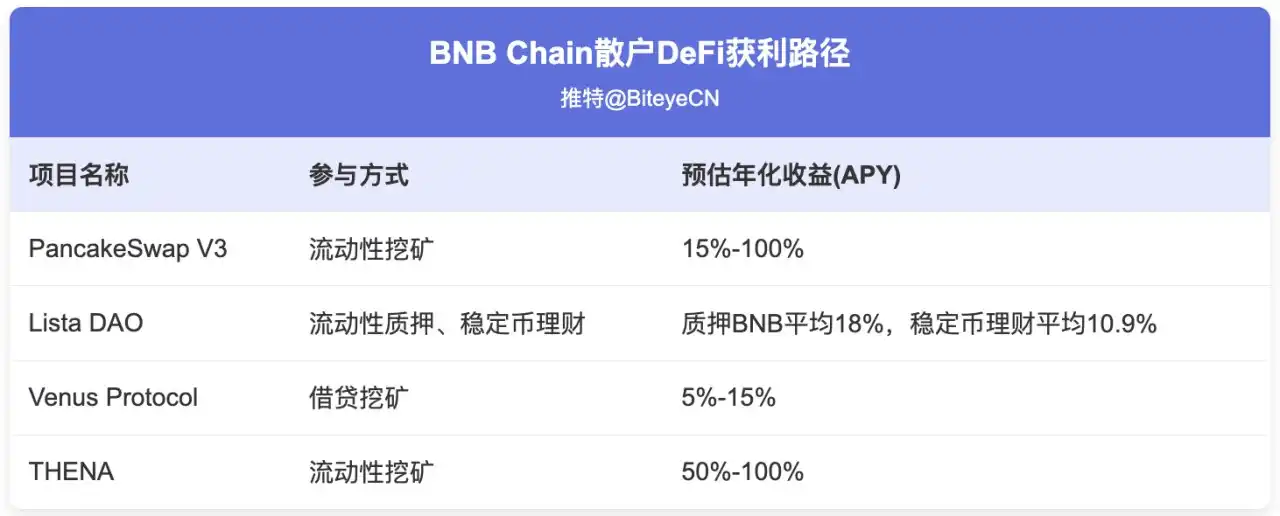
DeFi: The top DEX and lending protocol TVL on the BNB Chain are currently among the industry leaders. For example, the leading decentralized exchange platform PancakeSwap (V3) has a TVL of approximately $20 billion, providing liquidity pool returns for various token pairs; the established lending protocol Venus supports borrowing and lending of mainstream assets like BNB; Lista DAO's TVL has also reached $1 billion. Retail investors can choose suitable DeFi strategies based on their risk preferences (as shown in the following figure).
RWA: The BNB Chain is rapidly becoming an emerging platform for RWA on-chain. Ondo Finance announced in July that it is introducing tokenized products for over 100 U.S. stocks and ETFs to the BNB Chain, allowing global users to trade some U.S. assets 24/7. At the same time, the xStocks program launched by Kraken and asset management company Backed will also be deployed on the BNB Chain, supporting trading of 60+ U.S. stocks and ETFs. In the stablecoin sector, the Trump family company WLFI chose to launch the compliant stablecoin USD1 on the BNB Chain, which is now integrated into the BNB Chain DeFi ecosystem, offering a USD1 liquidity pool. Retail investors can more easily invest in U.S. stocks, treasuries, and more on the BNB Chain for diversified asset allocation.
Meme: At the beginning of the year, many iconic Meme tokens were born on the BNB Chain, creating unprecedented market enthusiasm. If you are interested in meme coin trading, you can explore the first Meme fair launch platform on the BNB Chain, Four.meme, and follow newly deployed tokens. Of course, remember that meme market trends are volatile, and as the current hype has significantly decreased, it is best to wait for a resurgence in popularity before investing. From a market opportunity perspective, meme popularity can bring considerable trading volume and new users to the BNB Chain, further boosting demand for BNB, indirectly benefiting BNB holders.
Overall, the BNB Chain ecosystem is in a phase of increasing traffic and value influx. For retail investors, this also means that on-chain opportunities are gradually emerging, allowing them to securely earn yields in blue-chip DeFi projects or explore RWA gameplay and even discover dark horse Memes. As BNB serves as the core value carrier of the BNB Chain, on-chain prosperity will eventually translate into support for the value of BNB. Therefore, deep involvement in the BNB Chain ecosystem is essentially growing together with BNB.
III. Retail Opportunity 2: Coin-Stock Resonance, "BNB Concept Stock" Ambush Strategy
Simply put, when a publicly traded company announces a significant purchase of BNB or includes BNB in its financial strategy, the price movement of these stocks becomes highly correlated with BNB. When BNB surges, they often experience synchronous or disproportionate increases, and vice versa. Therefore, if you have confidence in the fundamentals of BNB, you may consider ambushing relevant concept stocks before the market takes off. For example, as MicroStrategy continues to buy Bitcoin, retail investors buying MicroStrategy's stock is equivalent to indirectly betting on Bitcoin's trend, and sometimes MicroStrategy's stock price can even outperform Bitcoin's price increase during the same period. Now, with the rise of BNB institutional accumulation, it is expected to replicate such a coin-stock resonance effect.
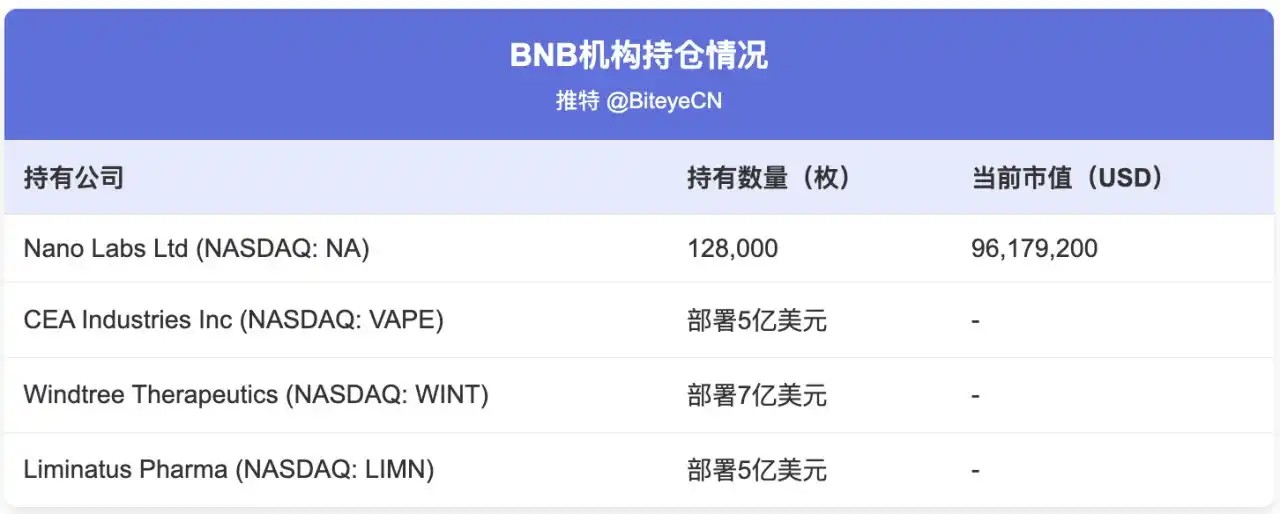
As mentioned earlier, several companies planning to include BNB in their asset reserves (as shown above) have stocks highly correlated with BNB. So how should retail investors operate and manage risks?
· Grasp the Information Rhythm: Pay close attention to the timing of the above companies' announcements regarding BNB. Often, the stock price has surged by the time the news is released, and chasing the price afterward increases the risk. For example, pay attention to key events such as SEC filings, fundraising, and completion of purchases. Position yourself at a low point before the news, and consider taking partial profits when the news is announced.
· Monitor BNB Price Linkage: These stocks are already highly correlated with the price of BNB. For example, when BNB broke above $800 at the end of July, stocks like CEA and Windtree saw intraday gains, and conversely, the stocks experienced some pullback. Therefore, you can use the BNB price movement as a leading indicator. If you believe that BNB will start a new uptrend, you can accordingly increase your holdings of related stocks and wait for resonance. However, be aware that if BNB experiences significant volatility, the stocks may undergo more intense roller-coaster movements.
· Pay Attention to Concept Stock and Binance Relationship: Some stocks have greater market confidence due to involvement from Binance or CZ. Therefore, you can observe whether the official entity provides further support to these companies, such as offering custody or strategic guidance. These signals will enhance the market's trust in concept stocks holding BNB, thereby raising their valuation.
error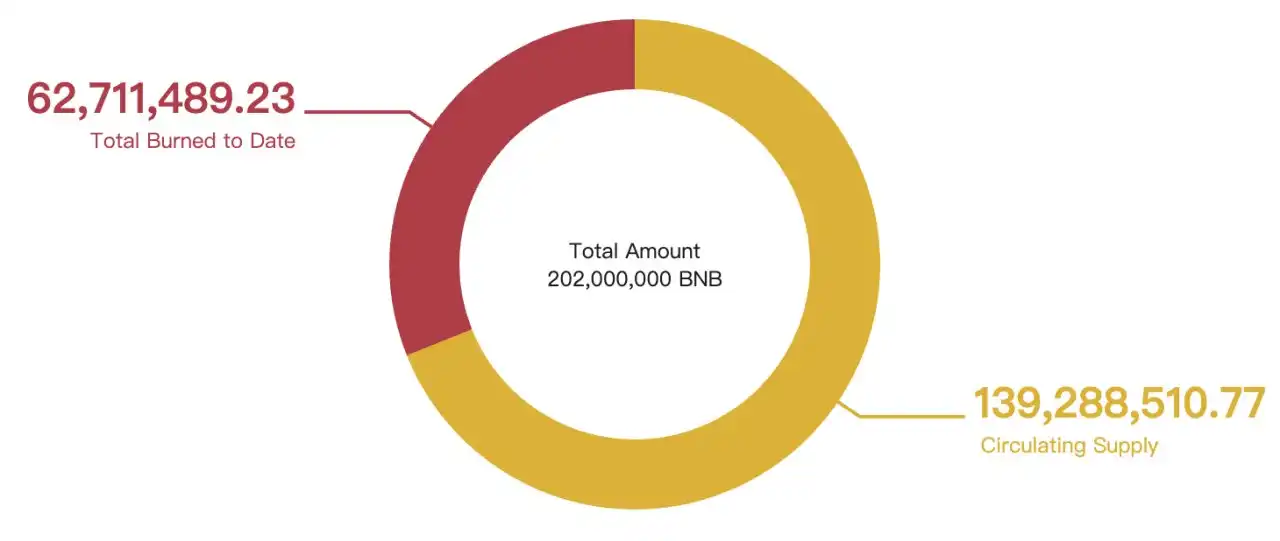
Source: bnbburn.info, Binance Research
Automatic Burn Mechanism: BNB's earliest burning method was based on the Binance exchange BNB trading volume. Starting from Q4 2021, a brand new automatic burn algorithm was introduced, which adjusts dynamically based on the BNB price and the number of blocks generated on the BNB Chain. For example, in the recent 32nd BNB quarterly burn, a total of 1,595,599.78 BNB were burned, valued at approximately $10.24 billion at the time of execution.
The formula for the automatic burn mechanism is shown in the figure below. B represents the amount of BNB to be burned this quarter, N represents the total number of blocks generated on the BNB Chain in this quarter (determined by a fixed block time), P represents the average price of BNB, and K is a constant (currently set to 250 after a hard fork upgrade). From the formula, it can be seen that the higher the price, the less is burned, and vice versa. The essence of this mechanism is to increase deflationary pressure in a bear market by reducing circulation to maintain the value peg of BNB, while automatically reducing the burning intensity in a bull market to avoid excessive supply contraction.

Real-time Burn Mechanism: In addition to the quarterly centralized burn, BNB Chain introduced the BEP-95 protocol in 2021 to achieve on-chain real-time burning. A fixed proportion of the Gas fees paid for each BNB Chain transaction platform is directly burned. The more prosperous BNB becomes, the more BNB is burned. Over the long term, the growth in on-chain activity will also drive an increase in transaction volume, triggering more real-time burns.
For retail investors, the deflation of BNB implies increased scarcity. Assuming demand remains stable or grows, a reduction in supply will drive up the intrinsic value of each token. This is similar to a public company continuously buying back shares to increase earnings per share and net assets, which is bullish for the stock price. It is worth noting that the BNB supply limit is around 1 billion tokens and will not decrease indefinitely to avoid impacting network security. Therefore, as the supply approaches 1 billion tokens, it will be necessary to consider whether to adjust policies, such as transitioning to maintaining a constant inflation rate. However, at least in the coming years, the deflation trend is evident.
Six, BNB Valuation Reassessment and Future Prospects
With institutional participation, traditional financial institutions are also reevaluating the value of BNB. For example, Standard Chartered Bank stated in a report in May of this year that it expects the BNB price to double by the end of 2025, reaching around $1275, and is expected to further rise to around $2775 by the end of 2028.
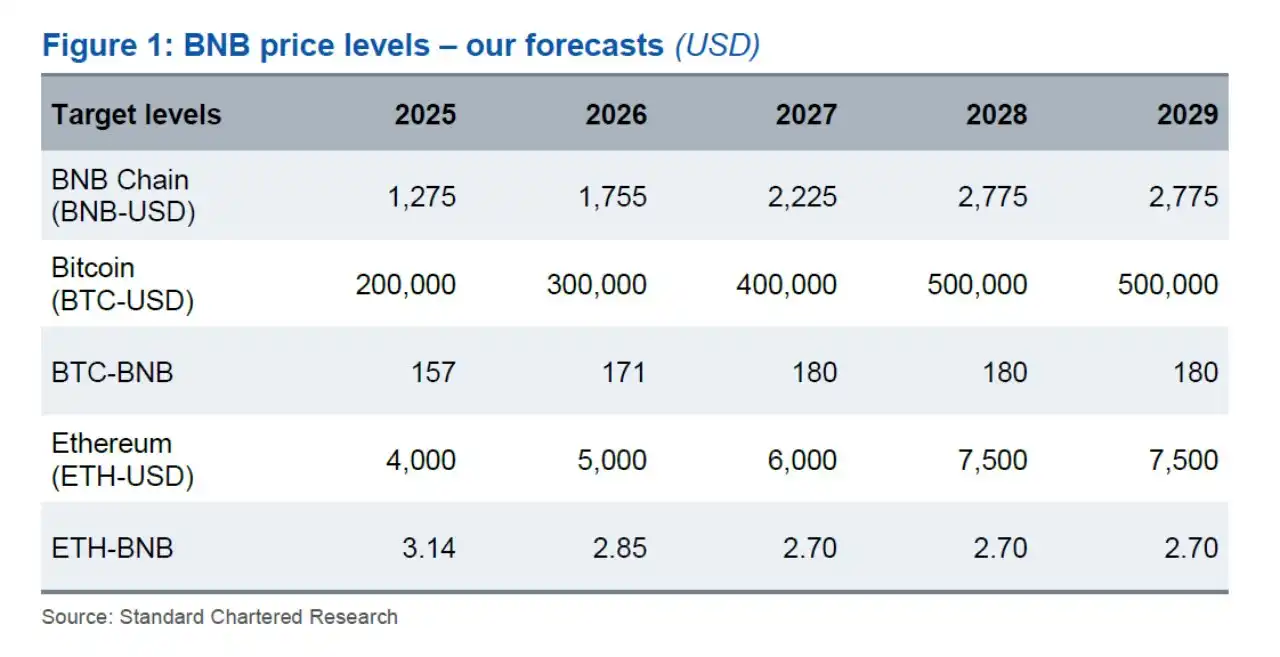
Source: Standard Chartered Bank (for reference only)
In addition, BNB's development in the payment track will also provide an additional support level for its value, further driving the market to adjust its valuation model upwards. Binance's payment application Binance Pay has been globalized, with BNB as one of the key settlement currencies. Data shows that Binance Pay has processed 300 million transactions to date, with a total transaction value of $230 billion, a significant portion of which was conducted using BNB. For example, in the Riviera region of France, Binance has partnered with fintech Lyzi to enable over 80 local merchants to accept cryptocurrency payments, including various currencies with BNB. If this trend continues, demand for BNB will come not only from investment and trading but also from real business circulation.
Overall, as of mid-2025, BNB is in an upward trend of value reassessment. The institutional accumulation has endowed it with the narrative of "digital gold reserve," the ecological prosperity has endowed it with the narrative of "leading public chain," and the payment expansion has endowed it with the narrative of "utility currency." With multiple narratives overlapping, BNB has the imaginative space to further increase its market value. At the same time, a rational approach should be maintained. The long-term value of BNB ultimately depends on whether the ecosystem can sustain its development, maintain innovation, and operate soundly in a constantly changing market.
7. Conclusion
From its initial platform token, a popular public chain token, to becoming a crypto asset now included in traditional institutional investor portfolios, BNB's transformation also reflects the maturity of the crypto industry. Under the wave of institutional accumulation, retail participants can share in BNB's value growth through on-chain deep involvement, layout of relevant concept stocks, participation in exchange platform activities, and holding BNB, among other avenues. As the slogan goes, "Build and Build," the value of BNB will be jointly participated in and shaped by everyone. Looking to the future, driven by the collaboration of institutions and retail participants, can BNB embark on a new era of innovative prosperity? Let's wait and see together.
Welcome to join the official BlockBeats community:
Telegram Subscription Group: https://t.me/theblockbeats
Telegram Discussion Group: https://t.me/BlockBeats_App
Official Twitter Account: https://twitter.com/BlockBeatsAsia