From Crypto to Sovereign Debt: The Logic Behind Tether's Massive $127 Billion US Debt Grab to Enter the Global Big Leagues

Original Title: "Tether Rises to Become the 18th Largest Holder of US Treasuries Globally, Analyzing the Stablecoin's 'Money Magnet' Technique"
Original Author: Ding Dang, Odaily Planet Daily
In a recent development, the latest data disclosed by Tether shows that its holdings of U.S. Treasury bonds have exceeded $120 billion, a figure that not only surpasses the holdings of sovereign nations such as the UAE and Germany but also has propelled a stablecoin issuer to the position of the 18th largest holder of U.S. Treasuries globally.
For those familiar with the crypto market, this number is astonishing; however, in the eyes of traditional finance, this appears more like a structural "financial tectonic shift." Some suggest that stablecoin issuers like Circle and Tether are accumulating more U.S. treasuries than most countries, potentially reshaping the U.S. economy.
In the eyes of supporters, this represents a new extension of U.S. dollar hegemony: through on-chain liquidity and a global payment network, stablecoins provide an unprecedented lever for the U.S. dollar's dominant position in international trade and the digital asset space. However, critics warn that even though stablecoins represent only a small portion of the overall market, they could lead to banking and financial instability because stablecoins may draw funds away from bank deposits, and since deposits are a necessary liquidity for lending, stablecoins are likely to threaten the credit system.
The Prosperity and Oligopoly of the Stablecoin Market
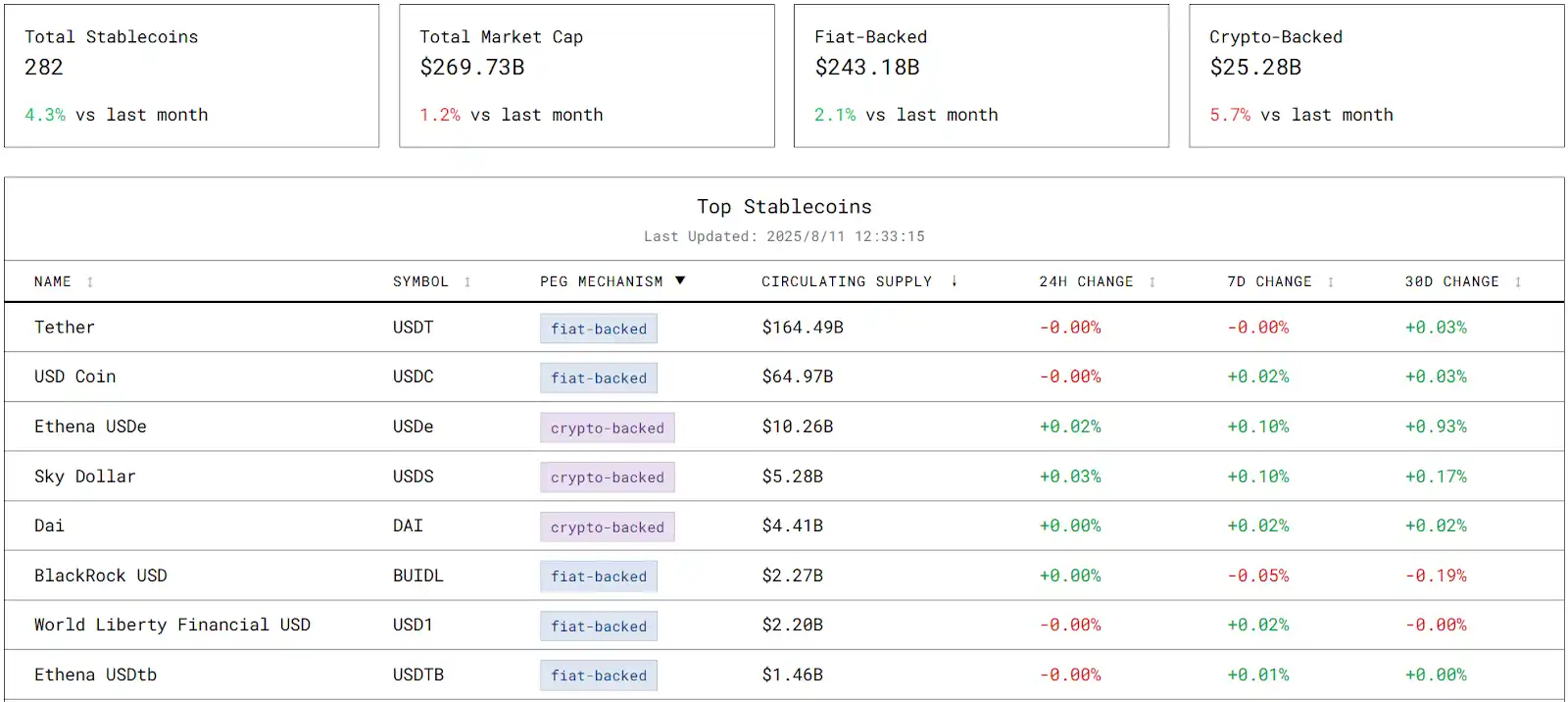
The stablecoin market is currently experiencing a period of liquidity prosperity. According to stablecoins.asxn.xyz data, the total market capitalization of stablecoins worldwide has surged to $2.6973 trillion, reaching a historic high. Among them, Tether's USDT holds the top spot with a market capitalization of $1.6449 trillion, while Circle's USDC follows closely at $649.7 billion, together accounting for over 85% of the market share, forming a clear oligopoly dominance.
What's even more intriguing is that the market's innovative vitality has not been suppressed despite the highly concentrated landscape. Since 2024, the total number of stablecoins has increased to 282 varieties, giving rise to new categories in various scenarios from on-chain payments to cross-border settlements.
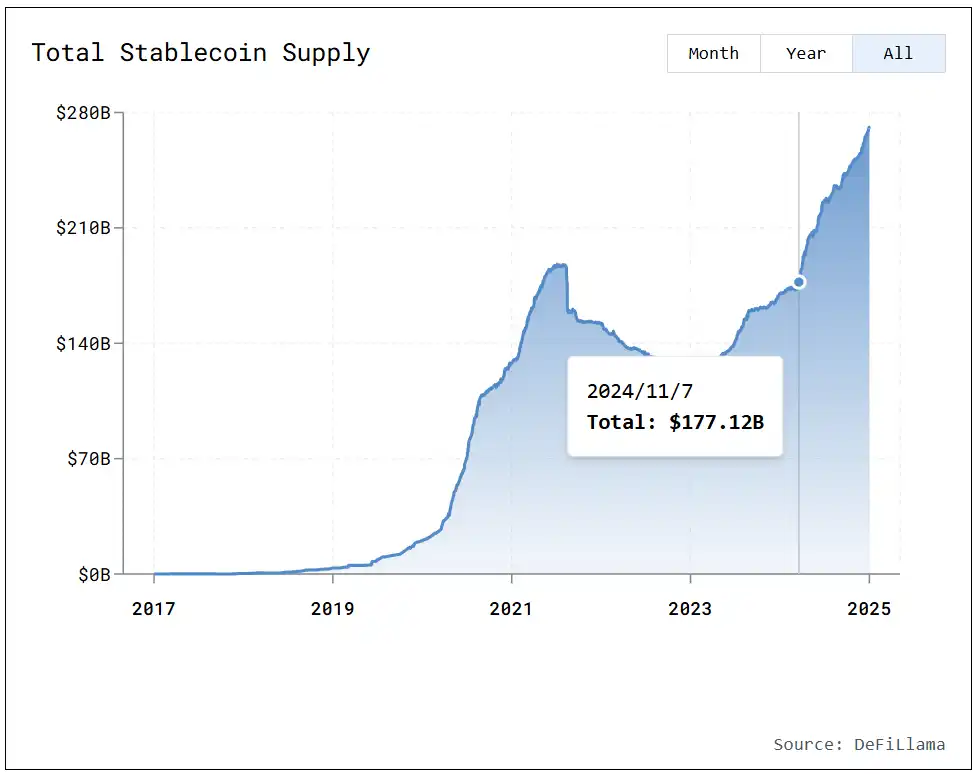
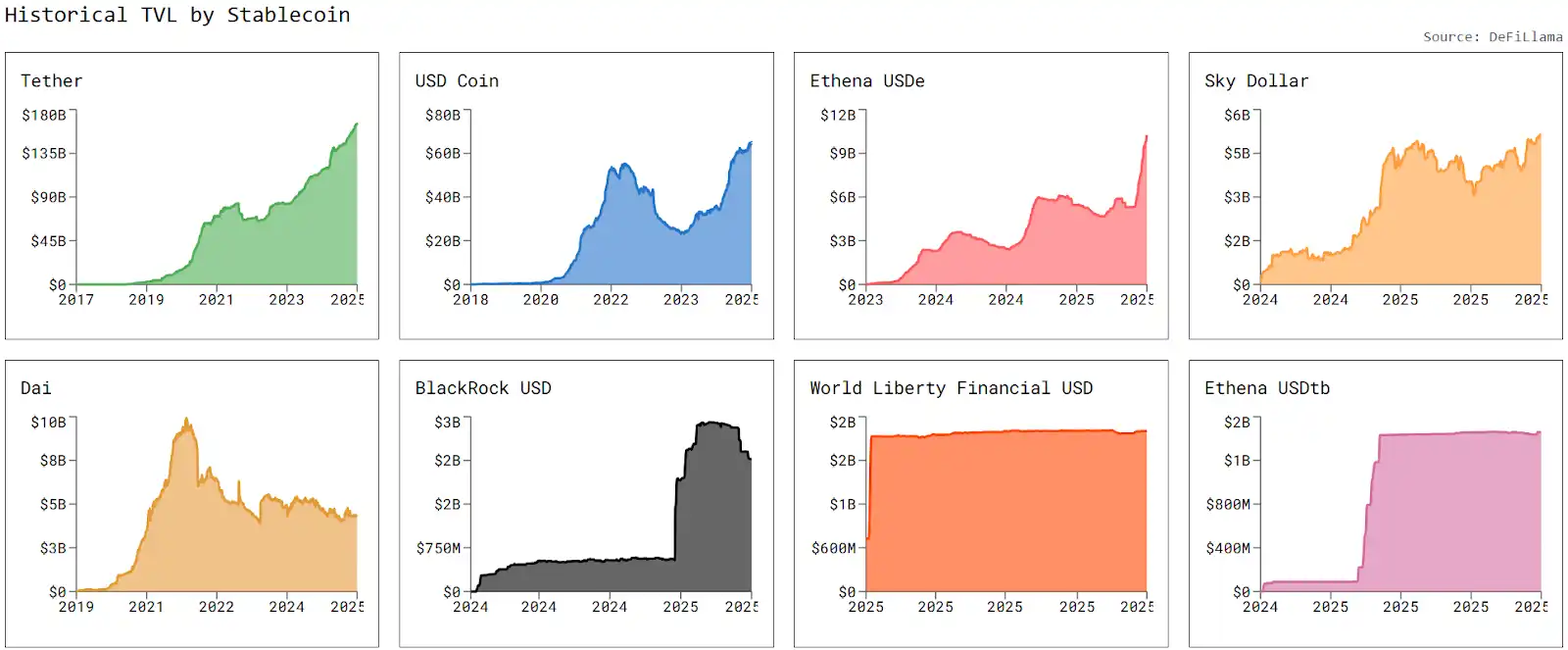
Regarding market capitalization trends, USDT has remained stable with an upward trajectory, USDC has shown a slowdown in growth since May 2025, and the decentralized stablecoin USDe recorded a over 75% monthly growth rate in July, emerging as a disruptive "dark horse" in the landscape.
USDT vs USDC: Two Paths, Two Logics
While USDT and USDC both promise a 1:1 peg to the U.S. dollar, they have chosen drastically different directions in terms of their development path and branding.
Tether (USDT): The Controversial Pioneer of Marketization
USDT, issued by Tether Limited registered in Hong Kong with headquarters in Switzerland, has dominated the stablecoin space through a market-driven approach. With a wide range of trading pairs and a massive circulation, USDT has become the most commonly used stablecoin in the crypto market, even navigating smoothly in the gray areas. However, its reserve transparency issues have long been criticized. In October 2021, Tether was fined $41 million by U.S. regulators due to reserve concerns. Despite regularly issuing reserve reports, the lack of transparency in audit frequency and detail has left market trust in doubt.
Circle (USDC): The Compliance-Focused Robust Choice
In contrast, USDC has taken a path of compliance. Issued by the Centre Consortium co-founded by Circle and Coinbase, Circle, as a fintech company regulated by the U.S. Financial Crimes Enforcement Network (FinCEN), publishes monthly reserve reports audited by third-party accounting firms like Grant Thornton, demonstrating its ample USD reserves. While USDC's market size is not as large as USDT, it is highly regarded in decentralized finance (DeFi) and institutional trading for its high transparency and compliance.
This difference is not just about two products but also about two strategic bets on the future: one betting on market efficiency and liquidity, the other on institutional trust and compliance barriers.
The "Cash Magnet" Logic of Stablecoins: Zero-Cost Deposits and Massive Profits
The business model of stablecoin issuers is the clearest and most direct in the crypto industry, with its core being zero-cost funding and stable interest differentials. When a user exchanges $100 for 100 stablecoins, this $100 becomes the issuer's reserve. Since stablecoins do not pay interest to users, the issuer effectively gains a no-cost deposit. Subsequently, these funds are invested in highly liquid, low-risk assets such as U.S. Treasury bonds, repo agreements, earning a stable interest return.
Under a multi-billion-dollar fund pool, this model turns into a continuously operating profit machine: stable returns, manageable risks, and perhaps the most predictable business model in the crypto industry.
For example, in Tether's asset portfolio, US Treasury bonds and other cash equivalents account for over 80%, Bitcoin accounts for 5%, and the rest is distributed among corporate bonds, precious metals, and secured loans. By the second quarter of 2025, Tether's US Treasury bond holdings reached $127 billion (direct holdings $105.5 billion, indirect holdings $21.3 billion), surpassing South Korea's $124.2 billion, ranking 18th globally.
The significance of this holding structure lies not only in the profitability of the stablecoin market but also in its position in the US dollar liquidity cycle. Stablecoins provide a way for global users to instantly access the US dollar and then channel these funds back into the US Treasury bond market, creating a "USD-on-chain-US bond" circular flow. This channel enhances the global demand for US bonds but may also amplify liquidity fluctuations in extreme cases, as stablecoin redemption demands are more immediate and concentrated than traditional bank deposits.
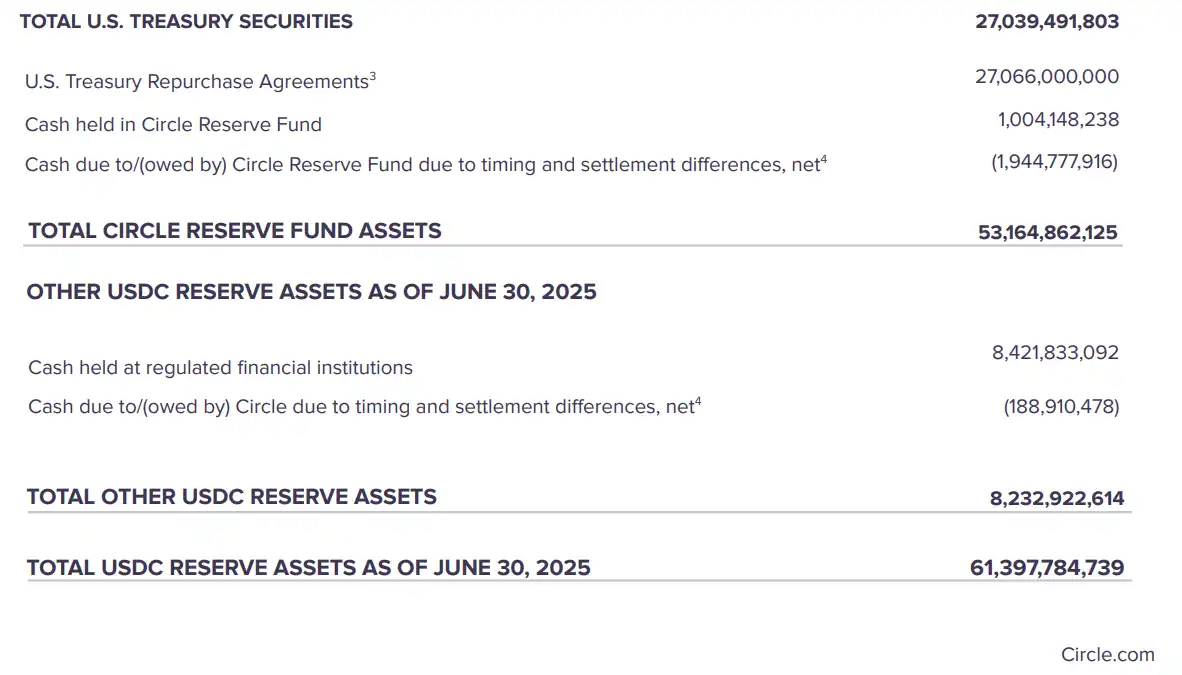
Circle, on the other hand, has a more conservative asset allocation: 44% in US Treasury bonds, 44% in government repurchase agreements, and 15% in bank deposits. As of June 30, 2025, its total holdings of bonds and repurchase agreements amount to around $54 billion (-3% related to temporary differences in transactions or settlements, which are usually balanced in the short term and do not pose a significant threat to overall reserve stability). This allocation is closer to the risk management logic of traditional financial institutions and indicates that Circle will achieve a relatively stable balance between short-term redemptions and interest income.
Financial Performance: The Other Side of Profit
Based on the second-quarter 2025 financial data, Tether's total assets reached $1,625.7 billion, total liabilities (token issuance) were $1,571.1 billion, net assets were approximately $54.7 billion, and shareholder equity remained stable. In just the second quarter, Tether achieved a net profit of $4.9 billion, with a cumulative profit of $5.7 billion for the first half of the year. Of this, $3.1 billion came from recurring profits, and $2.6 billion came from the revaluation of gold and Bitcoin holdings. This means that a considerable proportion of its profit structure relies on asset price fluctuations. Although the current market environment is favorable, valuation gains may quickly shrink when the cycle reverses.
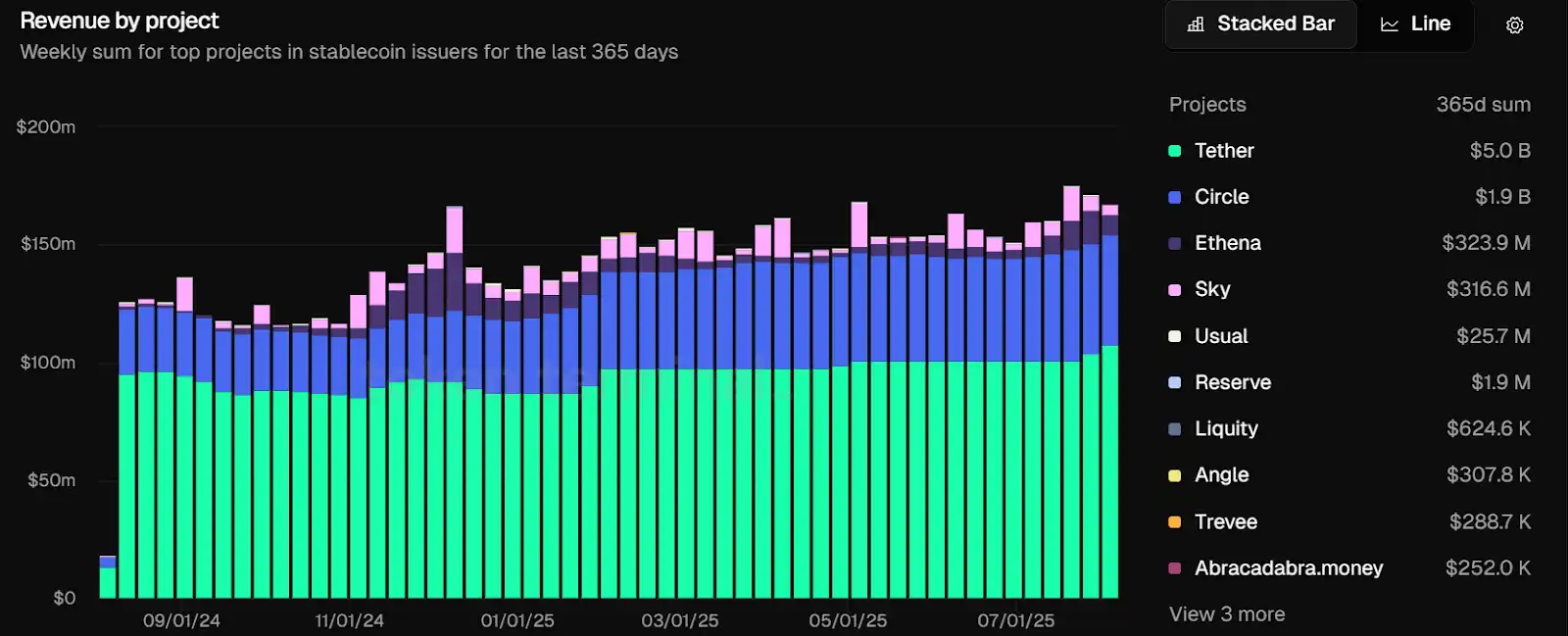
Circle, on the other hand, exhibits more "bank-like" financial characteristics—by June, total assets were $613.9 billion, total liabilities were $613.3 billion, with assets slightly exceeding liabilities. According to tokenterminal.com data, protocol revenue reached $1.9 billion in the past year, mainly from interest income on government bonds and repurchase agreements, with almost no reliance on high-volatility assets. This model is highly attractive in the current high-interest-rate environment, but if the US enters a rate-cutting cycle, income pressure may rise.
On July 18, 2025, President Trump of the United States signed the GENIUS Act, which set a new boundary for the stablecoin industry, marking a turning point for stablecoins from fringe innovation to mainstream finance. This legislation is not only a response to the industry's expansion but also reflects America's attempt to incorporate stablecoins into the strategic vision of the "digital dollar."
For compliance-focused issuers like Circle, the act signifies an expansion of market space. However, for Tether, the global market advantage may face challenges due to pressure for reserve transparency and compliance standards. Regardless of the ultimate outcome, stablecoins are becoming an extension of dollar hegemony in the digital age, introducing new variables to the global financial system.
Welcome to join the official BlockBeats community:
Telegram Subscription Group: https://t.me/theblockbeats
Telegram Discussion Group: https://t.me/BlockBeats_App
Official Twitter Account: https://twitter.com/BlockBeatsAsia

 Related Articles