3-Week 10x ZORA: Unpacking the Value Discovery of Content Coins
Original Author: Social Graph Ventures
Editor's Note:
Zora has recently become one of the most hotly debated topics in the crypto industry, not only because its token price surged tenfold in a month, hitting consecutive all-time highs, but also due to a public debate surrounding its core concept. As ZORA broke through $0.1 in a short period, Solana co-founder Toly and Base founder Jesse engaged in a heated debate on social platform X, unveiling the contentious core behind this "on-chain content monetization" mechanism.

Jesse Pollak is a staunch supporter of Zora, and he has publicly defined Zora as a key infrastructure for the "decentralized attention market," believing that its content coin model is an innovative form of empowering creators. In Jesse's vision, any content can be tokenized on-chain, enabling instant transactions and value capture. The ZORA token not only serves as a unit of account but also functions as part of the transaction's volatility hedge and incentive mechanism, distinguishing Zora from a mere speculative platform.
However, this seemingly progressive "creator economy" narrative has faced fierce criticism from Toly. Toly bluntly stated that Zora's content coin system is a "re-skinned meme coin," fundamentally similar to the popular Pump.fun on Solana, but disguised under the cloak of "empowering creation," blurring the risk boundaries. He pointed out that the liquidity of Zora's token comes from on-chain AMMs (Automated Market Makers), leading to extreme trading volatility, making retail investors highly susceptible to losses during price fluctuations. Additionally, the so-called "content empowerment" lacks a genuine rights structure—token holders neither possess copyright to the work nor receive a share of ad revenue, and they cannot even participate in creator revenue decisions.
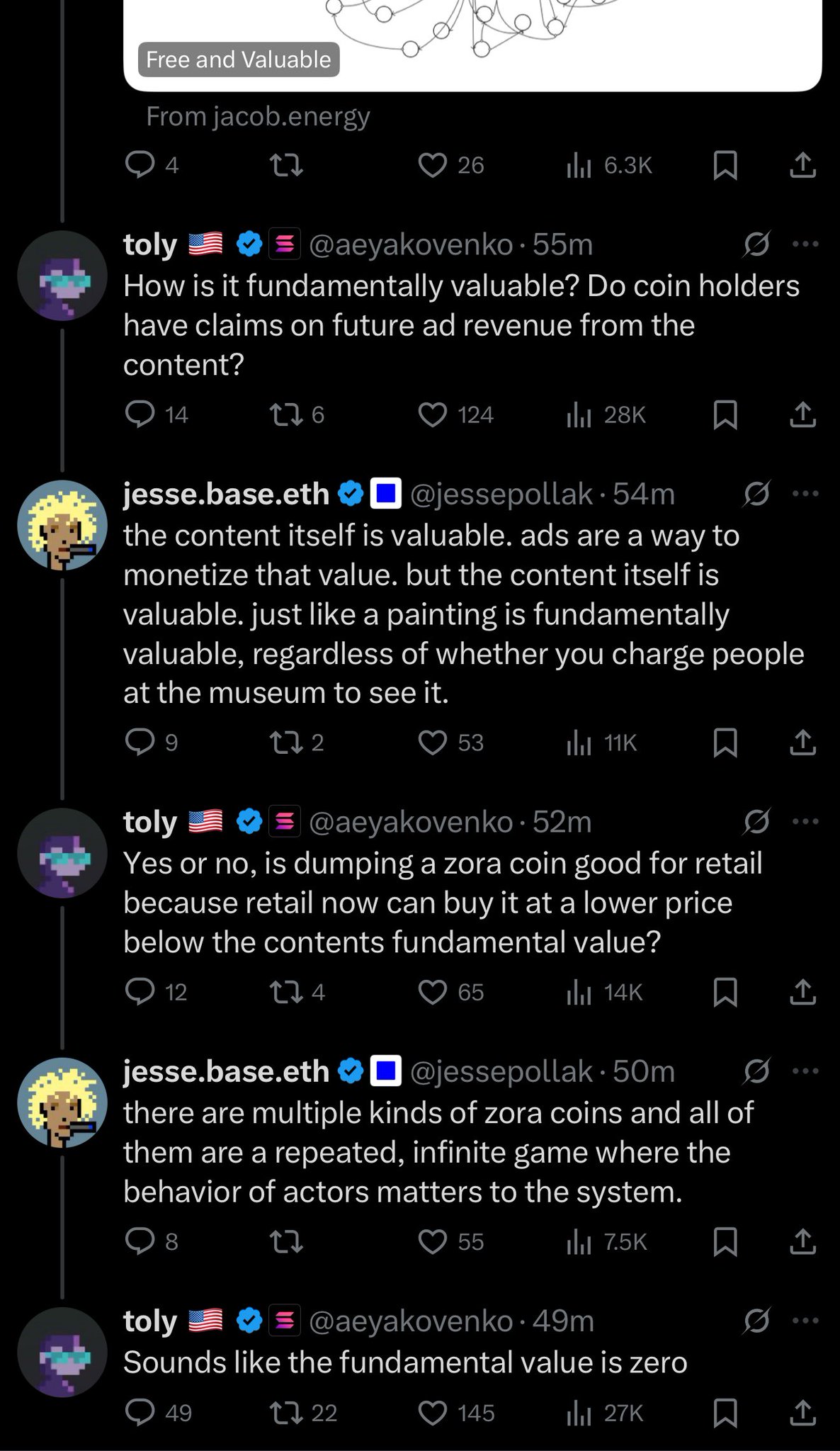
Toly further questioned why Zora did not adopt an NFT model to represent creative content. He believes that the non-fungibility of NFTs and their limited supply are more suitable for expressing the scarcity of art or original content, without the systemic risk of liquidity pool collapse. He warned that forcing unsecured content coins into an "on-chain asset" would only turn retail investors into victims in a high-volatility market, stating that "content tokenization without guardrails is a speculative trap disguised as an idealistic narrative."
Jesse, on the other hand, countered that Zora does not operate solely based on price fluctuations like Pump.fun, but has built a sustainable creator incentive structure. He emphasized that good content can naturally attract attention and support, and the content-coin model can continuously monetize this attention in an on-chain structure, driving a positive feedback loop between long-term participants and content creators. He acknowledged the high volatility risk in the system but emphasized that this is part of what Zora's design attempts to balance through bonding curves and protocol parameters.
As this debate escalated rapidly, the performance of the ZORA token stood out remarkably. On July 27, the ZORA price briefly surpassed $0.1, with a 67.35% surge in a 24-hour period, the contract's holdings surged to $170 million, and on-chain transaction activity spiked. Whether it's the bubble characteristics Toly warned about or the protocol's upgrade direction described by Jesse, Zora's tokenization model has become a hotbed of real-market fund competition.
The original text is as follows:
The Initial Vision
When we initially drafted this memo internally, ZORA had just launched, the token price was rapidly falling, and the project narrative was not yet clear.
However, we were not betting on a meme coin but on a protocol capable of rapid iteration and possessing the ability for "on-chain attention monetization."
In the past few years, ZORA has evolved from a simple minting platform to a protocol-based product with independent L2 infrastructure, ultimately transforming into a consumer-facing application that helps creators achieve on-chain monetization.
It had several distinctive features early on:
· Rapid iterative launches: supporting AI-generated content, native integration of USDC payments, and a mobile-first user interface
· A unique creator coin model with inherent virality
· Clearly quantifiable protocol revenue mechanisms
· A team with deep product and market design capabilities
Its on-chain mechanism design is highly efficient:
· Creators mint content on the platform, and fans support them by purchasing their tokens
· All transaction liquidity is routed through the ZORA token
· Tokens are priced in ZORA and traded on Uniswap v4
· In each transaction, Zora Labs extracts approximately 0.25% in fees
At its peak, ZORA's annualized transaction volume approached $5 billion, with projected annual revenue of $6 million. While most of the transaction volume did not occur within the official app, we see this as an opportunity for wedge insertion rather than a structural weakness.
What's Next for Zora?
Although the price of ZORA remains below its post-TGE peak, the product itself has become more robust.
Creator coins are now live and working well. Any user can mint their own creator coin and bind it to a content coin. These tokens trade based on a bonding curve, priced in ZORA, and settle instantly.
The whole experience feels like a TikTok feed embedded with market mechanisms, where attention can be instantly monetized and freely flowing.
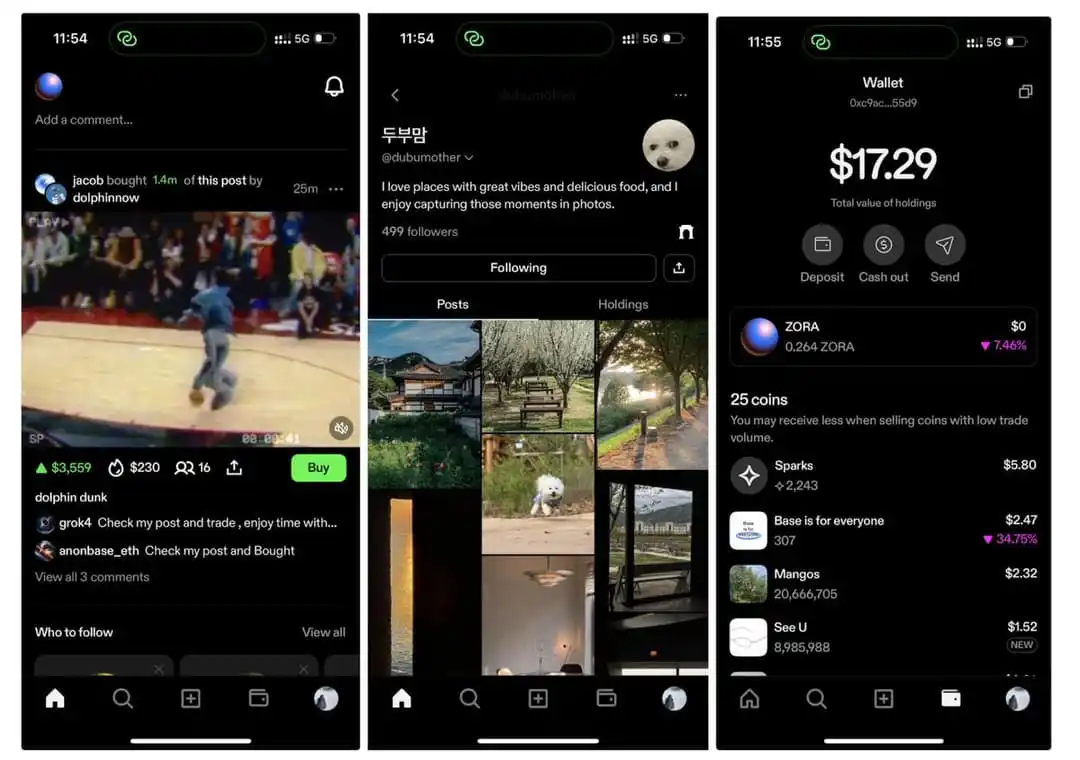
Content Flow and Product Interface
User Engagement Health:
· Creators with more than 5 interactions per post have a 30-day retention rate between 11–27% (a16z considers 25% D30 as an excellent benchmark for social products).
·Creator Activity is Continuing to Rise: Starting from an average of 3 posts per month in the first month, it grew to 10 posts per month by the 4th month.
The usage frequency is further amplified based on a pricing model, a mechanism originally pioneered by Virtuals.
Every token transaction involves:
· The creator themselves
· The buyer
· The Zora Labs team
· And ZORA itself
Features such as referral invitations, top coin holder comment pinning, and post monetization are gradually establishing the "attention economy" in a crypto context.
This is a consumer-grade product that can truly generate protocol revenue.
Zora's distribution challenge is being gradually solved.
Today, it has achieved deep integration with Base through an official app called TBD. This app takes a TikTok-like form, built on Zora's protocol foundation.
It is no longer just a monetization channel but is transforming into a full-fledged underlying infrastructure. They have distilled the entire ecosystem into six key pillars:
· Built-in Content Sharing Mechanism: The product flow encourages users to share their creations on external social platforms;
· Creator Incentive Program: Allocating $1 million to attract small and medium creators in the music, fashion, lifestyle, and meme sectors (with TikTok followers less than 10k and Instagram followers around 5-6k);
· User Growth Spend: Paid promotions on social platforms like TikTok;
· Token Incentive Distribution: 20% of the TGE is used for incentive programs, covering both transaction rewards and a variety of community development-related incentives;
· Events and Media Exposure: Reaching the crypto community and creator group through podcasts and events;
· Developer Integration Partnerships: Teams such as Base, Noice, and others are developing features and building ecosystems based on the Zora protocol.
Currently, searching for "Zora" on TikTok yields almost no relevant content. This means that as long as moderate effort is put in, there is still significant explosive growth potential for Zora on the social platform.
On-chain Data
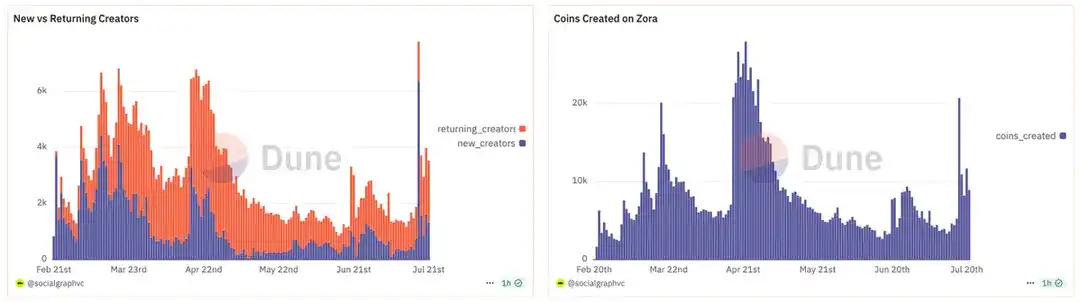
According to our data tracking on Dune, Zora's current fully diluted valuation is around 2.5 to 3 billion USD, with a historical monthly annualized trading volume peaking at 18 billion USD. The protocol currently captures about 1% of transaction fees overall, with approximately 0.25% going to Zora Labs. At peak times, the protocol sees nearly 18 million USD in annual revenue.
As of July, Zora's annualized trading volume is around 5.94 billion USD, with a daily active creator count ranging from 4000 to 7000 only. We believe that with its product experience and economic model, Zora is poised to increase its creator base by 10 to 100 times in the next 12 months.
For detailed data, you can refer to our Dune dashboard: https://dune.com/socialgraphvc/dollarzora
Viewing Zora Labs as R&D Investment
In the crypto industry, the debate over who gains actual value from the "protocol" itself versus the team behind it has always been ongoing.
We do not speak for Zora Labs, but based on multiple conversations with their team, we tend to view it this way: The revenue received by Zora Labs should fundamentally be seen as R&D expenditure.
The 0.25% fee per transaction allocated to Labs is not value extraction but rather fuels the following activities:
· Iterating on creator tools continuously
· Building infrastructure needed for user growth
· Driving various experiments within the ecosystem
· Optimizing the overall experience on mobile and web platforms
If Zora Labs can continue to increase user engagement, develop a stronger content monetization model, and enhance liquidity within the protocol, these achievements will ultimately be reflected in the long-term value of the ZORA token.
While Zora Labs has been a cost center, it has consistently delivered results.
Advertising, Will It Be Zora's Moat?
Advertising is currently one of the most critical and uncertain topics for Zora.
Currently, brands have not yet fully engaged in Zora's content tokenomics, but this market space is already evident.
If Zora can build a native advertising system based on its token mechanism, allowing brands to sponsor posts, hold content coins, or directly amplify the influence of creators, then the entire ecosystem will evolve into a self-reinforcing attention market.
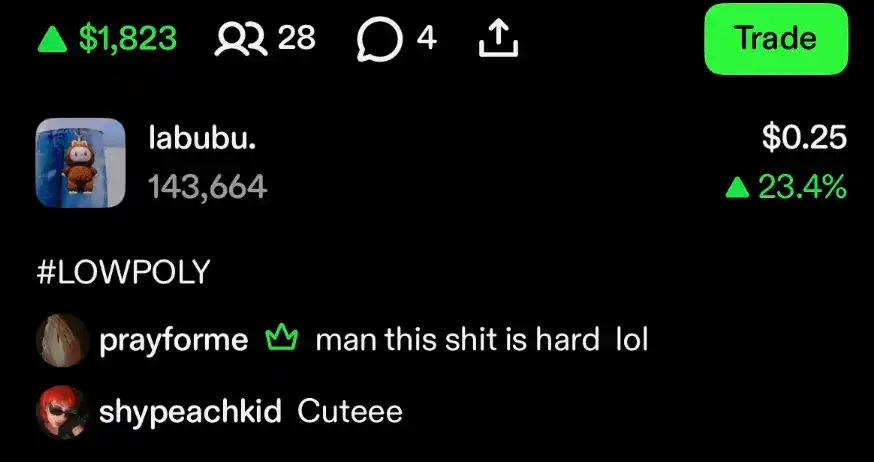
Top Holder Comment

Zora Creator Balaji on the Advertising Mechanism
We have already seen glimpses. For example, the top holder of content coins can now pin comments on related posts, which is essentially an early advertising unit. In the future, this mechanism could be fully extended into a native brand marketing path for post promotion and event partnerships.
If Zora can really achieve this, it will bring not only revenue sharing to creators but will also organically funnel brand funds into the token system, rather than relying on traditional banner or pop-up ads.
We believe they will ultimately achieve this goal.
Team Background
The team members are an efficient team from Coinbase, continuously driving innovation in content monetization and focusing on creating a unique product that integrates native crypto with Web2 user experience.
They have propelled the entire industry forward, introducing novel concepts such as bonding curve-based quote coins, content-driven tokenization, recommendation incentive mechanisms, and more. Zora embodies a style of daring public experimentation and rapid iteration, which is a trait we highly value in a team exploring new social, creator economic, and monetization mechanisms. Its core members include:
·Jacob Horne (Co-founder & CEO): Former Coinbase product manager, responsible for core products such as USDC and Coinbase Ventures, with a focus on Ethereum and DeFi. He has a deep understanding of crypto market design, NFTs, and the creator economy. Jacob is a key advocate for Zora and has been dedicated to the project since 2019, with early involvement in the crypto fashion space.
·Dee Goens (Co-founder): Previously part of the Coinbase marketing team, Dee was a significant contributor to the early NFT wave. He crafted Zora's early community strategy and partnership ecosystem, working long-term to empower underrepresented creator communities.
·Tyson Battistella (Co-founder & CTO): Leading Zora's technical development, Tyson is a former Coinbase smart contract architect who built the foundation of the Zora protocol, including core minting tools, L2 solutions, and other technical modules.
Token Structure
Zora officially launched its token (TGE) on April 23, 2025, with a total current supply of 10 billion tokens, reaching a peak valuation of $6 billion, backed by institutions like Haun Ventures.
The allocation is as follows:
· Strategic Investors: 26.1% (2.61 billion)
· Team: 18.9% (1.89 billion)
· Community Incentives: 20% (2 billion)
· Treasury: 20% (2 billion)
· Airdrop: 10% (1 billion)
· Liquidity: 5% (500 million)
Unlocking Schedule:
· Airdrop and Liquidity (15%): Fully unlocked at TGE.
· Community Incentives (20%): Fully unlocked post TGE for ecosystem development and incentive distribution.
· Team and Strategic Investors (45%): 6-month cliff post TGE, starting October 23, 2025, with linear monthly unlocks over 36 months.
· Treasury (20%): Similarly begins linear unlocking on October 23, with a 48-month unlocking period.
Conclusion
Although ZORA has not yet seen a price resurgence, its on-chain activity, content ecosystem integration, creator engagement retention, and protocol revenue capability have shown a positive structural turnaround.
The significance of Zora lies not only in token issuance or hype but in providing a sustainable monetization path for the entire attention economy through a content minting mechanism.
In the realm of crypto consumption, we still consider it one of the most deterministic long-term opportunities.
This article is a contribution and does not represent the views of BlockBeats.
Welcome to join the official BlockBeats community:
Telegram Subscription Group: https://t.me/theblockbeats
Telegram Discussion Group: https://t.me/BlockBeats_App
Official Twitter Account: https://twitter.com/BlockBeatsAsia