Amid the Yield Farming craze, how will BGUSD reshape the RWA Yield experience?
Original Author: Kazmin
BGUSD, a name that looks like a stablecoin but functions more like a financial management tool, may be an important step for Bitget in the CeFi financial system.

By 2025, yield-bearing stablecoins have become one of the fastest-growing sectors in the crypto market. According to a Cointelegraph report, as of mid-May, the market value of such assets has exceeded $11 billion, accounting for 4.5% of the total stablecoin market value, a significant increase from just 1% last year. This trend is now spreading from on-chain DeFi to CeFi platforms, becoming a new tool for centralized institutions to compete for asset retention.
Against this backdrop, Bitget has launched BGUSD—a "yield-bearing stablecoin-like" product that is circulating within the platform, accrues interest, and has no lock-up restrictions. BGUSD is purchased using USDT/USDC and is essentially a platform-issued yield certificate representing users' rights to the earnings pool. It combines financial returns, token functions, and collateral use, with the underlying reference asset being a basket of tokenized RWAs (such as US treasuries), providing high security and liquidity.
This article will dissect its design structure, functional mechanisms, and strategic significance, exploring whether it could become the asset form in the CeFi system that is closest to "Financial U."
1. What Exactly Is BGUSD?
Before delving into the detailed structure of BGUSD, we can quickly understand the basic characteristics of this product through a set of core parameters:
Product Nature: Platform-issued yield certificate
Supported Purchase Currency: USDT/USDC
Annualized Return: 5% for the first 30 days, then 4%
Interest Calculation: Daily interest settlement
Lock-up: No
Redemption Method: T+0 (daily limit of 10,000 BGUSD for non-VIP users) / T+3
Usage Fee: Both purchases and redemptions are subject to fees, with the first 30 days of purchase being free
Use Cases: Contract margin, borrowing, Launchpool, staking, etc.
Exchange Currency and Fee: Exchangeable with USDC at 1:1, with a fee of 0.1%
BGUSD is a profit certificate that circulates only within the Bitget platform. Its core logic is not pegged to the value of an asset but rather confirms users' "profit rights" to the platform's profit pool, acting as a structured "platform-native financial management certificate."
BGUSD is backed by Bitget's proprietary fund allocation in short-term U.S. Treasuries, repurchase agreements, and other traditional low-risk assets, creating a sustainable income foundation. Users can purchase BGUSD using USDT/USDC (with a 1:1 exchange rate between USDC and BGUSD, and USDT exchange based on the real-time USDC/USDT spot price), receive daily interest rights, have their earnings calculated based on the "minimum holding amount of the day," and automatically receive the earnings in their spot account without any on-chain operation or additional claim steps.
The purchase process is similar to the platform's financial products and can be completed directly in the Bitget App's "Financial Management> On-Chain Selection> BGUSD" module. With a low entry barrier, CeFi users can earn interest without the need for wallet participation. For example, if a user holds 10,000 BGUSD tokens and the initial annualized rate is 5%, they can expect to earn approximately 1.37 USDC per day, totaling 41.1 USDC over 30 days.
The main features of BGUSD include:
● Automatic compound interest mechanism: The platform takes hourly snapshots of holdings, uses the lowest value as the basis for earnings, and credits the earnings daily;
● High liquidity, no lock-up: Supports T+0/T+3 redemption;
● Multi-scenario versatility: Can be used within the platform as collateral for contracts, pledge lending, Launchpool, etc.
Fundamentally, BGUSD is not a stablecoin on the blockchain but a CeFi model asset that combines profit rights, circulation capability, and platform credit structure, representing another attempt by a centralized platform.
II. What "Bonding Design" does BGUSD demonstrate?
BGUSD's structure adopts a compound model of "Platform Bond + Token Form." Although it is not a traditional bond, its core logic is built around the closed-loop mechanism of "profit rights issuance - fund allocation - profit distribution," integrating the stable income characteristics of financial instruments with the liquidity functions of platform tokens.
The overall operation mechanism can be broken down into five key components:
Platform's proprietary fund allocation for Real-world Assets (RWA): Bitget invests its own funds in short-term U.S. Treasuries and other high-liquidity, low-risk real-world assets to provide sustainable support for profits. Unlike the common algorithmic interest rate models in DeFi, RWA is built on the deterministic income of the real-world financial system (such as the federal funds rate), providing a stable and controllable income path while safeguarding user funds from on-chain risks.
User Subscription, Yield Acquisition: Users subscribe to BGUSD with USDT/USDC, receiving daily yield distribution rights instead of underlying asset ownership. The structure is similar to a "Structured Deposit" in a bank's wealth management product, placing users on the participation end, with the yield coming from the platform's yield pool distribution.
Daily Interest Settlement, Automatic Distribution: The system records BGUSD holdings every hour and takes the day's lowest value as the interest calculation basis to prevent arbitrage. After daily settlement, the yield is automatically distributed without the need for user action, creating a passive yield path similar to compound interest, enhancing distribution fairness and transparency.
Multi-Scenario Applicability, Enhanced Utility Flexibility: Unlike single-purpose wealth management products, BGUSD is designed as a multi-functional native token within the platform, widely applicable for U-based contract margin, lending, staking, Launchpool, etc. It has the dual attributes of a wealth management tool and platform native token, enhancing asset reuse efficiency.
Platform Acceptance, Dual-Channel Redemption: Users can exchange BGUSD for USDC at a 1:1 ratio, supporting flexible T+0/T+3 redemptions, with the platform taking on liquidity and pricing responsibilities. The fee is 0.1%, ensuring a smooth and efficient asset withdrawal process.
Through this closed-loop structure, BGUSD establishes a "quasi-financial bill" system that does not require on-chain contract support. While achieving tokenized yield, it maintains a high degree of freedom in platform fund allocation and circulation. It retains the controllability of CeFi while leveraging the flexibility of on-chain assets, becoming a representative design of "bond-like + stable asset" in the CeFi world—of course, its operation still heavily relies on platform credit and operational capabilities.
III. Differences Between BGUSD and Stablecoins
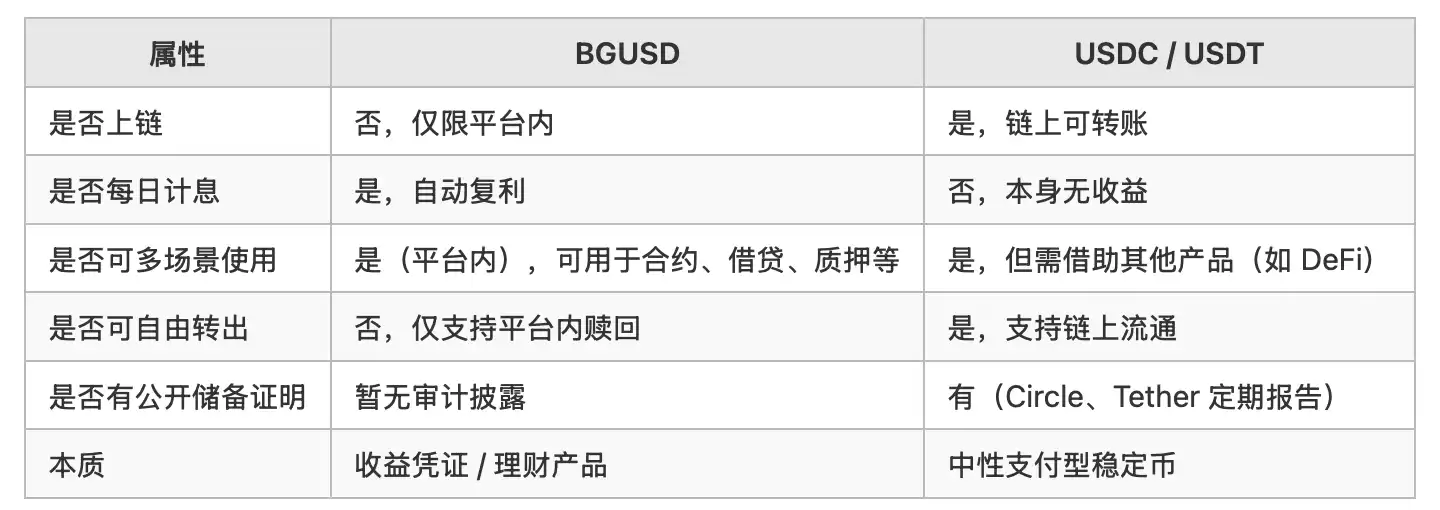
Although BGUSD's name ends with "USD," which may easily lead people to associate it with stablecoins, its product structure, yield mechanism, and circulation method differ significantly from stablecoins. Especially in terms of functional design, it combines the attributes of a stable asset and a yield certificate, positioning it more as a wealth management asset.
The main reason for this "contradictory" feeling is that: BGUSD superficially mimics the U-based setting of stablecoins to ensure its stable valuation and standardized asset experience within the platform; however, in essence, it is more like a "structured yield certificate" issued by the platform, representing users' ownership of the platform's yield pool, rather than a "neutral asset" that can be freely circulated on-chain for payments and transactions.
The following comparison table delineates the differences between BGUSD and mainstream stablecoins USDC/USDT in core dimensions, further highlighting its structural essence as "more of a wealth management product than a stablecoin."
However, in the current mainstream centralized exchanges, products designed similarly to BGUSD are not common. Exchanges such as Binance, OKX, and Bybit offer some products in their Savings or Earn sections, allowing users to deposit stablecoins to earn yield, but there is no independent "yield token" form available. Users need to manually separate the rewards, and the entry barrier is relatively high.
Therefore, BGUSD is an attempt within the CeFi framework to combine stable assets with a yield mechanism, not only enhancing the efficiency of user funds but also restructuring the platform's asset model of "platform token + savings." These products blur the boundaries between stablecoins and financial products, representing a strategic extension of cryptocurrency platforms in terms of user experience and asset design.
IV. Comparison of BGUSD with Other Platform Products
To better understand BGUSD's positioning and design logic in the CeFi world, it is necessary to compare it with several representative yield assets on-chain or under institutional compliance frameworks. Although these products have different mechanisms, most of them are backed by RWAs (Real-World Assets) and introduce traditional financial yields to crypto users in various ways.
We have selected several products with typical structural features: USDY from Ondo Finance, BUIDL launched by BlackRock, USD0 backed by US Treasury Bonds, sDAI from MakerDAO, and USDe, an algorithmic stablecoin from Ethena. They share some similarities and differences with BGUSD in terms of asset structure, yield mechanism, utility openness, and user accessibility.
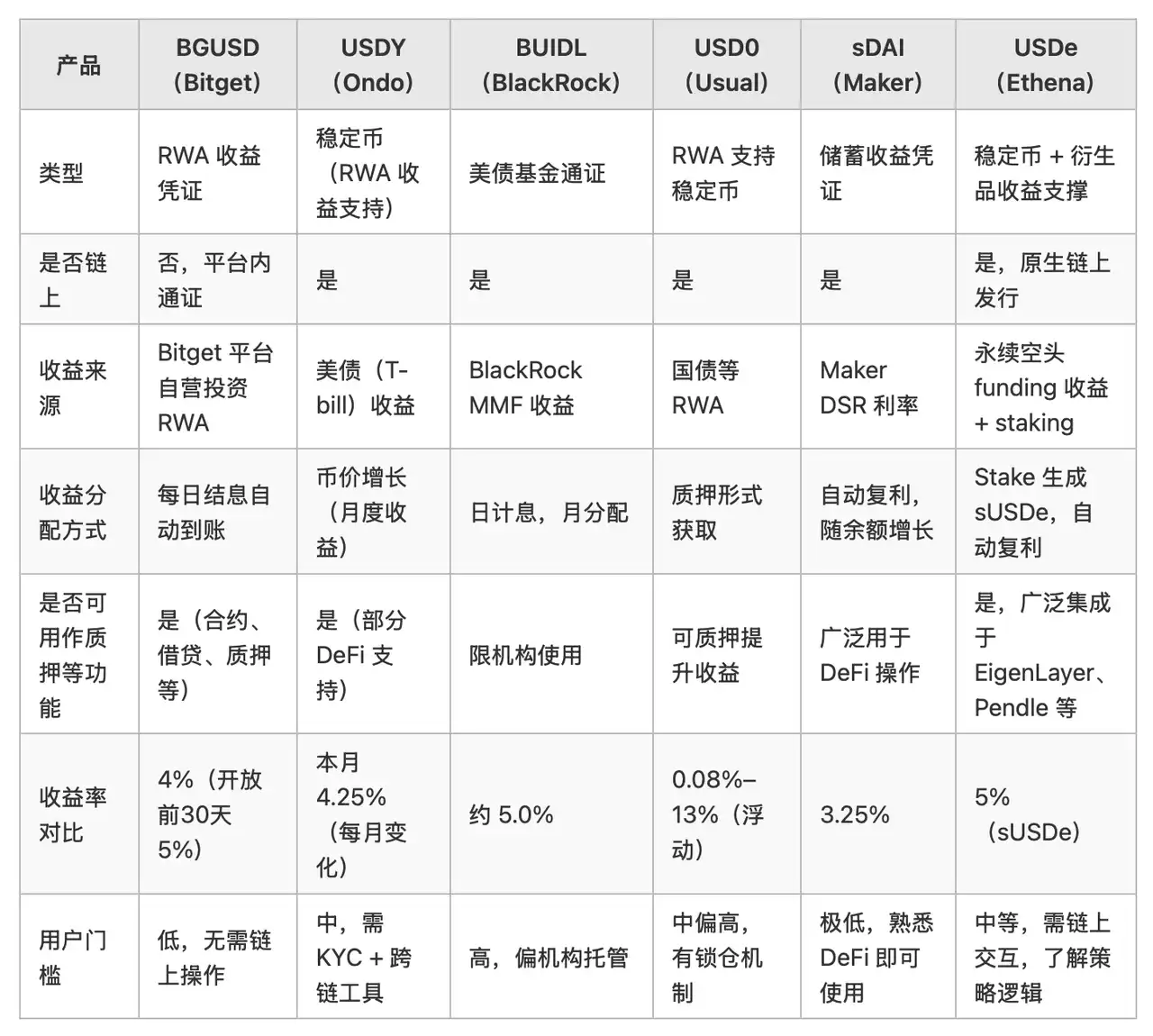
These products represent different design philosophies:
● USDY and USD0: Both are supported by government bond-type RWAs and are stable yield DeFi products. USDY leans towards a compliant path, while USD0 focuses on a staking incentive mechanism, requiring users to understand DeFi operational processes.
● BUIDL: Launched by the world's largest asset management firm, BlackRock, mapping the yields of its Money Market Fund (MMF), it is one of the most regulatory-compliant RWA applications. Constrained by its institution-focused issuance mechanism, it mainly targets users of custody platforms.
● sDAI: A native passive income certificate introduced by MakerDAO, with earnings derived from the Dai Savings Rate (DSR). It is known for its flexibility, transparency, lack of lockups, but lacks the RWA component of real-world financial support, making the yield rate sensitive to Maker's monetary policy.
● USDe: Built on a derivative hedging strategy, not relying on RWA. Users collateralize USDe to receive sUSDe, currently with an annualized yield of around 5%. The mechanism is innovative, but it needs to address the risk of funding rate fluctuations.
On the other hand, BGUSD, although lacking on-chain attributes, allocates RWA through platform proprietary funds, providing users with a similar experience within the exchange: low volatility, high certainty of income, automatic distribution, and with circulating functions such as platform token-owned contract collateral, staking participation, and more.
One could say that BGUSD is a "usability translation" version of CeFi to DeFi yield assets logic. It aligns with investment logic similar to USDY and BUIDL but follows an operational path closer to sDAI—users don't need to understand the on-chain structure, wallets, cross-chain tools, or pay on-chain Gas fees to "earn interest" with a single click.
This design lowers the entry barrier and constructs a user experience similar to traditional financial products through platform credit endorsement, packaging complex financial fundamentals into an intuitive, user-friendly digital token form. This is not only an optimization of product design but also an integration of the DeFi/TradFi model.
5. Who Is BGUSD Suitable For? What Is Its User Value?
The core advantage of BGUSD is to integrate "yield generation, token circulation, platform function access" into a unified asset unit. This naturally suits those who wish to enhance capital efficiency but avoid the complexity of on-chain operations. Below are some typical user profiles:
1. Centralization Preference Users: Those accustomed to managing assets on exchanges, unfamiliar with on-chain wallets and cross-chain operations. The "automatic interest settlement + no lock-up" feature of BGUSD meets their needs for yield and flexibility.
2. Long-term Idle Fund Users: Holding stablecoins as reserves but not allocating any yield strategies. Through BGUSD, these "idle assets" can automatically earn interest daily and be withdrawn at any time.
3. Highly Active Users Seeking Fund Reuse: Participants in frequent contracts, lending scenarios, hoping to utilize funds across multiple purposes. BGUSD possesses both yield properties and platform token functions, meeting the demand for flexible deployment.
4. Stablecoin Holders Not Involved in Financial Management: Due to hassle or risk concerns, they haven't allocated yield strategies. The asset form of BGUSD-like stablecoins offers a low-threshold automatic yield solution.
5. Somewhat Conservative Users Focused on Deterministic Returns: Unwilling to engage in high-risk on-chain strategies, preferring a simple, stable income experience. BGUSD's one-click purchase and daily compounding mechanism precisely cater to this preference.
Overall, BGUSD is an attempt at "financialization through tokens": it encapsulates revenue rights into tokenized form and can be flexibly used in various platform scenarios, enhancing user experience and prolonging capital's active period within the ecosystem.
Six, Risk Structure Behind Revenue
Although BGUSD has built a complete revenue closed-loop model, as a CeFi product, its operation still relies on platform credit and fund operation capability, which also forms its core trust foundation.
Unlike open compliance paths for on-chain RWA projects, BGUSD is more like a "platform-internal closed structure" financial token, with its institutional transparency and regulatory interface still needing improvement. This design gives it a lower usage threshold and stronger product integration, aligning with Bitget's strategic positioning to expand Web2 users.
Overall, BGUSD does not represent a replication of traditional stablecoins or on-chain strategic products, but rather a structured attempt that integrates revenue, liquidity, and user-friendly experience. Its innovation space comes from this "not yet fully defined" platform model.
Before using, users should still make rational judgments based on their risk preferences, fund flow needs, and their level of trust in the platform.
Conclusion: BGUSD is CeFi's Structured Attempt at Stable Income Assets
The launch of BGUSD is Bitget's strategic extension in the direction of income-generating assets, as well as an active exploration of the integration logic of RWA revenue. In a world where on-chain design philosophy emphasizes "transparency, composability, automation," BGUSD attempts to reconstruct a set of "concise, interest-bearing, schedulable" asset models from a user experience perspective using the platform token's form.
It does not rely on complex wallet operations or require users to understand on-chain protocol logic; without cross-chain or collateral requirements, with just one subscription action, stablecoin assets can be converted into interest-bearing certificates that are compoundable, participatory, and redeemable. In this process, users do not need to understand U.S. bonds, repurchase agreements, RWA, or DeFi interest rate models but can intuitively feel the increase in asset value through daily credited revenue. This experience reconstruction is a key trend in the mainstreaming of crypto finance.
In the field of on-chain finance, products like sDAI, USDY, USDe emphasize on-chain transparency and composability of revenue; whereas products like BUIDL, USD0 represent the on-chain mapping of traditional financial assets (RWA) and experimental compliance paths. In contrast, in the CeFi context, BGUSD offers a more feasible solution with lower learning costs and higher platform circulation efficiency. It is not a simple replication of on-chain logic but a structured innovation that combines user habits with platform fund operation models.
It is not equivalent to a stablecoin, but it may be a precursor to the multi-functionality evolution of stablecoins;
It is not a financial product, yet it provides a financial product-level experience;
It cannot be put on-chain, but it has become the most "monetary" internal token on the platform.
For exchanges, BGUSD represents a rearrangement of the platform's financial system: it turns "profit rights" into a programmable digital asset, transforming profit from an operational behavior into an asset form; for users, BGUSD is an entry point to "digital financial management" that does not require identity conversion, a relatively trustworthy "interest-bearing token" in a centralized financial environment.
Whether BGUSD will become the future industry paradigm remains to be tested by the market. However, it has undoubtedly opened up a whole new direction for CeFi financial product innovation—a direction worth observing, experimenting with, and potentially emulated by more platforms.
This article is contributed content and does not represent the views of BlockBeats
Welcome to join the official BlockBeats community:
Telegram Subscription Group: https://t.me/theblockbeats
Telegram Discussion Group: https://t.me/BlockBeats_App
Official Twitter Account: https://twitter.com/BlockBeatsAsia