The mainnet of the new Layer2 chain Blast is launched. Can it stand out from the crowd?
Original title: Can Blast Pull It Off?
Original author: David C, Bankless
Original translation: Deng Tong, Golden Finance
Ever since Blast announced it had raised $20 million in funding last November, the cryptocurrency community has questioned how it can justify supporting a project so keen to attract funds that its main investor, Paradigm, had to distance itself from the project.
Three months later, as expected, the cryptocurrency seems content to let the TVL of more than $2 billion speak for itself.
Today, the Blast network mainnet is unveiled. The big question is, can they build a sustainable network through long-term efforts?
While Blast activity over the next few weeks should give us an idea of the level of demand for this L2, the true test will come in May when Blast becomes available for airdrop. While only time will tell, examining the strategies Blast has employed so far, the performance of its sister project Blur, and the potential benefits of native yields may give us some insight into the future of blockchain.

What Makes Blast Unique?
Blast’s innovation lies not only in its technical features, but also in its pre-launch strategy. From the outset, Blast has fostered a unique user experience by only allowing people to communicate if they receive a referral code - giving the entire experience a sense of exclusivity.
What many call "Ponzi economics" was baked into this referral system, where users could earn a percentage of the points that the invitee earned by bridging ETH or stablecoins. The strategy proved successful. In a little over a month, they amassed over $1 billion in TVL, which Blast used as an incentive to attract developers to participate in the Big Bang competition.
Big Bang Competition
The developer-focused competition ran from January 16 to February 18, with 3,000 projects vying to be among the first to launch on mainnet.
The competition offered a first-mover advantage in Blast’s accumulated TVL, a large allocation of upcoming airdrops, and direct, ongoing support from Blast’s investors and operators.
Many of the 47 winners announced on Friday chose to allocate all of the upcoming airdrop to users in an attempt to “pay it forward” and further attract attention. While these projects sacrificed potential airdrop rewards, by incentivizing user activity through airdrops, projects will profit from Blast’s native revenue and gas fee sharing, which they clearly see as a more profitable pursuit.
Native Revenue and Gas Fee Sharing
Blast’s native revenue and gas fee sharing capabilities are arguably its most notable features.
By integrating with Lido and MakerDAO on the backend, Blast offers 4% and 5% APY on ETH and stablecoins respectively, anywhere on the chain.
Blast also shares net revenue from gas fees with the dapps that incur those fees, giving developers another revenue stream to tap into. This convergence of incentives makes L2 a place for users to deposit funds and for developers to earn revenue directly from smart contract contributions.
Between its initial launch strategy and unique technical features, Blast has demonstrated some standout features that make it unlike any other blockchain we’ve seen.
However, the question remains, will this be enough to keep it going after the airdrop?
Will Blast sustain its momentum?
We’ll learn about demand for Blast in the coming weeks, but by examining Blur’s trajectory post-airdrop and diving into specific use cases and business models enabled by native revenue and gas fee sharing, we can get a better idea of whether the network continues to survive.
Blur and its airdrop
The trajectory of NFT trading platform Blur, also founded by Pacman, post-airdrop. Signifies the promise of Blast.
After the first airdrop, Blur did experience a drop in weekly trading volume, arguing that this was part of a downturn in the overall NFT market, which bottomed out in October 2023. Since then, Blur’s market share has not only recovered, but has grown. The platform currently accounts for approximately 77% of weekly trading volume, a number that has continued to grow even after Blur launched its second airdrop last November.
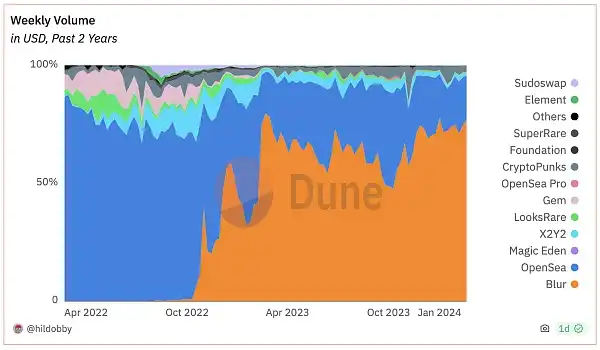
While it is not immune to market dynamics, Blur’s innovative incentive program keeps premium users active on the platform, and large airdrops tend to only attract more attention to the platform.
Blast has also taken a similarly innovative approach to incentive structures, using new mechanisms such as native revenue and gas fee sharing to retain and attract users, which also shows that the strategy employed by Blur is working.
Examples of Native Yield and Gas Fee Sharing
While 4-5% yield and gas fees may not seem like much at first, Blast’s native yield and gas fee sharing enable unique use cases and business models that were previously impossible or unprofitable.
For a couple of examples, look at Monoswap and BlastOff.
Monoswap is a new DEX on Blast that uses native yield to offer points that have real use, beyond just exchanging tokens. For actions taken on its platform, users receive MonoXP (their points), providing them with unique rewards and privileges — such as being able to share in native yield redistributions, gas revenue sharing, developer airdrop allocations, and overall profits for the Mono ecosystem. Through this, MonoXP demonstrates an attempt to tightly integrate users with the platform, using points in novel ways while further gamifying the DeFi experience.
Next, launchpad and yield aggregator BlastOff puts yield to work in a novel way with the Native Yield IDO. On their platform, users who stake ETH and stablecoins can choose to allocate a portion of their yield to support an IDO, combining passive income with early investment opportunities without risking principal. Together, these two platforms demonstrate use cases that are only possible with Native, which could provide Blast with staying power.
Conclusion
Blast’s journey from controversial debut to mainnet launch has certainly been an interesting one.
By combining a controversial (but compelling!) pre-launch strategy with unique technical features, Blast has already attracted a large following. Comparisons to Blur’s post-airdrop trajectory, as well as the novel use cases enabled by native yield and gas fee sharing, further solidify the argument for Blast’s continued relevance.
With all of these forces working together, it’s clear that Blast has put itself in an enviable position to thrive in this new bull market, leveraging its product and community commitment to stand out from the crowd of upstart L2s.
Original link
Welcome to join the official BlockBeats community:
Telegram Subscription Group: https://t.me/theblockbeats
Telegram Discussion Group: https://t.me/BlockBeats_App
Official Twitter Account: https://twitter.com/BlockBeatsAsia

 Related Articles