On the eve of the Cancun upgrade, will Metis be the biggest dark horse?
Original Title: "On the Eve of Cancun Upgrade, Will Metis Be the Dark Horse of This Round of Narrative?"
Original Author: Lucky, Biteye Core Contributor
With a 5x price surge in 3 months, Metis has undoubtedly captured the public's attention on the eve of the Cancun upgrade. So, what is driving Metis's development behind the scenes?
This article brings you a comprehensive analysis of Metis's technical progress, eco-development flywheel, decentralized sequencer, and more, aiming to give readers a clearer understanding of Metis's ecosystem.
01 Introduction to Hybrid Rollups
MetisDAO is a Layer 2 scaling solution compatible with the Ethereum Virtual Machine (EVM). Like other Layer 2 solutions, it reduces the pressure on the Ethereum blockchain by batching L2 transactions and sending them to the L1 network.
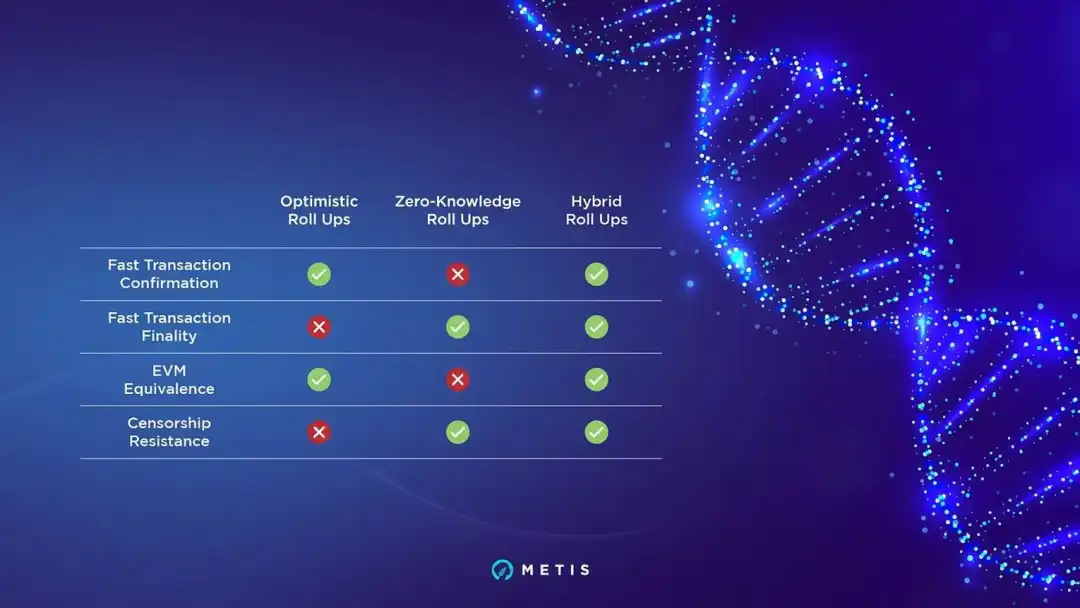
However, unlike other L2 solutions, Metis has adopted innovative Hybrid Rollups technology, combining two mainstream blockchain scaling solutions: Optimistic Rollup (OP Rollup) and Zero-Knowledge Proofs Rollup (ZKPs Rollup).
OP Rollup handles potential dishonest transactions through its fraud proof mechanism, while ZKPs provide a more secure verification method to ensure only valid transactions are confirmed. Therefore, Metis's Hybrid Rollup effectively reduces the risk of fraud and erroneous transactions.
Metis's Hybrid Rollup enables Metis to be both efficient and secure in processing a large number of transactions. Moreover, the overall system's scalability is not limited, and any EVM-compatible DAPP can seamlessly integrate with Metis. This way, Metis not only provides users with an efficient, secure transaction environment but also offers DAPP developers a convenient onboarding platform.
In the implementation of Hybrid Rollup, Metis incubated the zkMIPS project to assist in the implementation of Hybrid Rollup: ZKM. ZKM achieves zero-knowledge proof (ZKP) security for all virtual machines (VMs) and applications at the CPU level and supports multiple blockchain smart contract engines, allowing developers to easily apply ZKP to their development.
ZKM can verify all blockchain and non-blockchain transactions, reduce Gas fees, and shorten withdrawal waiting time. The introduction of ZKM is one of Metis's technical advantages compared to other L2 solutions.
In addition to its Hybrid Rollup technology, the most impressive development direction in this round of Metis is its upcoming decentralized sequencer.
02 Decentralized Sequencer
The sequencer is a role in L2 responsible for sorting, organizing, packaging, and submitting transactions to the L1 network. In most L2 projects (including Optimism, Arbitrum), a single sequencer is relied upon to perform these functions, leading to three potential risks:
1) Single point of failure. If this sequencer encounters issues due to attacks or technical failures, the entire network may come to a halt;
2) Scalability issues. A single sequencer may struggle to handle the increasingly growing transaction volume;
3) Limited resistance to censorship.
In addition to the above issues, a centralized sequencer also turns the community and on-chain users into passive participants in the network, unable to share sequencer revenue with the public chain.
To address these problems, MetisDAO plans to introduce a Decentralized Sequencer Pool to mitigate risks associated with centralized sequencers, enhance network scalability, and establish a sustainable, community-centric Layer2.
Advantages of Metis's Decentralized Sequencer Implementation:
1) In the decentralized sequencer pool, multiple sequencers work together. Any sequencer staking into the pool has the right to view the transaction pool content and process transactions, preventing a single sequencer from maliciously manipulating the system. This not only improves transaction processing speed but also enhances network fault tolerance (even if one sequencer encounters issues, the network can still function properly);
2) Users can become new sequencer nodes by staking the native token METIS, allowing network participants to supervise sequencer nodes, increasing system transparency and trustworthiness;
3) From a community sustainability perspective, node staking helps reduce circulating METIS supply, potentially positively impacting the long-term value of the token;
4) The introduction of the sequencer pool also signifies the introduction of liquidity staking / restaking into the Metis ecosystem. Liquidity staking has become one of the most important components of the DeFi space since last year, representing the largest share of TVL in DeFi. The introduction of liquidity staking to the Metis ecosystem can bring more possibilities and use cases for the ecosystem and the $Metis token.
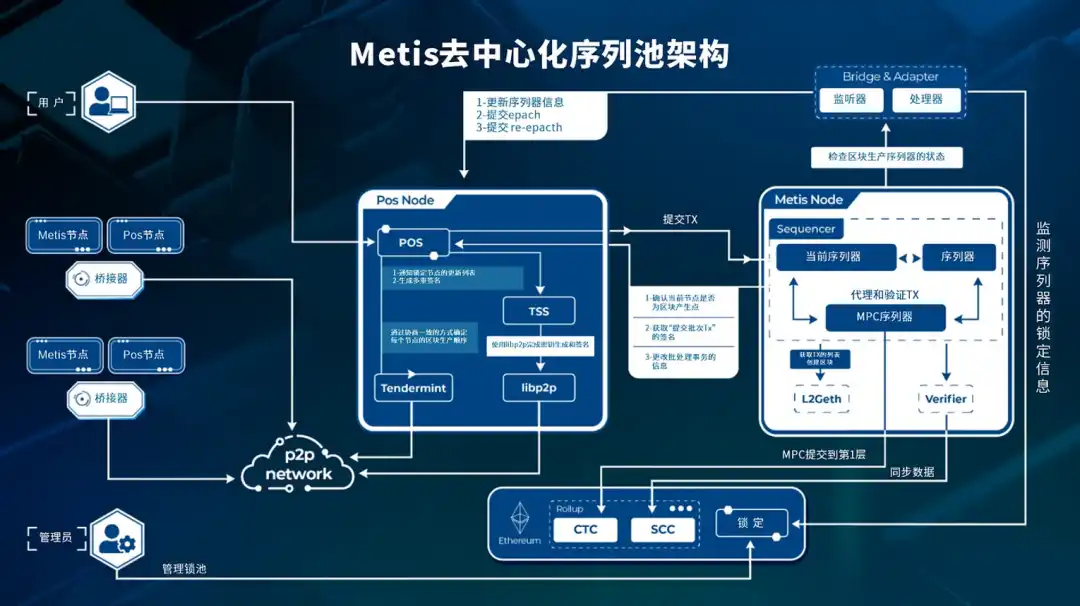
As shown in the above figure, Metis's Sequencer transaction process:
1. Initiation: User starts a transaction;
2. Sequencer Node: Transaction is forwarded to the network's sequencer node;
3. Block Generation: Sequencer receives the transaction and creates a block when the transaction is valid;
4. Final Confirmation: Multi-party Computation (MPC) nodes merge these blocks and forward them to the Ethereum main chain.
To encourage community participation, Metis also provides a staking reward for sequencer nodes, meaning these nodes can receive additional METIS rewards in addition to Gas fees (currently the main income for sequencers).
This design will incentivize more members to participate in staking sequencer nodes, ensuring power is not overly centralized and reinforcing the idea of decentralization.
Prior to the official launch of the decentralized sequencer, Metis will conduct 3 phases of community testing. The Metis sequencer pool has already undergone 2 rounds of community testing. The first round started from 1.3 and lasted for 27 days; nearly 200,000 users participated in the first round, generating 4 million on-chain transactions;
The second round of testing involved over 300,000 participants, and the network executed over 11 million on-chain transactions. For those who missed the first two rounds of testing, please pay attention to the release time of the third round of community testing and participate promptly.
03 Ecosystem Incentive Flywheel
On December 18 last year, Metis officially launched the Metis Ecosystem Development Fund (EDF) plan, aiming to allocate 4.6 million METIS to further drive the development and innovation of the Metis system.
Based on the current price of Metis at $106, this ecosystem fund is nearly $500 million, making it the largest ecosystem incentive fund among all L1/L2 solutions in the past two years.
The fund is allocated as follows:
Sequencer Mining: 65.4% ($3 million worth of $METIS, this fund is used to incentivize sequencer nodes for mining rewards, promoting community participation)
· Ecosystem Funding: 34.6% ($1.6M $METIS, this portion of the fund is used to support project teams for development, protocol deployment, liquidity provision, user incentives, and other ecosystem development measures)
On February 8th, the Metis team officially announced the launch of the Liquid Stake Blitz program, aimed at leveraging the MetisEDF Ecosystem Development Fund, totaling up to 4.6 million METIS, to accelerate the LSD protocol and LSD-focused product growth on the Metis Network.
According to the Liquid Stake Blitz program, from February 8th to the end of February, the LSD protocol in the Metis ecosystem will be able to make proposals through the Metis community governance system and move to formal voting in March.
After the voting, a limited number of winning protocols can win the right to be paired with a decentralized sequencer node (i.e., whitelist seat), thereby gaining stable node participation eligibility and receiving a 20% MRR (Mining Reward Rate) mining incentive for the first year.
It is important to note that the development of the LSD protocol in the Metis ecosystem is instrumental in addressing the staking threshold issue on this network.
Unlike the LSD protocol on Ethereum that lowers the staking threshold for POS nodes, the staking protocol in the Metis ecosystem, such as ENKI, lowers the staking threshold for sequencer nodes.
This provides more profit opportunities for ordinary users:
1) At least 20% guaranteed mining rewards provided by the ecosystem fund;
2) Airdrop rewards of corresponding LSD future tokens;
3) Increased demand for METIS, enabling the METIS ecosystem to achieve a positive development feedback loop.
For example, in the case of Enki, the protocol launched a Genesis Airdrop program called Fantasy in early February, which will airdrop 1 million ENKI (10% of the total supply) to community users as a reward;
Furthermore, Enki also announced that the team will not retain any tokens, and the remaining 90% of the total supply of other ENKI tokens will be gradually released over time in various forms, meaning Enki users can continue to earn ENKI rewards through a variety of protocol interactions, such as restaking eMETIS as seMETIS or through METIS/eMETIS LP pairing.
For large capital entities, they can stake 20k-100k Metis tokens to become a sequencer node.
For individual users, they can stake Metis on different LSD platforms to receive corresponding node rewards, and staking certificates can also circulate and be used in the ecosystem.
The emergence of decentralized sequencers, the revenue-sharing model, and the development of LSD have set $METIS apart from other L2 tokens.
For other L2 native tokens, they only have governance functionality and cannot share revenue with holders.
Therefore, we can see that when Metis is empowered with revenue, more people are willing to participate and become nodes, driving more tokens to be staked, further promoting the scarcity of Metis tokens and driving further price growth.
Price growth attracts more participants, making the ecosystem more prosperous. The prosperity of the ecosystem strengthens the incentives for sequencer nodes, with more people participating in staking. The entire development process gradually forms a positive flywheel.
04 Current Ecosystem Development Status and Key Projects
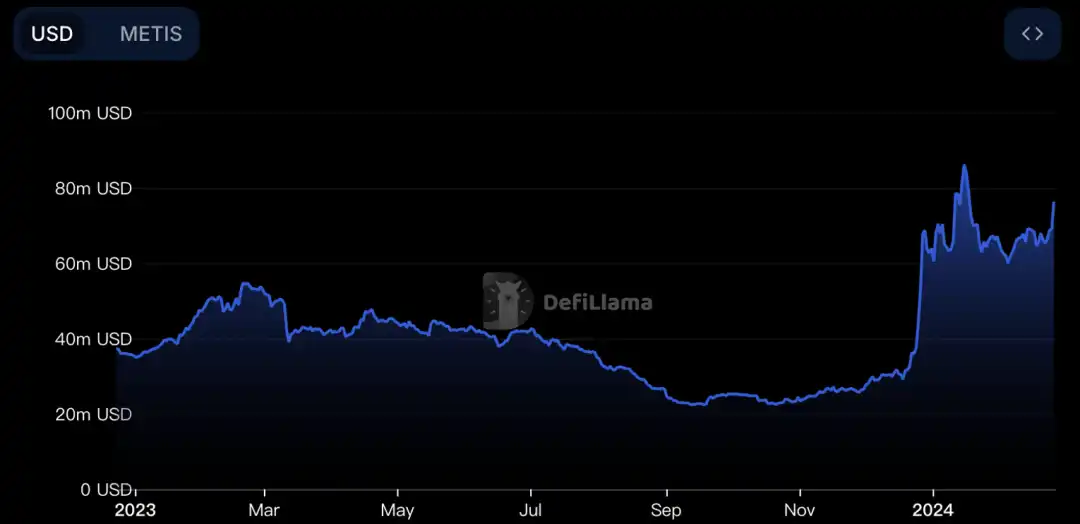
Metis's current TVL is $82.82M. From the changes in Metis TVL since 2023 mentioned above, we can see that since the launch of Metis Decentralized Sequencer design in 2024, on-chain TVL has shown significant growth, proving the community and the market's optimism towards this direction.
The current key projects in the Metis ecosystem are as follows:
1. ENKI: The first LSD project in the Metis ecosystem, aimed at simplifying and democratizing participation in the Metis Sequencer node ecosystem. It enables ordinary investors to earn rewards by staking Metis Sequencer nodes, currently in the testnet and not officially launched yet;
2. Hera Finance: An AI-driven DEX aggregator that helps users find the best trade prices.
4. Ethena: A recent popular stablecoin protocol on Ethereum, aimed at providing an anti-censorship, scalable cryptocurrency-native solution through USDe for the crypto world. On 2.28, it announced a collaboration with the Metis ecosystem.
5. Aave: The largest protocol by TVL on Metis, also the largest lending protocol across all chains.
6. Hermes Protocol: Allows users to perform slippage-free transactions on a DEX.
7. Net Swap: The first DEX in the Metis ecosystem, enabling users to conduct fast, low-cost token trades on the Metis Network.
8. Tethys Finance: The first perpetual trading protocol in the Metis ecosystem, allowing users to trade major tokens and METIS with up to 50x leverage.
9. Stargate: An asset cross-chain bridge developed by the cross-chain interoperability protocol standard LayerZero Labs. Through Stargate, users and Dapps can transfer assets across multiple chains.
10. Artemis Finance: A liquidity staking protocol designed for the Metis decentralized sequencer pool, also one of the two LSDs officially announced in cooperation with Metis. Users can stake their $METIS tokens on Artemis and receive liquidity tokens $artMETIS, automatically accumulate rewards, and interact with the Metis chain using $artMETIS.
11. WAGMI: A comprehensive DeFi solution with a liquidity pool that automatically rebalances dynamically allocated funds to maximize user transaction yields. It has received a 2M Grant from the Metis Ecosystem Fund and announced cooperation with DWF.
The Metis ecosystem incentives have just launched, indicating alpha opportunities worth watching.
05 Conclusion
As the first Ethereum Rollup to adopt a decentralized sequencer, Metis provides users and DApp developers with an efficient, secure trading environment and a convenient access platform through its unique Hybrid Rollups technology and upcoming decentralized sequencer.
With the continuous growth of the Metis ecosystem, the advancement of several key projects, and the official launch of the decentralized sequencer, under the positive incentives of its ecosystem fund, we have reason to believe that the Metis ecosystem is poised to carve out a place in the L2 competition, bringing more value and opportunities to users and developers.
Original Article Link
Welcome to join the official BlockBeats community:
Telegram Subscription Group: https://t.me/theblockbeats
Telegram Discussion Group: https://t.me/BlockBeats_App
Official Twitter Account: https://twitter.com/BlockBeatsAsia