Blayer: Decentralized BTC Layer2 based on mirrored blockchain.
Source: Blayer
The Huge Potential of Bitcoin Ecosystem
When it comes to blockchain, the first thing that often comes to mind is Bitcoin. In 2023, the recovery of the digital currency market will be mainly driven by Bitcoin. Despite the impact of the pandemic on the digital currency market, Bitcoin continues to create historic milestones. Especially since the Taproot upgrade in 2021, the technical foundation of Bitcoin has opened up new possibilities for embedding more data on the blockchain, sparking a frenzy in the world of Bitcoin and the entire digital currency world. In 2023, Bitcoin's share of the total market value in the cryptocurrency market will rise from 38% at the beginning of the year to 52% at the end of the year. The Taproot upgrade has once again made the Bitcoin ecosystem the focus of attention.
The ecology of Bitcoin is not a new concept. Since the birth of Bitcoin, the exploration of its ecology has never stopped. Recently, the popularity of inscriptions reflects the strong demand of the Bitcoin community for ecological expansion.
In April 2024, Bitcoin will experience its fourth halving, which will pose a huge challenge to miners' income. The volatility of the coin price will seriously affect the miners' enthusiasm. Bitcoin, which is centered on security and decentralization, will face a severe test, and the expansion of the Bitcoin ecosystem has become extremely urgent.
Currently, the market value of Bitcoin has exceeded 850 billion US dollars. If the development of blockchain is ahead of its value trajectory, then Bitcoin is likely to enter the next major growth cycle. Bitcoin is at the forefront of a new era, perfectly combining traditional finance with decentralized, trustless financial models.
Take Ethereum as an example, whose market value is only one-third of Bitcoin's. Its ecosystem accounts for 20% of its total market value, with on-chain assets of about $50 billion. If we calculate based on this proportion, the Bitcoin ecosystem should have at least $200 billion of development space. However, the current staked assets in the Bitcoin ecosystem are only $300 million. This indicates that the Bitcoin ecosystem has a growth potential of up to 600 times, demonstrating its huge potential for development.
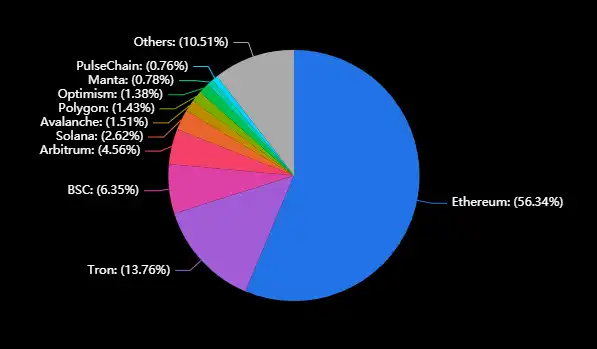
ETH and ETH Layer2 TVL are approximately $50B, accounting for about 18% of ETH's market value.
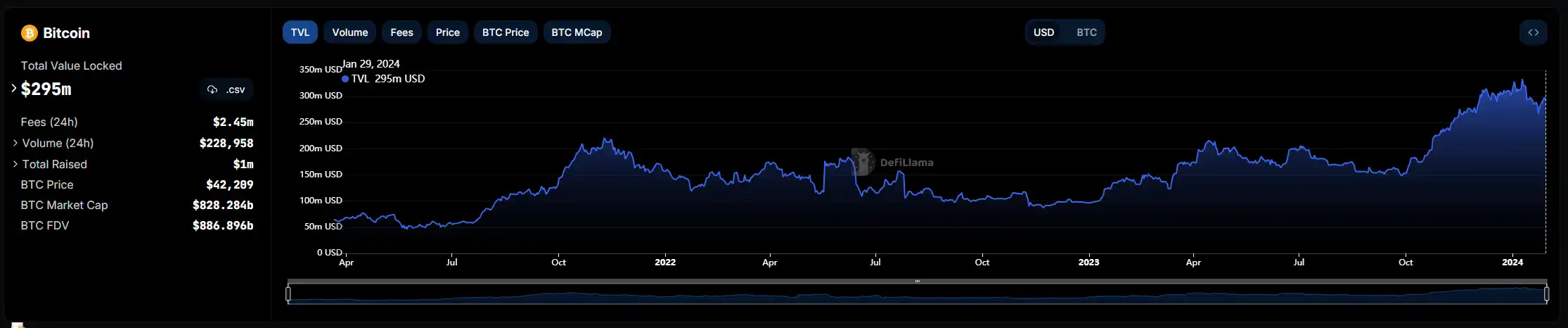
Bitcoin network TVL is $305M (total value locked)
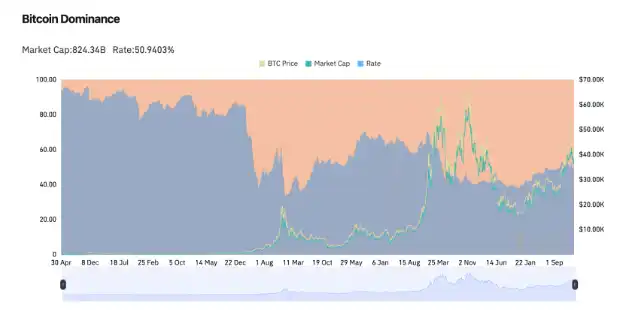
Bitcoin's current market value and total market share
Bitcoin needs L2
As the cornerstone of the cryptocurrency industry, Bitcoin is known for its security, reliability, and decentralized nature, and is regarded as the spiritual totem of the cryptocurrency field. Since its inception, Bitcoin has always insisted on protecting value in the safest way possible, ensuring the sanctity and inviolability of personal property.
Despite lacking Turing completeness and having a much lower TPS compared to other public chains, Bitcoin supporters believe that it does not require significant changes or risky technological innovations to maintain its core decentralization and security.
The launch of the BRC20 protocol doubled the price of Bitcoin and attracted a large number of Mingwen users to the Bitcoin mainnet. However, as a mainnet for value storage, it also faces problems such as high interaction costs, slow confirmation speeds, and difficulty in expanding applications.
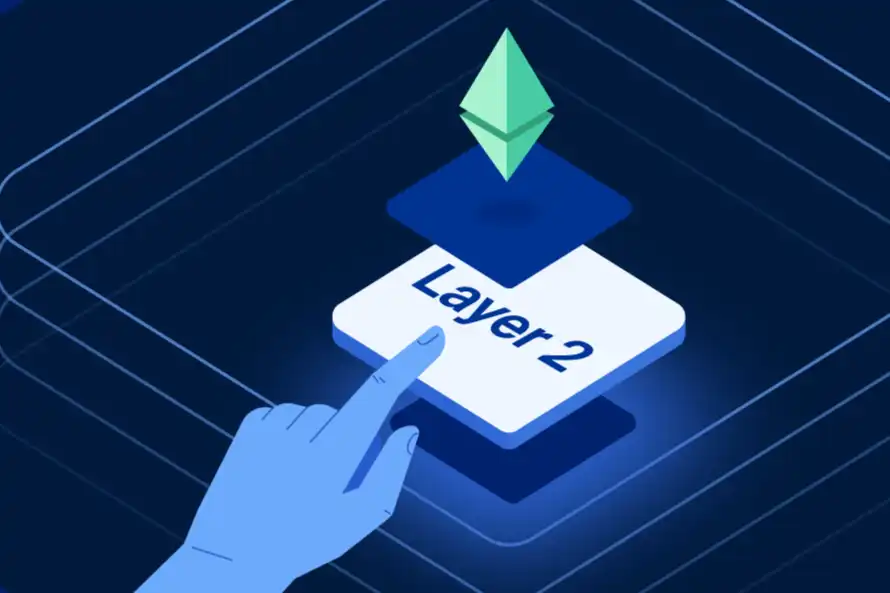
The community urgently expects the expansion of applications, and miners need stable income. Directly improving the underlying protocol of Bitcoin will face high complexity, which will lead to hard forks and community splits, increase system risks, and even threaten its most important decentralization and security. Drawing on the experience already verified in Ethereum, the community is more inclined to adopt Layer2 solutions. By processing a large number of execution operations outside the main network and only writing back the final state to the main network, this technology aims to improve transaction speed, reduce transaction costs, and solve the problems currently faced by the Bitcoin ecosystem.
Considering the practical situation, the Layer2 solution for Bitcoin should have the following characteristics:
· Decentralized Cross-Chain: Decentralized cross-chain based on the mainnet consensus is crucial and a continuation of the security concept of Bitcoin. Currently, traditional cross-chain technologies such as hash time-locks and multi-signatures are mostly centralized and cannot provide sufficient trust guarantees. Only by achieving true decentralized cross-chain can user trust be ensured and a solid trust foundation be laid for Layer2.
· Secure and efficient Layer 2: Layer 2 should not only support smart contracts and various protocols that allow the use of BTC as assets, but also fully inherit the security features of Bitcoin and provide fast and efficient transaction processing. At the same time, the state results should be effectively synchronized to the main network for confirmation.
· Boosting the Bitcoin ecosystem: For Bitcoin users, the lack of Bitcoin consensus participation in Layer2 means losing its core meaning. Using BTC as transaction fees (gas) is an important part of Layer2 narrative. From a strategic perspective, increasing miner revenue, stimulating community developer interest, helps to promote the development and innovation of Layer2, and thus promote the overall development of Bitcoin.
Bitcoin Ecological Development Status
Bitcoin Layer2 Decentralized Cross-Chain Technology Challenges
Layer2 refers to off-chain solutions built on top of the Bitcoin mainnet, aimed at preserving Bitcoin's decentralization and security features. Due to the Turing incompleteness of the Bitcoin mainnet and the limitations of the underlying block space, as well as the use of a simple UTXO model, Bitcoin faces unique challenges. For example, Ethereum's L2 project, such as Scroll, verifies the ZK Proof generated by the second-layer network calculation by deploying contracts on the first layer, but even after the Taproot upgrade, Bitcoin cannot implement complex OP/ZKP verification logic. Bitcoin's UTXO model, which is a disposable use model, means that the cost of generating a new contract is required for each contract call, which helps prevent double-spending attacks and maintain security, but limits Bitcoin's ability to directly replicate Ethereum-style cross-chain designs. In addition, although the Script Code supported by Bitcoin is stack-based, the types of OpCode supported are very limited and difficult to extend to the level of computation like Scroll ZK verification contracts.
Despite this, the exploration of the Bitcoin ecosystem has been ongoing for many years, with multiple teams dedicated to solving these technical challenges:
· Lightning Network: Supports fast and low-cost micro payments, achieved through the creation of payment channels with on-chain confirmation only at critical points. Key technologies include revocable sequence contracts and time-lock contracts, but sufficient funds must be locked in the payment channels, which may lead to liquidity issues. Effective operation depends on widespread participation and sufficient channels.
· Stacks: Provides decentralized mining and bridging technology for Bitcoin, bringing Bitcoin liquidity into Stacks applications through protocols such as sBTC. It adopts a proof-of-transfer consensus mechanism, and miners need to use BTC for STX mining. Cross-chain uses a centralized bridge project, and Stacks has its own chain, compiler, and programming language Clarity.
· RGB: A Bitcoin smart contract system with integrated lightning network. Transaction verification is completed by the client and is mainly used for asset issuance and trading with limited application scenarios.
· Rootstock (RSK): Allows Bitcoin miners to process both BTC and RSK transactions simultaneously. Supports EVM and implements Bitcoin extensions, but its security model differs from Bitcoin and its cross-chain security is questionable.
· Liquid: Allows users to move Bitcoin between two networks through a two-way peg, using 11 multi-signature nodes for cross-chain transactions. It is relatively centralized. The sidechain design limits the use of complex smart contracts.
Currently, various Bitcoin Layer2 projects are emerging, each with different compatibility designs. The main challenge for the current Layer2 teams is to achieve decentralized cross-chain and efficient second-layer solutions. There is currently no perfect solution in existing projects that fully addresses both aspects.
Blayer Solution
The Blayer protocol aims to bring revolutionary changes to the Bitcoin ecosystem. As an innovative BTC Layer 2 solution, the core of Blayer is to achieve efficient and secure transfer from Bitcoin to Layer2 in a decentralized manner. It not only provides an efficient, secure, and scalable value application platform, but also supports the use of native BTC as Gas fees through the developer-friendly BVM protocol. This not only enriches and improves the Bitcoin ecosystem, but also helps to tap the value on the Bitcoin chain, realize its transformation as a blockchain underlying asset, and promote the development of the Bitcoin Web3 ecosystem.
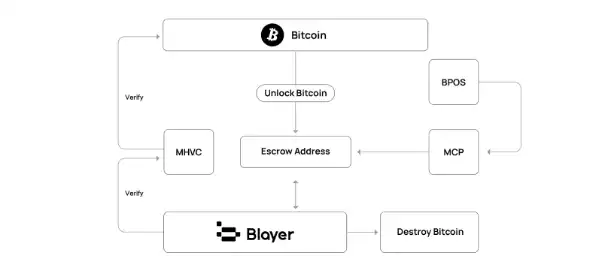
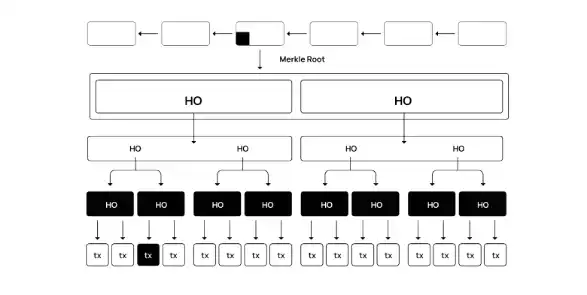
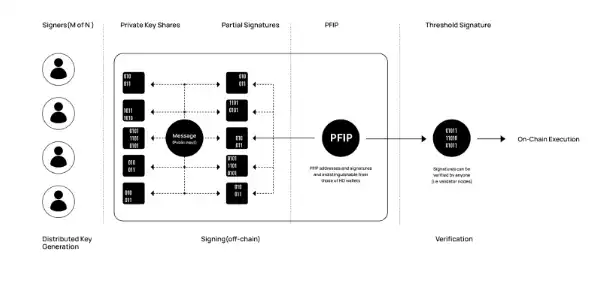
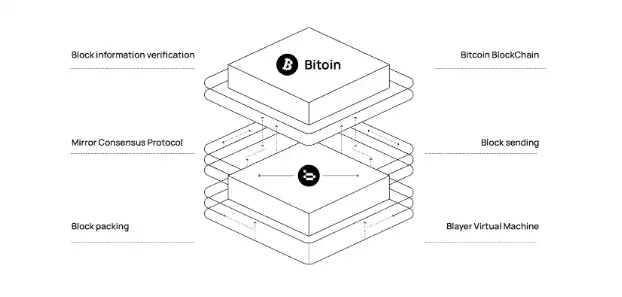
Blayer uses its unique Mirror Consensus Protocol (MCP) to achieve bidirectional synchronization between the Bitcoin network and the Blayer network, enhancing the security and integrity of data. This protocol allows data to be synchronized and verified between the two networks, ensuring the authenticity and tamper resistance of transaction data.
By utilizing the consensus mechanism of Bitcoin as a security foundation, MCP not only maintains the core integrity of Bitcoin, but also provides a two-way communication and verification framework. This framework enables the Bitcoin network to more flexibly interact with Blayer's ecological applications, greatly enhancing the scalability and diversity of the entire ecosystem.
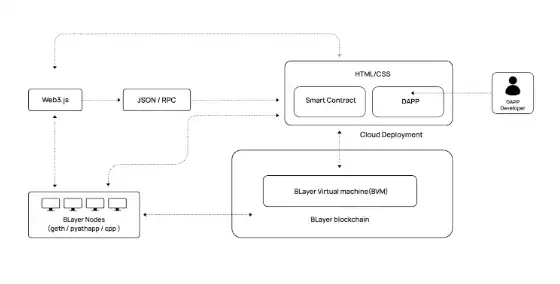
The ecosystem of EVM (Ethereum Virtual Machine) has already had multiple mature and market-validated projects. For the development of Bitcoin Layer2, the ideal situation is that these developers can directly build on Bitcoin Layer2. To achieve this, Blayer (BVM) virtual machine supports the development and deployment of smart contracts using Solidity language, allowing developers to build decentralized applications (DApps) on the Blayer platform using the smart contract language they are familiar with.
The Blayer protocol has adopted the "Swift Block Builder", which is an efficient data processing algorithm used to effectively sort blocks. This not only improves the transaction processing speed and efficiency of the Blayer network, but also provides great assistance to the development of the Bitcoin ecosystem. Through this integration with the EVM ecosystem, Blayer aims to maximize the development and expansion of Bitcoin's functionality and application scope, making it not only a value store, but also a multi-functional and efficient blockchain platform.
Blayer Consensus Mechanism: Strengthening the Security and Decentralization of Bitcoin Layer 2
When designing its Layer 2 solution, Blayer closely follows the principles of the Bitcoin mainnet, prioritizing security and adhering to its commitment to decentralization. To achieve this, Blayer's consensus protocol cleverly combines Byzantine Proof of Stake (BPOS) and Byzantine Fault Tolerance (BFT) mechanisms.
BPOS combines the high efficiency of PoS with the strong security of BFT, enabling the Blayer network to effectively combat malicious nodes and system failures, ensuring reliable operation in various scenarios. BPOS not only reduces computational consumption and improves transaction processing speed, but also maintains high network security and fault tolerance, ensuring stable operation even in the face of internal dishonest behavior or external attacks.
In terms of node management, Blayer uses a hybrid token of BTC and native tokens as node staking, and provides rewards for validators. By periodically rotating nodes that hold fragment addresses, Blayer enhances network security. If a node engages in improper or malicious operations, it may face partial or complete loss of staked funds, or even permanent disqualification from validation. This mechanism ensures the fairness of network management and effectively prevents centralization risks, further strengthening the decentralization and security of the network.
In addition, Blayer uses BTC as Gas, which not only promotes Bitcoin's entry into the deflationary era, but also creates additional revenue for miners. This move will undoubtedly further promote the development of the Bitcoin ecosystem and provide a solid foundation for the implementation of Bitcoin Layer 2 solutions.
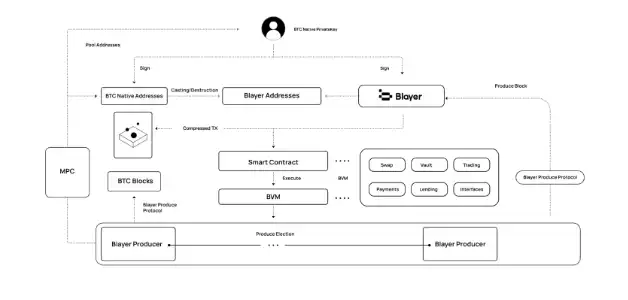
(User Usage Flowchart)
Blayer's Grand Vision: Leading the Future of Bitcoin Layer 2
Blayer's technical team is mostly composed of members from the Bitcoin native technology community. The core team has been deeply involved in the Bitcoin community for many years, with a deep understanding and practical experience of the Bitcoin mainnet. They have participated in many major events in the Bitcoin world and are early contributors to the Bitcoin code.
Blayer's vision is to become a leader in the Bitcoin Layer 2 field, promoting the application and popularization of Bitcoin in a wider range of areas. Blayer is committed to maintaining the purity and security of the Bitcoin network, while responding to the Bitcoin community's demand for ecological construction and promoting the prosperity and development of the Bitcoin ecosystem.
The Blayer team has launched a decentralized BTC Layer2 solution based on mirror blockchain technology. Through its core technologies - Merkel Hash Verification Protocol (MHVC), Privacy Fragment Integration Protocol (PFIP), Mirror Consensus Protocol (MCP), and Byzantine Proof of Stake (BPOS) - it solves the decentralized cross-chain problem from the Bitcoin network to Layer2 and the bilateral verification challenge of block information, while achieving efficient use of Bitcoin in smart contract applications.
The launch of Blayer heralds the explosive growth of Bitcoin ecological applications, which has the potential to open up a trillion-dollar market for Bitcoin and provide long-term consensus security for the Bitcoin network. This is not only a milestone in the development of Bitcoin technology, but also a huge contribution to the entire cryptocurrency field.
With the continuous evolution and adaptation of the Bitcoin ecosystem, we can expect more development. The various Web3 platforms in the Bitcoin ecosystem will integrate with each other, potentially reshaping the global financial market and forging a true Web3 world. Blayer's goal is not only to achieve technological innovation, but also to play a key role in promoting the overall progress of cryptocurrency culture and community.
This article is from a submission and does not represent the views of BlockBeats.
Original article link
Welcome to join the official BlockBeats community:
Telegram Subscription Group: https://t.me/theblockbeats
Telegram Discussion Group: https://t.me/BlockBeats_App
Official Twitter Account: https://twitter.com/BlockBeatsAsia

 Related Articles