Waterdrip Capital: The Past, Present, and Future of BTC Layer2.
Author: Glimmer @Glimmerllx, William @xswl.eth, Hankester @0xHankester
Mentor: Jademont, Elaine, Bill @Waterdrip Capital
Bitcoin, abbreviated as BTC, is an open-source cryptocurrency system based on blockchain decentralized consensus and peer-to-peer network communication, maintained by computer networks and nodes distributed around the world. BTC's white paper was released by Satoshi Nakamoto on October 31, 2008, and on January 3, 2009, the consensus chain of BTC produced the first block. However, as the encryption community and ecology grow and prosper, the early BTC technology can no longer meet users' needs for the scalability of cryptocurrency systems. Directly improving the underlying protocol of BTC is complex, with community resistance, which will increase the risk of the BTC system, leading to hard forks and community splits. A more suitable solution is BTC Layer 2, which builds new levels based on BTC without modifying BTC, compatible with BTC, and meets users' needs for scalability. This article investigates BTC Layer 2, comprehensively elaborates on the current situation and problems of BTC, the technical solutions and advantages and disadvantages of BTC Layer 2, and looks forward to its future.
BTC Technical Introduction
The core of BTC is distributed ledger technology, which uses blockchain to store transaction data. Blockchain is based on a hash pointer linked list structure, where each node in the list is a data block that contains the hash value of the previous block, transaction data, time data, mining parameters, and protocol version information. In the BTC network, the right to write new blocks, or the right to keep accounts, is obtained by nodes through a Proof of Work (PoW) mechanism that relies on computational competition. Nodes that obtain the right to keep accounts receive a certain amount of Bitcoin tokens as a reward after successfully writing a new block, which is why this process is also called mining.
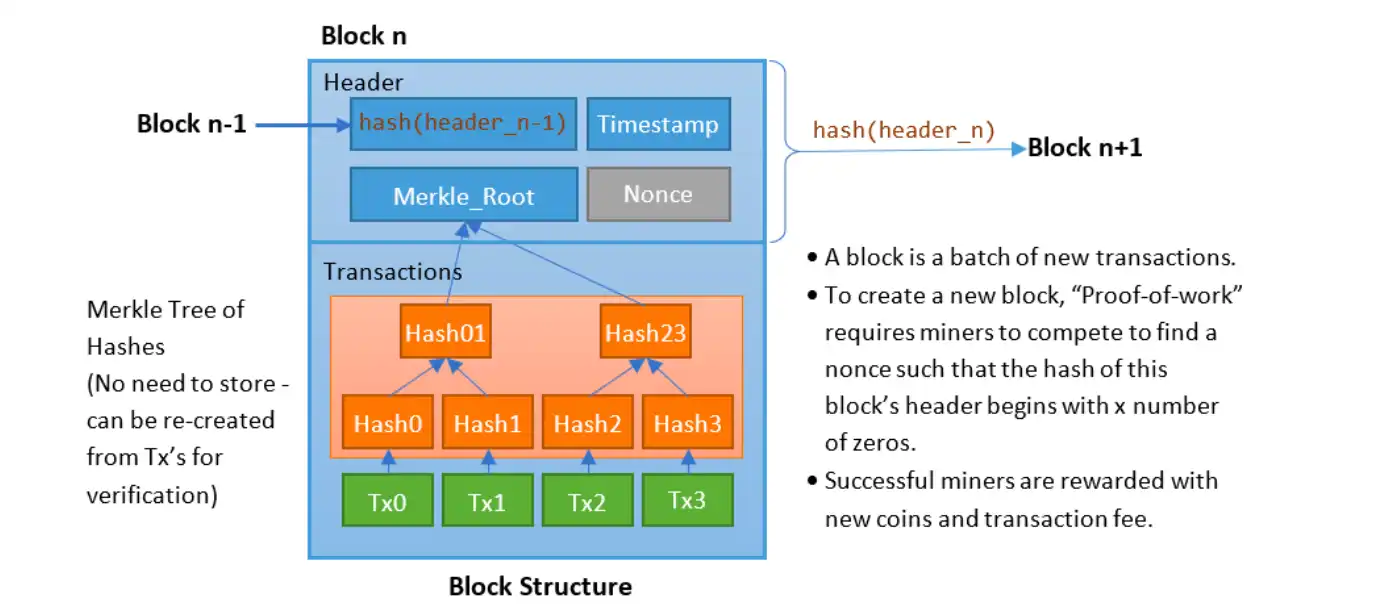 BTC's block data structure, image source: https://www3.ntu.edu.sg/home/ehchua/programming/blockchain/bitcoin.html
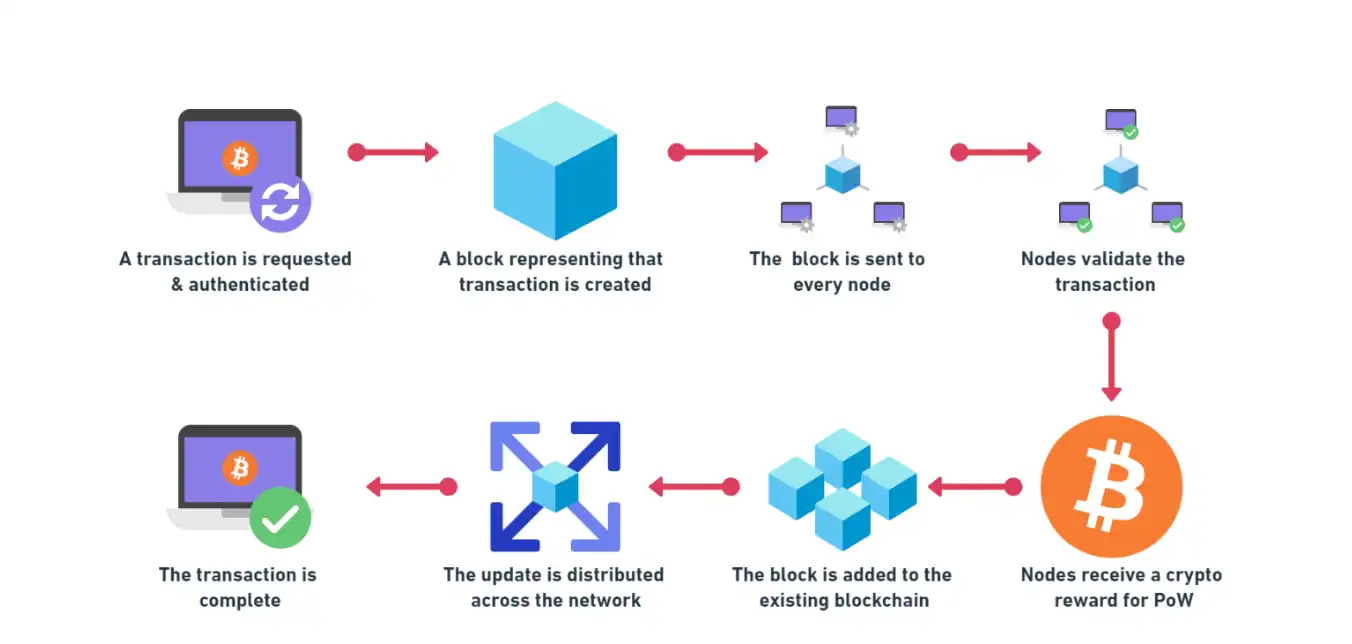
BTC's accounting workflow image source: https://hackernoon.com/exploring-the-feasibility-of-transitioning-btc-from-pow-to-pos
BTC adopts a transaction-based ledger scheme, which only records transaction information on the blockchain and does not maintain account balances. Therefore, in order to prevent double-spending attacks, nodes need to maintain a set of unspent transaction output data (UTXO) locally, and account transfers need to provide funding sources for nodes to verify the legitimacy of transactions.
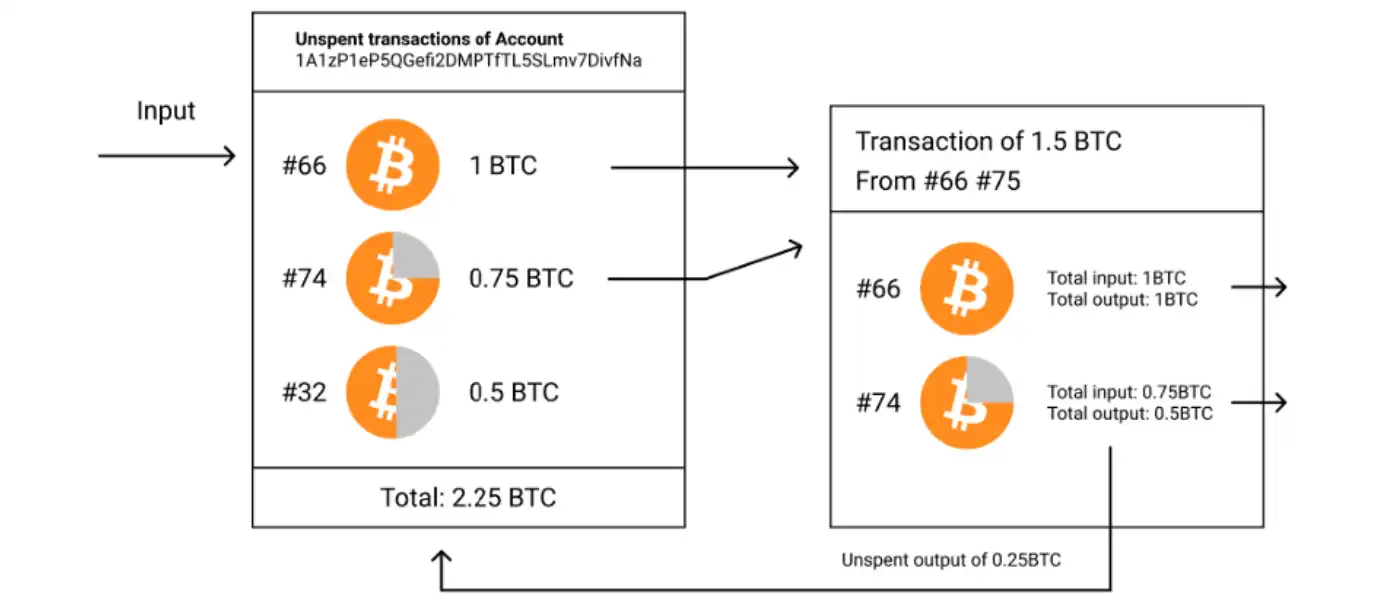
UTXO diagram for a single account, image source: https://docs.safepal.io/blockchain-tutorials/utxo-what-is-it-and-how-to-use-it
BTC uses asymmetric encryption and hash algorithms to organize accounts, protect and verify transactions. An account includes an account private key and an account public key. The account private key is a randomly generated private key, while the account's public key is generated by elliptic curve multiplication of the private key. In addition, the account's address is generated by hashing the public key using a hash algorithm. After the transaction is signed with the private key, it is broadcast to nodes through a peer-to-peer network. Nodes use the corresponding public key to verify the transaction. After successful verification, the transaction is then packaged into a new block.
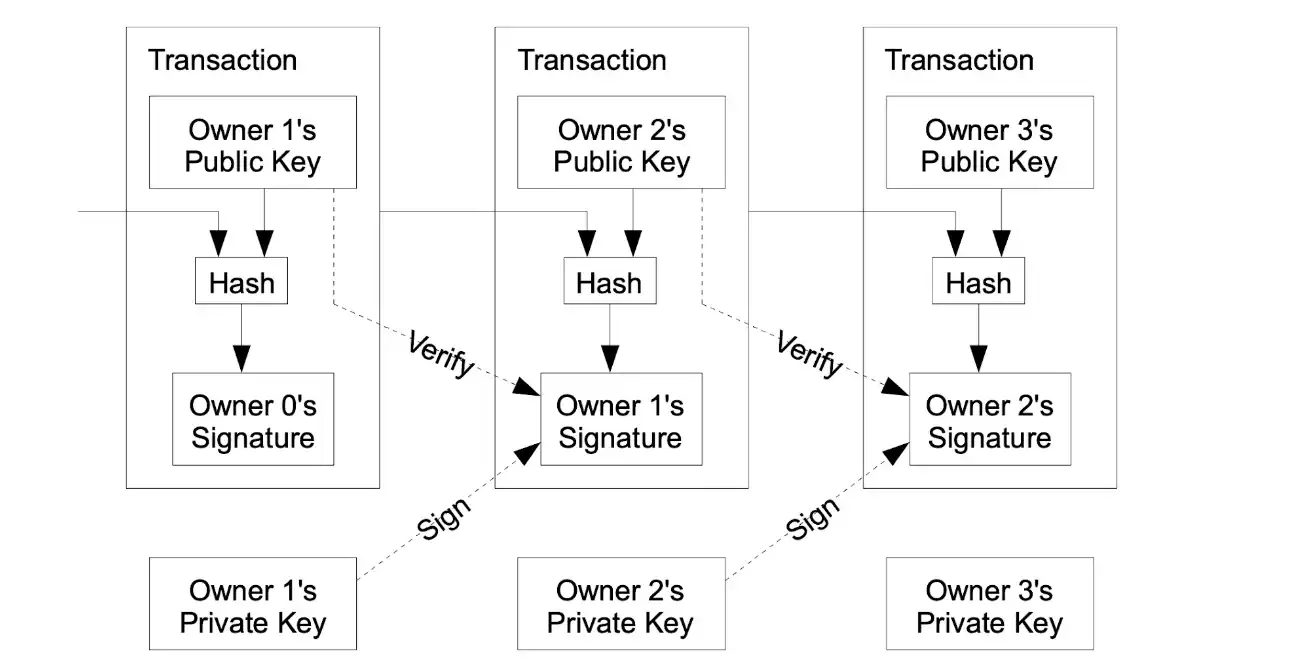
BTC account private key and public key signature and verification, image source: Nakamoto, Satoshi. "Bitcoin whitepaper."
The consensus mechanism for BTC is PoW. Each node constructs a new block header, with the hash value being less than or equal to a given target value. The node that first finds a block header that meets the criteria has the right to record the next block. By adjusting the size of the target value, the block time can be indirectly adjusted. The larger the target value, the easier the mining and the shorter the block time; the smaller the target value, the harder the mining and the longer the block time. BTC expects each block to have a block time of 10 minutes. Therefore, BTC will adjust the target value, or mining difficulty, every 2016 blocks.
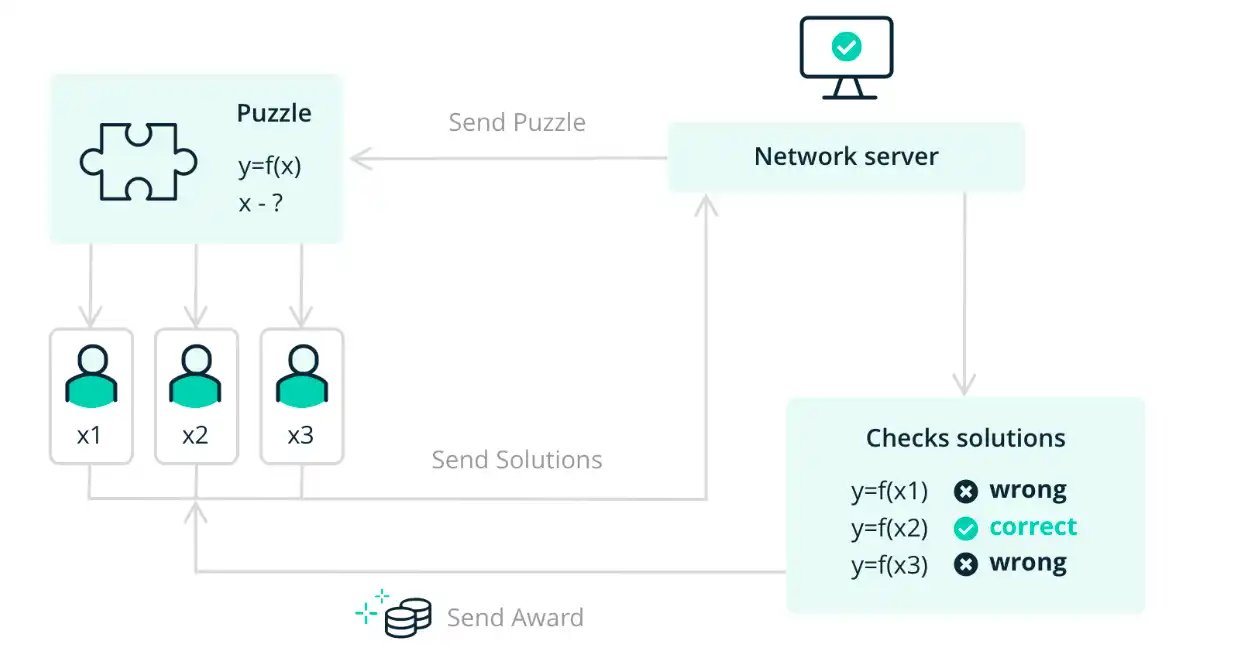 Proof Of Work Process Example, Image Source: https://www.ledger.com/academy/blockchain/what-is-proof-of-work
BTC's current situation and the problems it faces
BTC is the first digital currency system widely recognized by the global cryptocurrency community. Since 2013, BTC has consistently accounted for more than half of the total market value of cryptocurrencies, making it the undisputed leader in the cryptocurrency industry.

BTC market capitalization ratio, source: https://www.coinglass.com/zh/pro/i/MarketCap
For a long time, BTC has been popular among users due to its pioneering position and high security. However, with the growth of cryptocurrency users, BTC is struggling to meet the increasing demands for low transaction fees, convenience, instant transactions, privacy protection, diverse assets, and applications in the cryptocurrency system. In the long run, BTC's market value as a percentage of the total cryptocurrency market value is slowly declining. Compared to public chains such as Ethereum with a prosperous ecosystem, Solana with low transaction fees and high TPS (Transactions Per Second), BTC seems to have no other core competitiveness besides its popularity and security, and is facing the following problems:
- Slow transaction speed, long confirmation time, and inconvenient: BTC has a block size limit of 1M, and the data of each transaction is approximately 250B. Therefore, each block can only contain a maximum of 4000 transactions. Based on the expected block time of 10 minutes, BTC's TPS is only about 7. Transactions on BTC require 6 blocks for trusted confirmation, resulting in a final confirmation time of about 1 hour. In addition, transferring funds on BTC can only be done by transferring the entire balance at once, and change must be declared to be sent back to one's own address, otherwise it will be given as a reward to the miner. This cannot meet users' needs for convenient and immediate transactions.
- High transaction fees: When users use BTC for transactions, they need to pay a transaction fee to attract miners to package the transaction. The higher the transaction fee, the faster the transaction confirmation. When transactions are congested, transaction fees can become extra expensive, reaching over $60 in 2021. From May 14, 2020 to May 15, 2023, the average transaction fee for Bitcoin is $4.66. This transaction fee cost has hindered many users from using BTC.
- 不支持智能合约编程: BTC does not support direct construction of complex applications and can only be developed from the protocol layer. However, the cost of developing applications from the protocol layer is much higher than that of developing through standardized smart contracts. This limits the diversity of BTC applications and the development of asset diversity.
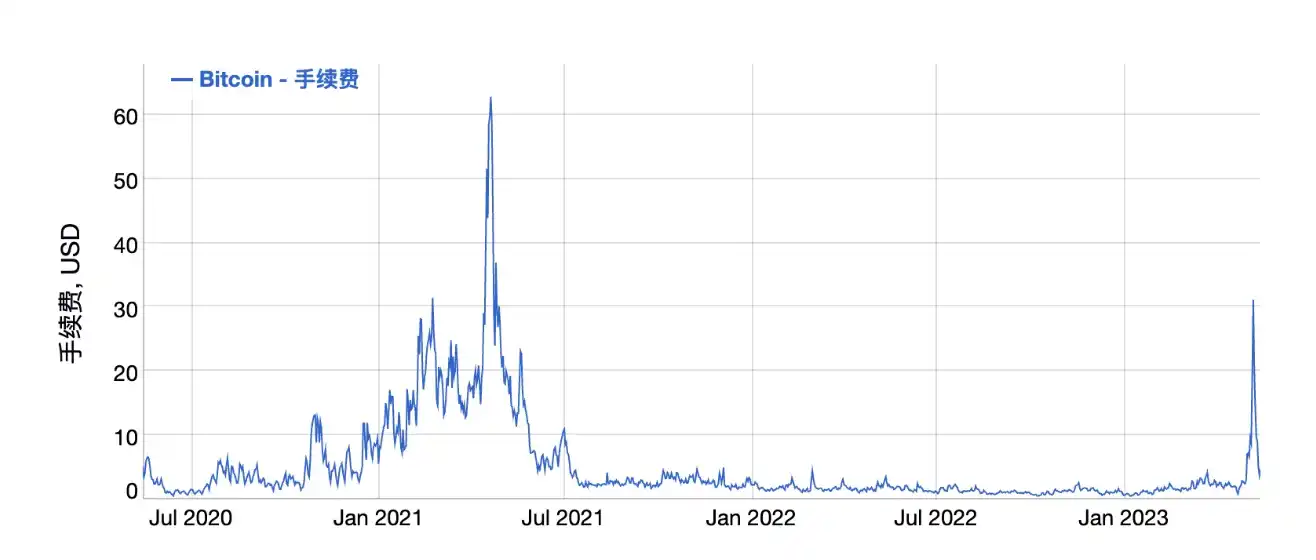
BTC transaction fees, source: https://bitinfocharts.com/zh/comparison/bitcoin-transactionfees.html#3y
Improving BTC's Resistance and Layer 2 Solutions
Technical Difficulty: The problem that BTC faces comes from outdated technical solutions that cannot meet current needs. Even if BTC is directly adjusted, it cannot completely solve the problem and may even create new ones. If BTC is expanded by increasing each block from 1M to 100M and increasing TPS to 700, it will result in nearly 5T of new ledger data generated each year, raising the threshold for running nodes, affecting the degree of decentralization, and increasing system risk. Even without considering the issue of ledger data size, based on the median internet bandwidth of 13 Mbps and each transaction size of 250 B per block, BTC's TPS limit is 6815, which cannot compete with public chains such as Polkadot and Solana that can support tens of thousands or even hundreds of thousands of TPS. Bitcoin Cash (BCH) expanded BTC's block size, but BCH's client frequently encountered errors and increased the operating costs of full nodes, bringing centralization risks. In 2019, to combat attackers who exploited BCH code vulnerabilities, BCH mining pools launched a 51% attack to modify transaction data.
Community Resistance: Between security and scalability, the BTC community prioritizes security. Due to cautiousness towards technical risks, BTC core developers have been very conservative towards proposals for direct expansion of BTC. The simplest expansion is to increase the size of each BTC block. The proposal to increase BTC block capacity has gained support from many users, miners, and developers since 2015. Increasing block capacity allows users to have faster transaction speeds, and miners can collect more transaction fees. However, some developers, led by BTC core team leader Wladimir van der Laan, do not agree with this expansion method and support solutions such as Segregated Witness and Lightning Network. The debate over block expansion has caused a split in the BTC community, and after the introduction of the Segregated Upgrade technology, some people refused this technology upgrade, causing a hard fork in BTC in August 2017, resulting in the emergence of BCH. After the hard fork, BCH raised the block limit to 8M, and later to 32M, with an average TPS of around 120. In addition, due to differences in technical upgrade routes in 2018, the BCH community split again, resulting in a hard fork of BSV (Bitcoin Satoshi Vision). This fork caused the total network computing power of BCH to plummet and has not reached the pre-fork computing power level since. The block size limit of BSV has been raised to 4G, but it lacks miners and users and is far less secure than BTC.
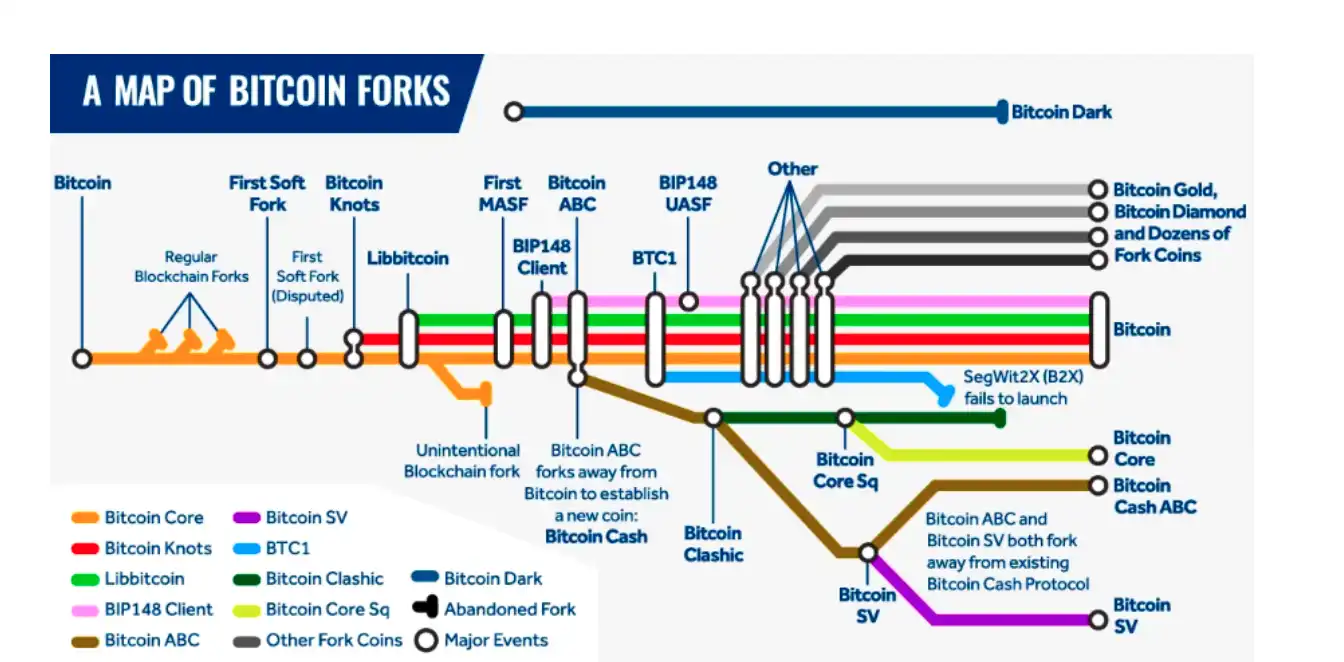
BTC's fork history, image source: https://www.blocktempo.com/forks-history-5years-review/
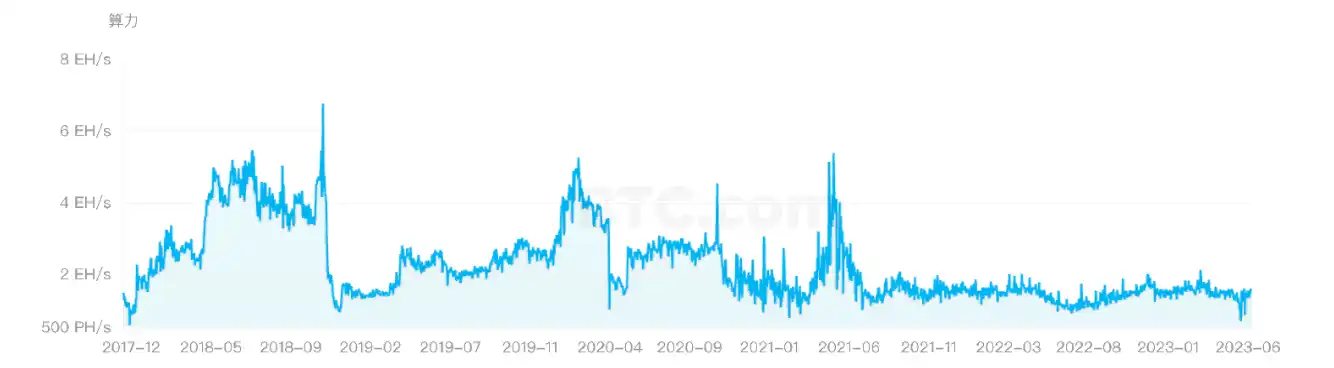
BCH network total computing power history, image source: https://explorer.btc.com/zh-CN/bch/insights-hashrate
Layer2 Solution: In fact, directly modifying the complexity of BTC is high and there is strong resistance from the community. The more accepted solution is to build a new layer based on BTC, which is both compatible and does not affect the BTC system, and solves the above problems. BTC has extremely high security. By using BTC as the core layer and relying on BTC block data and BTC script programs, developers can build BTC-compatible systems on top of BTC, execute a large number of transactions outside of BTC, and only write the final state data into BTC. This type of solution is called BTC Layer 2.
BTC Layer 2's Goals and Development History
Development goals of Layer2:
In 2012, the concept of Pegged Sidechains was first proposed, which derived from Two-way Peg and enabled assets to be seamlessly transferred between two chains. This proposal laid the foundation for later sidechain technology.
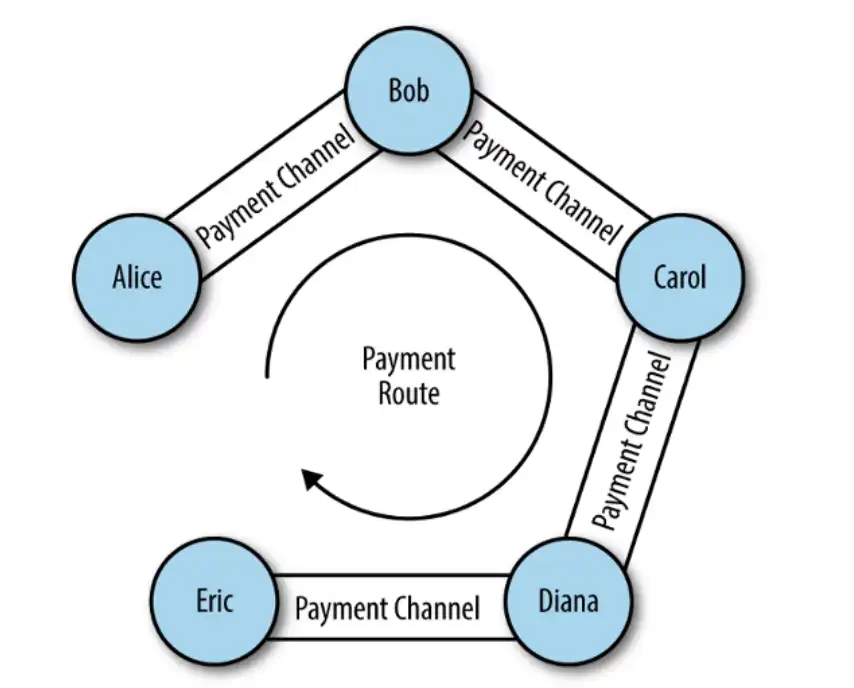
To construct a secure and reliable micro-payment channel, the Lightning Network adopts the Recoverable Sequence Maturity Contract (RSMC) and Hashed Timelock Contract (HTLC) as key technologies.
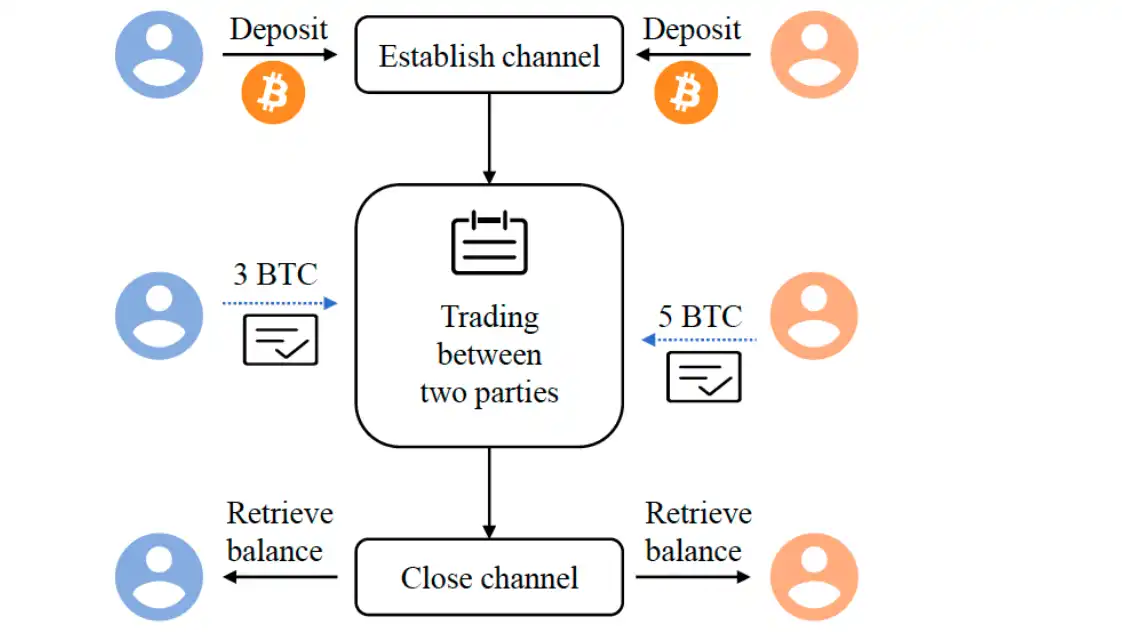
HTLC establishes a transaction channel between two parties, similar to a trading room, with a set expiration date for automatic settlement. At the same time, HTLC also establishes rules for cross-channel transactions, facilitating transaction routing. In the Lightning Network, establishing a transaction channel incurs a cost, and there may not be an existing transaction channel between any two users. In this case, an existing transaction channel with another user can be used as an intermediary for the transaction.
OmniBOLT stands for "Omni Basis of Lightning Technology". "Omni" means complete and comprehensive, while "BOTL" is the abbreviation for the basis of Lightning Network technology. OmniBOLT is based on BTC and the Omni Layer, proposing a complete Lightning Network protocol that not only expands the Lightning Network's BTC payment capabilities, but also enables the issuance and trading of diversified assets based on the Omni Layer. It also supports an Automated Market Maker (AMM) mechanism, allowing users to use the liquidity of payment channels as a pool of funds to build and use decentralized exchanges on the Lightning Network. The vision of OmniBOLT is ambitious, but currently, the technology is complex and involves multiple protocols and systems, which may pose security risks and require more time to verify its safety.
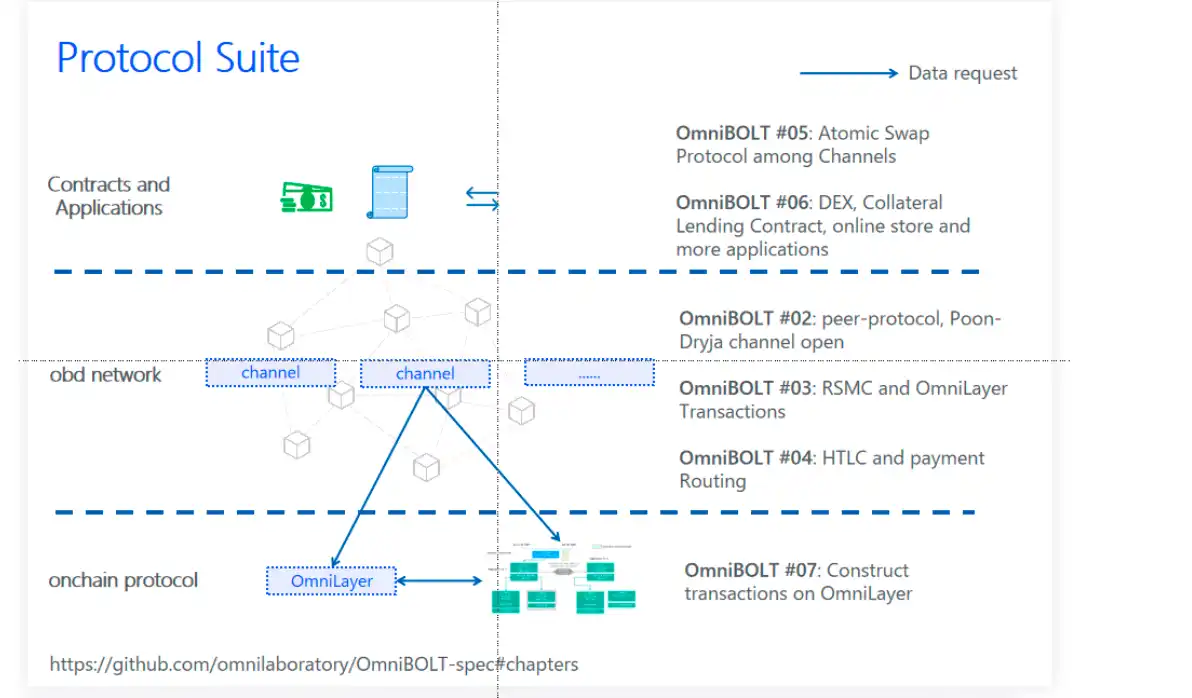
OmniBOLT protocol architecture, image source: https://omnilaboratory.github.io/obd/#/
OBAndroid is a fully-featured lightning network full-node mobile wallet. In this wallet, users have control over their private keys while being able to automatically monitor transactions, quickly synchronize full-node data, and support cloud and local backup channel states. In addition, OBAndroid also supports trading of assets through OmniBOTL on the Omnilayer. OBAndroid makes the lightning network trading experience accessible to users, reducing the barrier to entry for using the lightning network.
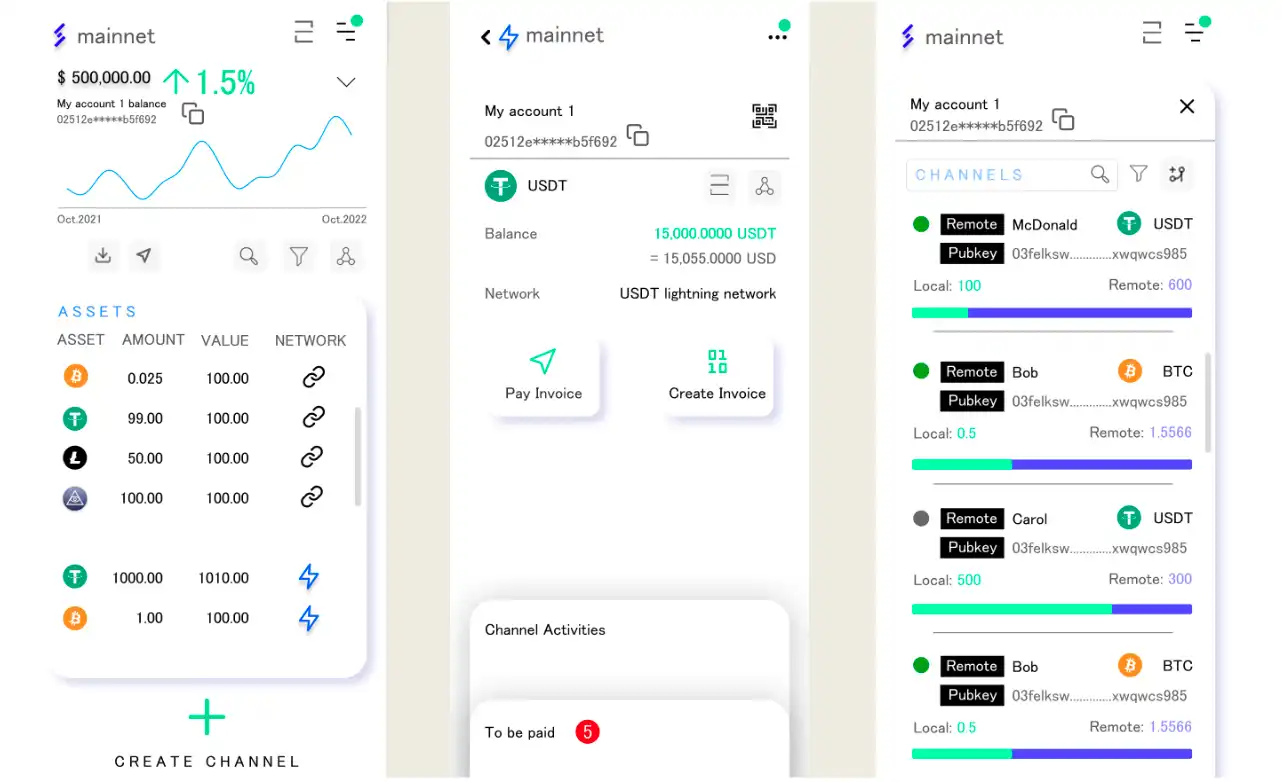
OBAndroid full node wallet, image source: https://github.com/omnilaboratory/OBAndroid
Other BTC Layer 2 Projects
Apart from the Lightning Network, there are other BTC Layer 2 projects under development:
Syscoin was developed by the SYSLab team by forking the BTC source code, with the aim of utilizing the security of BTC while being compatible with the Ethereum ecosystem. Currently, the SYSLab team has launched NEVM (Network-Enhanced Virtual Machine), a virtual machine built using the security of BTC's PoW, which is compatible with Ethereum smart contracts. In addition, the SYSLab team also plans to launch projects such as ZK and Optimistic Rollup, and Validium with on-chain data proof. There is limited information available on the Syscoin project, making it difficult to evaluate its strengths and weaknesses from a technical standpoint, but its source code repository is frequently updated and is still in stable development.
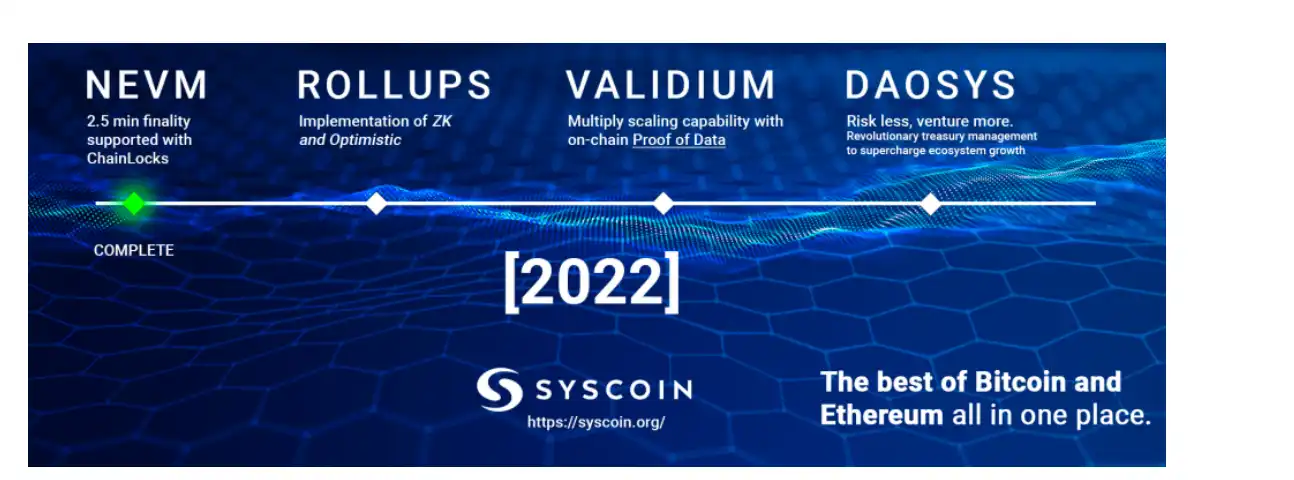
Syscoin's roadmap, image source: https://syscoin.org/news/syscoin-roadmap-2022
RGB (Really Good for Bitcoin) is a BTC smart contract system that integrates the Lightning Network. It was proposed by Giacomo Zucco and Peter Todd in 2016. RGB uses BTC to maintain censorship resistance and resist double-spending attacks. In RGB, all token transactions and validation are processed off-chain, and only the receiving party needs to perform client verification. The client verifies the source of funds for the payer in BTC, and after confirming that the transaction is valid, directly modifies the UTXO of both parties to the transaction without writing the transaction data to the blockchain, thus ensuring privacy protection. In addition, the client can directly introduce smart contract functionality to judge transactions according to rules, and because global state consensus is not required, smart contract data does not need to be put on the chain, which also ensures privacy protection. The RGB community has developed a Turing-complete smart contract virtual machine called AluVM (algorithmic logic unit VM), which has good scalability, security, and privacy protection.
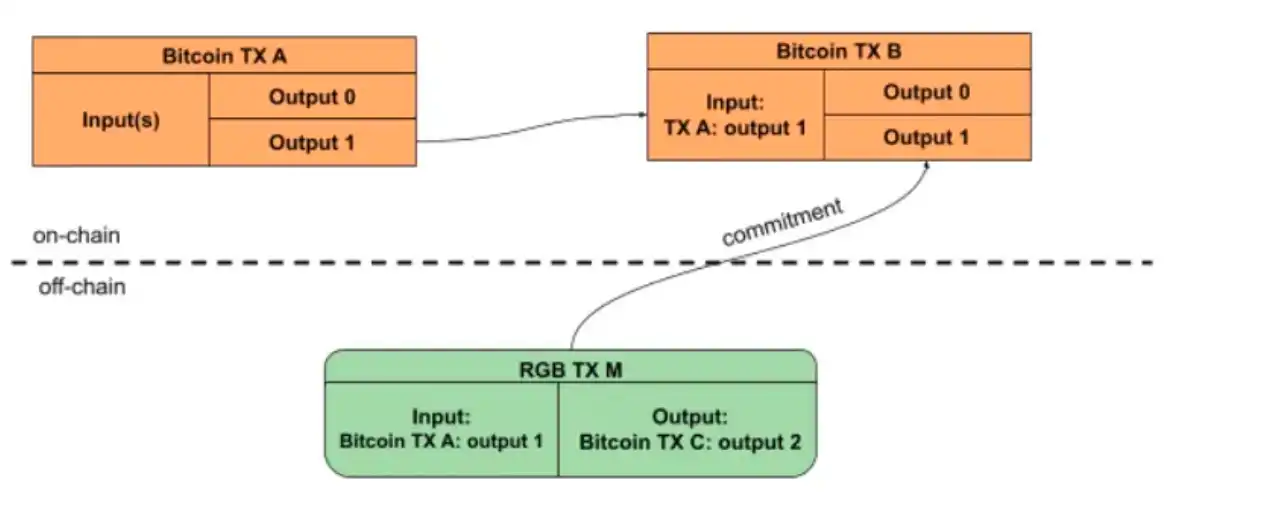
Comparison between trading on RGB and BTC in terms of RGB, image source: https://medium.com/@FedericoTenga/understanding-rgb-protocol-7dc7819d3059

Comparison between AluVM and other programming modes, image source: https://www.rgbfaq.com/glossary/aluvm
BTC Layer2 Summary and Outlook
Despite being the earliest, safest, most well-known, and highest market value blockchain network in the world, the development of Bitcoin's ecosystem has been continuously deepening. For example, its largest second-layer network, the Lightning Network, has continued to increase its channel capacity, the Taproot upgrade has improved the efficiency and privacy of Bitcoin, and the Taro protocol has introduced stablecoin payments and on-chain native NFTs to the Lightning Network. However, compared to the amount of Bitcoin on the Ethereum chain, the Bitcoin capacity of the Lightning Network is relatively low, and due to full node data synchronization and channel state management, the usage threshold of the Lightning Network is higher and the user base is not as large as Ethereum's. But this situation may indicate huge growth potential, as the Lightning Network-related ecosystem continues to develop, similar to the OmniBOLT improved version of the Lightning Network protocol and the OBAndroid wallet that lowers the usage threshold, allowing the Lightning Network to eventually have good security, scalability, and ease of use, and be accepted by users, perhaps allowing BTC's market value to rise to a new level.
At the same time, it is also necessary to pay attention to the development of other Layer 2 projects, such as the RGB scheme with natural privacy protection and the Syscoin compatible with the Ethereum ecosystem. These projects are not as well-known as the Lightning Network, but they can also solve the problems faced by BTC and have advantages that other solutions cannot match. However, compared with Layer 2 expansion projects of Ethereum, these projects are not well-known, receive less investment, and do not receive support from the BTC core development team like the Lightning Network. It is highly likely that their expansion on BTC will be later than that of Ethereum, such as Syscoin's Rollup scheme. In terms of Layer 2 ecology, it seems that the Ethereum ecosystem has a better virtuous cycle and is more favored by investors.
In the future, we may see the Bitcoin ecosystem accelerate its expansion. With the Lightning Network infrastructure becoming increasingly mature and attracting more attention, projects based on Lightning Network such as OmniBOLT and RGB can benefit from it, gaining better development foundations, more users, and even more investment. BTC Layer 2 projects compatible with Ethereum, such as Syscoin, will also benefit from the rapidly developing Ethereum Layer 2 ecosystem, accelerating the progress of their roadmaps. In addition, discussions on BTC expansion solutions have never stopped: John Light's zk-rollups Layer 2 network based on Bitcoin proposed in 2022 may bring more functionality, higher scalability, and better privacy to Bitcoin while maintaining its decentralized nature; Block, led by former Twitter CEO Jack Dorsey, is pushing for liquidity improvements in the Lightning Network, which may mean that the Bitcoin ecosystem will open up a new track beyond payments, DeFi, NFT, and cover more users.
Welcome to join the official BlockBeats community:
Telegram Subscription Group: https://t.me/theblockbeats
Telegram Discussion Group: https://t.me/BlockBeats_App
Official Twitter Account: https://twitter.com/BlockBeatsAsia
 Related Articles