ZERO "Resurrection from the Dead", a detailed explanation of Analysoor's transformation of the golden shovel
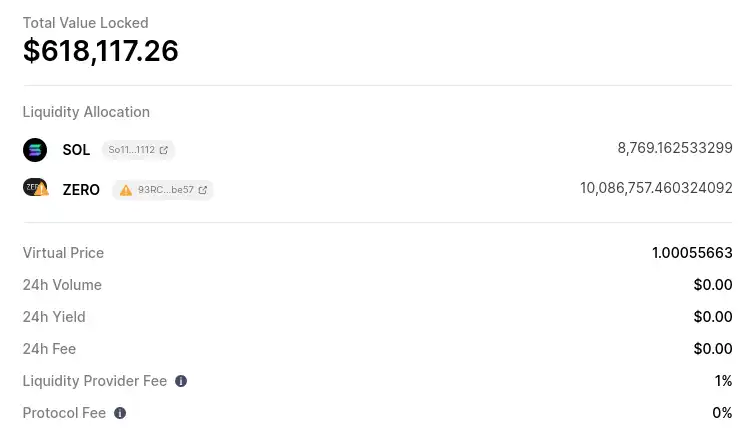
On the evening of December 20th, ZERO, a Solana meme coin that was thought to be on the road to zero by the community, took off from a price of $0.65 and was priced at $2.45 at the time of writing, with a growth rate of over 250% in the past two days. Since its launch two weeks ago, ZERO's TVL has exceeded $10 million. What changes have occurred in the token empowerment of the "resurrected" ZERO?
铭文+meme+博彩:最公平的铭文?
In the encryption industry, could you please translate the above Chinese text to English? Please do not consider the context or industry-specific terms and names. Do not omit any English words or phrases, including capitalized ones such as ZKS, STARK, and SCROLL. If there are English characters in an a tag, please do not translate and return it directly. If the content only contains punctuation marks, please return them as they are. Do not translate HTML tags such as
, , , and. If an HTML tag contains English characters, please omit the translation and return it directly. Please preserve the content in a link. Do not translate any Chinese characters.
As a token in the encryption industry, the reason why ZERO can be noticed by the community is its "gambling gameplay" mint mechanism, with sols breaking through the floor price of 100 SOL in front as the inscription token.
ZERO was created by the Analysoor project on Solana. Unlike other minting methods, Analysoor extracts numbers from the hash value of each block during the ZERO minting process. If the block number is even, the winner is the first number closest to the block hash value from the top-down transaction in the block. If the block number is odd, it is the opposite. This means that players participating in the minting process can only rely on "luck" to win their ZERO tokens, and gas fees are not applicable here.
In addition, a fee of 0.08 Sol is charged for each transaction during the minting process, and all of it is added to the ZERO pool. This means that all remaining funds during the coin minting period, except for successful transaction fees, are used to provide liquidity for ZERO.
Analysoor was officially launched on December 13th by Pland, a former developer of Ordinals OG and Solana. Prior to the popularity of the first inscription sols on Solana, Pland, as an Ordinals OG member, pointed out that Sols is not purely an inscription, but an NFT (the sols minting process requires downloading an image). As a Solana developer, Pland firmly believes in Solana's high performance advantages in the public chain and believes that the gas fee incurred during the sols minting process should not be an implicit cost (the cost at that time ranged from a few U to tens of U).
Therefore, Pand launched the Meta Protocol Analysoor using inscription technology, introducing the Index Protocol off-chain indexer, using Solana's historical data to prevent robot participation, and achieving more fair distribution and guiding token liquidity during meme coin issuance. ZERO was the first purely inscription-based deployment launched as Analysoor. The total supply of ZERO is 21 million, of which 10.5 million will be minted at a price of 0.08 SOL, generating more than $600,000 in funds.
Pand believes that the popularity of NFT in 2021 is not because the community is full of artists and has formed a good atmosphere for artistic exchange, but because NFT allows everyone to have the opportunity to participate in projects at a low price. The same goes for the inscription fever in 2023, and ZERO follows this point.
On the one hand, in the previous frenzy of inscriptions, players often needed to pay gas fees to increase the likelihood of successful minting, and the frequent appearance of scientists raised questions about the fairness of this retail frenzy. However, Analysoor's mechanism fundamentally eliminates the possibility of "scientists taking over" the scene. On the other hand, the minting cost of players in the frenzy of inscriptions ultimately ends up in the hands of miners. In the minting process of an inscription token, a lot of funds are gathered, but these funds cannot provide liquidity for the token itself. While gas is being frantically rolled up during minting, there is no market demand for secondary trading. Only miners become the ultimate winners.
However, Analysoor uses a different method, random selection instead of first come first served, to provide liquidity for tokens with a mint cost, and the remaining funds from minting are used to build a liquidity pool. This mechanism not only achieves fair distribution, but also adds a certain gambling element, where the "betting money" does not go to the miners, but instead becomes the liquidity pool for the project.
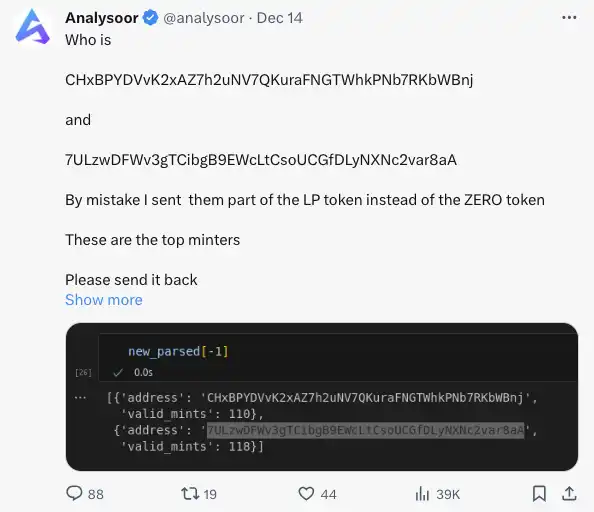
However, ZERO encountered some setbacks during the casting process. First, the casting time originally planned for 3:00 pm on December 14 was postponed, and then, after about three hours after the minting ended, some users did not receive the ZERO tokens they deserved. The most unexpected thing was that Analysoor stated on social media that the funds originally planned as LP pool were mistakenly sent to ZERO holders and released the wallet address of the holders, calling for them to return ZERO. This move prompted users to leave comments directly in the comment section saying "drama".
Approximately half an hour later, Analysoor posted that they had received all of the ZERO tokens as liquidity, and the first minting process ended without incident.
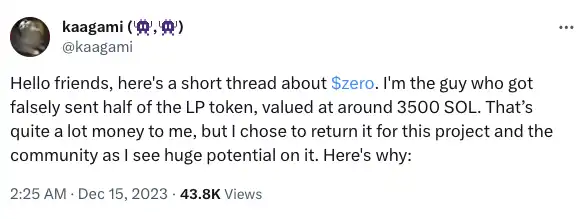
In this twist and turn, Analysoor would like to express special thanks to community member kaagami, who received half of the LP tokens worth about 3500SOL. Later, kaagami posted a long tweet to explain the reason for returning ZERO, "I saw its huge potential. Personally, I interpret the Analysoor protocol as a unique new asset allocation method specified on Solana."
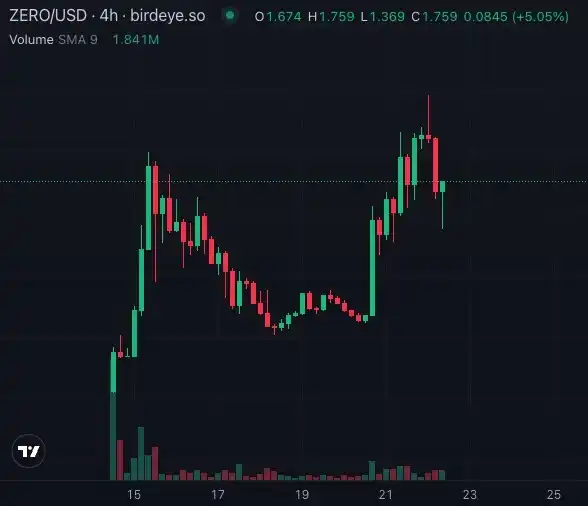
As an interlude, this does not seem to affect the market expectations of ZERO. The ZERO token was listed on Bitget on December 15th and reached $1.7 on the first day of listing.
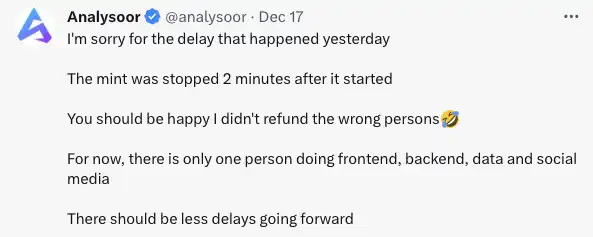
As the community was anticipating the follow-up development of ZERO, on December 16th, during the second deployment of Analysoor and the first NFT series "ONE" of the protocol, if the casting process of ZERO was "full of surprises", in the eyes of the community, the casting of the ONE series was "full of loopholes". Firstly, its casting time was delayed, and then ONE was closed after only two minutes of casting. Analysoor announced that it would be recast the next day, and the raised 513 SOL was refunded to users afterwards.
Amidst continuous apologies, Analysoor revealed that "currently, only one person is doing front-end, back-end, data, and social media simultaneously."
On December 17th, the "ONE" series began casting, but due to high demand, over 25,000 addresses participated in the casting. The number of NFTs that could be minted per block quickly decreased from 80 to 1. Before the end of the time period, Analysoor manually closed the minting entrance and stated that the remaining participants were mostly bots.
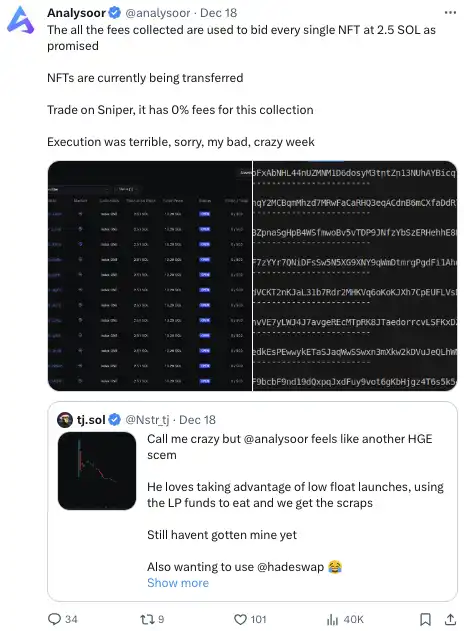
If this operation can still be explained, according to the plan, after the minting of the ONE series is completed, the NFT trading platform SNIPER on Solana will be launched, and holders can sell their NFTs at a price of 2.5 SOL. The funds raised during the previous minting will bid for ONE NFT at a price of 2.5 SOL. However, at the same time, many users in the community have reported that although they are shown as "winning the lottery", they have not received the NFT, and some even say that "Analysoor looks like another high gas fee scam".
While Analysoor was busy providing "after-sales service" for the ONE series, ZERO had dropped by 60% in two days at a higher point, and this experiment seems to be ending in failure. There are constantly ZERO holders leaving messages in the social media comment section of Analysoor, urging them to take action to "save" ZERO.
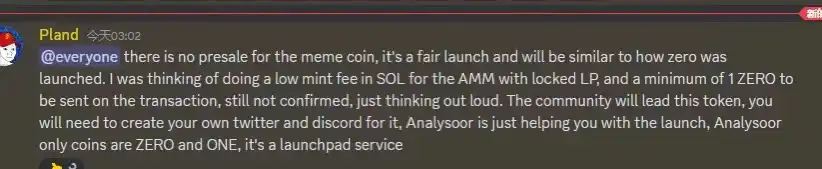
On the 20th, Analysoor made the first rescue action by opening a Discord community with a threshold of holding 100 ZERO or 1 ONE. At the time, 100 ZERO was worth $76. In the Discord community, Pland announced his plan to launch a community-led meme coin, with Analysoor only responsible for starting token minting and locking liquidity pool.
Pland later provided a more detailed explanation. In the meme coin launched by the community, 48.5% of the total supply is minted through 0.05 SOL and 1 ZERO, while the remaining funds are stored as liquidity pool reserves for ZERO. Additionally, 3% of the meme coin will be airdropped to ONE holders.
After that, Analysoor announced that it will continue to deploy other projects, and the ZERO token will participate in every deployment until its total supply reaches 5%, in order to "be listed on the top three centralized exchanges in the future". The funds raised will provide liquidity for ZERO after it is listed.
Here, ZERO is no longer an experimental attempt, but has the attribute of "golden shovel". The price of ZERO has also been rising steadily since the 20th, and it broke through 2 US dollars on the 22nd. After a 60% drop in two days, ZERO once again achieved a growth rate of over 250% in two days.
Related reading: "Apart from the soaring AUCTION, what other "golden shovels" are worth paying attention to in the market?"
The reason for ZERO's fall is not difficult to speculate. On the one hand, although Analysoor does have innovative significance, the wave of inscriptions has gradually receded, and investors are more concerned about the speculative properties of the leading inscriptions on each public chain. A more "fair" inscription mechanism seems insufficient to endow ZERO with strong consensus. In addition, with the frequent occurrence of accidents in ONE's casting series, investors' confidence quickly dissipated.
ZERO's "resurrection" is unexpected in the community. Analysoor's mint mechanism is similar to Ordinals. In Pland's vision, ZERO is not the "Sols No. 2" on Solana, but the "ORDI" on Solana. Additionally, due to the significantly lower transaction fees on the Solana chain compared to Bitcoin and Ethereum, the gas wars that occurred during the Inscription craze in the Bitcoin ecosystem will not occur.
"Fairer" minting mechanism sounds attractive enough, but it is not yet known what kind of "token matrix" Analysoor can create. However, it is certain that the Solana ecosystem always brings unexpected surprises.
Performance aside, there are always surprises on Solana
But now, in addition to its trading performance advantages, the "community culture" on Solana also has a noteworthy aspect. As a high-performance public chain, Solana has developed its own path in the public chain due to its high throughput.
On December 21st, Magic Eden officially launched a project called Solmaps, which represents ownership of block space on Solana. Its concept is similar to the first metaverse project in the Bitcoin community, Bitmaps, and its core is the power to claim digital sovereignty over "plots" (unique parts of continuous slots on the Solana blockchain). Solmaps has attracted great attention from the community since its launch, and its floor price once reached 0.8 SOL. After being launched by Magic Eden, Solmaps will be managed by the community.
Welcome to join the official BlockBeats community:
Telegram Subscription Group: https://t.me/theblockbeats
Telegram Discussion Group: https://t.me/BlockBeats_App
Official Twitter Account: https://twitter.com/BlockBeatsAsia



 Related Articles