Blockchain Capital: Why did we lead the investment in ZK infrastructure company RISC Zero?
Original Title: "Democratizing Zero-Knowledge Computing: The Power of RISC Zero's Bonsai Network"
Original Authors: Bart Stephens, Ryan Sproule, and Yuan Han Li, Blockchain Capital
Translated by: Zen, PANews
On July 19th, RISC Zero, an infrastructure company aimed at helping developers create zero-knowledge proof software, announced the completion of a $40 million Series A financing round. The round was led by Blockchain Capital, with participation from Galaxy Digital, IOSG, and others. As the lead investor, Blockchain Capital analyzed the development of zero-knowledge computing, as well as the characteristics and advantages of RISC Zero. PANews has compiled the analysis.
Imagine a world where data privacy, security, and trust are no longer a concern, where software supply chains are transparent and verifiable, and where the power of zero-knowledge (ZK) computation is harnessed to solve some of the most pressing challenges of the digital age. This is the promise of ZK computation, and it is why we have invested in RISC Zero, a pioneering company that aims to democratize ZK access through its Bonsai network.
Zero-knowledge computation is a revolutionary primitive that allows applications and protocols to leverage the key properties of simplicity, correctness, and zero-knowledge. This means that through the verification of ZK proofs (correctness), verifiers can almost precisely guarantee that the computation has been executed correctly.
In addition, the verified proof will be much simpler than the original calculation, and the zero-knowledge property of the proof can be used to ensure that the verifier knows nothing about the calculation itself. This unique combination of properties has far-reaching implications and provides a new way to verify information. These properties balance the needs of privacy, security, and trust, and offer potential for a more secure and private digital world. However, there are still some obstacles to be overcome before ZK can fully realize its potential.
First of all, running calculations in ZK is too time-consuming and costly. The time and cost of proof need to decrease significantly in order to achieve complex calculations in ZK. The good news is that these are rapidly decreasing: the trajectory of ZK proof time and cost has always followed familiar trends in technology history - whether it's Moore's Law (halving computing costs every two years), Vratil's Law (the cost of sequencing the human genome is decreasing at an even faster rate), or Clyde's Law (disk density doubles about every 13 months). The latest architectural advances in proof systems (Plonky2, Hyperplonk, STARK) and the progress in underlying cryptography (Poseidon) have reduced the cost of creating ZK proofs for any computation. And these areas of progress will continue to happen at a similar pace (especially with recent talent influx into ZK), and proof management costs will also benefit from hardware acceleration (MSM, NTT) progress, which is something that has not yet been fully developed.
Another major obstacle that ZK widely adopts is the highly complex mathematics and cryptography inherent in the ZK system. Only a small number of highly skilled technical developers have the depth and expertise required to drive ZK innovation.
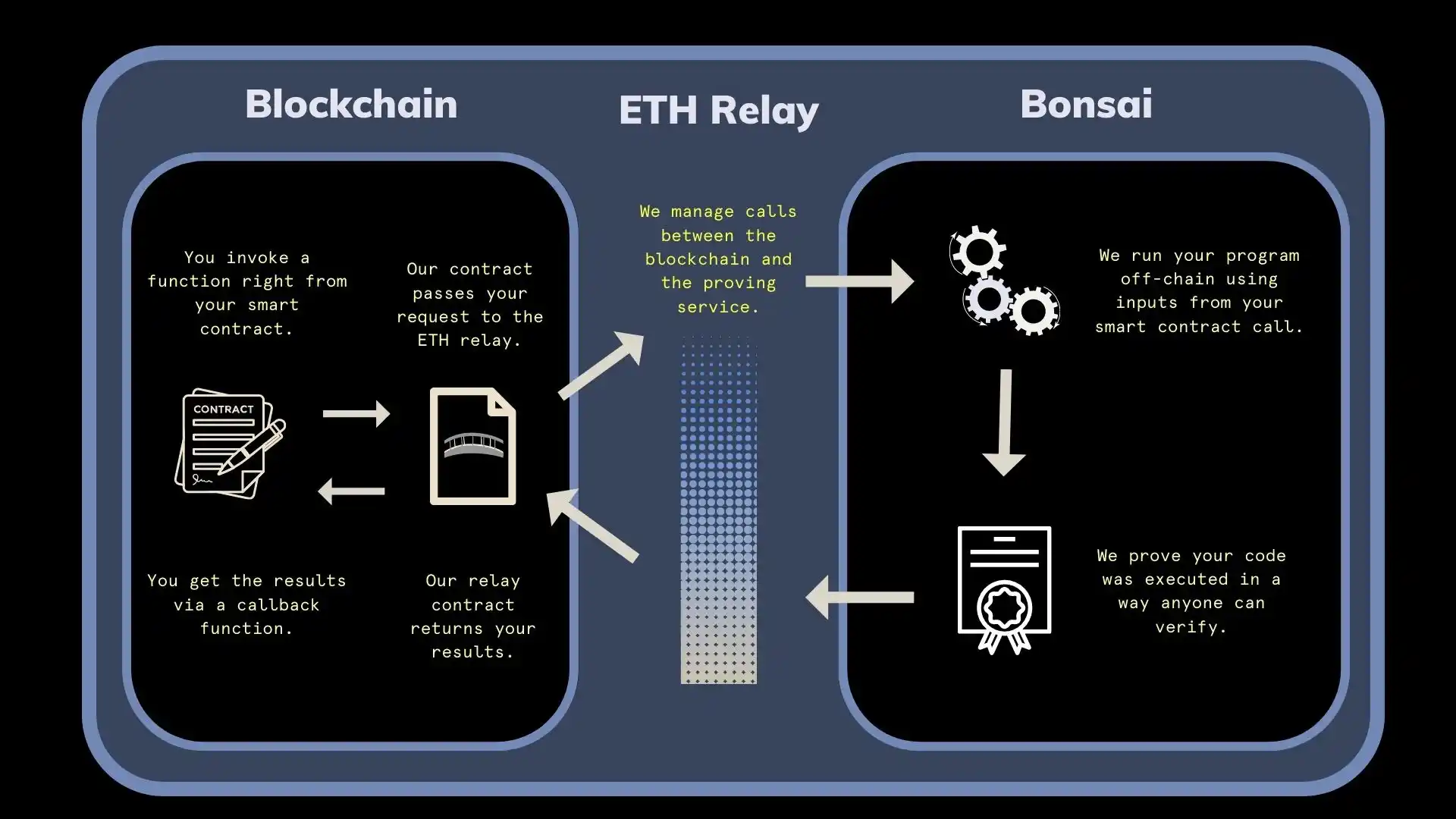
In an ideal scenario, developers can freely write programs in their preferred language while still being able to perform zero-knowledge proof calculations without having to handwrite inputs and design circuits using low-level, ZK-specific programming languages. This is where RISC Zero's Bonsai platform becomes a game-changer for developers worldwide, and it is the reason why we invested in RISC Zero.
By creating a zero-knowledge virtual machine (zkVM) that simulates the RISC-V instruction set architecture (ISA), RISC Zero has built a system that can prove the execution of low-level code. As the ISA serves as a bridge between human-readable code and machine-interpretable instructions, this achievement means that the Bonsai network can prove that any high-level program can be compiled into this architecture. With most modern programming languages being compatible with RISC-V, RISC Zero's Bonsai can execute almost any arbitrary computer program with zero knowledge.
In the future where zero-knowledge (ZK) computing becomes widespread, many previously impossible applications will become possible. This includes not only Ethereum-based applications, but also applications outside of cryptocurrency, utilizing the RISC Zero as a co-processor to perform resource-intensive off-chain work before verifying the results on the validation chain. For example, Bonsai can allow white-hat hackers to prove the existence of security vulnerabilities and errors without directly disclosing them. It can also ensure that the code they are running on Bonsai has been audited in advance by allowing users to download and verify ZK proofs, preventing future supply chain attacks on the software. The most exciting part is that the widespread adoption of Bonsai may bring about entirely new use cases that have yet to be imagined.
In addition to impressive technological breakthroughs, RISC Zero also has a strong and unique team behind it. The three co-founders, Brian Retford, Jeremy Bruestle, and Frank Laub, have known each other for over 20 years. Their shared experiences include co-founding multiple companies, with the most recent one delving into the fields of artificial intelligence optimization and compilation, ultimately being acquired by Intel.
Each member of the RISC Zero trio brings a wealth of experience: Brian previously worked on pricing and measurement systems at Google Cloud Platform; Jeremy is a lifelong math enthusiast dedicated to GPU-accelerated gene sequencing, with a background in cryptography, high-performance computing (HPC), and security; Frank has a strong background in compilers and has built numerous code libraries. With a shared history and diverse skill set, the RISC Zero team has a unique advantage in providing zero-knowledge computing to the public and potentially reshaping the digital landscape in the process.
When we look forward to the future where zero-knowledge computing is widely popularized, the possibilities for innovation are endless. RISC Zero's Bonsai network can support a wide range of programming languages, democratizing ZK computing and enabling developers to create secure, private, and trustless applications in various fields. From strengthening network security measures to enhancing trust in software supply chains, to significantly improving the computing power available for on-chain applications, the potential impact of zero-knowledge computing is enormous. The rapidly decreasing ZK proof time and cost, the loyal team of RISC Zero, and the emergence of Bonsai as a multi-functional computing platform herald a new era of computing - one where privacy, security, and trust are built into the structure of our digital world.
Original article link
Welcome to join the official BlockBeats community:
Telegram Subscription Group: https://t.me/theblockbeats
Telegram Discussion Group: https://t.me/BlockBeats_App
Official Twitter Account: https://twitter.com/BlockBeatsAsia

 Related Articles