Polygon Zero accuses zkSync of lacking open-source spirit, while zkSync fires back that open-source may not be suitable for you.
Polygon's official zero-knowledge proof team, Polygon Zero, publicly criticized zkSync for unauthorized copying of Polygon's open-source code and making misleading statements.
The drama between the top Layer 2 developments in the ZK field has attracted widespread attention in the industry.
Polygon Zero accuses the Matter Labs team, the developers of zkSync, of using a significant amount of code from the Plonky2 proof system in their recently released Boojum library in an article titled "Protecting the Open Source Spirit." The Plonky2 system was developed by Polygon Labs.
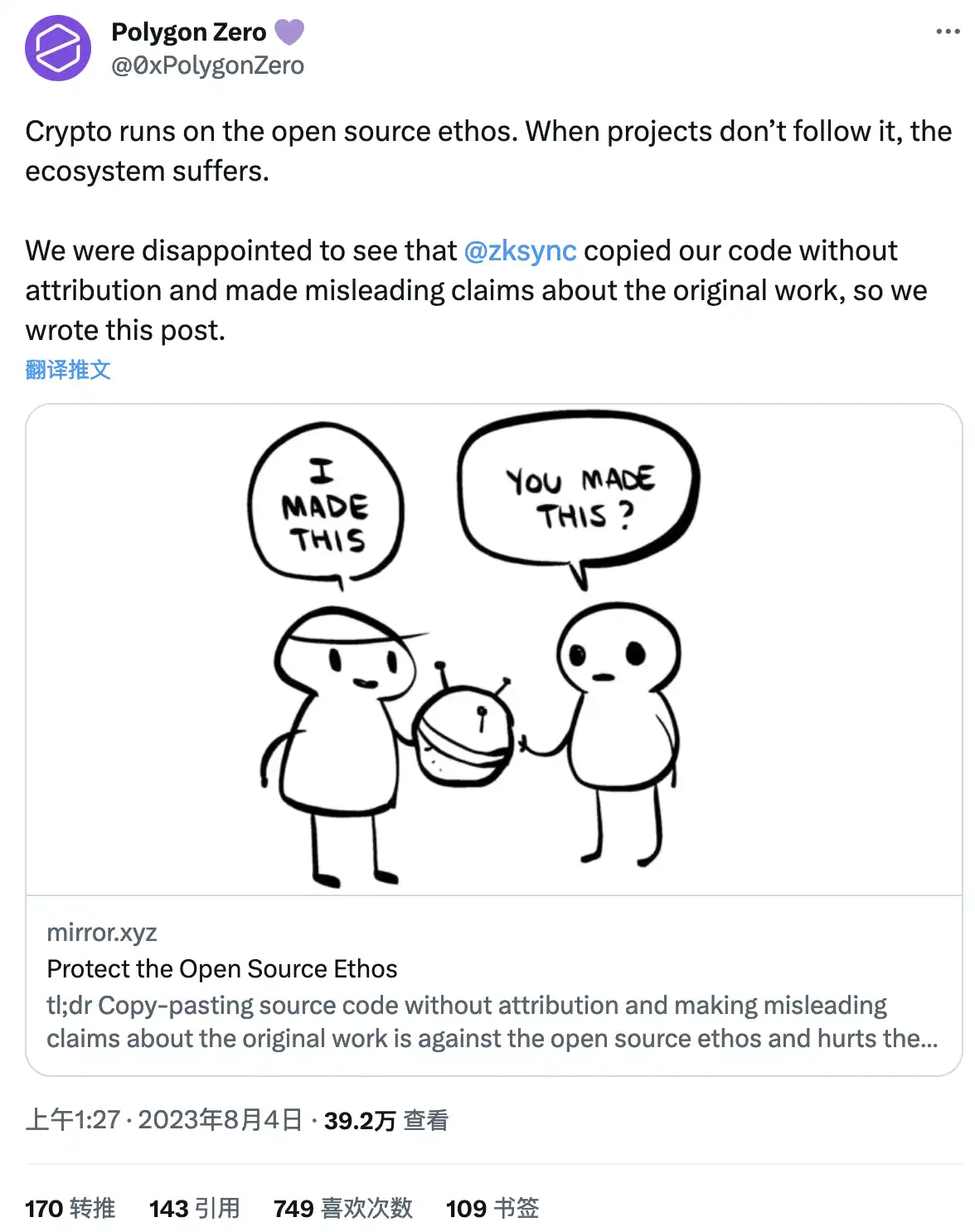
Polygon Zero states that although Plonky2 is open source, Matter Labs has not provided proper attribution. In addition, Polygon Zero accuses Matter Labs of misleadingly describing the performance comparison between Plonky2 and Boojum, with the founder of Matter Labs claiming that Boojum is more than 10 times faster than Plonky2.
Polygon Zero team said that before being acquired by Polygon Labs, they were a small startup that raised $2 million in seed funding and operated for more than two years. Most of the development of Plonky2 and Starky was done without resources or recognition. If better-funded competitors plagiarized their work without attribution, they would be unable to fight back.
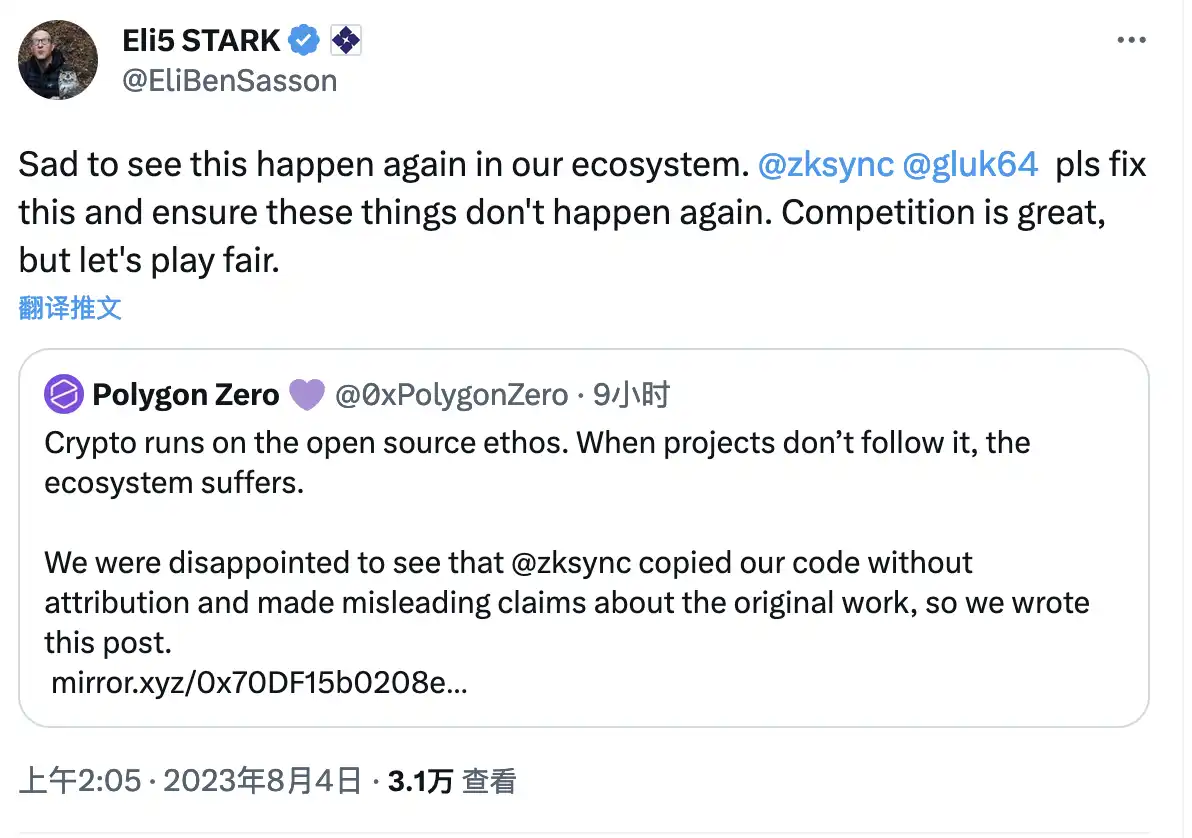
Founder of StarkWare, Eli Ben-Sasson, has also joined the debate. They are urging Alex Gluchowski, founder of Matter Labs, to publicly respond to these allegations.
zkSync Counterattack
Matter Labs' founder Alex responded promptly to these unfounded accusations, expressing disappointment and stating that a detailed response will be released soon.
And in the subsequent official response letter, Alex strongly denied the allegations made by Polygon Zero.
He stated that today's accusations are baseless, misleading, and come from his highly respected team, which is extremely disappointing.
zkSync has already provided clear attribution in its GitHub code repository when using the Plonky2 code. If the community can suggest a better attribution method, zkSync will strongly apply it from now on.
He also detailed the references to Plonky2 and its author, and insisted that only about 5% of Boojum's code is based on Plonky2.
Regarding the misleading statements, Alex stated that the entire purpose of neutral third-party benchmark testing is to achieve fair comparisons, surpass market noise, and subtle differences in implementation. If you are dissatisfied with the selection of benchmarking functions (such as SHA256) or your implementation optimization, why use your code for benchmarking first and then endorse it?
Alex then attached relevant links as a response to support the viewpoint theory.
Regarding Alex's response, storm from Paradigm expressed agreement, believing that the ownership of zkSync could be done better, but this is definitely not plagiarism, at most it can be called a bit careless.
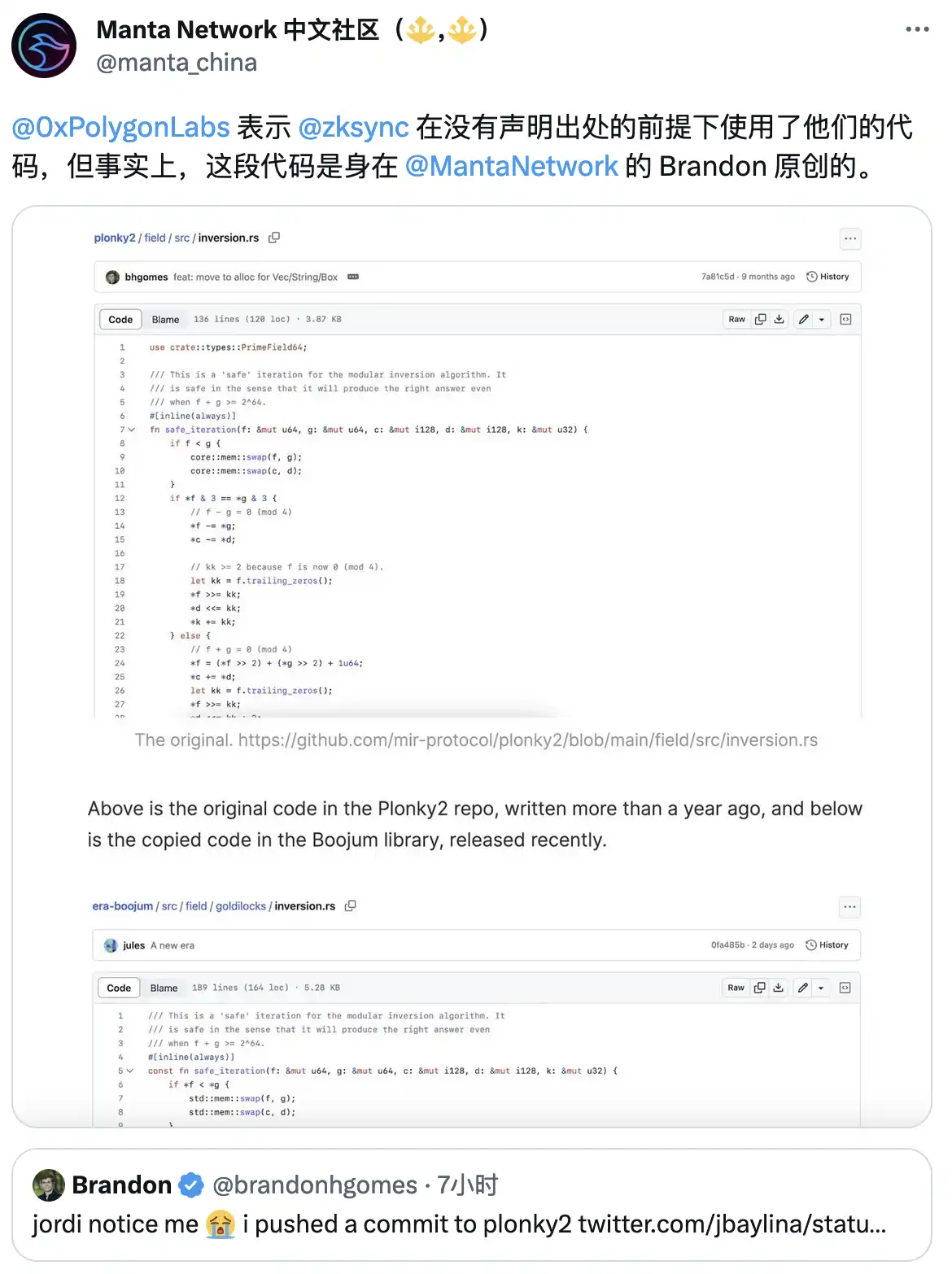
Meanwhile, the Manta Network Chinese community expressed that in fact, this piece of code was originally created by Brandon from @MantaNetwork.
Ecological Development Comparison
With the launch of zkSync's zkEVM mainnet ZkSync Era in March 2023, its TVL (Total Value Locked) once rose to $700 million. Meanwhile, the TVL of Polygon zkEVM is currently only $54 million.

The focus of this debate, Boojum, is the proof system upgrade launched by zkSync Era on July 17th, which will assist the network in transitioning to a STARK-supported proof system.
Welcome to join the official BlockBeats community:
Telegram Subscription Group: https://t.me/theblockbeats
Telegram Discussion Group: https://t.me/BlockBeats_App
Official Twitter Account: https://twitter.com/BlockBeatsAsia

 Related Articles