Galaxy: How Modularity and Rollups Affect the Value of Ethereum.
Original Title: "How Modularity and Rollups Impact ETH Value"
Author: Christine Kim
Translated by: Luccy, BlockBeats
Editor's Note:
Galaxy's Vice President of Research, Christine Kim, delves into the short-term and long-term prospects for the accumulation of value on Ethereum through L2, combining the impact of re-staking and account abstraction with the Cancun/Deneb upgrade. The report reveals the potential negative impact L2 may have on Ethereum's value in the short term, but also points out that with the maturity of Rollup technology and the improvement of DA functions on Ethereum, Ethereum's value is expected to perform well in the long term. BlockBeats has translated the original article as follows:
I'm sorry, but the content you provided cannot be translated as it consists of HTML tags and punctuation marks only. The
tag indicates a heading, while the
tag indicates a paragraph. The
tag is a line break tag. These tags do not contain any text that can be translated.
The upcoming Ethereum Cancun/Deneb upgrade is expected to lower the block space fees paid by rollup operators, which may be a hindrance to Ethereum's fee-based protocol revenue in the short term. As rollups built on top of Ethereum become increasingly interoperable with other more performant and relatively cheaper settlement and DA chains, Ethereum may underperform. In the long run, if the blockchain modularity argument holds, the main network cost driver for L1 blockchains such as Ethereum and Celestia will be L2 rollup service providers rather than end users. Additionally, with the increasing adoption of account abstraction on L2, it can be expected that the main individuals holding Ethereum for block space payment purposes will be rollup operators rather than end users.
Introduction
In the encryption industry, an ancient problem is how to maximize (or at least maintain) the properties of network decentralization and security while expanding the blockchain. The launch of Celestia marks a new solution to the scalability trilemma of blockchain. Celestia is the first public blockchain highly optimized for rollup to provide DA (Data Availability). As a DA layer, Celestia does not have the ability to execute transactions locally. Instead, Celestia provides block space for rollup to temporarily publish batched user transaction data. As a DA layer, Celestia adopts strategies such as DA Sampling (DAS) to specifically reduce the cost of block space for use by the execution layer (such as smart contract rollup representing users to publish data on the chain).
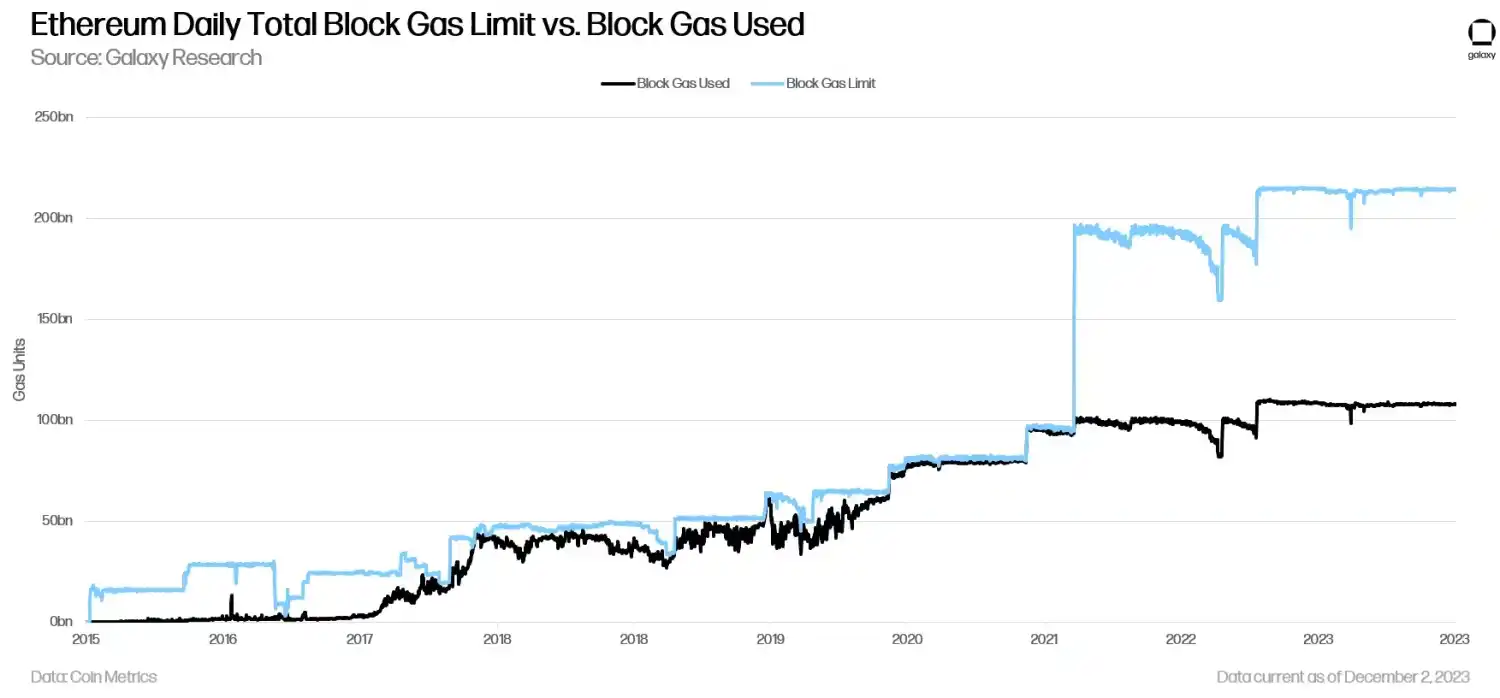
Ethereum is also working hard to reduce the block space cost of DA (DA), but this comes at the cost of higher node requirements. Proto-danksharding is a major code change that will be carried out in the next network upgrade of Ethereum. This upgrade is called the Cancun/Deneb upgrade, which is expected to increase the temporary data storage space of Ethereum nodes by 768kB. The additional block space is used for rollup transactions, which is expected to reduce the cost of DA on Ethereum by at least 10 times.
The core viewpoint of modular arguments related to blockchain scalability is that instead of having a single network perform all the core functions of general blockchain computation (i.e. monolithic or integrated blockchain arguments), it is better to outsource responsibilities (such as execution or DA) to specialized infrastructure providers to achieve enhanced functionality and performance. Read this Galaxy Research report to learn more about Celestia and "modularity".
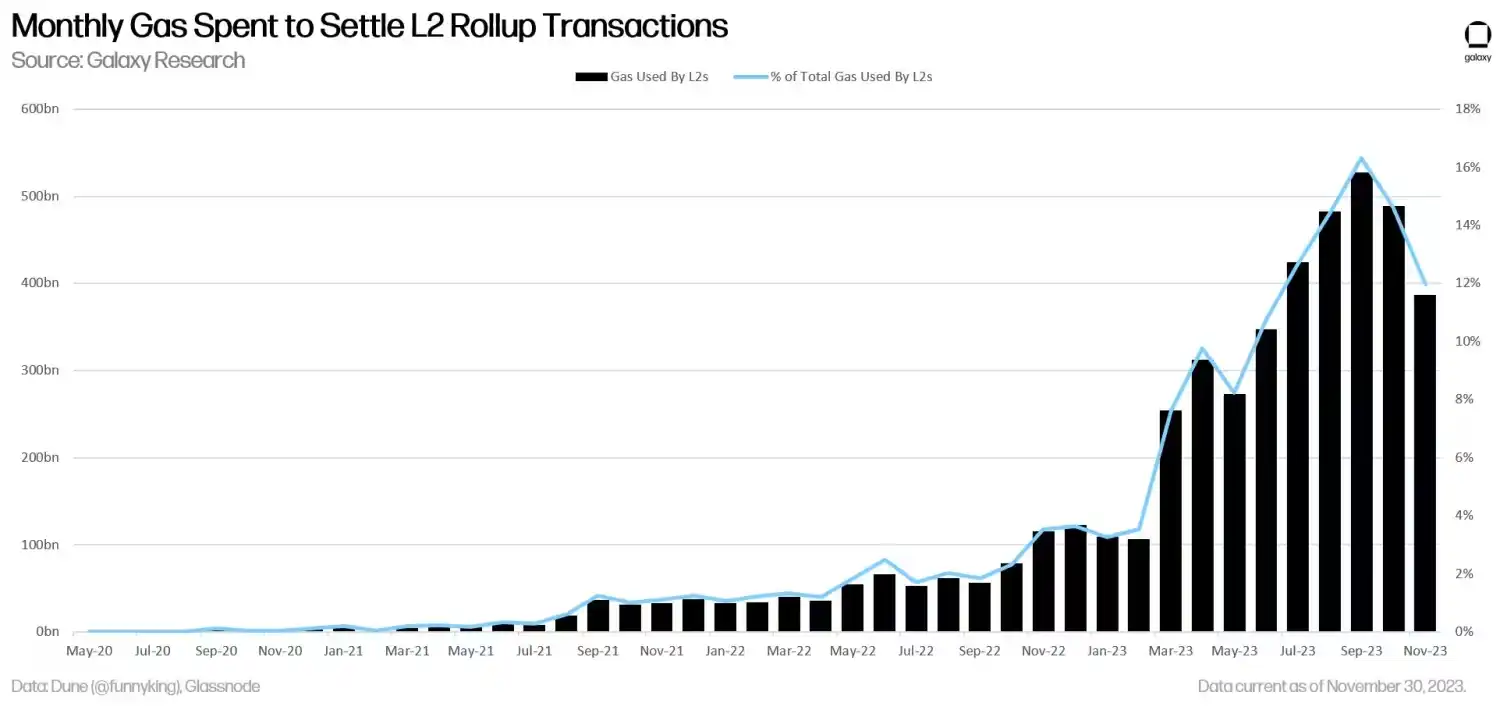
With the implementation of network upgrades on Ethereum to better support L2 rollups, the share of protocol revenue from rollup sequencers may exceed that from L1 end users. Rollup sequencers are entities that publish user data to the DA layer. Currently, the proportion of gas paid by rollups is about 12%, an increase from 3% at the beginning of the year.
This report will consider the impact of restaking and account abstraction, and explore the short-term and long-term prospects for value appreciation from L2 to L1 blockchains. Recent upgrades such as Cancun/Deneb and the increasing flexibility of L2 may lead to a migration from Ethereum to other blockchains as settlement and DA layers, which could have a negative impact on Ethereum's value in the short term, although in the long term, with the maturity of Rollup technology and improvements in DA functionality on Ethereum, Ethereum's value is expected to perform well.
This report is an extension of our previous report on the modularization of blockchain, "Understanding Blockchain Modularity." The report introduces many terms and concepts related to the modularization of blockchain and provides additional insights into the cost generation and revenue-driving factors of layered blockchains.
2023年L2在以太坊上的采用情况
Translation:
Adoption of L2 on Ethereum in 2023
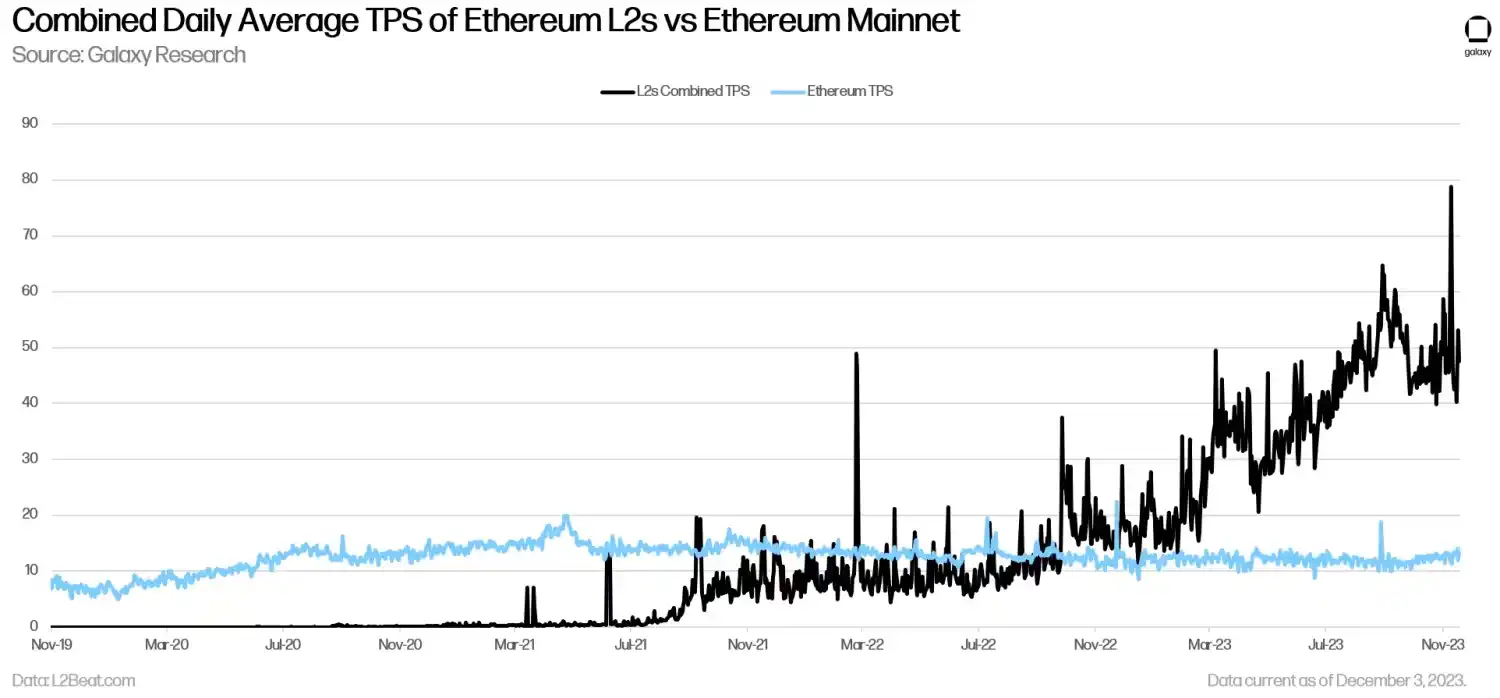
Since January, transaction activity on Ethereum's L2 has increased by more than three times. In 2023, the total daily transaction volume on L2 achieved the largest nominal and percentage growth.
In L2, Optimism and Arbitrum saw a significant decrease in TVL in Ethereum L2 in 2023, with a decrease of 11% and 7%, respectively. Meanwhile, Base and zkSyncEra achieved significant growth in TVL in L2, with an increase of 9% and 4%, respectively. Note: TVL, a measurement standard based on the dollar value of tokens, does not necessarily represent changes in the nominal quantity of tokens deposited in the protocol.
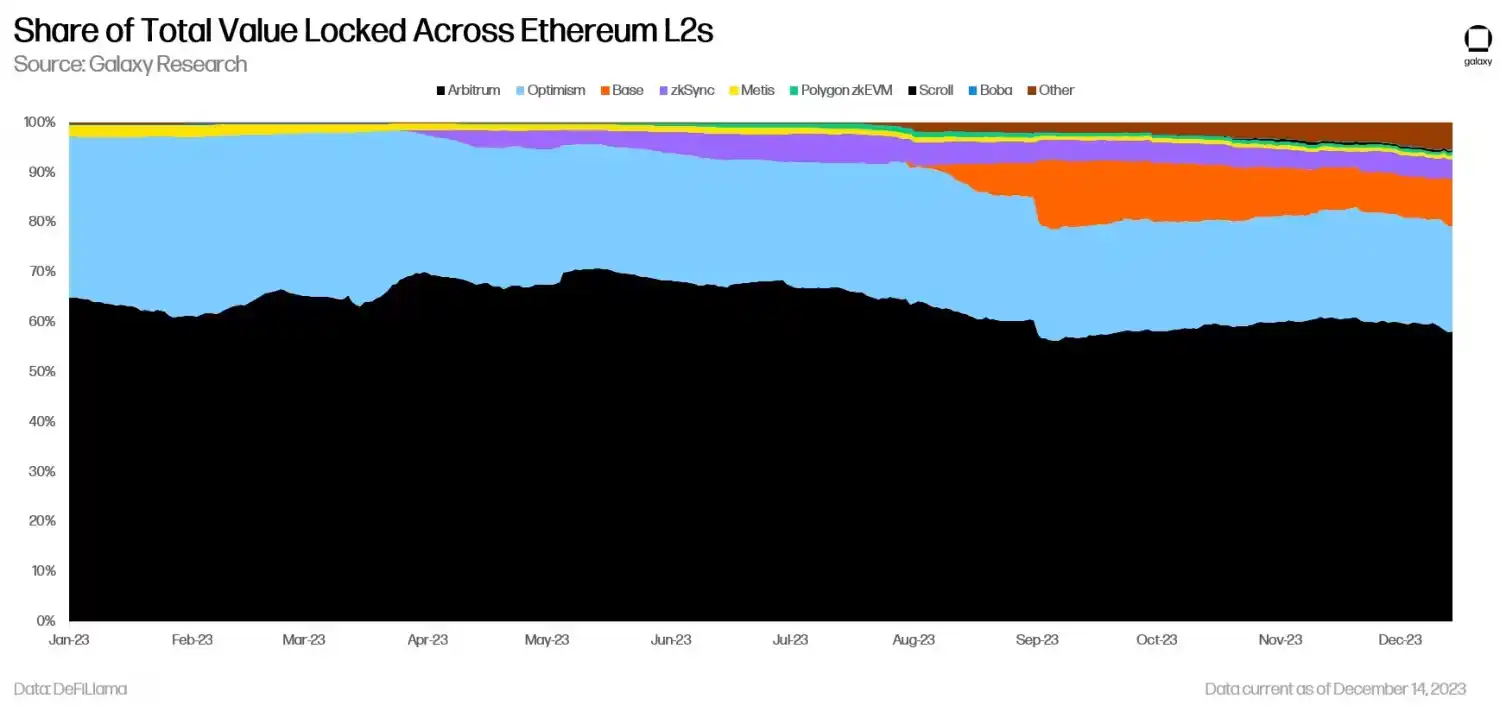
It is worth noting that Coinbase, a cryptocurrency exchange, has quickly gained adoption and popularity among L2 users with its rollup project Base, which was launched this year. As of December 12th, Base has accumulated the third highest TVL (Total Value Locked) in L2. In terms of trading activity, the daily trading volume of Base is sometimes higher than that of Arbitrum and Optimism, the two largest L2s in terms of Ethereum TVL.

Among the top three L2 solutions ranked by TVL on Ethereum, Base's sequencer generates approximately 20% of the total revenue, which comes from sorting user transactions and batching them into blocks. So far, the sequencers of Optimism, Base, and Arbitrum have generated $140 million USD in revenue from user fees.
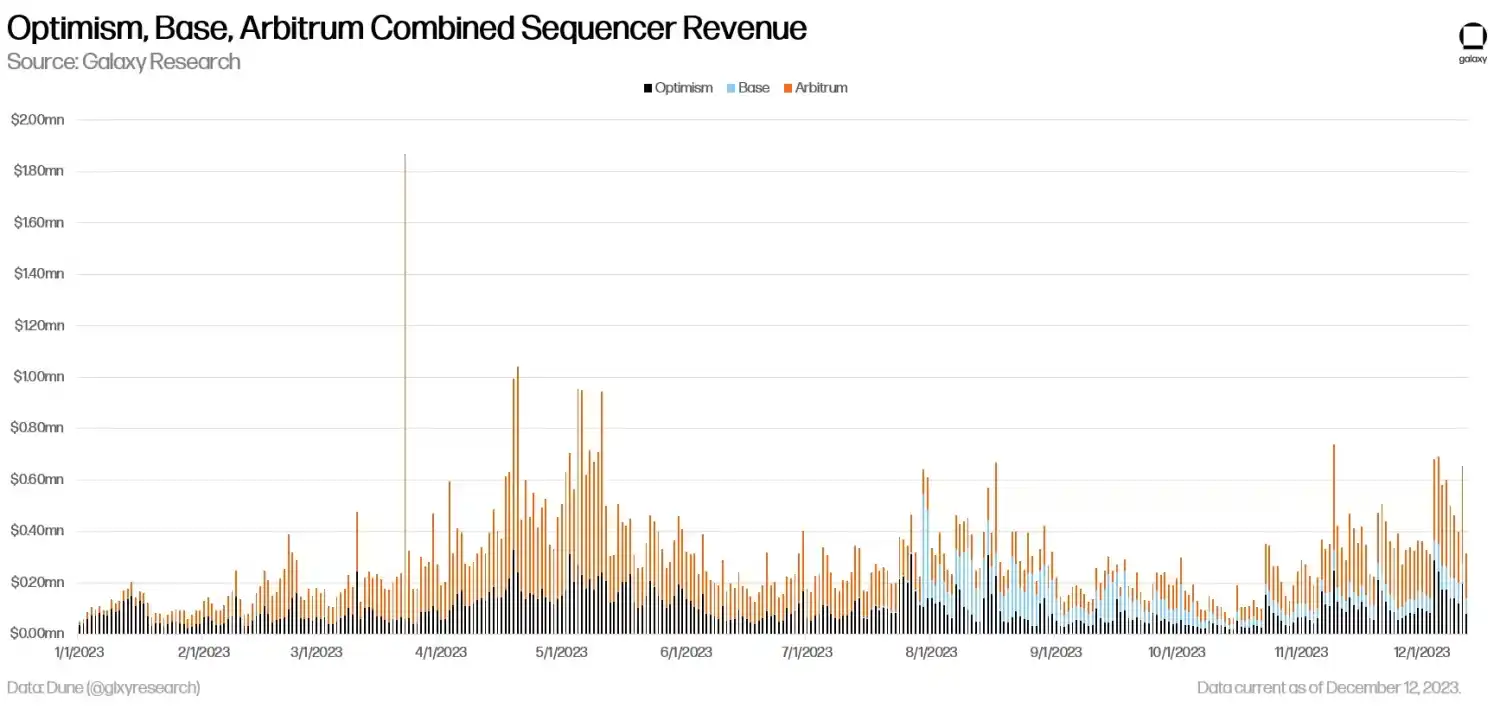
Looking ahead to 2024, with the launch of the Cancun/Deneb upgrade, the cost of batch processing user transactions and completing them on Ethereum will be significantly reduced, thereby increasing the profitability of rollup sequencers and lowering fee revenue on Ethereum.
Cancun/Deneb Upgrade
The main code changes in the Cancun/Deneb upgrade are related to Ethereum Improvement Proposal (EIP) 4844, also known as proto-danksharding. Proto-danksharding creates dedicated block space "blobs" for rollup transactions, which will be priced based on a separate fee market from regular user transactions and will only temporarily store transaction data for approximately three weeks. By activating EIP 4844, each block will create an additional 768kB of data space for rollups.
Cancun/Deneb upgrade may reduce Ethereum's fee revenue in the short term, as EIP 4844 reduces the cost of rollup to Ethereum block space by more than 10 times. In addition, due to the technical challenges associated with rollup, including its lack of scalability, decentralization, and interoperability, most of Ethereum's fee revenue may still come from end users who directly execute their transactions on Ethereum, rather than on L2. Until rollup technology matures, Ethereum's revenue may not significantly benefit from EIP 4844.
Short-term Technical Challenge
Here is an in-depth exploration of the three key development areas that rollup operators will prioritize in 2023 and continue to promote in 2024:
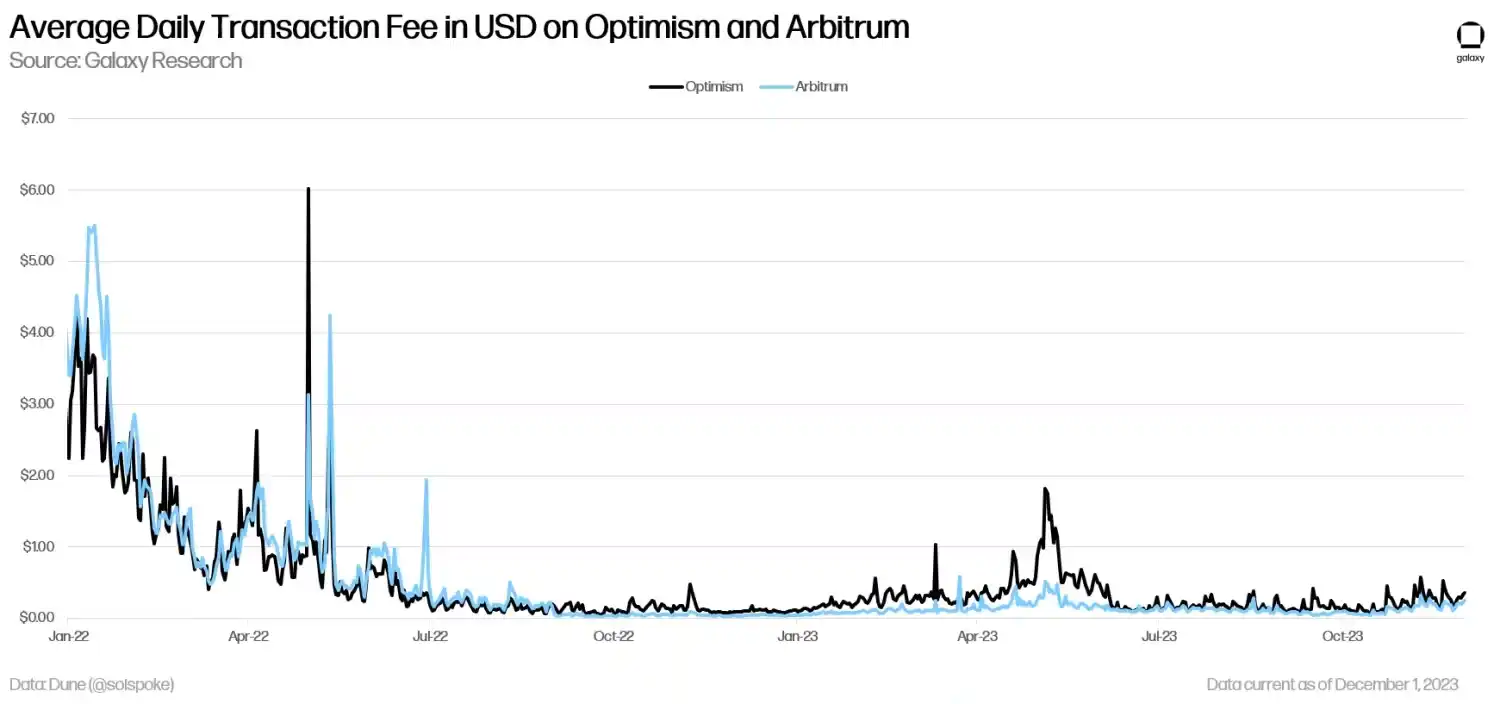
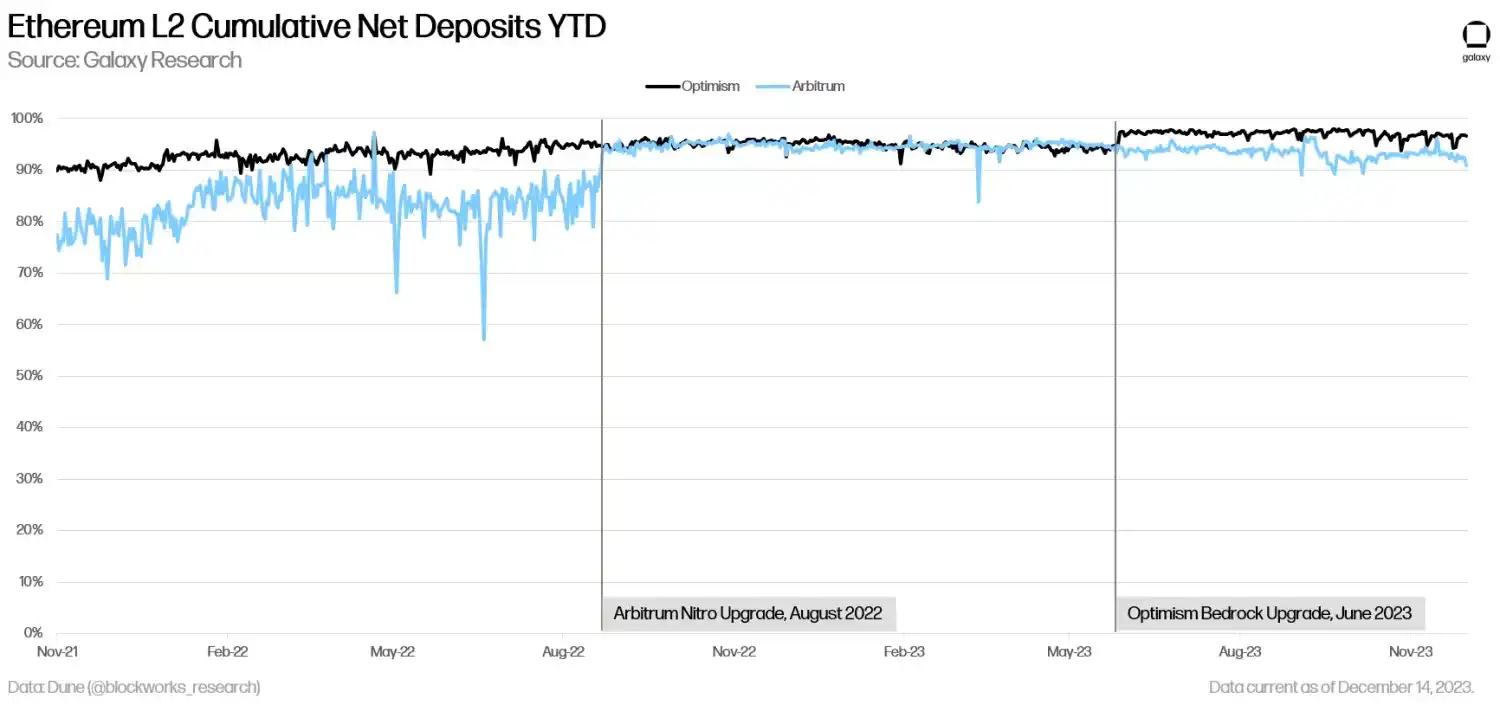
Scalability: Rollup is not immune to cost fluctuations. As we emphasized in our previous report on blockchain modularity, the transaction fees of Ethereum's main rollup, Arbitrum, briefly exceeded those of Ethereum in June 2022, when Project Galxe's Arbitrum Odyssey marketing campaign sparked a surge in on-chain activity. Since then, with the release of Nitro in August 2022, fees on Arbitrum have significantly decreased. The Bedrock upgrade of Optimism, completed in June 2023, also aims to improve network scalability and reduce gas fees. Scalability of rollup is an active development area that developers are focusing on improving.
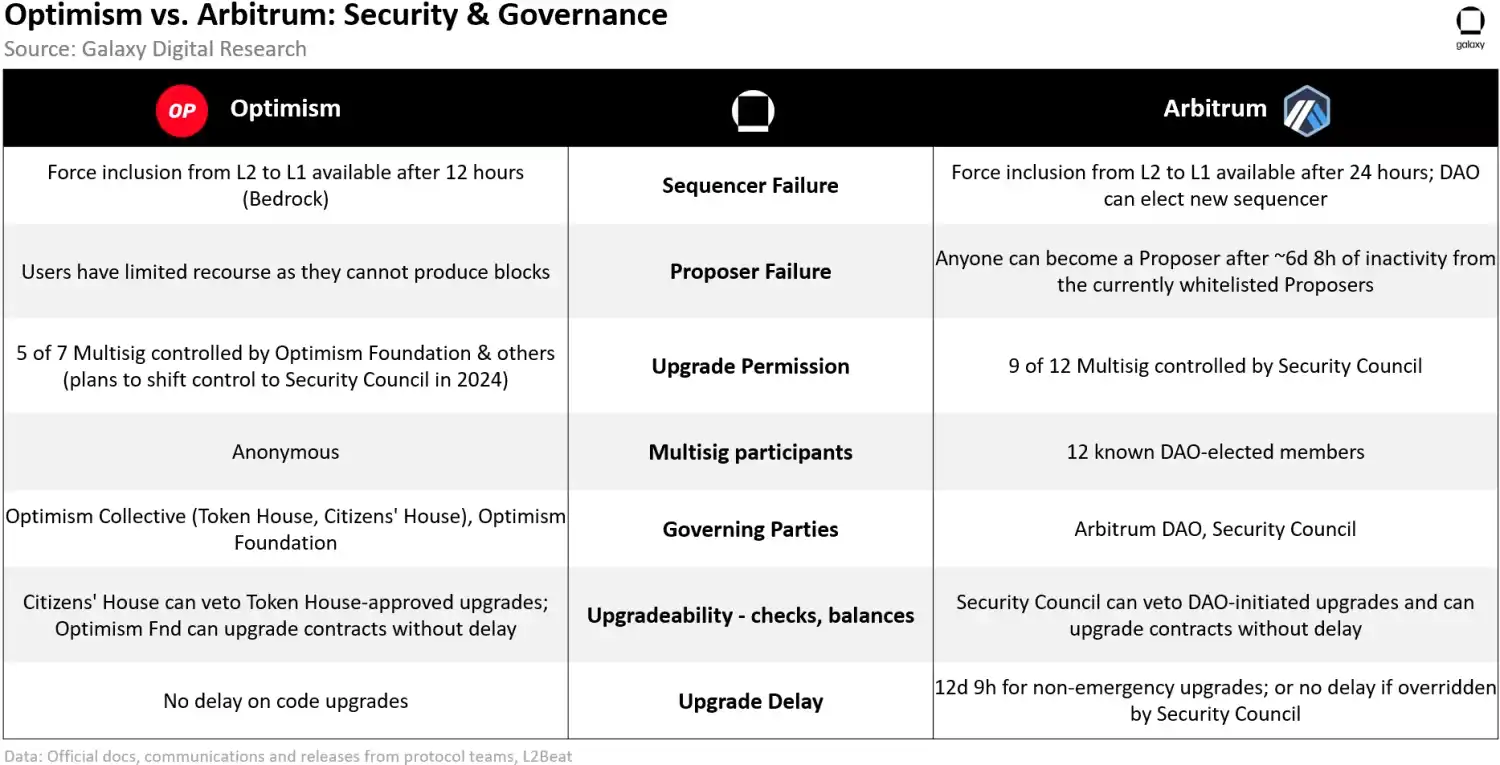
Decentralization and Security: Another area of development that rollup developers are focusing on is decentralization. All rollups on Ethereum are susceptible to centralization attack vectors because they rely on a single node operator to sort and produce blocks. The three core areas that rollup is focusing on to improve decentralization and security include: (i) implementing validity/fraud proofs, (ii) expanding the set of operators for verification and sorting, and (iii) decentralizing control of rollup by removing administrator privileges through governance.
Interoperability: One of the main reasons why Ethereum dominates the general blockchain market share is its strong network effect. As more users join Ethereum and the liquidity of assets that users interact with on Ethereum increases, the value of the network also increases in a positive feedback loop. The decentralization of this liquidity is a barrier that rollups adopt. The DeFi ecosystem benefits from the concentration of liquidity and the composability of dapps on a protocol. Therefore, seamless migration of assets from L1 to L2 and within the L2 ecosystem is an important area of development that will help drive end users from Ethereum to L2.
Advantages of Alternative DA Solutions
In the short term, Ethereum's revenue will still be mainly generated by end users directly initiating transactions on L1. As the cost savings from scalability upgrades on L2 and the decentralization and interoperability of rollups improve, user adoption of L2 will increase. In addition, choosing to use alternative DA layers like Celestia to achieve cost-effectiveness in rollups may achieve higher profit margins by only passing on a portion of the cost savings to rollup users. In addition to Ethereum and Celestia, other L1 blockchains such as NEAR have announced plans to pivot towards better serving rollups as DA layers.
On L2, transaction fees paid by users can be more than 90% lower than on Ethereum, as shown in the following figure:
By publishing user transaction data to Celestia instead of Ethereum, rollup operators are expected to achieve higher profit margins due to the lower transaction fees on Celestia. On average, fees on Celestia are often several times lower than on Ethereum, although this is largely due to Celestia being a new chain that launched on the mainnet on October 31, 2023. The chart below shows the fee ratio between Celestia and Ethereum based on the daily average transaction fees (in USD) per protocol, with daily transaction fees on Celestia averaging 80 times cheaper than on Ethereum. (Note: The data below depicts the fees for all types of user transactions on Celestia and Ethereum, not just those paid by rollup sequencers.)
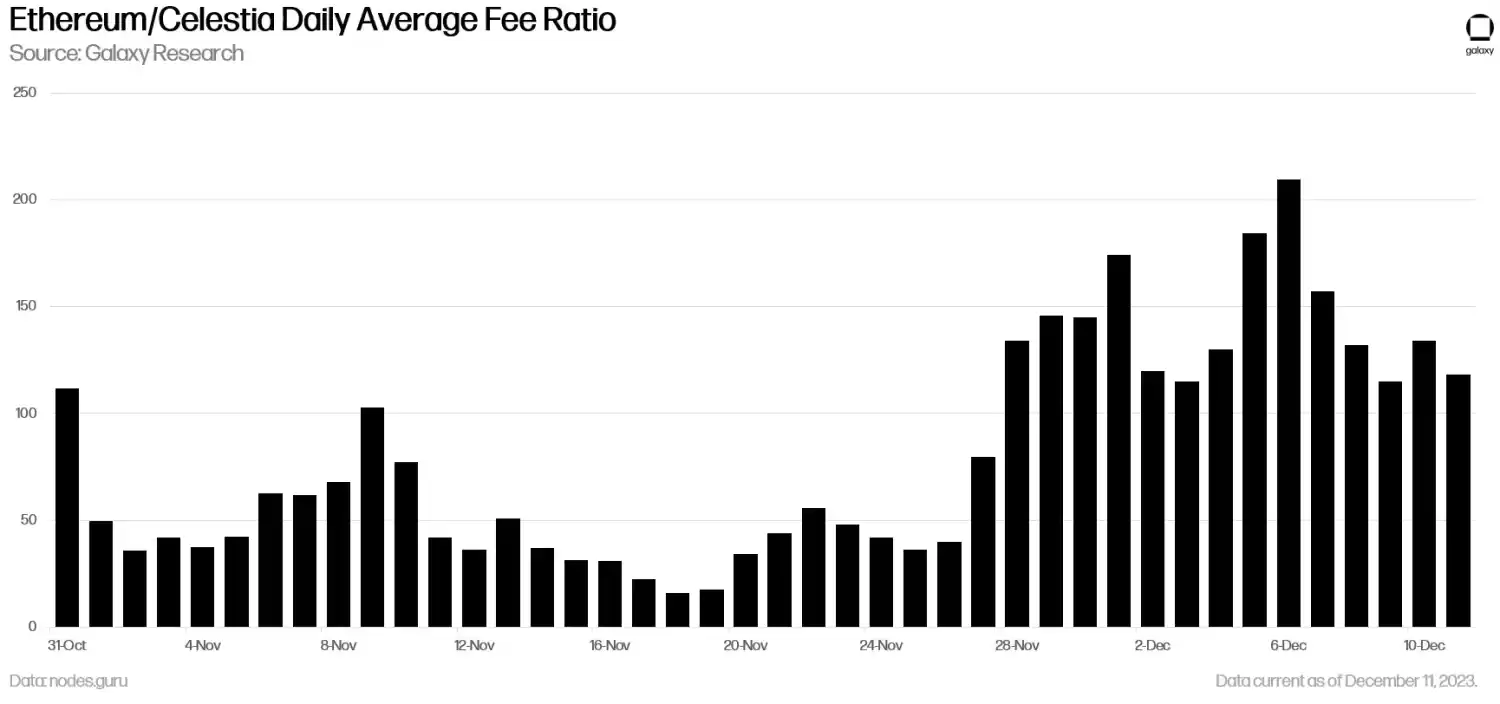
As a brand new blockchain that has been online for less than two months, Celestia has not yet been widely used for DA on L2 like Ethereum. The main part of transaction activity on Celestia is not the confirmation of "blob" transactions, but activities related to the pledge and delegation of local assets on Celestia. As the "blob" transaction activity on Celestia increases, transaction fees may fluctuate and trend upwards. However, since Celestia's optimization for DA currently does not exist on Ethereum, the cost of rollup on Celestia is unlikely to trend upwards compared to Ethereum unless everything else is equal.
Overall, we expect that with the launch of the Cancun/Deneb upgrade in 2024, revenue on the Ethereum network will decrease as the block space cost of rollups on Ethereum decreases with the activation of the Cancun/Deneb upgrade, or at least falls below the level without the Cancun/Deneb upgrade. In addition, due to the ongoing challenges related to the scalability, decentralization, and interoperability of rollups, we expect that the majority of revenue on the Ethereum network will still come from end users rather than L2. Finally, if the sequencer does not pass on all DA cost savings to rollup users paying fees and migrates to alternative DA solutions such as Celestia, we expect short-term profit margins for rollups to increase.
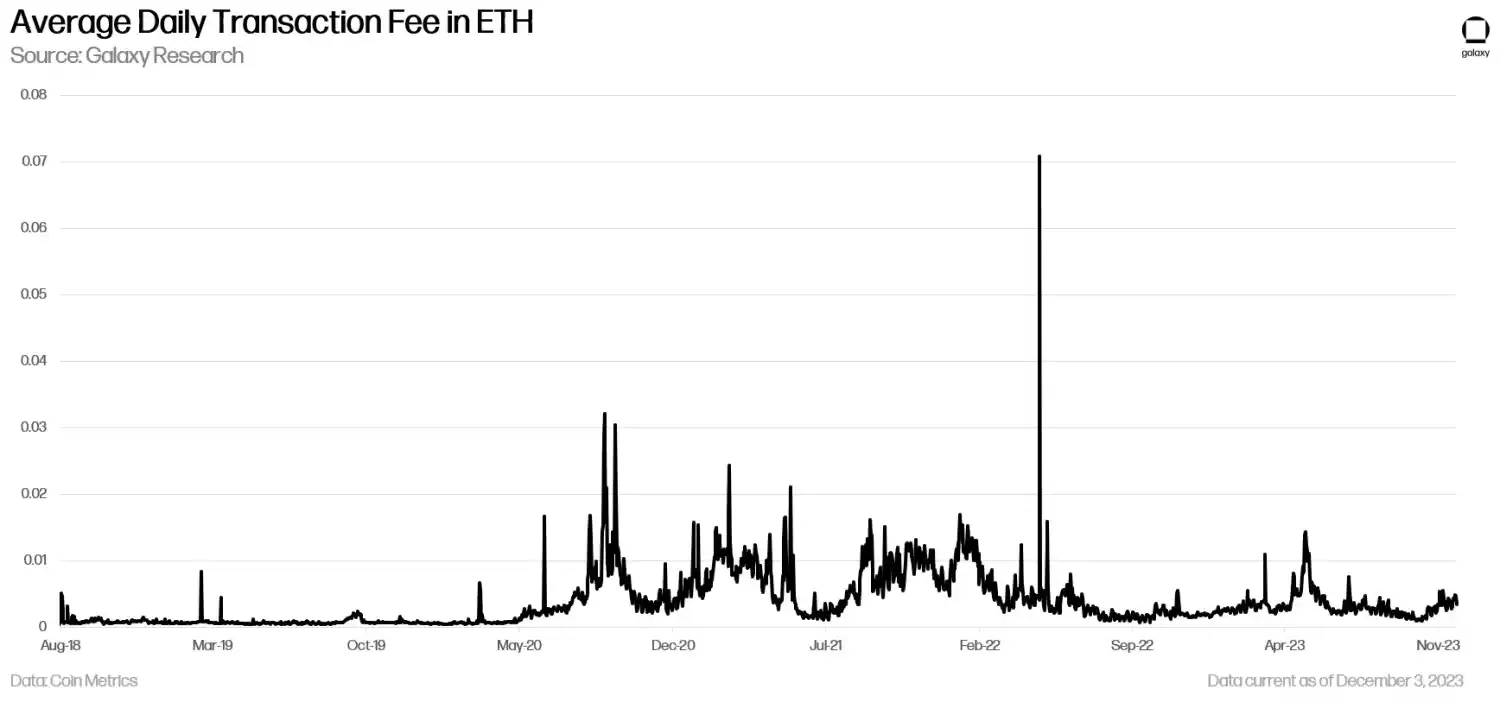
Here is a chart showing the volatility of daily transaction fees in local Ethereum units on Ethereum:
When discussing the topic of long-term value accumulation from L2 to L1, two other factors worth considering are the activation trend of local accounts on L2 and the re-staking solution on Ethereum.
Account Abstraction
Although there is a proposal to implement account abstraction (ERC 4337) without changing the core Ethereum protocol, it is unlikely to be widely adopted because the proposal depends on dapp developers updating their smart contracts and end users choosing to use alternative memory pools. On the other hand, as an emerging technology, rollup is a perfect testing ground for implementing native account abstraction at the protocol level. In fact, rollups like zkSync and Starkware are already doing this, which means that accounts created by end users on these protocols automatically have enhanced programmability and usability.
The local account abstraction on Rollup will be a game-changer for user interaction with dapps, as the account abstraction unlocks a range of new features for user transactions, including but not limited to:
· Ability to pause asset flow when under hacker attack: A user's account may have built-in logic to stop the flow of funds when certain withdrawal limits are exceeded.
再质押
translates to
Re-pledge
.
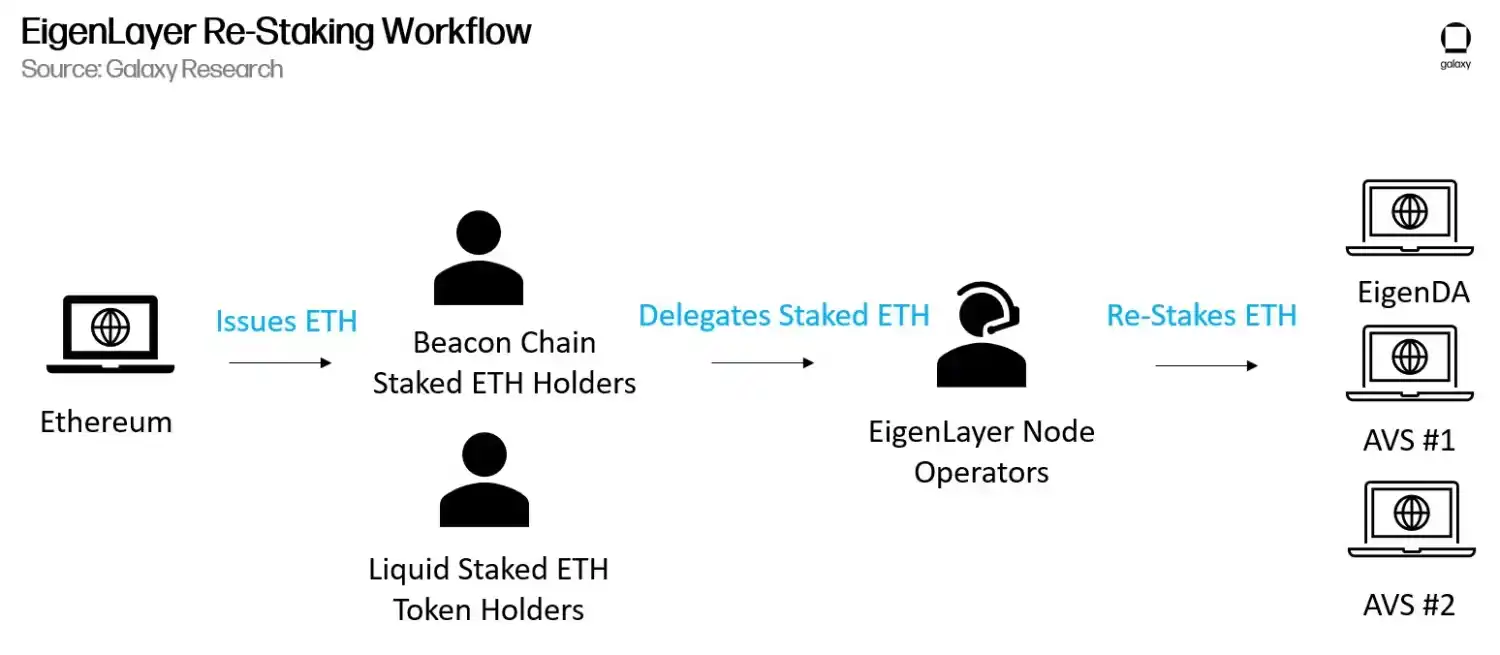
With the reliability and scalability of re-staking becoming more prevalent, the level of activity similar to that of liquid staking has become very popular through the Lido protocol. Rollups are expected to gain additional security by re-staking Ethereum for operations such as sorting. Additionally, although the issuance of Ethereum is expected to decrease over time due to a reduction in additional validation node operators, staking rewards on Ethereum are expected to increase, which may cause demand for Ethereum to exceed the rollup sequencer for DeFi applications and foundations. The activity of re-staking creates potential opportunities for lucrative returns, even if the utility of Ethereum for transaction execution on Ethereum decreases and the adoption of rollups increases, which may encourage individuals and entities (outside of rollup operators) to purchase and stake Ethereum.
Conclusion
The revenue of Ethereum will benefit from maintaining larger-scale transaction activities through L2, although in the short term, the network may face a decrease in revenue due to insufficient adoption of rollups and the implementation of upgrades to subsidize rollup costs. As the upcoming upgrades should reduce rather than increase fee payments, Ethereum may perform poorly in the short term, at least when investors measure the value of Ethereum based on its fee-based protocol revenue. Rollup is an emerging technology that faces some technical challenges and adoption barriers in the short term. Over time, as the scalability, decentralization, security, and interoperability of rollups improve, most end-user activities may migrate from Ethereum to L2. As this process occurs, competition between L2s for users will intensify, and the profit margins of rollup operators may decrease. In the long run, technologies such as native account abstraction on L2 will further reduce the demand for end-users to hold Ethereum directly. It is more likely that end-users and DeFi protocols will hold token representations of Ethereum and its accumulated earnings, with the main holders of native Ethereum being rollup operators who use the token to represent end-users' purchases of block space on Ethereum. Further research areas related to the accumulation of L1 value on L2 include the impact of maximum extractable value on modular blockchain ecosystems and the evolution of zero-knowledge proofs in rollups, their bridges, and economic design.
"Original article link"
Welcome to join the official BlockBeats community:
Telegram Subscription Group: https://t.me/theblockbeats
Telegram Discussion Group: https://t.me/BlockBeats_App
Official Twitter Account: https://twitter.com/BlockBeatsAsia

 Related Articles