Modular Blockchain Options: How Data Availability Layers Can Shape the Future of Blockchain
Original title: "Foresight Ventures: "Foresight Ventures: "Foresight Ventures" Modular Blockchain and Data Availability Layer"
Original author: msfew, Foresight Ventures
0.Rollup's bottleneck
If you read the last Rollup article I wrote, you will probably find that The final comparison between Optimistic and zk Rollup was intentionally or unintentionally left a hole.
The conclusion reached at that time was: because there is no Proving Overhead, Optimistic Rollup is in In the long run, it will be far better than zk Rollup. But in fact, in the development of different time periods, the performance of Optimistic and zk Rollup will actually lead alternately:
< img src="https://image.blockbeats.cn/upload/2022-07-05/f1f2bcb5a98012c192989fabc604916949c28a97.png?x-oss-process=image/quality,q_50/format,webp">
Different stages and different types of Secured Rollups have different bottlenecks, and for them now, the main problem is that the data availability scheme currently provided by Ethereum limits their peak theoretical performance .
In order to solve the performance problem of Rollup at this stage, we have two methods:
Upgrade the main network of Ethereum, and wait for it to upgrade successfully. The disadvantage is that you cannot grasp the initiative, which may take a long time.
Switching the type of Rollup (such as changing into Validium), directly using a data availability solution with better performance, the disadvantage is that some of the security is sacrificed.
1. Block chain modularization
The Secured Rollup (Arbitrum, etc.) we are referring to is actually an implementation of modular blockchain, and there will be more and different modular blocks in the future Chain implementation, or different variants of Rollup.
Ethereum’s Rollup route reflects the modularization trend of the blockchain, allowing the layers of the blockchain to be separated, Each performs its own duties, so that the network can be rolled up.
The previous Rollup article mentioned two routes for expansion, one is to upgrade the blockchain itself, and the other It is to use the Rollup method to better use the blockchain.
The modular blockchain combines two routes, 1+1 > 2, completely Switched the monolithic architecture of the blockchain, making the new modular blockchain network the most suitable soil for Rollup growth, and endowing these Rollup solutions with more module choices and higher performance.
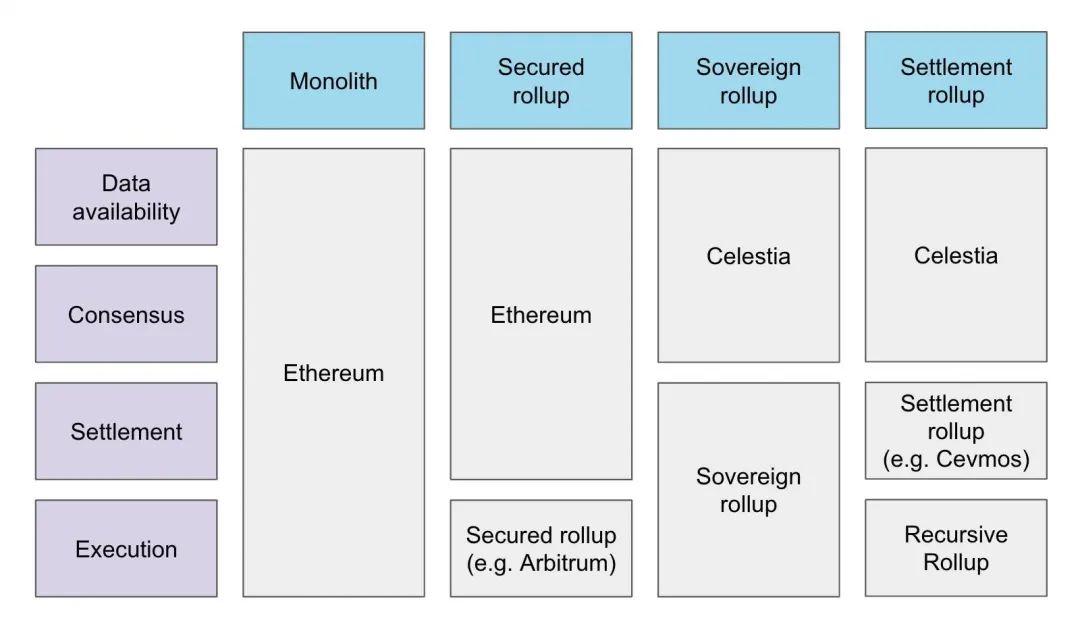
a) Two levels, four modules

Security layer: to ensure the security of the blockchain.
Data Availability Module (hereinafter referred to as DA): to ensure that transaction data can To be used (guaranteed storage and verifiable and usable).
Consensus module: determine the order of transactions, etc. (PoW, etc. are anti-attack mechanisms and the basis of consensus does not represent the entire consensus).
Execution environment layer: Provides the execution environment of the blockchain.
Settlement module: settles out state commitments.
Execution module: calculates individual state transitions.< /p>
If the block chain module is compared with the computer structure, then:
< br>
- The operating system of the block chain execution module computer (the environment that actually executes instructions)
- The DA of the block chain The memory of the module computer (to realize short-term data access)
-The settlement and consensus of the block chain The CPU of the module computer (hardware guarantees the correctness of instruction execution)< /p>
In future articles, we will refer to these "modules" as "layers", but they are actually modules.
< /p>
b) Predict the trend of modularization from the development of the Web
We can learn from the development of the Web to learn about the future modularization of the blockchain Development route:

The blockchain network is actually a more decentralized and stable cluster, allowing nodes Collect computing power to form a large trusted computer all over the world.

Split: The blockchain network has been It is simply split into the two levels and four modules mentioned above.
Connection: to ensure communication and security between modules. This is Why modules of the same origin are more secure, because no additional connections are required, avoiding the dangers exposed in the process.
The problem of splitting has been clearly defined , but the connection problem has an impact on the modular architecture. How to improve security and user experience may be a problem that the modular blockchain needs to solve.
c) Why modular?
After the modular blockchain decouples the single blockchain, the new network structure = multiple similar Arbitrum and StarkEx Different Rollup + an underlying main network similar to Ethereum.
The main point of their improvement is that they no longer need to pass the traditional single block because of the coupling of consensus and DA Proof of Replication caused by the chain to verify and guarantee DA (limit performance and greatly increase the size of the full node to affect decentralization).
This means that the module It is no longer necessary to decouple the consensus of the single blockchain network, but directly use a dedicated layer to process DA after decoupling. Under the priority of main network security, it reduces the waste of redundant computing power and storage, and improves throughput.
In addition to the overall performance can break through the bottleneck and leap to the next era, What are the other significant benefits of a modular blockchain?
Better Blockchain
- Execution performance: Flexibility to adopt faster execution or/and settlement modules.
< br>
Composability in development
- Iteration: Module decoupling. Modules can make more radical proposals and faster Innovation.
- Pluggable: More chain development solutions and technology stack options.
d) Different implementations of modularization?
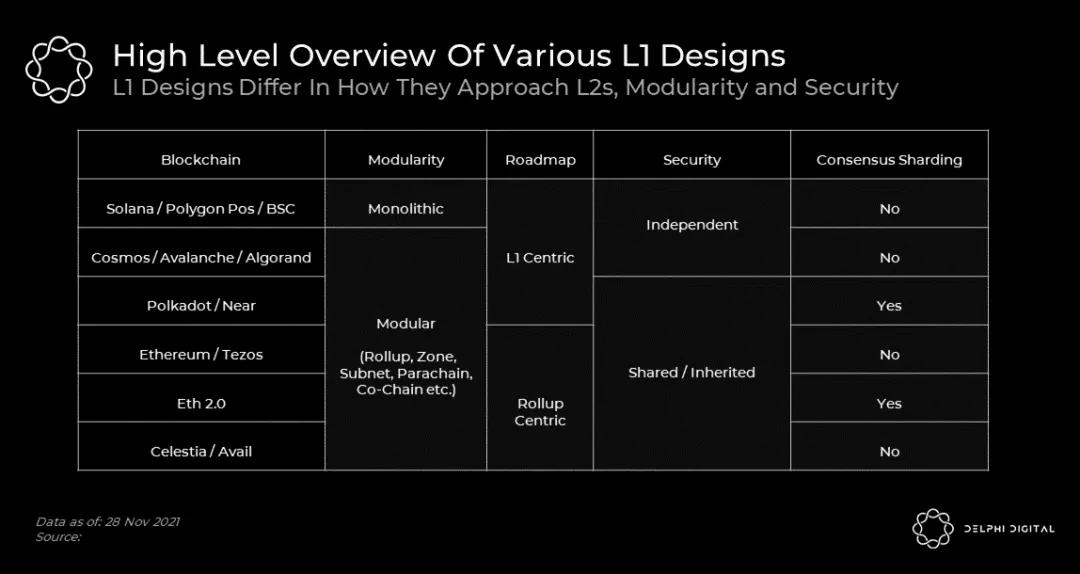
Modular blockchain network can actually build a lot of types of "chain" practice, the main There are three major categories and countless subcategories:
- Rollup (including Sovereign or Secured Rollup, etc., see the previous article. Such as Ethereum/Celestia security layer + Execution Environment / or Execution Module only.)
- Multi-Monolithic (such as Tendermint/Substrate security layer + execution environment for Cevmos stack and Recursive Rollup. Celestia itself In fact, it belongs to this architecture, and it belongs to the Cosmos ecology.)
- Subnet (Assembling the most free modular blockchain, it is not able to inherit security, but more focused on deployment and development efficiency.)
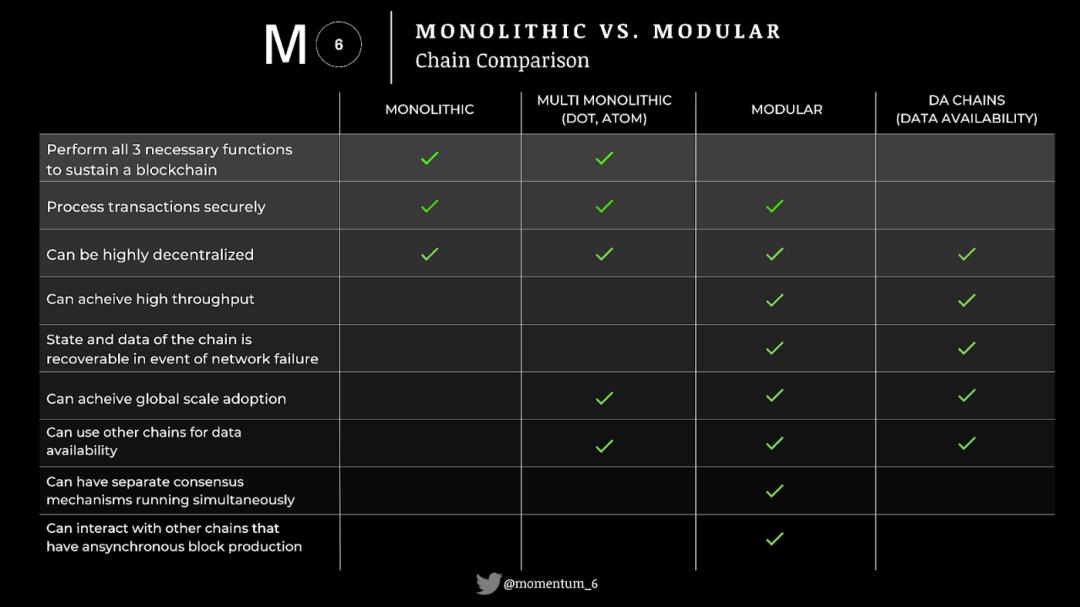
The general direction of these three modular blockchains and monolithic blockchains Different, the characteristics are also different:
- Rollup: In the world of martial arts, the only thing that can't be broken is fast, but the technical progress is the slowest and the most immature.
- Multi-Monolithic: Shared security, communication is composable and interoperable, application chain is sovereign, but performance is not guaranteed.
< /p>
- Subnet: Deploy in seconds, the solution is mature, but the degree of security and decentralization is not necessarily good.
- Monolithic: "Complete "degree of freedom, but the scheme is too heavy, and the whole system may be too coupled.
e) The impact of the modular concept?
After the advent of the modular blockchain era, the traditional concepts of L1 and L2 may have to be redefined.
- Single Zone Block chain: L1 refers to single block chains such as Ethereum, and L2 refers to Rollup based on the combination of Ethereum-based security layer and execution module.
- Modular Blockchain: L0 refers to social consensus and trust assumptions on L1, L1 refers to the security layer (DA and Consensus) of the modular blockchain, and L2 refers to the execution environment layer (Settlement and Execution) of the modular blockchain
In addition:
- Performance measurement: from consensus TPS and TTF to DA Throughput comparison.
- Definition: It should be noted that for Rollup such as Arbitrum, Arbitrum network = Arbitrum execution environment + Ethereum security Layer and settlement module. For Ethereum itself, Ethereum network = Ethereum execution environment + Ethereum’s security layer and settlement module. When the scheme can be modularized and deconstructed, they can all be called modular blocks A practice of blockchain. A network suitable for L1, such as Ethereum, can be called a modular blockchain network.
- Trend: When When an application wants more functions, reduced operating costs, enhanced security, and greater sovereignty, the application can choose a solution that suits it from a basket of modules, thereby developing App-chain, App-rollup, or App-subnet.
In the future, perhaps each application will choose to become a modular blockchain.
2.DA layer
Since Rollup not only guarantees security but also improves performance, why not make blockchain the best soil for Rollup? Modular block The chain is to make the blockchain a better base layer for Rollup.
Rollup made everyone pay attention to the impact of the DA layer on performance, and the appearance of Rollup also inspired A modular blockchain network concept focusing on multiple Rollup ecology. The modular blockchain allows the blockchain to overcome the consensus bottleneck of the single era and enter the era of the modular concept focusing on DA.
< p>“Rollup is to take the execution layer off-chain, and the next step is to take DA off-chain.”
a ) What is DA?
For the modular blockchain and Rollup network, the complete data needs to be there and guaranteed to be available, so as to ensure the network Decentralization and security:
Current Data Availability: Why do you need the latest state root and tx data to be available when generating blocks?
< br>
Because new blocks need to be revealed in L1, so that other nodes can re-execute to achieve verification, and this process must ensure the security of light clients (they only check the block header !Do not reject invalid transactions).
Archive Data Availability: After the block is valid, does the tx data need to be retained to ensure availability?
Yes. For example, you want to view a transaction from a few months ago, or you want to run a node from scratch.
Rollup and Modular Blockchain: What does Current Data Availability mean for Rollup and different future Modular Blockchain practices?
Optimistic Rollup: When a new block is produced, the state root data needs to be available to be verified. During the challenge period, the tx data needs to be available to make the challenge Sequencer feasible and ensure security.
zk Rollup : When the Sequencer runs away, the state root data is needed to rebuild the state and withdraw funds.
b) Current Data Availability
The availability of up-to-date data affects the security and performance of the network itself.

< br>
When we talk about DA, we usually refer to it.
The era of monolithic blockchain :
DA scheme: Since the consensus and DA are not decoupled, it relies on the full node Proof of Replication.
The data is there: Guaranteed by replicating the complete data through a bunch of full nodes.
The data is available: via linear complexity Download complete data to verify that data is available.
tx Validity: Verify tx validity by re-executing.
< /p>
Problem: Too much redundancy, and if the node only stores a part of the data on average, the probability of losing data is very high (similar to the birthday paradox).
Modular blockchain era:
DA solution: dedicated independent DA solution.
Data is there: Data availability is guaranteed by erasure coding (the data protection scheme used by CDs and satellites).
Data availability: Verify in sublinear time through data availability sampling, for example, you only need to download 1% of block data to get 99% block availability guarantee.
< /p>
tx Validity: Through error coding proof (similar to Optimistic mechanism) or polynomial commitment or even directly on validity proof (we usually call it zk proof) to ensure that the erasure coding is correct and tx is valid.
c) Archived Data Availability
Availability of archived data only affects outside the network itself such as blockchain Infrastructure such as browsers may be optional for the network itself, but it must be available for users to use.
The main things we want to explain first Yes, Arweave or Filecoin's Web3 storage solution cannot provide direct DA for Current Data Availability:
Arweave: SPoRA. It is essentially a Moore's Law assumption and economic model Probabilistic storage (of course everything is probabilistic...). In use, it usually takes more than ten blocks to confirm the data "permanence", which cannot guarantee real-time DA.
Filecoin: PoSt. Point-to-point distributed storage network. Miners who store data can withhold data, and cannot guarantee decentralization and DA.
IPFS : It mainly exists as an infrastructure, which is used in the network layer of Polygon Avail and Celestia's DA.
In addition, Arweave and Filecoin are still The multi-copy redundancy mode of the single block chain ensures that the data is available, and it is difficult to establish an efficient sampling mechanism.
Although they are not suitable as "memory" for the latest data Provide usability, but it is suitable as a "hard disk" to provide availability for archived data. At present, Web3 still lacks a more modular and dedicated dedicated "hard disk".
3. Choice of Modular Blockchain

a) DA layer ecology
The DA layer is the direction that everyone is paying close attention to recently. But judging from our decision map, in fact, there is not a high probability to make so many "right" pre-selected choices in a row, and finally make the DA choice.
In addition to the self-built private DAC (performance + sovereignty) or side chain DA solution most likely to be adopted by the project, there are basically three options for the DA solution:
- The highest security: consistent with the consensus layer, such as DA and consensus using Ethereum or Celestia.
- Extreme throughput: sacrifice security, add additional trust assumptions, such as off-chain data committees (security is the same as multi-signature, poor).
- Both: Through the Restaking mode, high security and high throughput can be obtained, such as DataLayr.
The business structure of the DA solution will basically be as follows:
- Business model: facing the application chain, by providing DA to collect the "protection fee" paid by the application chain.
- Competition: The strength of the DA scheme is actually a comparison of two levels: security and throughput. And the one with better throughput can easily win an overwhelming victory.
< br>
- Value capture: Since there are not many examples for analysis and comparison in practice, we can think about the following questions: If the market value of the DA layer is much lower than that of the application chain (like the relationship between Chainlink and DeFi applications ), does the entire protocol have security shortcomings? The DA layer alone cannot form a complete application ecology, how does Token capture value?
b) Execution layer ecology
If the modular blockchain is compared to a highly divided kitchen, and the performance of the blockchain is the speed of serving food, then the DA layer with greater throughput is A bigger pot, a better execution environment means a cook who is more skilled and can cook more cuisines.
There are basically several options for the execution layer plan :
Existing mature solutions: EVM and its ZK or OP variants, WASM and its various variants, etc.
< /p>
For the value capture of cutting-edge execution layer solutions, they can be very It is easy to combine Optimistic Rollup to form an application ecology, so in terms of value capture, they have natural advantages over the DA layer.
c) Consensus layer ecology
c) Consensus layer ecology
For modular blockchains, the consensus layer needs to:
Security Priority: Guaranteed Stability and security of the bottom layer.
Smart contract environment: it is convenient to verify various outputs on the chain.
Social and economic consensus: It needs to be a "highly respected" public chain, so that there is no need for additional trust assumptions.
So we are left with the right choice Not much more:
Exactly suitable: Ethereum, Cosmos, etc.
Badly suitable: Bitcoin , Arweave (there is no Turing-complete smart contract on the two chains, and the settlement is carried out on the application chain), etc.
Not suitable: Solana (the network is not particularly stable ) etc.
Probably most suitable: future Celestia, future Ethereum.
4 .Thoughts on modular scheme
a) Further exploration
DA layer: state explosion problem The network's entry threshold is too high, which weakens the decentralization of the network. The statelessness we described in the DA section is only weak statelessness, that is, only block producers need to store state data, and more optimization is needed later, so that All nodes do not need to store all state data.
Execution layer: The current modular division of labor is only to open many execution layers (Sharding), and when After a certain execution layer is fully loaded, its performance still cannot meet the requirements of Web3. Then what we need to expand is the performance of a single execution layer (Parallelization), such as Fuel and Solana.
b) Demand and Supply

How much is the demand for App-chain?< /p>
At present, only popular applications will have the demand for App-chain. We may need more users onboard to stimulate a real large demand for modular solutions.< /p>
At the same time, we have also seen countless module choices, and it is a process of exploration and selection to find out which ones can be actively used.
< p>c) Security
Modularity has two aspects, split and join:
< p>Will the split cause the entire blockchain network to have short boards? The capital required to attack its short boards will be greatly reduced, as the lead role of the Curve pool will detonate Luna Tragedy?
d) experience

A decentralized modular system may lead to the separation of user experience and funds just because of the difference in the execution layer. At the same time, will it lead to the separation of developer experience due to the difference in development tools? MEV How to deal with it?
e) Long-term separation must be combined
Similar to Apple's transition from Intel chips to m-series SoCs Will the fragmented architecture of the modular blockchain be reunified in a few years due to ecological or experience issues, will the monolithic blockchain return to its dominant position? Will the modular blockchain appear like Cosmos IBC Interoperability agreement?
5. Summary
The current modular blockchain only runs out It is the tip of the iceberg, but it is already very prosperous. There are various Secured Rollups based on Ethereum, Cosmos, Polkadot, Subnet, etc.
Bitcoin is a blockchain Concept, Ethereum is the practice of blockchain, and modular blockchain will be the basis for the extensive engineering and practice of blockchain.
Original link
Welcome to join the official BlockBeats community:
Telegram Subscription Group: https://t.me/theblockbeats
Telegram Discussion Group: https://t.me/BlockBeats_App
Official Twitter Account: https://twitter.com/BlockBeatsAsia

 Related Articles