POW Race Track Top 7 Projects

Source: Biteye
The explosion of Kaspa has attracted many people's attention back to the POW track. Coupled with the narrative of next year's BTC halving, the rise of the POW track can be said to be one of the strongest in this cycle.
In this issue, Biteye brings you the introduction of the seven major projects in the POW track. Don't miss it if you are interested.
1Kaspa
2Bittensor
3Dynex
4Conflux
5Zephyr
6Clore. AI
7LiquidLayer
Project: Kaspa
Token: $KAS
Market Cap: $2.87B
@KaspaCurrency is a PoW-based decentralized Layer1 project. Its team has a good background, with the founder being a Harvard postdoc focusing on transaction ordering and MEV.
Kaspa's blockchain structure pattern is different from BTC. It is not a single-chain structure but a Directed Acyclic Graph (DAG) structure, which can maintain a faster block generation speed.
The KAS mining algorithm is kHeavyHash, supporting ASIC miner mining.
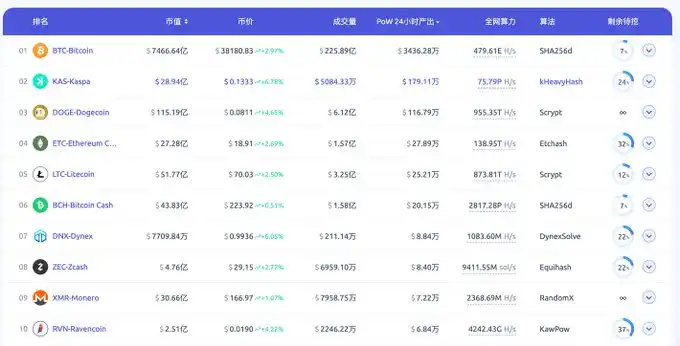
Due to its recent skyrocketing token price, it currently ranks second in daily token production value and plans to develop its own Layer1 ecosystem in the future.
Project: Bittensor
Token: $TAO
MC: $1.29B
@bittensor_ aims to drive the development of artificial intelligence through a blockchain-powered incentive structure. In this ecosystem, contributors are rewarded with $TAO for their efforts. The network combines a hybrid consensus mechanism of Proof of Work (PoW) and Proof of Stake (PoS) elements.
Bittensor integrates PoW with AI, using PoW for mining and AI model computation to form a decentralized large model network.
In Bittensor, miners host AI models and provide them to the network, and validators rank them based on the miners' "intelligence contribution." The network rewards 1 $TAO per block, distributed evenly through mining and validation by miners and validators.
Project: Dynex
Token: $DNX
MC: $78.3M
@dynexcoin is a neural-form supercomputing blockchain based on the DynexSolve chip algorithm, proposing a Proof of Useful Work (PoUW) approach to enhance the speed and efficiency of decentralized networks.
The Dynex network nodes are composed of PoUW miners, allowing any miner to perform Dynex chip calculations and receive the native token $DNX as a reward.
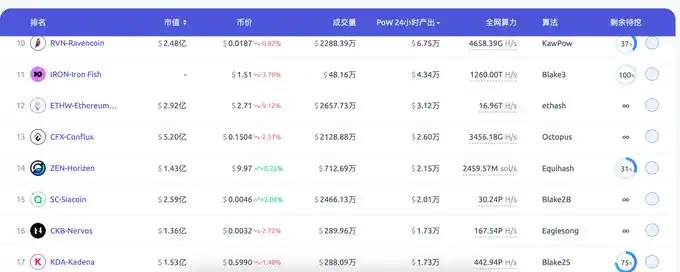
Currently, its daily token output value ranks seventh in F2Pool.
The project's token DNX uses the DynexSolve mining algorithm, supporting GPU mining.
Mining Equipment: GPU (NVIDIA & AMD, mainstream GPUs with no less than 3GB VRAM are all acceptable).
Operating Systems: Windows, Linux.
Note: There is some controversy surrounding the project as the founder's previous project was charged by the U.S. SEC in 2019.
Project: Conflux
Token: $CFX
Market Cap: $521.4M
@Conflux_Network Blockchain aims to address the blockchain trilemma using a hybrid consensus mechanism that combines PoW and PoS. By leveraging the advantages of both mechanisms, Conflux is able to achieve a higher level of scalability and security while maintaining network decentralization.
Conflux is also EVM-compatible, allowing developers to more easily build dApps on the platform.
Conflux ranks 13th in daily token value output in F2Pool.
The $CFX mining algorithm is Octopus, supporting GPU mining with GPUs such as RTX 4090, RTX 3060, GTX 1660Ti, RTX 3070, and others.
Mining Equipment: GPU (supporting NVIDIA and AMD graphics cards), recommended memory size of 6GB or above (memory requirements increase linearly, adding 1-1.5GB per year).
Operating System: Windows, Linux.
Project: Zephyr
Token: $ZEPH
Market Cap: $56.3M
@zephyr_org Protocol, built on Monero, allows each native asset (ZEPH, ZephUSD, and ZephRSV) to inherit Monero's privacy features. This ensures hidden transaction destinations and amounts, resulting in a private stablecoin protocol.
The Zephyr protocol operates on the RandomX Proof of Work (PoW) algorithm, designed to optimize general-purpose CPUs and support decentralized and egalitarian mining. There are three tokens in its ecosystem: the base currency (ZEPH), the stablecoin (ZephUSD), and the reserve coin (ZephRSV), where users can mint the latter two using the former. The base currency ZEPH is mined through the PoW algorithm.
Mining Tutorial: https://pool.zephyrprotocol.com/#getting_started
Project: http://Clore.AI
Token: $CLORE
Project: Clore.AI
Token: $CLORE
MC: $31.6M
Clore.AI is an emerging GPU hashpower rental platform, with a dual narrative of POW and AI that has recently garnered significant market attention.
Its business model includes AI training, movie rendering, VPN, cryptocurrency mining, and users can earn $CLORE tokens by renting hashpower or providing hashpower.
The project uses the kawpow algorithm, resistant to ASIC mining. The token has no pre-mine and no ICO, with 50% of each block reward allocated to miners, 40% to lessors, and 10% to the team, and introduces a Proof of Holding system (POH) to incentivize token holders. In the future, Clore plans to introduce Clore Storage storage services, VPN services, and more.
Project: LiquidLayer
Token: $LILA
MC: $8.2M
@LiquidLayer_ is a highly scalable PoW blockchain with an integrated Liquid-Stake-Derivative Bridge, incorporating a POW+LSD hybrid consensus protocol.
The protocol creates a unique LSD bridge that allows users to transfer funds from Ethereum, bridge assets, and earn APY. 90% of the earnings are returned to the tokens bridged on LiquidLayer and $LILA holders.
LiquidLayer's LSD bridge is designed to seamlessly transfer assets between Ethereum and the LiquidLayer chain.
The transferred assets will be held in various vaults and stable pools, such as Lido, Frax, RocketPool, and Aave, and will be integrated into liquidity platforms to optimize yield while maintaining asset liquidity. Earnings will be automatically transferred to users' Ethereum network wallets in the form of USDC.
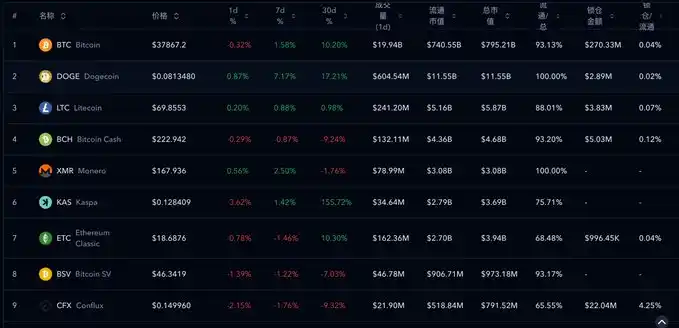
Those interested in the POW track can view POW token information on the Cryptohunt website linked below:
https://cryptohunt.ai/en/tokenScreener/token
Original Article Link
Welcome to join the official BlockBeats community:
Telegram Subscription Group: https://t.me/theblockbeats
Telegram Discussion Group: https://t.me/BlockBeats_App
Official Twitter Account: https://twitter.com/BlockBeatsAsia

 Related Articles