



A comprehensive interpretation of the DePIN track: Is it a case of "old wine in a new bottle" or a breakthrough opportunity?
Original Title: "Ryze Labs Comprehensive Analysis of the DePIN Track"
Original Source: Fred, Ryze Labs
Introduction: What is DePIN
DePIN represents a decentralized physical infrastructure network that incentivizes users through tokens to share personal resources in order to build infrastructure networks, including storage space, communication traffic, cloud computing, energy, and other fields.
In simple terms, DePIN distributes the infrastructure that was originally provided by centralized companies to a large number of users around the world in a crowdsourcing manner.
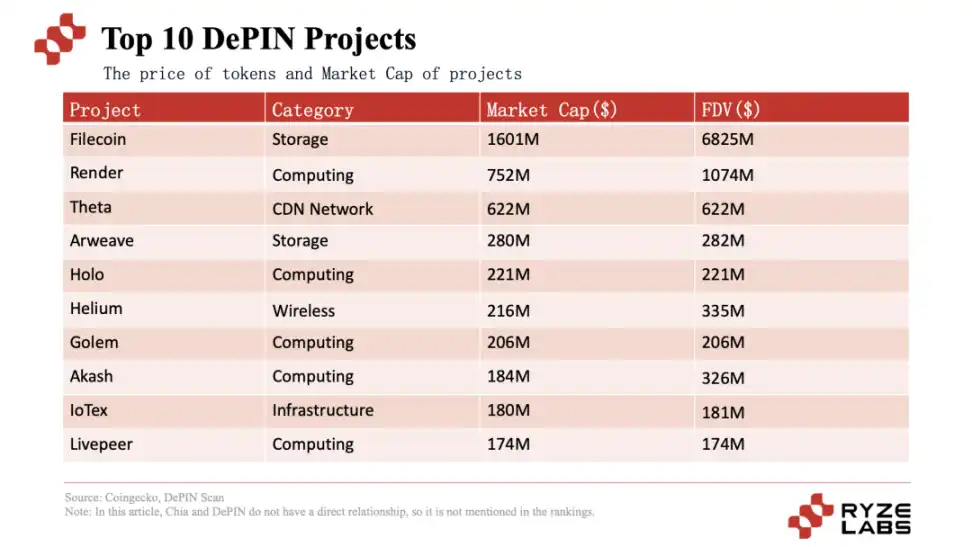
According to CoinGecko's data, the market value of the DePIN field has reached $5.2 billion, surpassing the $5 billion market value of the oracle field and showing a continuous upward trend. Whether it is the earliest emerging Arweave and Filecoin, the Helium that took off in the last bull market, or the recently highly anticipated Render Network, they all belong to this field.
Some readers may be curious, these projects already existed before, Helium also attracted hot attention in the previous bull market, but why has DePIN recently attracted people's attention and enthusiasm?
The reasons can be roughly summarized into three aspects::
The construction of infrastructure has improved a lot compared to a few years ago, which has paved the way and empowered the Depin track.
On the other hand, at the end of 22, Messari first proposed the new concept of DePIN, believing that it is "one of the most important areas for encrypted investment in the next decade", and the new definition and expectations have also added a narrative fire to this track;
In addition, people have previously placed the new narrative of breaking through the web3 circle on social and gaming, but with the arrival of the bear market, people have also begun to explore more possibilities in other directions. The DePIN track, which is closely linked to web2 users, has naturally become an important choice for web3 builders.
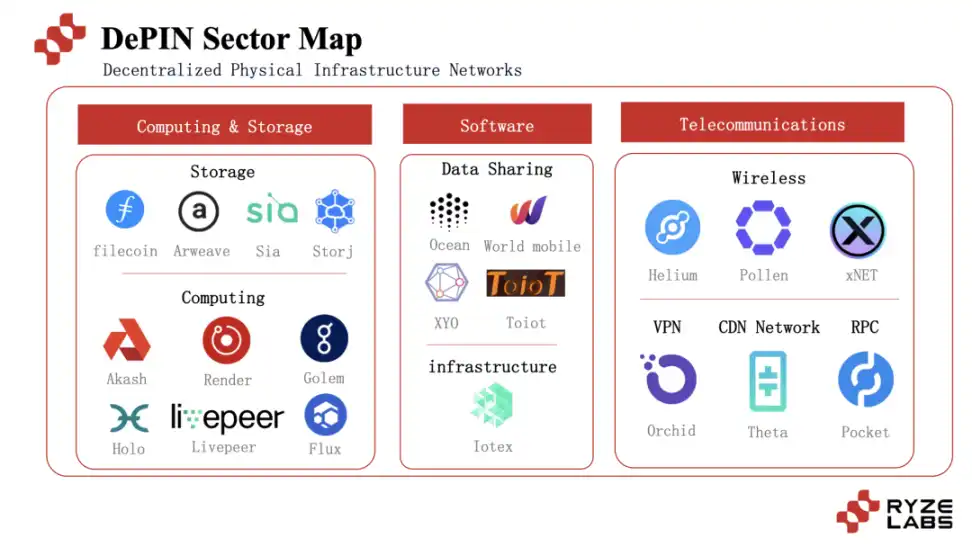
So, is DePIN a new opportunity for breaking through the Web3 circle, or just an old wine in a new bottle? This article will provide an in-depth analysis of DePIN from five perspectives: why DePIN is needed, DePIN's token economic model, industry status, representative projects, advantages analysis, as well as limitations and challenges.
Why do we need DePIN?
So why do we need DePIN? What problems does DePIN solve compared to traditional ICT infrastructure?
2.1 Current Status of Traditional ICT Industry
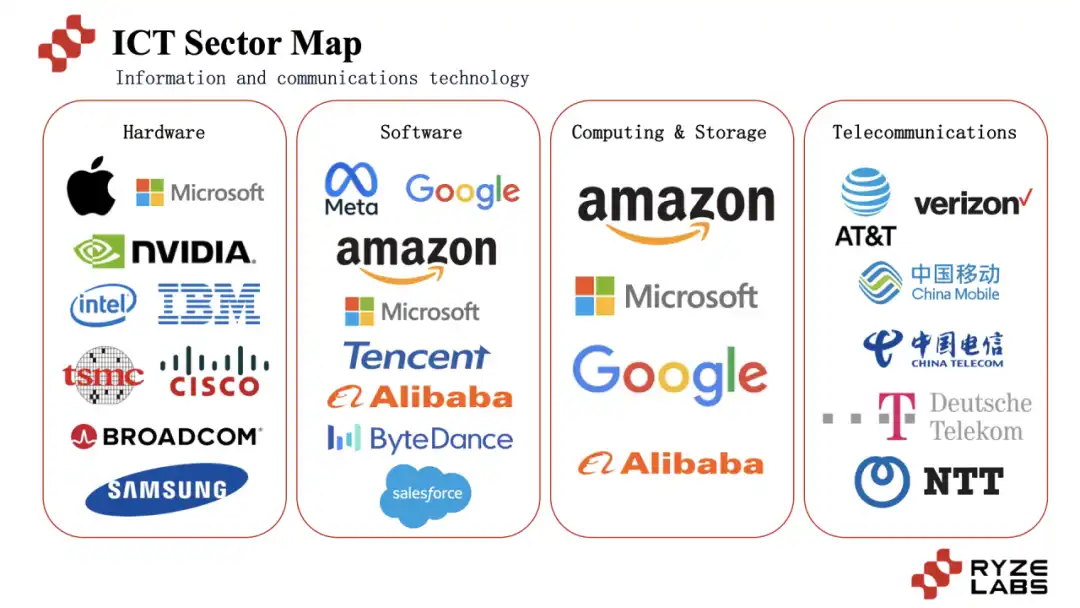
In the traditional ICT industry, we can mainly divide infrastructure into the following categories: hardware, software, cloud computing and data storage, and communication technology.
Among the top ten companies in the world by market capitalization, six of them belong to the ICT industry (Apple, Microsoft, Google, Amazon, NVIDIA, Meta), occupying a significant portion of the market.
According to Gartner's data, the global market size of ICT has reached 4,390 billion US dollars in 2022. Data centers and software have shown growth trends in the past two years, affecting our lives in all aspects.
2.2 Challenges faced by the traditional ICT industry
However, the current ICT industry is facing two significant challenges:
1) The high entry barrier in the industry restricts full competition, leading to pricing monopolized by giants.
In fields such as data storage and communication services, enterprises need to invest a large amount of capital in hardware purchases, land leasing and deployment, and hiring maintenance personnel. These high costs result in only giant enterprises being able to participate, such as AWS, Microsoft Azure, Google Cloud, and Alibaba Cloud, which collectively hold a market share of nearly 70% in the cloud computing and data storage fields. This leads to pricing being monopolized by giants, and ultimately, high costs will be passed on to consumers.
Using cloud computing and data storage as an example, the cost is quite expensive:
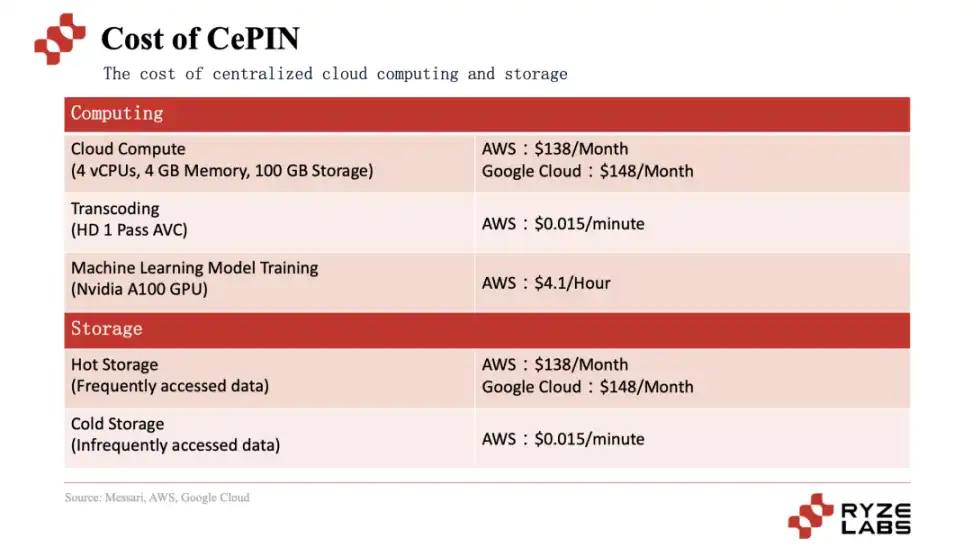
According to Gartner's data, the total expenditure on cloud services by enterprises and individuals is expected to reach $490 billion by 2022, and is expected to continue to grow in the coming years, reaching over $720 billion by 2024. According to RightScale data, 31% of large enterprises spend more than $12 million annually on cloud services, while 54% of small and medium-sized enterprises spend more than $1.2 million on cloud services. As enterprise investment in cloud services increases, 60% of enterprises report that their cloud costs are higher than expected.
Only by looking at the current situation of cloud service expenditures related to cloud computing and data storage can we see that after prices are monopolized by giants, the pressure on users and enterprises to spend will also increase. In addition, the capital-intensive nature of the industry restricts full competition in the market, which also affects innovation and development in the field.
2) Centralized infrastructure has lower utilization of resources.
The low utilization of centralized infrastructure resources is a major challenge in today's business operations. This problem is particularly prominent in cloud computing environments, where companies typically allocate significant budgets for cloud services.
According to a recent report by Flexera (2022), there is a worrying trend where on average, 32% of a company's cloud budget is wasted. This means that after spending on cloud resources, one-third of the resources are left idle, resulting in significant financial losses for the company.
This kind of improper resource allocation can be attributed to various factors. For example, for resource supply, companies often overestimate their demand to ensure the continuous availability of services. In addition, according to data from Anodot, cloud waste is caused by a lack of understanding of cloud costs in more than half of cases, lost in complex cloud pricing and a variety of packages.
On the one hand, the monopoly of giants leads to high prices, and on the other hand, a considerable portion of the company's cloud spending is wasted, which puts enterprise IT costs and IT utilization into a double dilemma, which is very unfavorable for the healthy development of the business environment. However, everything has a double-edged sword, which also provides soil for the development of DePIN.
Facing the high prices of cloud computing and storage as well as the dilemma of cloud waste, DePIN track can solve this demand very well. In terms of price, decentralized storage (such as Filecoin, Arweave) is several times cheaper than centralized storage; in terms of cloud waste dilemma, some decentralized infrastructure has begun to adopt layered pricing to distinguish different needs. For example, Render Network, a decentralized computing track, adopts a multi-level pricing strategy to match GPU supply and demand most efficiently. The advantages of decentralized infrastructure in solving these two dilemmas will be detailed in the project analysis section later.
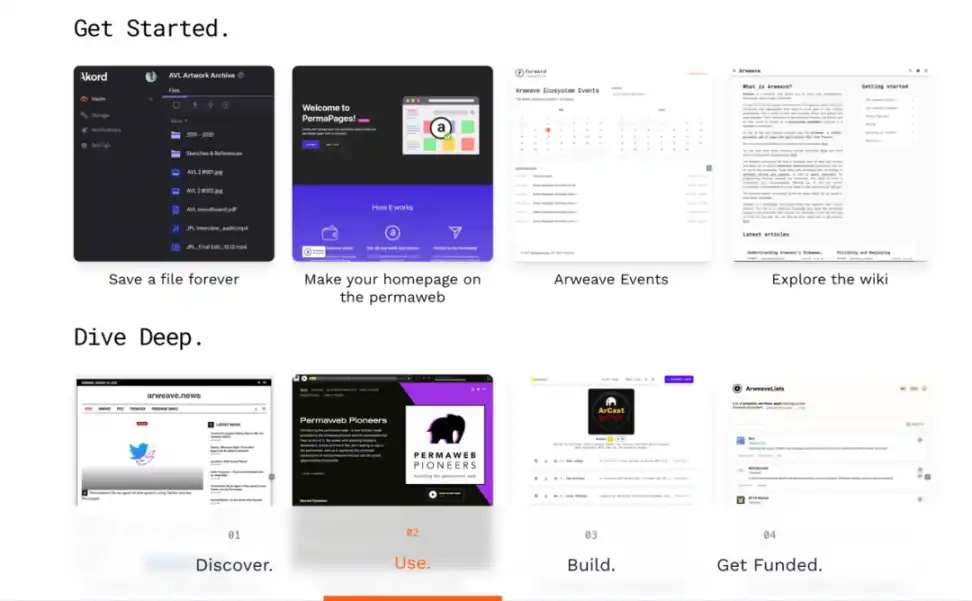
(Source: Arweave official Website)
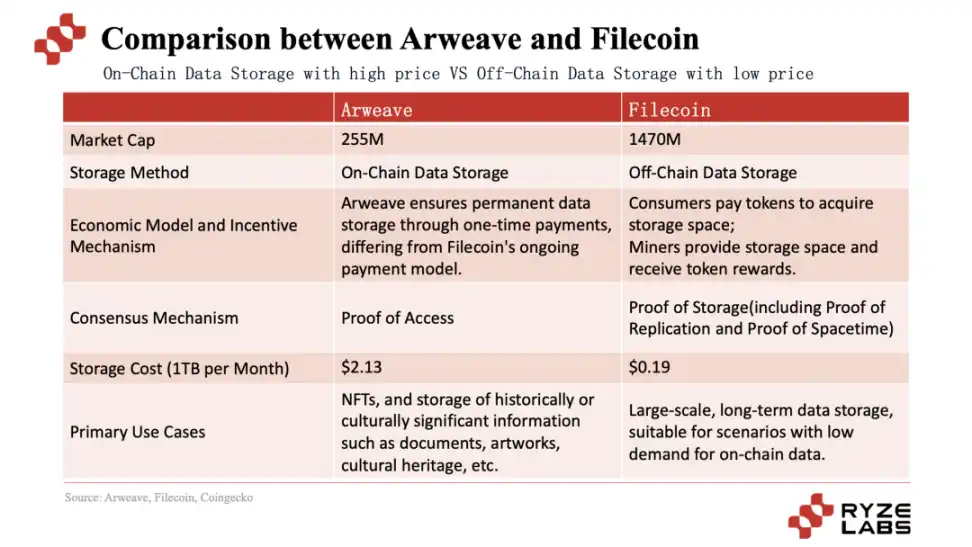
From the above table, it can be seen that Filecoin and Arweave have significant differences in storage methods, economic models, and consensus mechanisms, which gives them their respective advantages in different application scenarios. However, due to lower storage prices, Filecoin is currently in a leading position in the market performance.
Overall, with the popularization of big data and artificial intelligence applications, the amount of data generated is growing exponentially, leading to an increasing demand for data storage. Against the backdrop of high pricing for centralized storage, the demand for decentralized storage is also increasing. As shown in the following graph, there is a significant difference in price between decentralized storage and centralized storage.
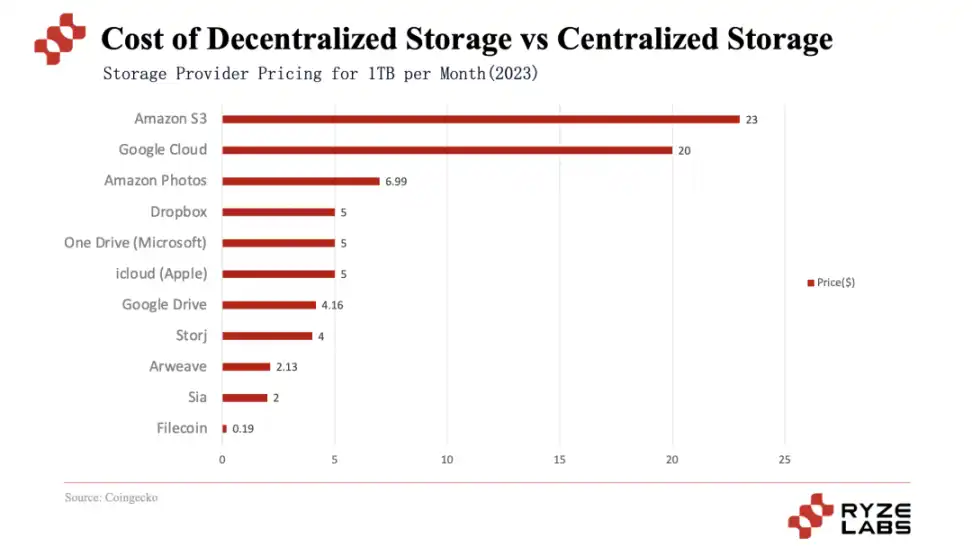
Under the condition of storing 1TB for one month, the average price of decentralized storage is less than half of Google Drive and one-tenth of Amazon S3.
In addition to price advantages, decentralized storage has higher security. Data is stored on multiple nodes, reducing the risk of single point of failure, and also has higher resistance to censorship.
Regarding data privacy, users retain absolute ownership and control over their data in decentralized storage. Users can access, modify, or delete their data stored on the network at any time. In centralized storage, however, users entrust their data to service providers, who may have some degree of control over the data. Users must comply with the service provider's terms of use and privacy policy.
In terms of disadvantages, there are many technical challenges in decentralized storage, including the efficiency of data storage and retrieval, and the reliability of nodes that need to be addressed. Compared to the high availability and performance guarantees of centralized storage, the availability and performance of decentralized storage may be affected by the participants in the network, resulting in some fluctuations that may affect the user experience.
5.2 Helium - Decentralized Wireless Network
After understanding the decentralized storage track, let's take a look at the highly anticipated decentralized wireless network project Helium. It was founded in 2013 and is also a veteran and pioneer in the DePIN track.
Why is decentralized wireless network so important? In the traditional IoT industry, due to the difficulty of covering revenue with infrastructure costs, there is no giant network supplier for IoT devices and no integrated market. The demand and difficult supply provide Helium with a soil for development in IoT.
Since the most difficult bottleneck lies in infrastructure costs, DePIN's natural advantage in this field is to share the costs by involving users in "crowdfunding" on the supply side. By incentivizing users with tokens to participate in purchasing Helium's network equipment to form a network, the supply of the network can be achieved. Its technical strength gives it a significant advantage in the Internet of Things (IoT) field. In August last year, the number of hotspots exceeded 900,000, and the monthly active hotspots in IoT reached 600,000, which is 20 times the 30,000 hotspots of The Things Network, a leading player in traditional IoT networks. (Even if today's active hotspot count has dropped to 370,000, there is still a significant advantage.)
After making progress in the IoT field, Helium hopes to further expand its network business by entering the 5G and WiFi markets. However, as shown in the following figure, Helium's performance is mainly outstanding in the IoT field, while it is mediocre in the 5G field.
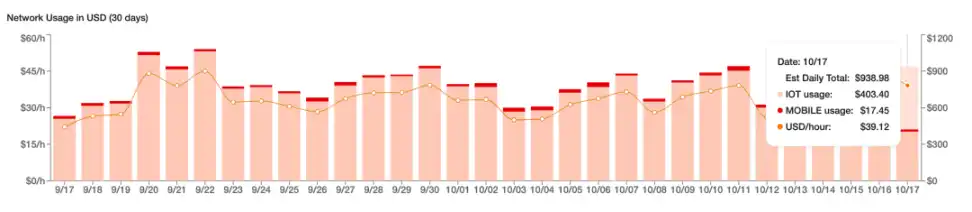
(Source: Helium official Website)
Why is Helium performing well in the IoT field but showing some weakness in the 5G field? Let's analyze it from the perspectives of market and compliance.
Helium uses LoRaWAN technology in the IoT field, which is a low-power wide area network technology. Its characteristics are low power consumption, long transmission distance, and excellent indoor penetration. This network usually does not require specific authorization and is an affordable choice for large-scale IoT deployments.
For example, in agricultural scenarios, farmers only need to monitor whether the soil humidity and temperature exceed a certain critical value to implement intelligent irrigation and crop management. Similarly, in smart city scenarios such as intelligent streetlights, trash cans, and parking sensors, there are also many development prospects.
Moreover, the IoT network market is difficult to cover revenue due to its wide coverage but low data transmission volume, and no industry giants have emerged yet. Helium seized this opportunity by combining web3 technology with IoT networks and cleverly solved the problem of high capital threshold through DePIN. By involving everyone, the heavy cost of early IoT construction can be shared among each user, thus achieving lightweight startup. Currently, some indoor and outdoor positioning devices, smart farms such as Abeeway and Agulus have started to adopt Helium, and as of August last year, the number of hotspots has exceeded 900,000.
On the other hand, Helium has been involved in the 5G market for a year, but its performance is still unsatisfactory, mainly due to the dual dilemma of compliance and market ceiling.
Regarding compliance, the allocation and licensing of frequency bands in the United States are strictly regulated by the Federal Communications Commission (FCC). The low-frequency bands of 600MHz and 700MHz, the mid-frequency bands of 2.5GHz and 3.5GHz, and the high-frequency bands of 28GHz and 39GHz all require strict review and authorization before they can be used. For example, T-Mobile, which has been authorized, uses the 600MHz band to deploy 5G, while Verizon uses the 700MHz band. As a newcomer, in order to reduce deployment costs and solve compliance issues, Helium has chosen the unlicensed CBRS GAA band, which has a slightly smaller coverage area compared to the mid-frequency band and has not shown significant advantages compared to US operators.
Regarding the market ceiling, it is worth noting that 5G is a field that is strictly regulated by national policies. Most network operators in the world are state-owned enterprises, with only a few being private enterprises with close ties to the government. Therefore, from the perspective of the large market, it is difficult for Helium to replicate its experience in the US 5G market overseas.
Additionally, the lack of transparency in collaborative equipment is also an experiential issue on the supply side. As Helium's devices are open source, different collaborating manufacturers have varying differences in performance, price, and installation processes. The opacity of performance and price is a major concern for suppliers participating in Helium, and there is also a phenomenon of merchants using second-hand equipment to fill the numbers. How to optimize the supply-side experience, balance the transparency and affordability of open source and device performance and price, is also a challenge that the Helium project needs to face.
It is worth noting that on March 27th of this year, Helium began migrating from its own Layer1 blockchain to Solana. The reasons for the migration can be summarized as follows:
The core of the Helium team's vision is to build a network. After evaluating the importance of maintaining Layer1, they decided to entrust the maintenance of the underlying blockchain to those who are skilled in this area. This allows the team to focus on the construction of the Helium network.
Choosing Solana is mainly considered from the perspective of its ecosystem. Solana has many high-quality ecological projects and developers. Helium's token HNT is natively compatible with other innovative projects on the Solana ecosystem, allowing token holders to have more use cases.
In addition, Solana's latest state compression feature can cast a large number of NFTs at extremely low cost, allowing nearly one million NFTs migrated from Helium to Solana to be cast at a cost of only $113, saving a lot of expenses. These NFTs can serve as Helium's network credentials to verify hotspots, and can also integrate the functions of the entire ecosystem, including token access control and hotspot owner access, which is very efficient and convenient.
In terms of future planning, there are many opportunities for collaboration between Solana, including Solana Mobile Stack and the upcoming Saga phone, and Helium. This is a win-win situation for Solana, which wants to enter the mobile phone market, and Helium, which wants to develop into a 5G service provider.
In the long run, Helium's exploration in the IoT field is an innovative business from 0 to 1, which has high value for meeting the needs of the Internet of Things. Although there will be many challenges in this process, with the popularity of IoT devices and the continuous expansion of application scenarios, Helium's decentralized network solution may be more widely used. It is believed that in the future fields of smart agriculture, smart cities, etc., it will play a huge potential.
5.3 Render Network - Decentralized Computing
Render Network is a decentralized GPU rendering platform. Rendering refers to the process of converting 2D or 3D computer models into realistic images and scenes. Render Network has generated a lot of buzz, particularly during the Apple Vision Pro launch event and the rise of the metaverse and AR/VR trends.
Perhaps some readers may wonder why personal computers are not enough to meet the needs of video editing and animation production, and why Render Network is needed. The reason is that for small projects such as short videos or micro-movies, the requirements for computing power are relatively low. However, for many large projects, the computing resources required for rendering are huge, and usually rely on centralized cloud service providers such as AWS, Google Cloud, Microsoft Azure, etc. However, the prices of these giants are often not cheap.
For customers, the most important aspect is pricing. Render Network uses multi-layer pricing to efficiently match the supply and demand of GPUs.
Render Network focuses on the pricing aspect that customers are most concerned about, and adopts a multi-level pricing strategy to efficiently match the supply and demand of GPUs.

(Source: Render Network Knowledge Base)
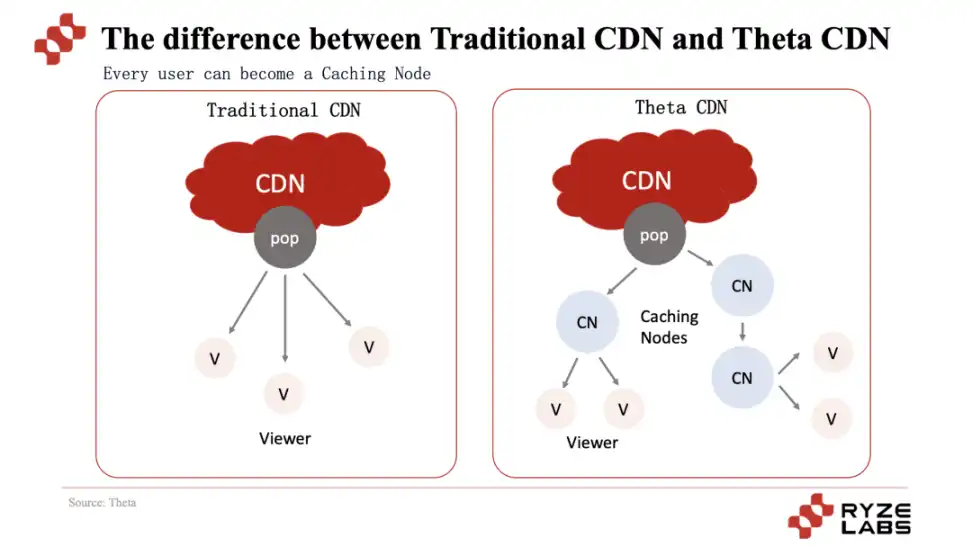
In the field of infrastructure construction, the problem of oligopoly in centralized markets was once significant. Especially in the traditional storage and computing industries, which are capital-intensive, giants such as AWS, Azure, and Google Cloud dominate the prices, and users often lack bargaining power, forced to accept high prices, and even lack real choice.
6.2 Idle resource reuse, promoting better social development

However, the emergence of DePIN provides a new solution to this dilemma. Many users hold a lot of idle resources, whether it is storage, computing power, or data. The key is how to mobilize these resources. Through incentive mechanisms, DePIN encourages users to share and utilize their resources, maximizing the utilization of resources. This includes not only data storage, computing power and other resources, but also environment-related resources. For example, React Protocol connects batteries with the power market to form a community network, helping to stabilize the power grid by connecting batteries and sharing excess electricity from users. This not only contributes to the supply of clean energy, but also provides a way for users with limited resources to earn money, which can be said to be a win-win situation. This initiative can not only reduce resource waste, but also bring more sustainable development to society.
6.3 Eliminating Intermediaries for More Efficient Money Flow
除了去中心化存储、计算和网络体现出的模式的转变和闲置资源的再利用之外,在最近一些新兴的 DePIN 项目中,发现了其想做成 web3 的美团、大众点评、滴滴等这类 O2O 项目的愿景和特点。
Translation:In addition to the transformation of patterns and the reuse of idle resources reflected in decentralized storage, computing, and networking, the recent emerging DePIN projects have discovered the vision and characteristics of O2O projects such as Meituan, Dianping, Didi, etc. to become web3.
For example, Ketchup Republic hopes to use the location relationship between consumers and merchants (using Bluetooth) to help merchants attract offline traffic. Merchants can configure their own token incentive methods for users, and can set marketing settings in terms of location, frequency, distance, etc. Compared with the incentive model of merchants-platform-users in web2 such as Meituan and Dianping, in Ketchup Republic, the merchant's marketing expenses are directly deposited into the user's pocket, thereby reducing the wear and tear of marketing expenses.
These emerging DePIN projects aim to replace web2 infrastructure projects, allowing users who provide data to directly receive payment from merchants, eliminating intermediaries.
This means that DePIN has established a decentralized ecosystem that directly connects supply and demand, enabling the direct transfer of value and faster flow of funds and resources, thereby improving transaction efficiency and transparency. This mechanism not only reduces transaction costs, but also brings more opportunities and flexibility to market participants.
DePIN's Limitations and Challenges
DePIN's track covers a wide range of categories, including storage, computing, data collection and sharing, communication technology, etc. These existing markets all present varying degrees of competitive situations. The development of DePIN also faces many limitations and challenges:
7.1 User Experience: Lack of Standards in the Early Stages of the Industry, Resulting in Poor Developer and User Experience
Currently, the development of the DePIN industry is still in its early stages and lacks complete infrastructure. Each project needs to be developed independently. In addition, the understanding and usage threshold for user participation in projects is relatively high. Users need to learn and hold tokens, as well as purchase and configure some hardware. These factors have led to a general user experience for DePIN projects in the current market. Companies need to aggregate and simplify the threshold for user participation and usage to improve network availability, in order to have more possibilities for breaking through the circle.
It is worth noting that some companies have started to build infrastructure for the DePIN track. For example, Filecoin has announced the launch of Filecoin Data Tools, a set of computing and storage technologies based on its network, to enhance the developer experience and provide comprehensive solutions for data service needs. In terms of infrastructure, IoTex is also developing tools such as the move to earn SDK, hoping to achieve some standards and consensus at the DePIN level to promote the healthy development of the industry.
7.2 Competitive Aspect: Lack of Competitive Moat
The lack of competitive moats poses a challenge to the long-term stability and development of the network. As users who provide resources, they may easily turn to other networks once more choices become available in the market. For example, in the 5G arena, Pollen has already entered and some miners from the Helium community have also started deploying Pollen's mining machines. As a decentralized mobile network provider, how to enhance its own uniqueness and competitive barriers is a long-term exploration process.
In addition, it is also very important to prevent cheating for the sustainable development of the industry. How to avoid cheating behaviors such as cluster mining cheating encountered in the Helium project and GPS location modification cheating in geospatial data-related projects is also a crucial aspect. For example, Helium has dropped from 600,000 monthly active hotspots during its peak period to 370,000 monthly active hotspots currently. It is an urgent issue to face the downturn and provide better services.
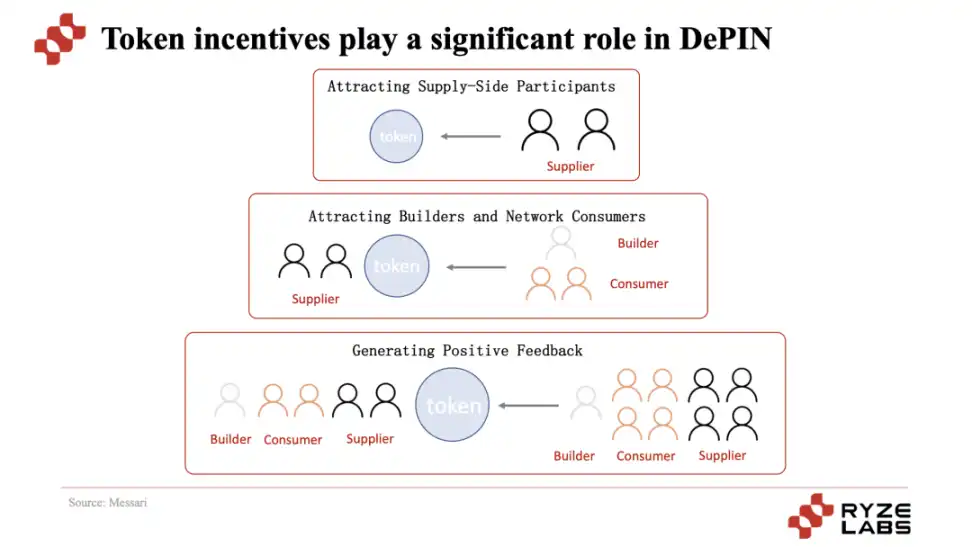
Currently, many projects attract users through token incentive methods, such as adjusting the token incentive amount from multiple dimensions such as coverage and usability. However, there has not yet been a continuously effective solution on how to continuously attract user participation and form a positive flywheel effect. There is still a long way to go in exploring this.
7.3 Expansion Level: Regulatory Compliance Restrictions
On the contrary, in the IoT field, due to the lack of mature solutions from industry giants, Helium has been given room to play. Currently, DePIN is still in its early stages. On one hand, it can try new approaches in areas that web2 has not yet solved, such as IoT networks. On the other hand, in the race where web2 has more mature solutions, such as 5G and data security, it still needs to grow together with the development of regulations, and the speed of this growth is unknown and subject to change.
When communicating with some DePIN track project parties, it was found that the common pain point and challenge is the scarcity of talent.
DePIN requires talents with comprehensive skills in the field, who not only understand the Internet of Things but also the operation of the web3 market. However, such talents are relatively scarce in the current industry.
Overall, the DePIN industry is facing many challenges in the short term, including product experience, establishing a moat, regulatory compliance, and talent shortage. However, in the long run, regardless of whether it is from the perspective of lowering barriers to entry, innovation, or utilizing idle resources and money flows, the emergence of DePIN will have a profound impact on the market. The market changes it brings will affect the supply chain, industrial structure, and the evolution of the entire economic ecosystem. As DePIN continues to develop and mature, we have reason to believe that it will become a key force that can bring real change to society, enterprises, and individuals.
Reference
https://tadviser.com/index.php/Article:ICT_%28Global_Market%29
https://www.consultancy.uk/news/1079/strategy-top-50-best-performing-global-ict-companies
https://www.linkedin.com/pulse/ict-market-2023-size-share-trends-growth-forecast/
https://www.cloudzero.com/blog/cloud-computing-statistics
https://www.peaq.network/blog/what-are-decentralized-physical-infrastructure-networks-depin
https://iotex.io/blog/what-are-decentralized-physical-infrastructure-networks-depin/
https://coinmarketcap.com/academy/article/a-deep-dive-into-depin-decentralized-physical-infrastructure
https://messari.io/report/navigating-the-depin-domain
https://www.coingecko.com/research/publications/centralized-decentralized-storage-cost
https://www.techflowpost.com/article/detail_14063.html
https://open.spotify.com/episode/0VjsMFwFgVhPifDzMYdDGv?si=e19e74774d634693
https://decrypt.co/137257/helium-completes-solana-migration-minting-nearly-1m-nfts-in-the-process
https://aws.amazon.com/nimble-studio/pricing/
https://filecoin.io/
https://www.arweave.org/
https://thetatoken.org/
https://www.helium.com/
https://rendernetwork.com/
https://www.theblockbeats.info/news/37098
https://www.odaily.news/post/5188821
https://www.odaily.news/post/5187843
https://www.panewslab.com/zh/articledetails/e2agtcx3.html
https://www.panewslab.com/zh/articledetails/jbjh40057cho.html
https://foresightnews.pro/article/detail/40042
https://www.btcc.com/zh-TW/academy/crypto-basics/theta-network-coin
Original Link
Welcome to join the official BlockBeats community:
Telegram Subscription Group: https://t.me/theblockbeats
Telegram Discussion Group: https://t.me/BlockBeats_App
Official Twitter Account: https://twitter.com/BlockBeatsAsia



