GameFi triggered heated debate among KOLs. Is it the engine of the bull market or false demand?
Original Title: "KOL Debate GameFi, Bull Market Engine or False Demand?"
Original Source: TechFlow
With the recent market recovery in the past 1-2 months, discussions have begun on which track has more potential for development.
Among them, GameFi is definitely an unavoidable topic.
From the popularity of gold farming games in the previous bull market cycle, to the emergence and difficulties of so-called 3A blockbuster games, to the current higher expectations for games to break out in the current cycle... GameFi has experienced ups and downs, but is still developing.
You can like it, hate it, but you can't ignore it.
GameFi, is it a bull market engine that brings in more users, or a pseudo-demand disguised as entertainment?
Backgrounds, experiences, and preferences vary among KOLs, who have recently engaged in a debate surrounding GameFi. The more they argue, the clearer the truth becomes. Let's take a look at everyone's respective viewpoints.
Supporters: More Funding, Better Quality, Wider Audience
Summarizing the views of KOLs on the GameFi track, it can be seen that the main focus is on the supply and demand sides of the game.
From the supply side, the first and most obvious sign that is easiest to give people a "bullish" feeling is that more money is flowing into the GameFi track.
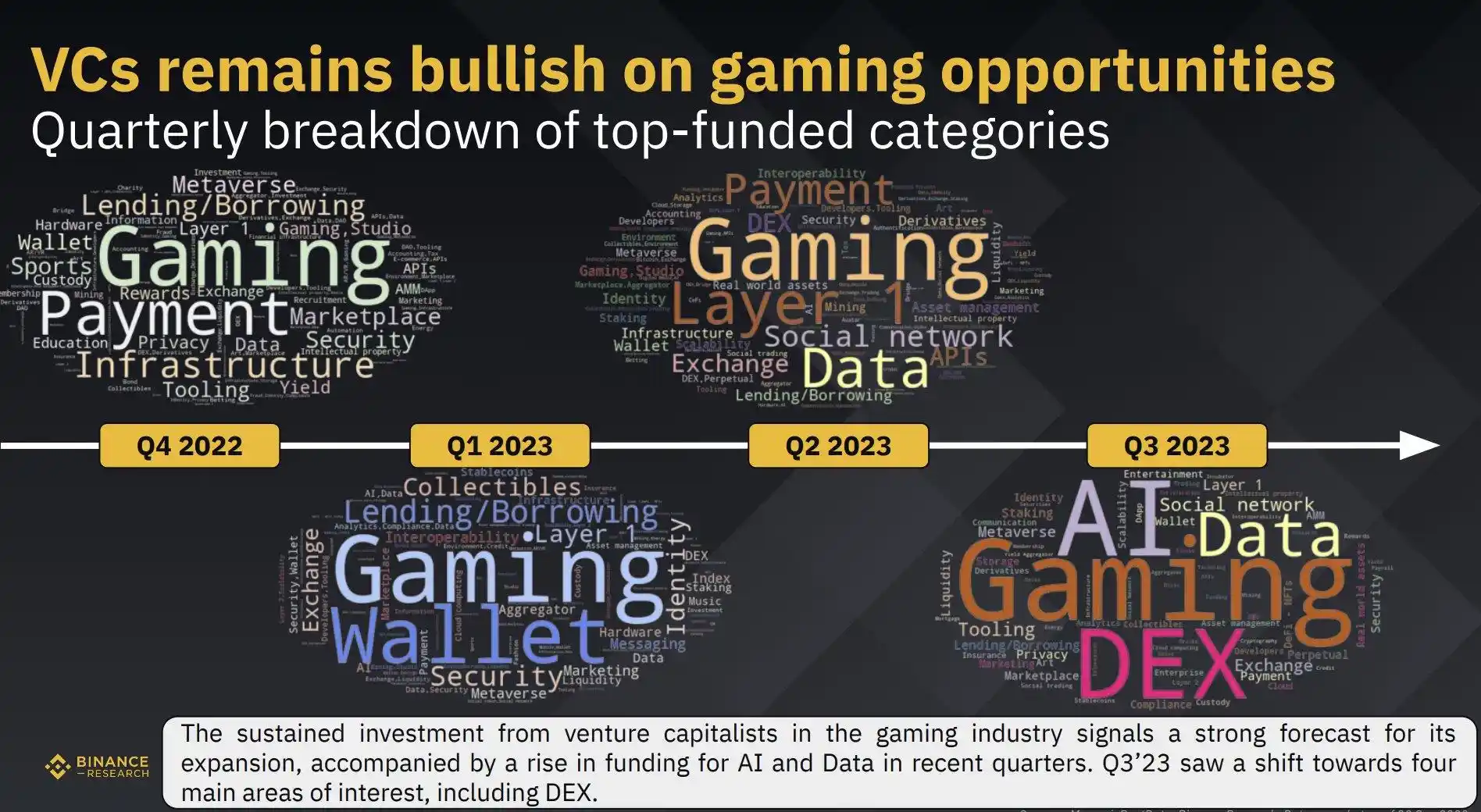
For example, according to a report from Binance Research quoted by Chen Jian (@jason_chen998), VCs have been consistently investing in gaming projects since the last quarter of last year, reflecting their optimism about the opportunities that the entire industry may bring.
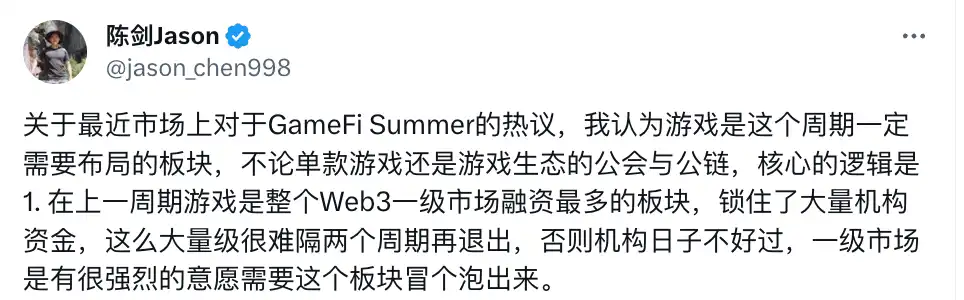
And if there is capital entering, there must be a plan for exit. Considering that the GameFi sector has received a large amount of investment capital from the primary market, major VC institutions will inevitably seek to exit and recover their investments within a reasonable time frame.
Meanwhile, it is difficult for funds to exit from sectors with no heat, because without heat there is no opponent's position. Therefore, considering the logic of investment and financing, it has become an expected thing to make a big splash in the GameFi sector.
Another significant change in the supply side comes from the replacement of concepts (narratives) and the improvement of quality.
During the previous cycle, we repeatedly heard frequent concepts such as "gold farming", "mining games", and "GameFi"; however, in the recent trend of discussing games, these past terms seem to not be mentioned much anymore.
The new narrative that replaces GameFi is "Web3 games".
Researcher NingNing (@0xNing0x) pointed out very sensitively that this year, the Western Web3 game industry has reached a consensus to use Web3 Game instead of Gamefi, which has become a taboo in the industry.
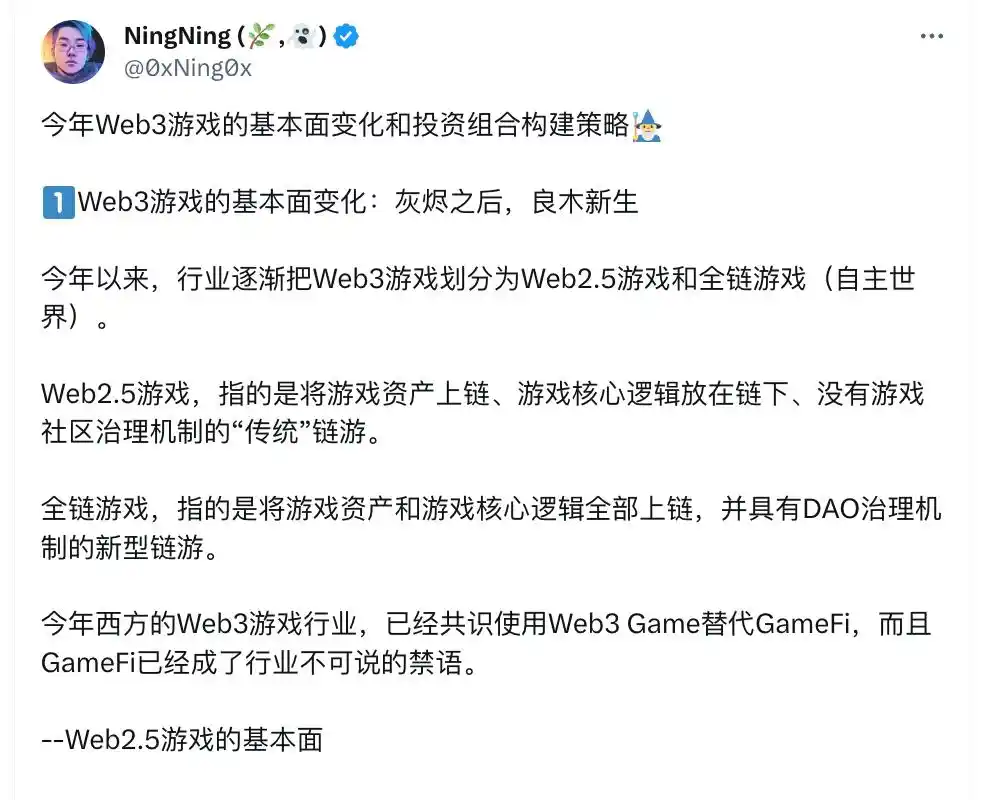
As for why it is a taboo, practitioners naturally understand without saying and will smile knowingly.
The game may still be just a game in essence, but the previous concepts and narratives have left a mess; under the packaging of new concepts, there will naturally be new gameplay and dissemination methods, which will also attract the attention of newcomers.
And this concept replacement is not just limited to paper: the exploration of full-chain games is landing, playing incompatible games in some Web2.5 games is also being properly handled, and the difficult "3A-level" games are gradually showing their high quality to the market...
Everything seems to be in a state of disrepair, but slowly improving.
In addition, on the demand side of the gaming industry, KOLs generally recognize the natural appeal brought by the characteristics of the product category --- games are entertainment products, and the threshold for attracting users to use them is naturally lower when the quality is online.
And it's difficult for you to find another category of encryption products that can self-consistently, seamlessly, and willingly experience multiple elements such as NFTs, tokens, and economic model control, and have the opportunity to touch everything about Crypto while playing.
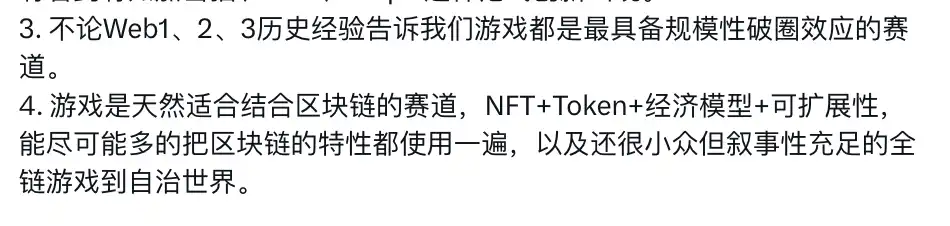
Therefore, if we must talk about breaking through the circle and taking on new demands, the gaming industry undoubtedly takes the lead.
Opposition: Acquiring and retaining customers is difficult, playing incompatible games
If the pro-support views mainly revolve around expectations, narratives, and investment, among other aspects, KOLs in the opposing camp are using more practical and concrete thinking to approach the issue.
For example, Ni Da @Phyrex_Ni clearly sees the significant difference between "game products" and "Ponzi schemes" in the current context.
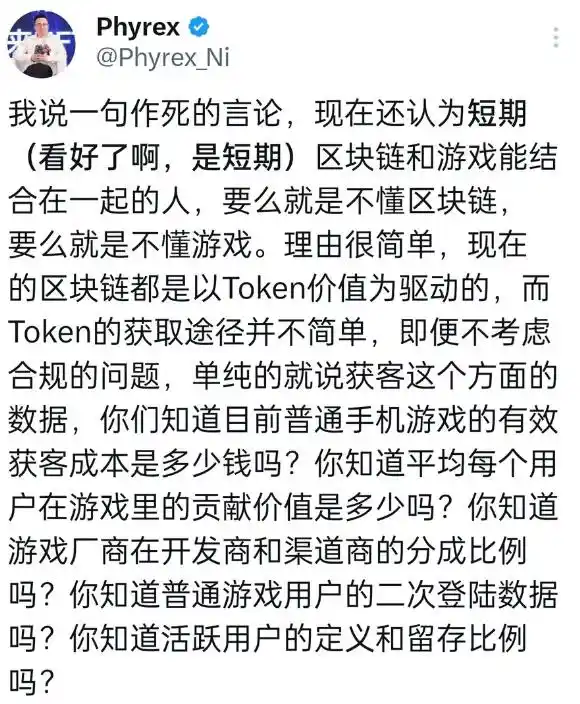
If we are to discuss gaming products, it is inevitable that we will touch upon the user's consumption of gaming content. If we view it as an internet product, there will also be classic stages such as customer acquisition, engagement, retention, and revenue contribution.
However, the current GameFi industry may have a customer acquisition cost that is 10 times higher than traditional gaming, and users do not have a sustained active curve. At the same time, the average contribution of users to game revenue is also very low.
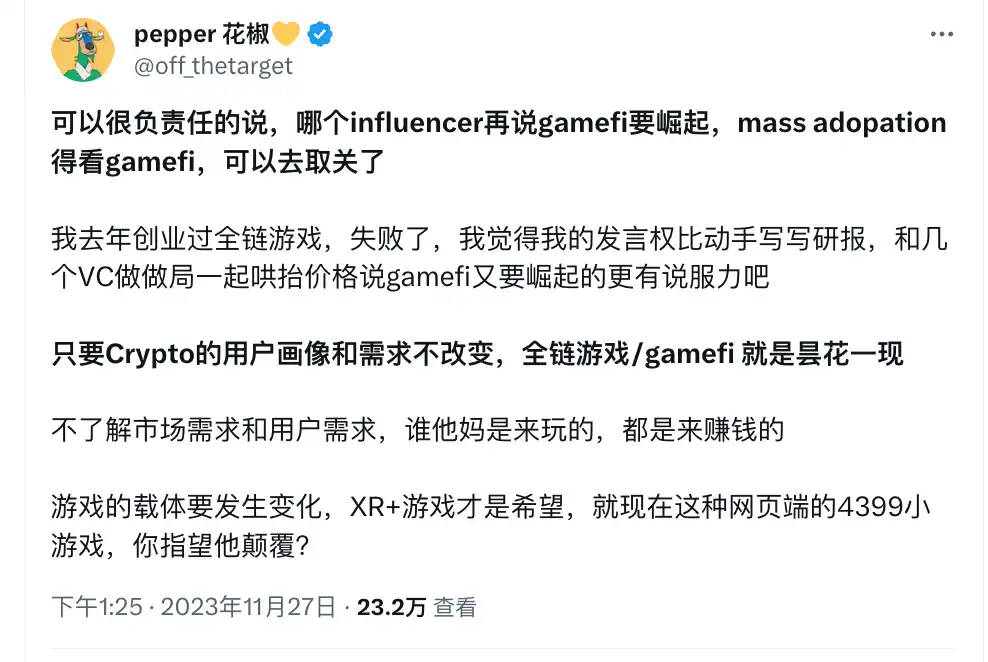
The reason behind this is that GameFi itself is not content-oriented, but rather investment-oriented with tokens. All user actions are geared towards profit, and the game is simply a tool for carrying the financial platform.
Welcome to join the official BlockBeats community:
Telegram Subscription Group: https://t.me/theblockbeats
Telegram Discussion Group: https://t.me/BlockBeats_App
Official Twitter Account: https://twitter.com/BlockBeatsAsia

 Related Articles