Analysis of the current status and technological development trends of Ethereum L2 ecosystem.
Original Title: "Analysis of the Current Situation and Technological Development Trends of Ethereum L2 Ecology"
Original Author: Ebunker
Ethereum L2 TVL hits a new high
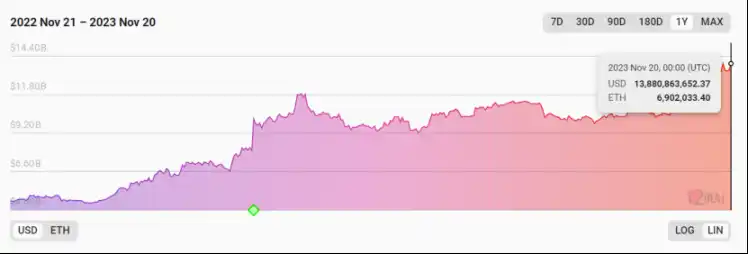
According to L2Beat data, on November 20th, the total value locked (TVL) on Ethereum L2 reached a new high of $13.8 billion. Despite some challenges in user experience and security, L2 will continue to trend upwards overall.
According to L2Beat's statistics, there are 32 different networks that qualify as Ethereum L2, including Arbitrum One, Optimism, Base, Polygon zkEVM, Metis, and more. As shown in the chart above, the TVL of L2 has been declining since April of this year until it started to grow positively after June 15th, recovering to over $10 billion. By the end of October, the TVL reached nearly $12 billion, and since then, investment in L2 applications has continued to rise, reaching the current $13.8 billion.
During the bull market in 2021, investments in the crypto industry were much larger than they are now, but the rise in L2 network TVL is even more significant than during the bull market. On November 12, 2021, when the total market value of cryptocurrencies reached a historical high of $2.82 trillion, L2 network TVL was less than $6 billion. According to CoinMarketCap data, while the total market value of cryptocurrencies has fallen by about 50%, L2 TVL has risen to $13.8 billion. This indicates that despite the current bear market, the L2 ecosystem continues to grow.
Ethereum's high gas fees during the previous bull market cycle had a significant impact on the market and users, leading to a desire for better alternatives as demand began to return. Another reason for the flourishing of L2 networks during the bear market is due to the successful marketing efforts of numerous development teams, resulting in highly active user activity and therefore higher profits. L2 networks are deploying capital to attract new users and bring new business to DeFi.
L2 faces challenges
However, L2 networks still face challenges in the field of user experience. The Optimistic Rollup network requires users to wait 7 days to withdraw funds from the official website to L1, which may lead to a poor user experience. On the other hand, the Zero Knowledge Proof network (ZK network) can process withdrawals immediately, but it is still in the early stages of development and often more prone to crashes than older L2 networks, with higher fees compared to the OP system. However, the Metis team is building a "hybrid" L2 network that allows users to choose between using the instant ZK network or waiting for a 7-day period for Optimistic Rollup.
L2 networks also face another often overlooked challenge: centralization. Although L2 solutions are becoming increasingly popular due to their enhanced scalability, they often sacrifice a certain degree of decentralization. Due to the use of centralized sequencer nodes in the transaction execution layer, concerns have been raised about potential censorship or human intervention. L2 poses a challenge to the core principles of decentralization and trustlessness in transaction execution.
Aside from the increase in TVL, the number of L2s continues to grow. Following Coinbase, on November 14th, OKX announced that they are creating an L2 network, and there are also reports that Kraken is also creating an L2 network. This expansion not only demonstrates the resilience and adaptability of the blockchain industry, but also reflects the market's relentless pursuit of improving DeFi efficiency, scalability, and user experience. The L2 ecosystem has reached a new high in TVL, proving its importance and potential in the blockchain and cryptocurrency industry. As the industry continues to develop and innovate, L2 will continue to be a key area for investors, developers, and users.
Exploring Plasma Extension Solutions Again
Ethereum co-founder Vitalik Buterin has urged Web3 developers to revisit Plasma as a scaling solution technology. Plasma aims to improve efficiency by removing most of the data from the main chain and redistributing it to a series of side chains. However, due to limitations in implementing smart contract deployment, the development of the Plasma solution is currently lagging behind competitors Arbitrum One and Optimistic rollup.
In addition, Plasma needs to sacrifice certain aspects of security in order to achieve higher scalability. Vitalik Buterin also acknowledges that "because each sidechain of Plasma is independent and responsible for its own security, it makes it more vulnerable to hacker attacks." In contrast, Rollup publishes all information about executing transactions on the main chain, making it more secure than Plasma.
However, Vitalik Buterin claims that Proof of Stake can help overcome the limitations of Plasma, and the achievements of ZK-EVM this year make it an excellent opportunity to explore the design space of Plasma again. In fact, Polygon proposed a proposal at the end of June this year to upgrade the POS network to ZKEVM validium. While acknowledging that rollup is the "gold standard" in scaling solutions, Vitalik calls for a re-examination of Plasma technology because of its advantages in throughput and cost-effectiveness.
Account abstraction will be integrated into the Rollup ecosystem
Recently, the Ethereum network is integrating account abstraction (AA accounts) into its rollup ecosystem. The proposal was put forward by Alexander Forshtat of the Ethereum Foundation and is listed in the "Roadmap for Local Account Abstraction Introduction: Local Account Abstraction". This proposal marks Ethereum's first attempt to incorporate AA accounts into its L2 solution.
The account abstraction aims to seamlessly integrate user accounts and smart contracts, enhancing the overall functionality and user experience of the Ethereum network. The account abstraction extends to EVM rollup, which is significant for unifying the L1 and L2 environments, creating a more cohesive and efficient ecosystem. This integration is particularly important for the Web3 field of Ethereum, as it is expected to simplify operations and promote ongoing ecosystem development.
To successfully implement the AA account in rollup, major modifications need to be made in three areas, including changing the entry point address, rewriting the ValidateUserop function, and enhancing transaction logic. In addition, Paymaster operations and signature aggregation technology are also required. After the implementation of the "Account Abstraction" ERC-4337 on the Ethereum mainnet, this integration will also create new validation code restrictions, Staking protocols, and reputation systems.
From the extensive feedback and contributions on the project's GitHub page, it is evident that the Ethereum community has shown great interest in this development. The author of this proposal also emphasizes the importance of community involvement in the standardization process of local account abstraction, and this collaborative approach is crucial for the adoption and efficiency of the AA project on L1 and L2 networks.
In March 2023, Ethereum demonstrated "Account Abstraction" ERC-4337 on its mainnet. Account Abstraction can facilitate the convenience of Ethereum wallet transactions on the blockchain, enabling them to conduct smart contract transactions. This paves the way for new smart contract account Ethereum wallets and is expected to completely change the landscape of Dapps.
Integrating AA accounts into the Ethereum rollup ecosystem can be seen as a crucial move, which is expected to enhance the scalability and functionality of the Ethereum network. The plan will simplify the interaction between on-chain accounts and smart contracts, providing users with a more friendly and efficient experience. The active participation of the Ethereum community in the development process reflects its importance and potential impact on the wider blockchain and cryptocurrency field, as well as its commitment to promoting an inclusive and collaborative environment for innovation. As Ethereum continues to evolve, its role in shaping the future of blockchain technology and decentralized systems remains undisputed.
Welcome to join the official BlockBeats community:
Telegram Subscription Group: https://t.me/theblockbeats
Telegram Discussion Group: https://t.me/BlockBeats_App
Official Twitter Account: https://twitter.com/BlockBeatsAsia
 Related Articles