Zee Prime Capital: "The wedge" is the founder's advantage.


Original Title: "Wedge is the Founder's Edge"
Original Author: Rapolas
Translation: Joyce, BlockBeats
Editor's note:
Zee Prime Capital introduces the concept of "wedge" in this article, discussing how successful projects/companies such as Uniswap, Blur, and Amazon in the Web2 era break through their own "wedge" by starting from a smaller scenario or user group, and then continuously expanding, covering adjacent markets, and gradually achieving a monopolistic market size. What are the potential "wedges" in the cryptocurrency field? How should project parties view the volatility of their native tokens? Zee Prime Capital provides its own views in this article, emphasizing the need to distinguish between "means" and "ends" when starting a business in the crypto field.
Why You Should Never Aim to Capture 1% of a $1 Trillion Market
For founders, there is nothing more self-destructive than presenting a slide with unlimited TAM potential. Anyone who claims their TAM is "everyone on the internet" or "every smartphone user" indicates that they have not thoroughly understood their target market.
Every market is composed of finer-grained markets; if you are an early-stage startup, you are likely able to articulate the niche market your product serves on day one. That's why we say that building a product that appeals to everyone means it appeals to no one. Every successful product must either be a novel idea or have a unique approach to executing a tested idea; therefore, most users will likely ignore it at first.
Occupying 1% of the $10 trillion market (although not yet existing) is a tempting $1 billion wish, but without a unique value proposition for the submarkets of this giant market, it sounds like boarding a flight that has already taken off. You must find a smaller plane (or jetpack) - your own "wedge".

Zee Prime Wanted: Founder of "Wedge" jetpack product
Blockchain has a "prologue"
The mainstream cryptocurrencies or blockchains that we know today began with the whitepaper of Bitcoin. This was a protest against the current banking and monetary system. The proposed P2P payment system without centralized intermediaries is an elegant solution to a very specific problem.
Bitcoin has already validated its original purpose of payment, but the underlying blockchain technology later inspired broader ideas. If the original white paper of Bitcoin also proposed to launch financial primitives, social networks, games, and art on the blockchain, it would have nowhere to go. The idea of blockchain itself has caused skepticism; using blockchain to solve all imaginable problems will raise the standard of execution unimaginably.
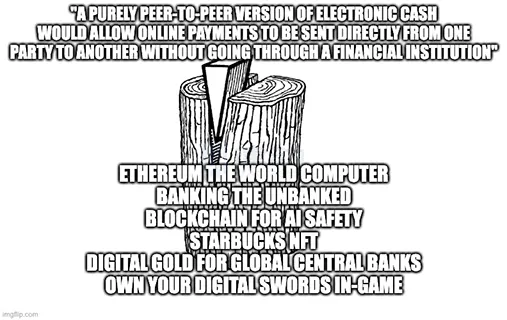
If you take a look at the on-chain applications, you will find that they have grown and survived to this day by solving a very narrow problem (or even something that doesn't seem like a problem) that is important to a small group of users. Few people can identify the problems they encounter and come up with a specific solution (if they did, these problems would have been solved long ago).
Of course, the mystery is that we cannot reason why or how this problem is related to many people from being related to a few. In some cases, excellent products will specify the problems that consumers need to solve. Before seeing a car, you cannot imagine driving a car (then your problem becomes buying a car), nor can you imagine using a full touch screen phone perfectly before getting one.
This is why establishing and investing in enterprises is so non-normative and often inspired by science fiction. The founder's intuition helps guide and bet on specific outcomes; when this intuition is lacking, people resort to solving abstract problems for a large group of people, with little in common between them.
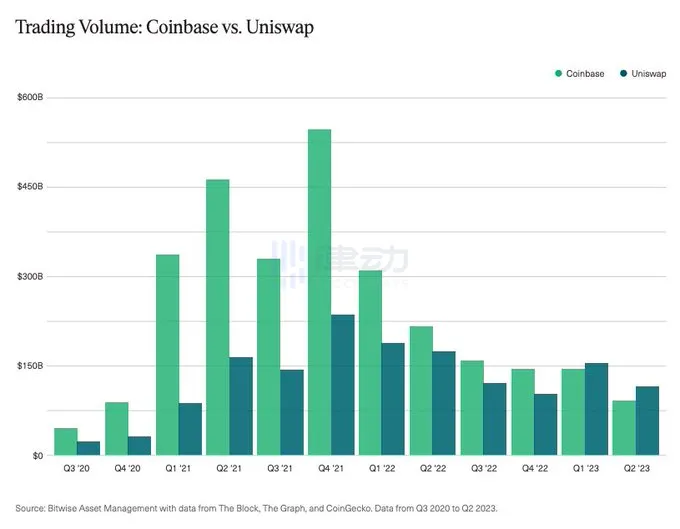
Uniswap processes nearly $1 billion in daily trading volume, giving people reason to view it as a competitor to centralized exchanges. However, it is actually an inferior trading product, and if its claim is "trading, but on-chain," it will not succeed.
Uniswap V1's "prologue" allows for permissionless liquidity provision (and trading) for long-tail tokens, something that market makers and centralized exchanges cannot provide, but is necessary for industry pioneers. Even the term "liquidity provision" is now primarily associated with Uniswap, much like "Google" is synonymous with search.
Once this "narrow" issue is resolved and an on-chain usage model is established, Uniswap can capture adjacent markets typically traded on centralized exchanges (such as ETH) and mitigate the shortcomings of AMMs to the fullest extent possible (e.g. by providing centralized liquidity).
This is not about creating a perfect product for everyone. It's about solving someone's problem (or specifying a problem, as mentioned earlier), and then using that momentum to expand into adjacent areas when iterating the product. Now, Uniswap's trading volume in 2023 has surpassed Coinbase:
Although the comparison between Blur and Opensea is not very popular nowadays in the encryption industry, we believe that Blur has done a good job in identifying two insights, which enables it to occupy a place in the market mainly dominated by Opensea:
NFT investor market is not unified. There are clear differences between collectors (passive holders who accept low liquidity and fees) and traders (active participants seeking higher liquidity and lower fees). Opensea caters to the needs of the former but sacrifices the interests of the latter - there is an inherent conflict between the two.
The incumbent did not utilize tokens. Tokens themselves are a product that is more inherently encrypted than any other product.
If Opensea's target users are artists and collectors, then trading volume may not be the perfect or only indicator of market success; on the contrary, if Blur's target users are traders, then trading volume is more crucial because it depends on available liquidity. This is exactly what Blur aims to achieve through token rewards for market making (providing bids and asks).
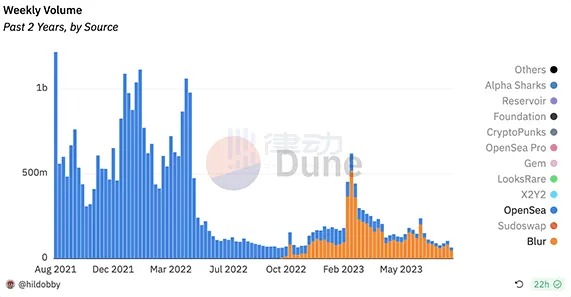
Although some people criticize Blur for primarily serving a small group of advanced users (i.e. 500 whales), it's not a bad thing if these whales are fashion creators. In fact, building for a few interested people can: a) validate product ideas and deliver quickly; b) achieve outstanding marketing results.
Due to Blur's deep market liquidity, it allows for the launch of a closely related product - Blur Lend or Blend - which is a lending market that uses NFTs as collateral.
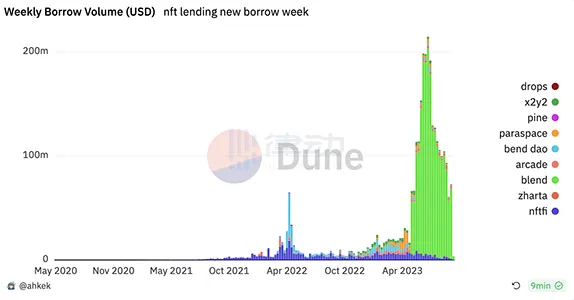
Small markets discover big markets
The above example shows how successful companies create their own monopoly markets. They escape competition by breaking through the "wedge". Uniswap does not compete with Binance on the same axis; Blur does not compete with Opensea for the same users; blockchain does not compete with the "Internet" or tradfi institutions - blockchain is its own thing, with unique properties.
Blake Masters explained the concept of Thielism. He elaborated on this more extensively.
"The usual argument is that capitalism and perfect competition are synonymous. No one is a monopolist. Companies compete and profits are fought over. But this is a strange narrative. A better perspective would be to view capitalism and perfect competition as opposites; capitalism is the accumulation of capital, while the world of perfect competition is one where no money can be made."
The contradiction is that in perfect competition, companies start with a very broad scope, but immediately narrow their market scope in pursuit of differentiation (even if narrowing the scope is not what they are actually doing). However, if they do not participate in the market of perfect competition, but start from their own (small) market, they can only grow, not shrink.
Therefore, the best companies are those that can tell a fascinating story about the future. These stories may differ, but they share a common form: find a small target market, become the best in the world at serving that market, capture adjacent markets, expand the scope of what you're doing, and capture more markets.

Reverse "wedge" is prevalent in perfectly competitive markets

Initially just an internal project, it eventually led to the launch of AWS and a whole new market - the cloud. In 2022, annual spending on cloud services will reach $5 trillion, according to Computerworld. However, when AWS was launched in 2006, Amazon employees did not fully recognize the potential behind their idea. It was their own market, with many unknown factors that were not worth quantifying.
Despite the popularity of renewable energy and renewable energy investments since the 2000s, their "wedge" has always relied on government subsidies through tax credits. Supporters of climate change will claim that the "wedge" is for environmental reasons, but try arguing that point to those who struggle to pay their energy bills. For a long time, renewable energy itself was not economical (even with subsidies):
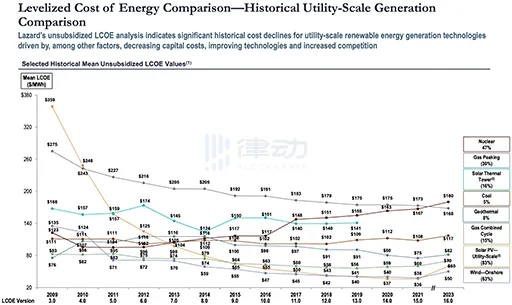
In the 2000s, renewable energy was no longer a secret - the power of wind and solar energy had been understood and used by people for thousands of years (vertical axis wind turbines and concentrators). The industry was developed under government initiatives and budgets, which encouraged the private sector to further develop panels and turbines, to the point where unsubsidized renewable energy is now competitive in some cases.

Source: Lazard's Annual Levelized Cost of Energy Report
We want to point out that cheap and hollow blockchain is somewhat similar to uneconomical and subsidized renewable energy. Just like renewable energy, there are no obvious barriers except for subsidies, and it is hoped that costs will eventually come down. Most of the currently developed blockchain infrastructure relies on the same premise - a large amount of venture capital and a predicted decrease in transaction costs. But what if consumers accelerate development progress under external pressure?
The price of blockchain has been cheap enough and has lasted long enough for the product to be showcased (and it has been showcased more than once in the past). If you are a founder who thinks that your crypto product will be adopted once the aggregated transaction cost is $0.01 instead of $0.10, then you may be looking in the wrong direction. Applications on Solana and NEAR can cover hundreds of thousands or millions of users, regardless of what Ethereum aggregation does.
Cryptocurrencies have two directions: one is anti-censorship and private currency/payment (which has been successful but difficult to scale); the other is to create global online wealth through technology. Cryptocurrencies have a huge "wedge" in the latter - it is the volatility of every new asset and the easy liquidity available (unlike the real world). It is similar to the wave led by low-priced stocks, tech stocks, poker, sports betting, and other forms of speculative activities earlier.
In the encryption industry, we have ICO, NFT, ERC-20 tokens, LBP, and the recent friend.tech stock. Don't hate the player, hate the game. This is not the destination, but the means to achieve the destination.
Volatility has won founders time and user attention. In many ways, it is akin to a customer acquisition tool. The best cryptocurrency founders leverage this momentum to test and release killer products while managing pressure and ever-expanding expectations. However, the volatility of your native token should not be the default assumption - there are other speculative means that will not undermine the long-term product-market fit discovery (consider the rise of Uniswap, Aave, and Maker, all of which have speculative elements, but the success of a project does not necessarily require the protocol's native token to have speculative properties).
Conclusion
There is no one-size-fits-all method for finding and executing great ideas. We are not sure if secrets are created or discovered, we do not know if your product should solve someone's problem or "create" a problem for someone, and we cannot determine if first-mover advantage is more important than later-mover advantage.
But one thing is clear - success requires progress, and progress is achieved in order (although sometimes unexpectedly), with major discoveries preceding smaller ones. "Wedge" is crucial for finding the right users for the right product (product-market fit); "wedge" is not about casting the widest possible net, but about allowing interested users to test product ideas together.
We have proven through countless examples (whether in web2 or in the encryption industry) that the success stories desired by new founders all start from small, obscure ideas. Founders cannot predict path dependence on the first day; at the beginning, they cannot see all the adjacent markets on the distant horizon. It is the "proximate possibility" that allows enterprises to identify and merge new markets during the development process.
We hope to see cryptocurrency founders start using "wedge" as their default buzzword from now on (just like they used super apps this year).
原文链接 translates to "Original article link" in English.
Welcome to join the official BlockBeats community:
Telegram Subscription Group: https://t.me/theblockbeats
Telegram Discussion Group: https://t.me/BlockBeats_App
Official Twitter Account: https://twitter.com/BlockBeatsAsia

 Related Articles