Track the "fake data" on the chain and understand the hair-raising party and the hair-raising industry

Original Title: "Follow the (fake) Data: Understand the 'airdrop farming stack' and the industry around it"
Original Author: Kerman Kohli
Translated by: Kaori, BlockBeats
Summary: As long as the cost is lower than the potential reward, airdrops will prevail.

One thing that has increasingly troubled me in the past few years as a practitioner in the encryption industry is the growing reliance on "data". I put it in quotes because much of it is fake or not genuine. In order to demonstrate what is happening and how it works, I think I should write a longer article on the whole issue.
When I started researching this article, I realized how industrialized the whole thing was and how many investors were fooled by it. The whole thing is a big joke, showing how far the entire industry has to go.
Layer 1 Valuation
Our problem began with these overpriced, overhyped tokens that investors were willing to pay billions of dollars for. All you needed was a fancy whitepaper and some twisted unit economics to make it all work. My research started with Dune, where I found this dashboard calculating the CAC for multiple airdrops.

This is a good start, although I do want to point out that these CACs (from a project perspective) are undervalued figures because they are simply: dollar value ($) / claimed address. This calculation does not take into account the actual percentage of airdrop retained. Given that typically only 10%-20% of addresses hold the airdrop, it is safe to assume that these CAC figures are 5 to 10 times higher than what you see above.
The second thing is that we have an implicit airdrop value ranking:
Layer 1 / layer 2 / hyped protocol = thousands of dollars in expenses.
Small and medium-sized applications = spending of hundreds of dollars.
Fortunately, the two are not mutually exclusive! If you use the correct application on the correct chain, you will receive two airdrops.
Therefore, ideally, you would want to focus the airdrop primarily on-chain and then interact as much as possible. Well, but what happens next?
Looking for suitable airdrops
Luckily, for you as an airdrop hunter, there is already an entire industry built specifically for finding airdrops. Typically, these airdrop discovery websites require you to perform very specific "actions" and need evidence on-chain that you have performed these actions. Whether it's your grandmother or your robot performing the actions, just make sure the transaction is visible on-chain.
All of these "task" platforms are actually disguised airdrop discovery websites. If these websites can attract high-quality users, there is usually no problem, but the users attracted by these websites are often highly hired, representing the short-term speculation suffered by the industry as a whole.
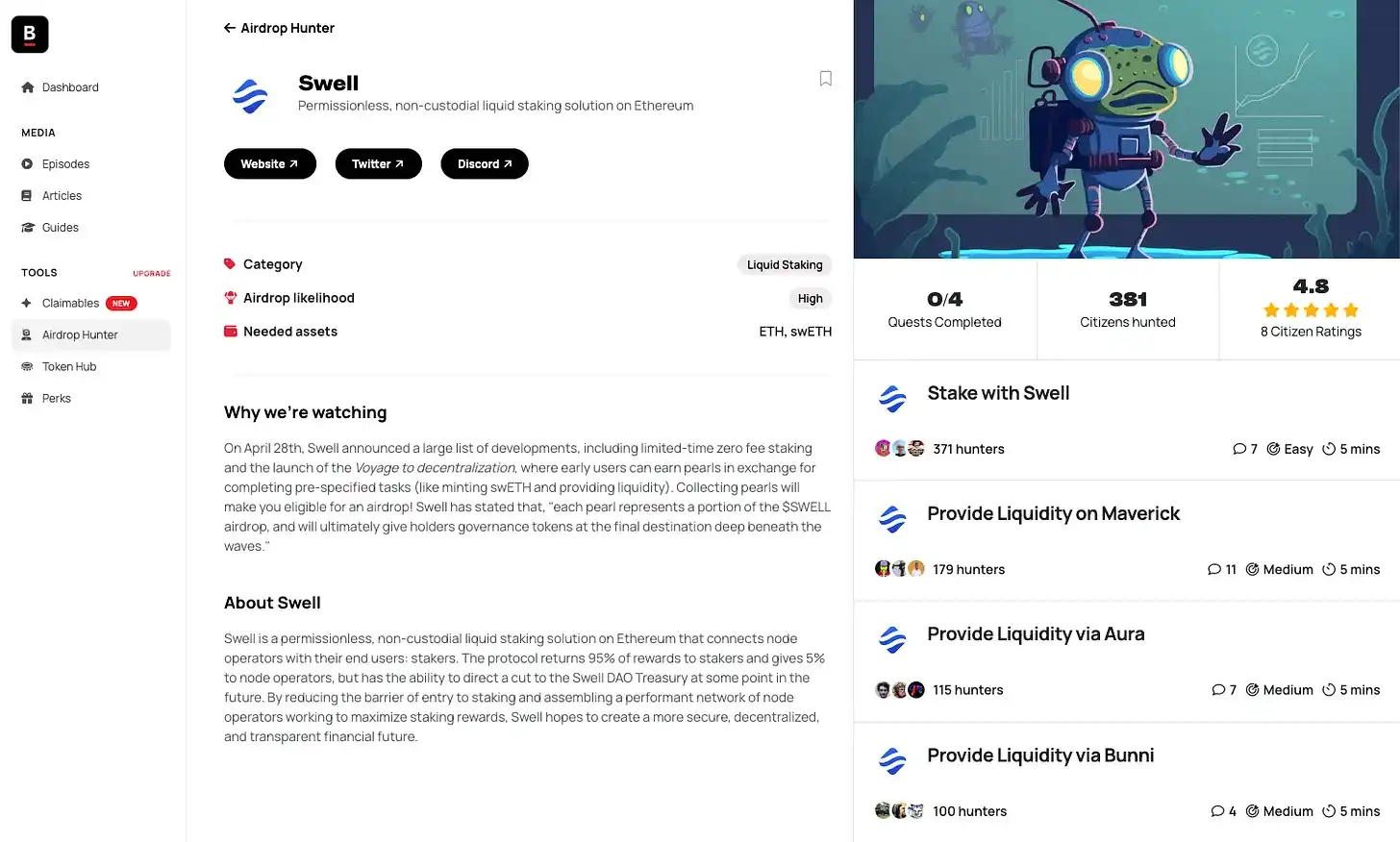
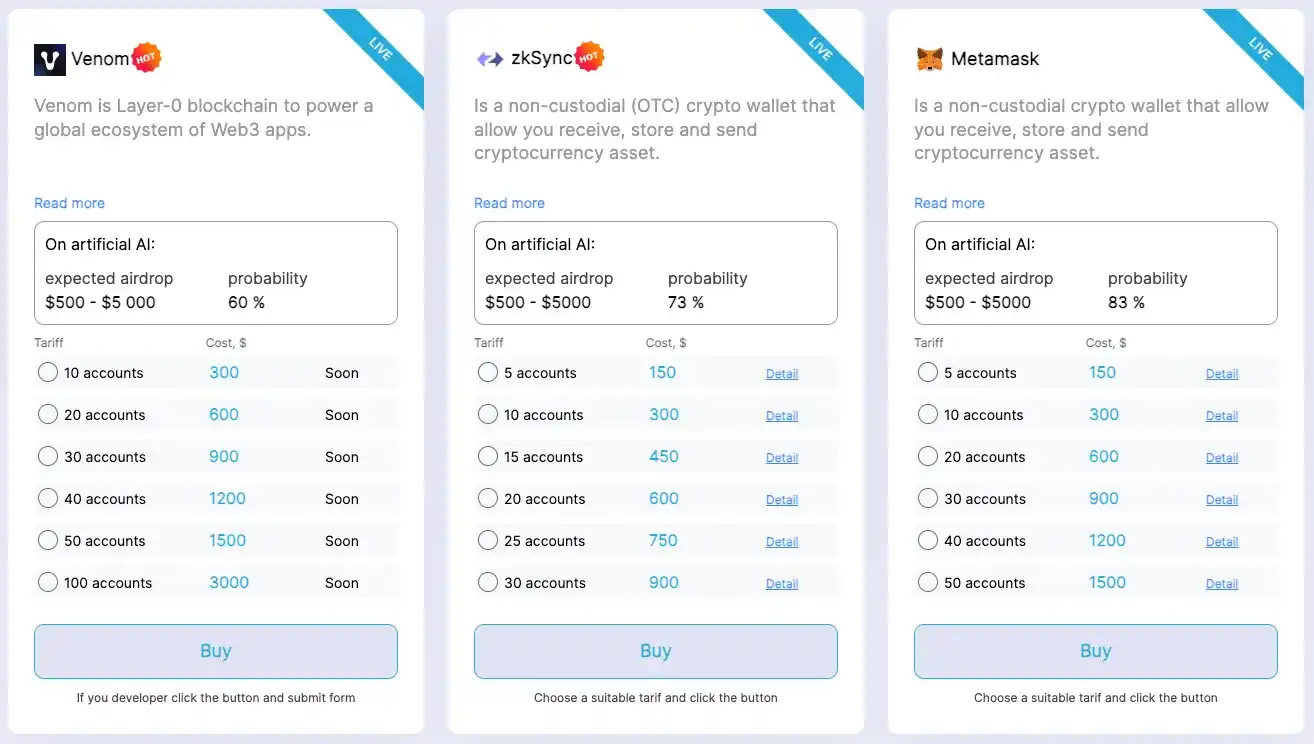
Let's reach out to our trusted friends at dApp Radar and see what airdrop activities may be happening at this time.

Based on this, my game plan is likely to be:
· Using zkSync as my underlying chain.
· Layer Zero bridges my funds.
· Metamask serves as my chain wallet.
All of this may just be part of my natural workflow, without any extra work required. But the question is, what do you need to do to understand your ranking in these potential airdrops? What surprised me is the emergence of an entire community made up of "airdrop simulators". These people exist to help you understand your status relative to other airdrop farmers. Simply search for "airdrop" and you can find a dashboard that simulates how projects distribute airdrops using past airdrop standards.
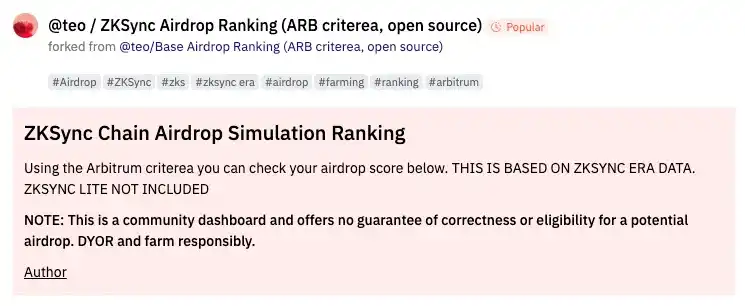
The fascinating thing is the level of detail depicted. Check out all the columns mapped in this table. Any fractional score, last transaction time, transaction count, unique contract, total USD amount traded, unique active days/weeks/months, wallet age, and block time.

When your "community" has already completed the airdrop calculation for you, why bother with the airdrop calculation yourself?
Playing with Systems
If you are surprised by the planning of the whole thing, wait until you see the next part: if you know all the arrangements and combinations for standard things, then you can start automating and building efficient systems around it. I spent some time researching and found these two magical tools. You may want to try it out just to report how corrupt the entire airdrop game is.
The first is our friend at nftcopilot.com, who has built a flexible dashboard for you to automate and set up your farm.
It is amazing how deep and detailed their association is. In the product, you can create "groups" and customize the following parameters:
1. The number of transactions through bridge routing.
2. Bridged networks (Ethereum, Polygon, Binance Smart Chain, Arbitrum, Avalanche, Optimism, Metis, Aptos).
3. The randomly generated configurations include the probability of configuration opportunities, sleep intervals, and the maximum number of random transactions per transaction.
Welcome to join the official BlockBeats community:
Telegram Subscription Group: https://t.me/theblockbeats
Telegram Discussion Group: https://t.me/BlockBeats_App
Official Twitter Account: https://twitter.com/BlockBeatsAsia

 Related Articles