Building "true BRC20" assets on the Bitcoin network, what is the technical implementation logic of Lightning Network's Taproot Assets?

Original author: Haotian (@tmel0211)
Last night, Lightning Labs released the Taproot Assets mainnet alpha version, which means that stablecoins and other assets can now be built on the Bitcoin network. These assets are completely decentralized and are controlled by the programmable features of the Bitcoin Script script, and will ultimately be implemented through the Lightning Network. At first glance, it seems that Bitcoin has ushered in a true BRC20 era?
So, what is the technical implementation logic of Taproot Assets? What is the difference between it and BRC20 on Ordinals? Will it bring another wave of new BRC20 token issuance frenzy? Next, let's objectively interpret these questions with doubts.
Technical Implementation Logic
In the previous article about BitVM, I introduced the limited but achievable programming capabilities of Bitcoin, which is to write "simple code" in the Script script of Taproot addresses and execute it as a UTXO spending condition instruction.
In the asset issuance scenario of Taproot Assets, this simple opcode can be specified as the total amount of tokens issued, the issuance time, the issuance object, and other rules. A set of multi-signature addresses can be used to jointly trigger the opcode. Assuming that a user at address A generates a multi-signature address B and plans to issue 10,000 USDT to address C using address B, then address A can be considered as the project owner of USDT assets on Bitcoin, and address C is the first holder to receive USDT.
The successful issuance of Token requires the signature trigger of address A. After that, if address C wants to spread the assets to other addresses using transfer logic, it also needs to be triggered by the signature of address A. You may ask, if address C wants to spread Token to thousands of addresses, can't it queue up and wait for the signature of address A? Good question, the key is here. Address C, as the receiving address of assets, is usually issued on the Lightning Network, which can be highly efficient, low-cost, and interacted multiple times between the two addresses that have established a bidirectional channel.
Originally, the Lightning Network only supported point-to-point scenarios, but the new Taproot Asset enables point-to-multi functionality, allowing a payment to be forwarded to multiple receiving addresses within a single transaction channel. The script can transfer assets to multiple addresses based on conditions. This allows tokens issued to address C to be distributed to a large number of addresses using the Lightning Network, ultimately achieving decentralized ownership of assets. This closed-loop technology for issuing tokens on the Bitcoin network has been successfully implemented.
Moreover, C addresses can be managed and distributed by different relay nodes according to rules for accounting execution in the Lightning Network. For example, an owner can distribute their USDT tokens to 10 relay nodes, each acting as a CEX hot wallet address for secondary distribution and accounting management.
As a result, within this logic, the joint action of Owner, issuance condition address, receiving condition address, multi-signature trigger control, efficient and trustworthy distribution network, and other necessary components, a complete accounting system that can realize decentralized asset issuance, management, and distribution has emerged.
"True or False" BRC20?
The logic of Brc20 appearing on Ordinals is to define asset circulation rules by implanting json data packets in the Scrip script and writing parameters such as Mint and Transfer in the data packet, and the interpretation right is ultimately determined by the third-party Ordinals protocol. Throughout the process, Bitcoin network knowledge is passively made into a data memorandum and does not participate in verification calculations, nor can it determine asset ownership disputes. Even in processing transfer logic, there may be bugs, and users become the main force of asset minting and transfer without project parties, empowerment, and liquidity.
Compared to Taproot Assets, the discovery of multiple assets is more advanced. There is an Owner for the project, and the issuance and destruction of assets can be determined by the True or False operation codes in the Script script. The subsequent circulation of assets is supported by the Lightning Network with trusted technology, and the Lightning Network itself is a high-frequency circulation application scenario. It cannot be said absolutely, but compared to Taproot Assets, the multi-asset network supported by it is more like the "new" token standard that geeks find very sensible. (Note: Only the technical logic difference is distinguished, and market factors such as hype logic and scarcity profit effect are not within the scope of this topic.)
New BRC20 Token Issuance Craze?
Perhaps, at this moment, many people have started to imagine whether the prosperity of the previous Ordinals can be replicated now that the true BRC20 token has arrived. In theory, it is possible, but I personally believe that the system engineering of Taproot Assets is stronger. However, it is not so easy to establish a complete project because of its multi-signature system, issuance and transfer logic, especially the cost and threshold of accounting management and operation on the Lightning Network. Unlike Ordinals, which only needs to send one transaction to issue tokens, the difficulty of replicating BRC20 is higher. On the contrary, the Lightning Network is naturally a scene suitable for high-frequency consumption landing, so the best tokens for Taproot Assets to issue are stablecoins such as USDT and USDC.
Obviously, the Lightning Network officials also emphasized the stablecoin's statement. As for other project parties who insist on abandoning the more advanced Ethereum EVM smart contract and deploying other tokens on Bitcoin, it is also possible as long as the project party is willing to do so and the market is willing to accept it. Following the inherent conditions of the Lightning Network payment scenario, the only vision I can think of is that tokens suitable for payment can be used in this way. As for those POS Staking tokens, it's weird to play like this. (If any, various gameplay such as DEX, Lending, derivatives, etc. can also be realized, depending on whether someone is willing to implement it at a high cost.)
Above.
To be honest, I prefer to describe Taproot Assets as the multi-asset era of Bitcoin. Comparing it to BRC20 is just for the sake of convenience and highlighting its innovation. Whether Taproot Assets will be used to start a new narrative in the upcoming market remains to be seen, although it has the potential and conditions to do so. However, regardless of whether the Taproot Assets market is hyped or not, there are two visions worth looking forward to:
1) Stablecoins such as USDT will re-enter the Bitcoin network and become the mainstream currency in Lightning Network applications. It is worth expecting whether they can regain the position of stablecoin leader from TRON's BitTorrent.
2) The widespread adoption of Lightning Network's complementary wallet applications and offline payment channels will bring a wave of growth in data, which will be a turning point for the Lightning Network. Whether this will have a stimulating effect on social platforms related to potential Nostr is yet to be seen.
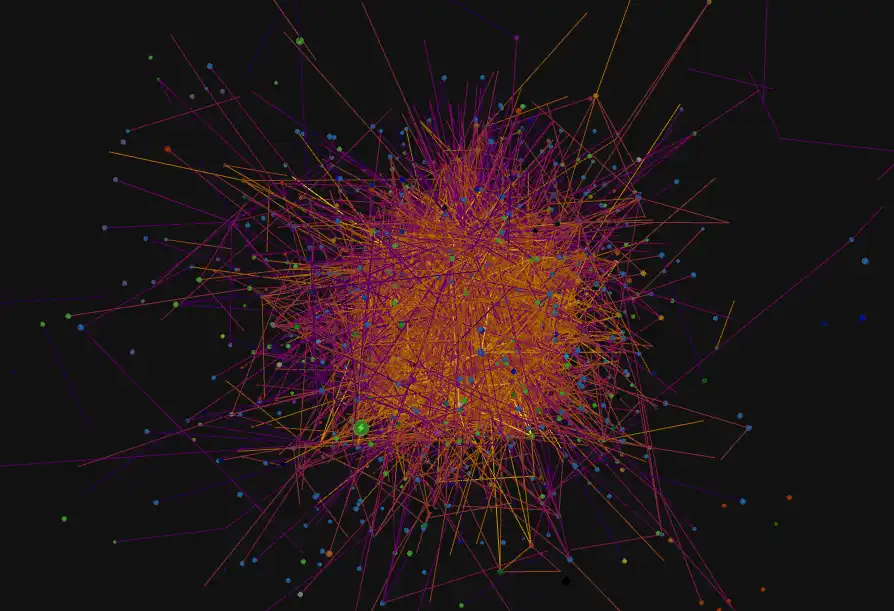
Note: The illustration shows the global distribution of lightning network channels at present.
Welcome to join the official BlockBeats community:
Telegram Subscription Group: https://t.me/theblockbeats
Telegram Discussion Group: https://t.me/BlockBeats_App
Official Twitter Account: https://twitter.com/BlockBeatsAsia

 Related Articles