What’s New in the Bitcoin Ecosystem | Nostr Assets airdrops big coins, what is the Atomcial protocol? Bitcoin inscription returns to spring?

Written by: Jaleel, Luccy, BlockBeats
According to Tradingview data, the BRC20 price is on an upward trend, with ordi's increase reaching 38.87% this month. Currently, the trading volume of $SATS has reached 21,388,827, far ahead of other BRC20 projects that have broken trading volume records. As of October 28th, the following is the ranking of BRC20 projects with the highest trading volume.
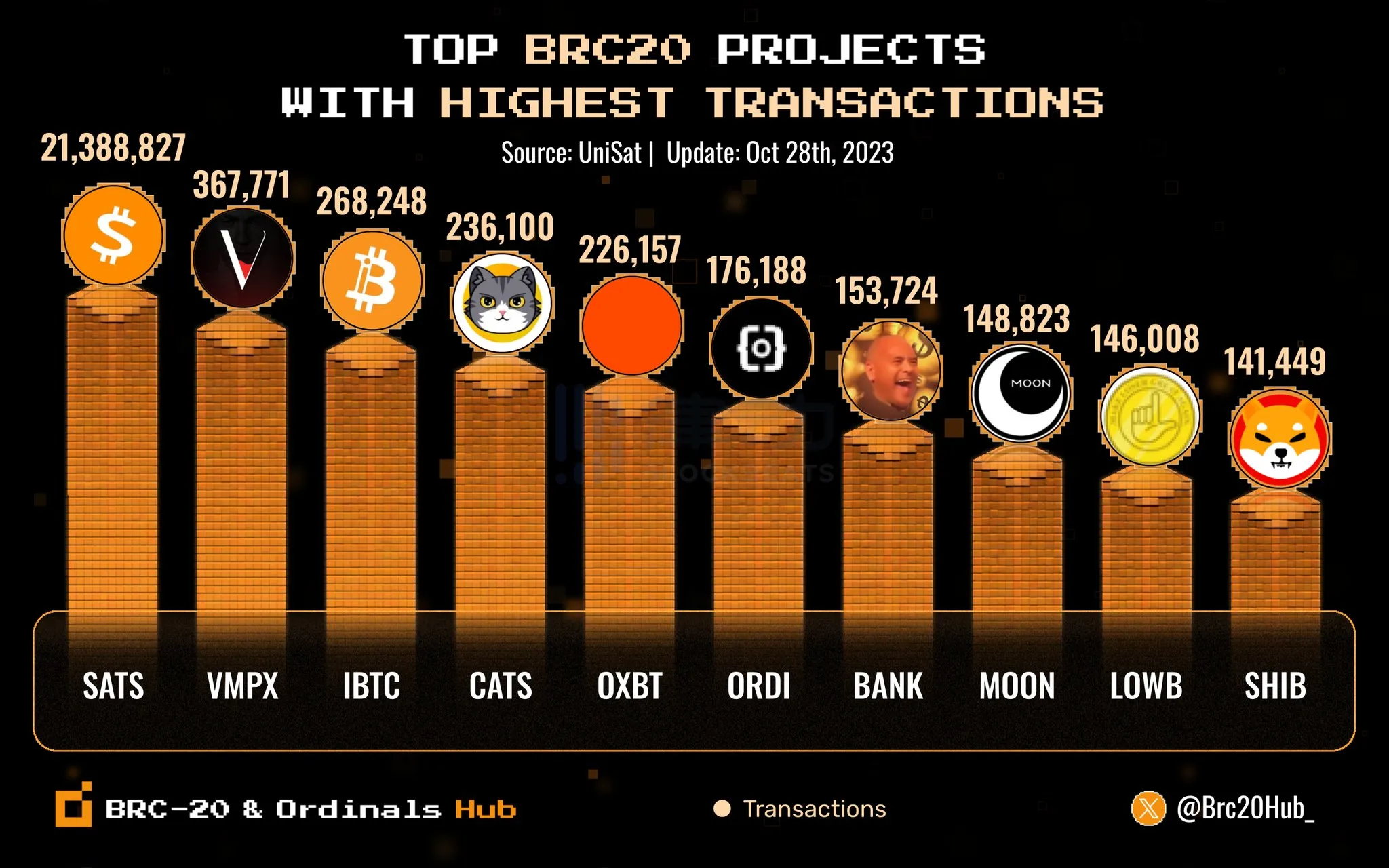
Source of the image: @Brc0Hub_
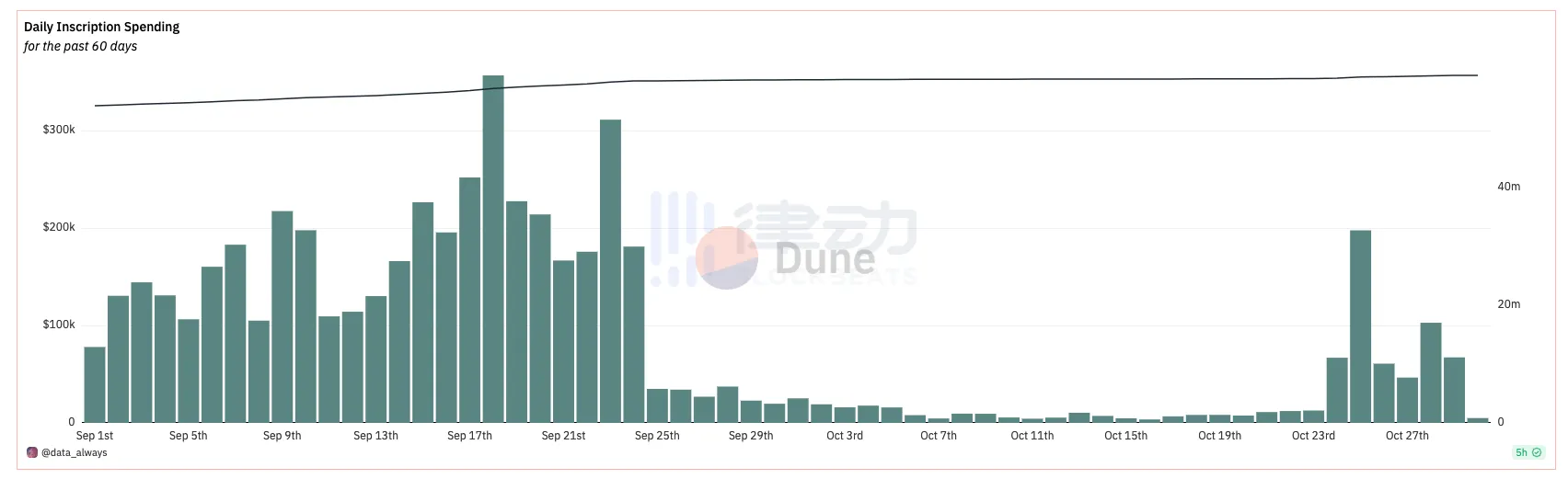
According to the data of Bitcoin's daily output in the past 60 days, as shown by Dune, the mining output has significantly increased this week.
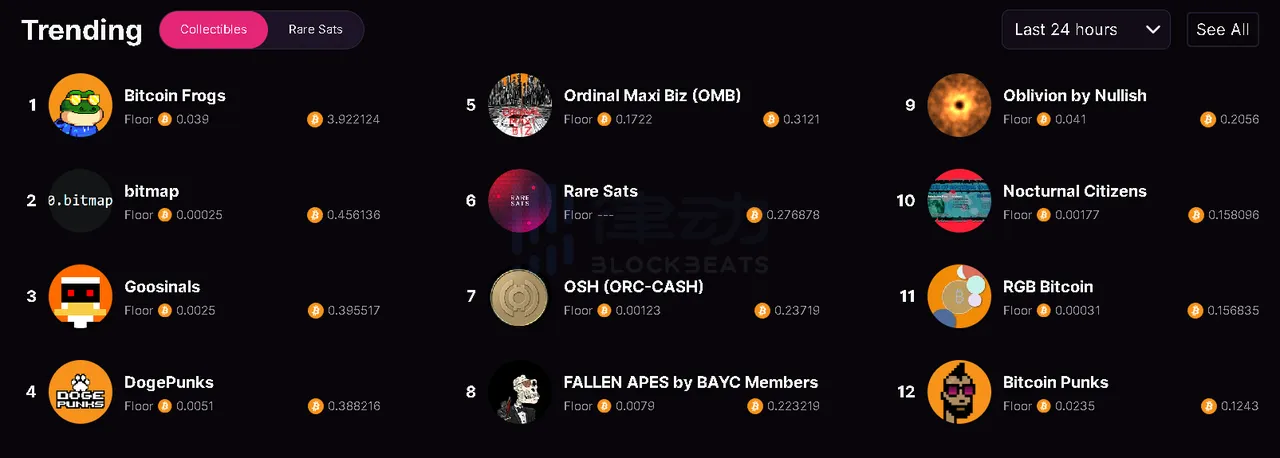
At the same time, the trading volume of the "dragon head" transaction of Bitcoin Inscription has started to increase, and the trading volume of Bitcoin Frogs on Magic Eden has exceeded 500 BTC, and the price has also shown an upward trend.
According to Magic Eden data, Bitcoin Punks, DogePunks, Taproot Wizard, and others have seen significant increases in value: @Bitcoin_Punks_ is currently priced at 0.0235 BTC; @PepesPixel is currently priced at 0.028 BTC; @DeGodsNFT is currently priced at 0.27 BTC; @BitcoinFrogs is currently priced at 0.039 BTC; @ordinalmaxibiz is currently priced at 0.1722 BTC; @bitmapcommunity is currently priced at 0.00025 BTC.
Not only that, Ethereum's inscriptions are also considered a project in the Bitcoin ecosystem. Unlike the Bitcoin ecosystem, Ethereum players can only choose ETHS to speculate on inscriptions. This Ethscriptions, which imitates BRC-20 Token, was suddenly pulled back half a month ago and saw a peak in market value on October 8th. After a brief decline, it has been rising all the way. At the time of writing, its market value has reached 38 million US dollars.
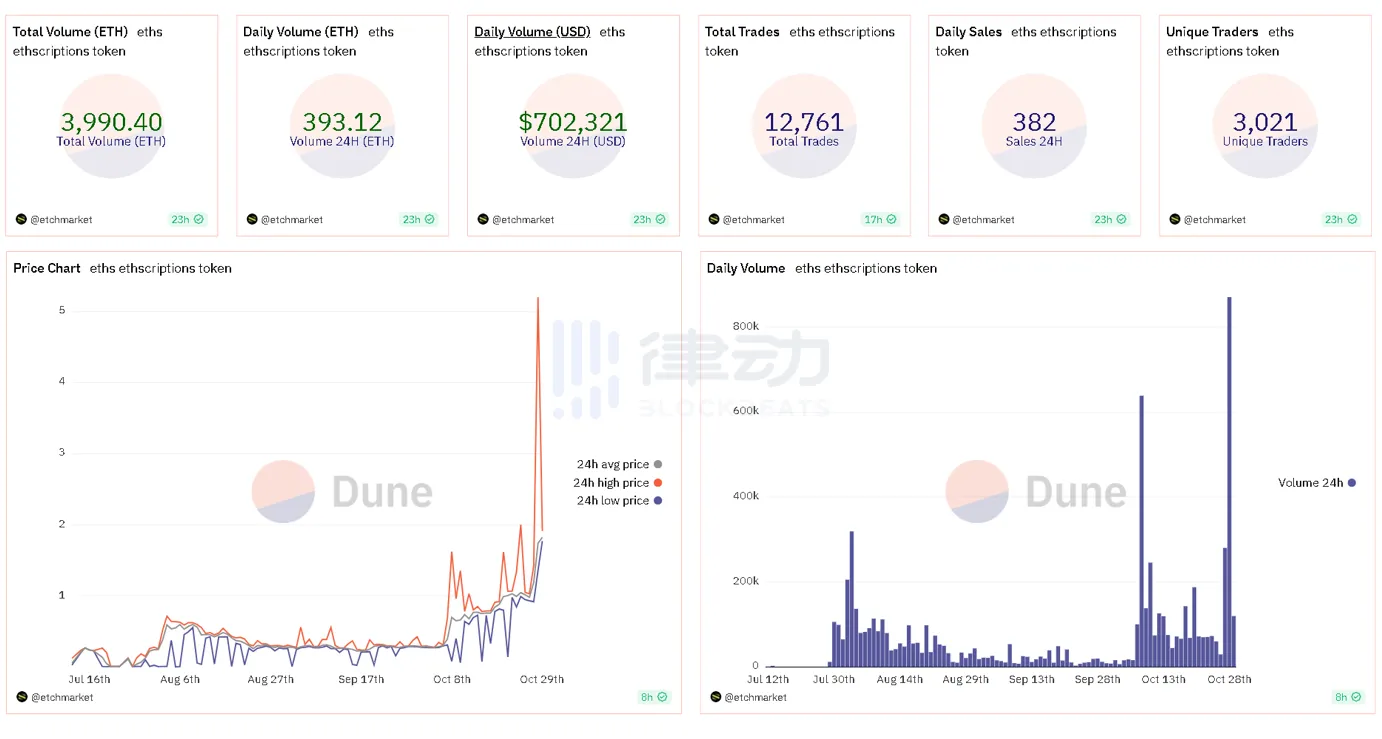
During the rise of Ethscription, KOL played a role in promoting it. As long as they included "#ETHS" in their posts, they only needed to wait for the ETHS army to arrive and they could receive many likes, comments, and shares. In addition, another tactic used by the Ethscription army was to compare ETHS with L2, which gained strong traction within the community as a new narrative.
Related reading: "ETHS hits new highs, how advanced are the operational methods behind it?"
With the rise in prices brought about by traffic, the call for "1ETHS=1ETH" in the community is getting higher and higher. Now, we are fortunate to see this "feat" completed. As the only child of Ethereum's inscription, the price of ETHS has been raised to $1800.

Bitcoin's New Protocol: What is the Atomic Protocol?
Ordinals founder Casey Rodarmor has always been opposed to BRC20. After the proposal of the Runes protocol, Trac founder Benny upgraded it to another protocol called Pipe. In the community's view, PIPE is the first token after the concept of Runes was proposed, and it is also the first token of the pipe protocol, with its dual identity significance, even likened to $ordi in BRC20.
Atomcial, on the other hand, is the "new darling" of the Bitcoin ecosystem. Compared to Ordinals, Atomcial allows for the storage of one or more files during minting, defines and updates the application state of basic file types and any complex file types, and uses Satoshis as the accounting unit for its first-class "ARC20" cabin. It provides decentralized and direct minting modes and comes with a built-in stock code naming service.
Atomicals protocol solves the long-standing problem of representing any fungible token asset on the Bitcoin blockchain. The ARC-20 standard for homogeneous token introduces colored coins to Bitcoin and uses each Satoshi to represent ownership units of deployed tokens.
ARC-20 uses native Satoshi units to represent each token, which can be split and combined like regular bitcoins. ARC-20 tokens can be minted by anyone and transferred to any Bitcoin address type, and used with wallets that support UTXO selection, such as Sparrow Wallet (external link). There are two deployment modes: direct deployment and decentralized deployment. Learn more about the different minting methods and their benefits for ARC-20 below.

Atommap is the first CPU mining-generated NFT on the Atomicals protocol, which has recently caused a stir in the Bitcoin community. However, when Atommap was first released, it was "resisted" by the Atomicals official, meaning that they would release a more standardized version, but later changed their stance to support it, indicating that the official has the intention to develop in this direction.
UniSat Wallet: brc20-swap mainnet launch is imminent
In order to gain more testing time, UniSat Wallet has postponed the launch of the brc20-swap mainnet to today. With the mainnet launch imminent, UniSat Wallet announced yesterday in a blog post that after research, they have decided to include 14 engraved assets in the first batch of supported assets for the brc20-swap mainnet. The 14 engraved assets are sats, ordi, trac, oshi, btcs, oxbt, texo, cncl, meme, honk, zbit, vmpx, pepe, and mxrc. UniSat stated that the "on-demand trading" model will be implemented in the early stages of the brc20-swap mainnet launch: withdrawal requests can only be made when new users deposit relevant assets into brc20-swap.

The first launchpad with royalties
Previously, all Bitcoin NFT trading markets did not support royalties, which was a major obstacle to the development of NFT projects. Many Bitcoin NFT project parties are currently in a completely "volunteer" stage, following their own "Bitcoin spirit" and insisting on a fair, free, and voluntary launch method, which means that the successful launch of the project will not bring any income to the project party.
And now, with the launch of the first royalty-bearing launchpad on Ordinals, it seems that this market has a new development.
Ordzaar platform has released an update log. The most noteworthy feature in this update is the creator royalty function, which is the OIP-06 standard. Currently, this feature is only applicable to new collections created after the 2.10.0 update. In the OIP-06 standard, when artists create collectibles, they will be able to set royalties, with a current maximum of 20%.
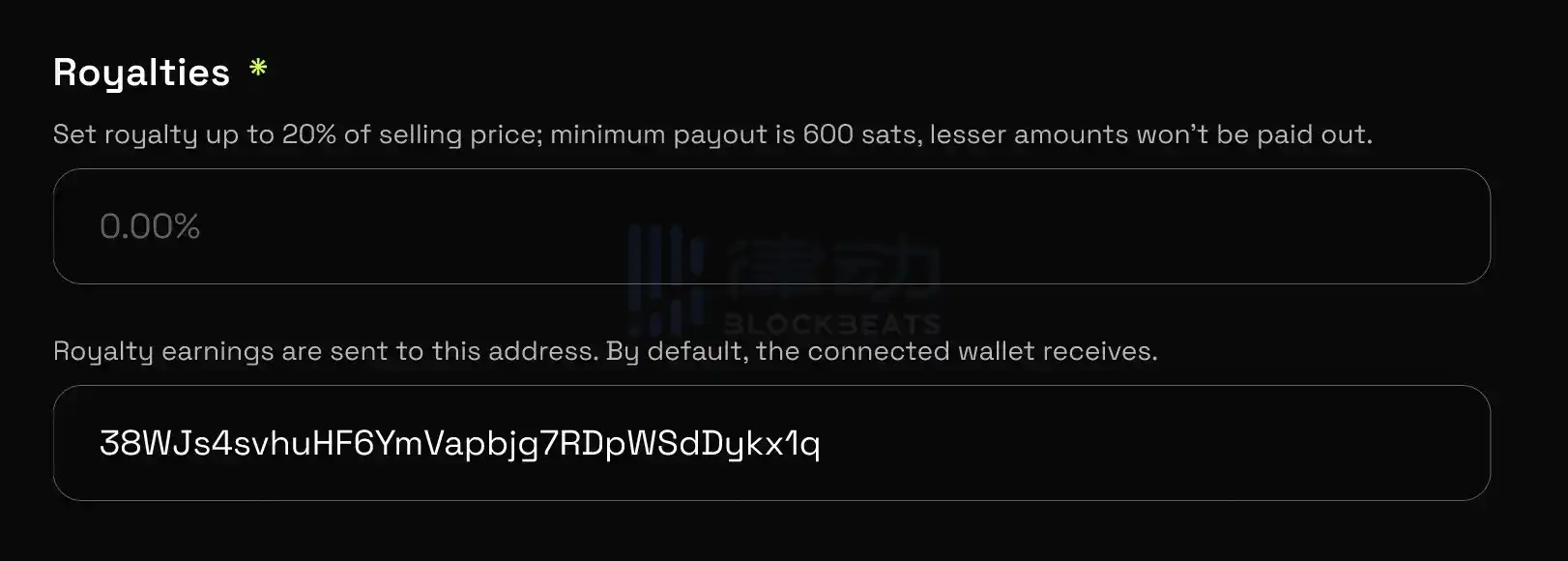
After successfully creating a collection, the creator's set royalty percentage will be displayed. When listing inscriptions, the author can determine if there are any related royalties. If the inscription includes a license fee, it will be displayed in the purchase mode and the license fee will be included in the price calculation.
Through this update, Ordzaar has enhanced the usability of the purchasing mode, the title search bar, enhanced list sorting functionality, and a series of user interface/user experience improvements.
Bitcoin production continues to halve, what should we do?
Since the beginning of this year, various protocols such as Ordinals, Runes, Pipe, and Atomcial have emerged. BitVM, Taproot asset, RGB, and other protocols have also gained attention from primary and secondary markets due to their core reasons and narrative power.
But one question has always lingered in the hearts of capital in the mining industry: how can we deal with the continuously halving Bitcoin production that cannot cover the cost of maintaining the Nakamoto consensus? Craig Wright, who has always claimed to be "Satoshi Nakamoto," has made some new discussions on this issue.
Craig White referenced the concept of a universal Turing machine in a tweet, explaining it as an unrestricted computing system whose hardware and computational power are not limited by traditional systems. In this system, the infinite nature of functions can be considered.
This means that miners can create automated programs that can run not only for a year, but even for a hundred years or more. The system, like the Bitcoin network, has a continuously growing economic incentive, which means that miners compete eternally. As the incentive grows, storage, hardware, and computing power will also increase accordingly. The cost of using the system can be partially recovered into the system by users to keep it running continuously, such as paying miner fees. Before such a system enters hibernation, it will continue to run. In addition, such a system can even be designed to resume from where it stopped when it receives funds in the future after pausing.
Bitcoin L2 Trilemma Sparks Debate Again

Welcome to join the official BlockBeats community:
Telegram Subscription Group: https://t.me/theblockbeats
Telegram Discussion Group: https://t.me/BlockBeats_App
Official Twitter Account: https://twitter.com/BlockBeatsAsia
 Related Articles