Behind the sluggish market, there may be certain positive factors.
Original author: @Louround_
Original translation: Peisen, BlockBeats
According to BlockBeats' incomplete calculation, there were 9 projects, exchanges, and communities that shut down in the cryptocurrency industry in 2021, 17 in 2022, and 27 in 2023. At the same time, the growth rate of shutdown projects in 2023 is getting faster, increasing from an average of 1 per month to a maximum of 5 per month.
Related reading: "Multiple projects announce shutdowns in succession, is the cryptocurrency industry facing a "shutdown tide"?"
"LPs continue to support early VCs that promote industry growth, and VCs continue to support founding teams in emerging fields. Teams continue to expand and grow, and everything seems to be moving in a better direction. However, the reality is not so. For many teams, this 2049 event is basically their last hope for financing. If the bear market does not end, this may be their team's last brand exposure, because the expansion of most early teams in the past two years has basically reached the bottom of the runway. The burn rate of some teams is very high, and in such a market, they only have 5-10 months left, and they are even willing to buy 2049's sky-high ticket/sponsorship booth to pitch to more potential investors."
Perhaps behind the recent shutdowns of multiple projects is the fact that the funds that were raised have now been burned through. And looking at the fundraising history of these projects in recent times, this may very well be the case. Behind these events, every participant in the cryptocurrency industry, from community operations to project financing, has felt the chill of the bear market. However, former hedge fund analyst and cryptocurrency KOL @Louround_ expressed optimism about this on social media, pointing out that there are certain positive factors behind this. BlockBeats has translated the original text as follows:
An important indicator shows that we are currently in a bear market, where the cash and operational capabilities of projects and investors are gradually being depleted. More and more projects are cutting staff or closing down, and investors are starting to sell off their holdings.
Although this may sound somewhat pessimistic, it actually contains certain positive factors. In the past bull market, many teams raised funds and planned to maintain operations for 2 years with these funds, which is already a long time in the industry. Now they need to launch tokens or conduct public sales.
However, the market is currently extremely sluggish, which forces them to demonstrate their true value proposition to attract new investors, which is likely to be much higher than what they initially showed in a bull market environment. This makes fundraising much more difficult compared to the bull market period.
Therefore, they face two choices: either lower their valuation and proceed with the next round of financing, but this can become quite complicated if there is venture capital support; or wait for market sentiment to improve as well as liquidity or capital inflows, provided that their continued operational capacity allows for it.
Unfortunately, the market is still in PvP mode, and we hardly see any new stablecoins flowing in or user activity. In addition, the fragmentation of liquidity caused by new chains and rollups has had a significant impact on overall capital flow, which also increases the market's unfavorable factors.
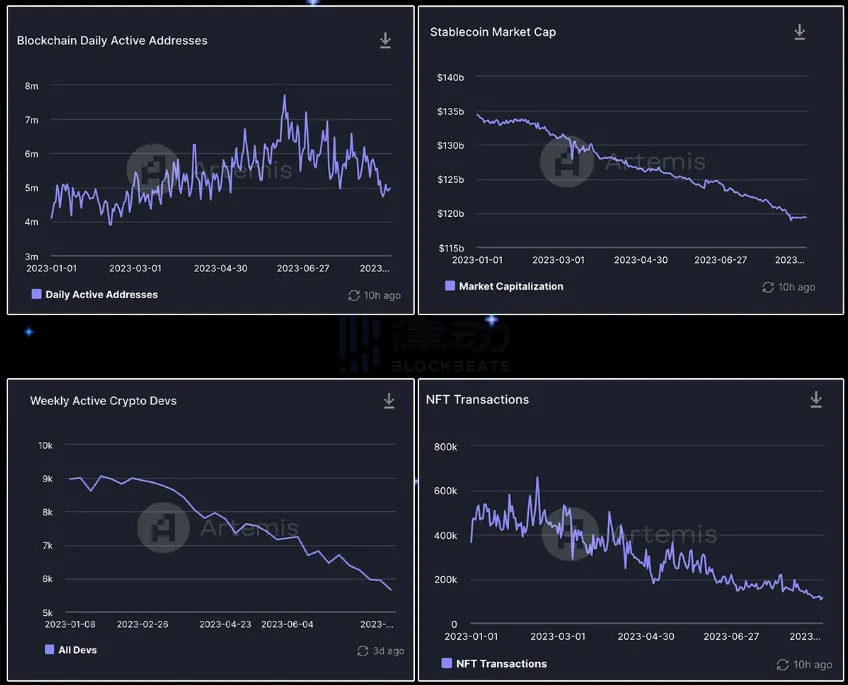 The content you provided is:
Image source @alpha_pls
Therefore, as usual, if the amount of financing sought by the project continues to increase but global liquidity remains unchanged, it will become increasingly challenging to attract capital, stand out, and successfully raise funds.
This means what?
Projects that successfully raised funds in the previous bull market or in the past year must demonstrate real competitive advantages in order to successfully raise the next round of financing without generating revenue.
Obviously, many projects will not be able to raise more funds or sell, resulting in a reduction of funds needed for operation and extension of service life, increasing development pressure, and possibly leading to project closure. We are likely to see projects develop new features or services in an attempt to gain attention from the market.
Recent Examples
Fuji Finance closed due to financial and fundraising issues;
Yuga Labs laid off 120 employees;
Ledger is cutting 12% of its employees;
Polkadot laid off 300 employees, or "make room for new ecosystem leaders and surpass Parity."
Utopia is closing its current product and shifting focus to a new project.
Yield Protocol has reduced its business due to market inadaptability.
Therefore, the market is undergoing self-regulation, eliminating projects with weak profitability or insufficient innovation that do not meet market demand, and only allowing truly innovative and high-quality projects to stand out, paving the way for the next bull market. Although this is unfavorable for investors, cleaning up the market is necessary. This will help eliminate projects that provide little value to the market.
Do we really need 5 to 10 decentralized exchanges (DEXs), lending or perpetual contract DEXs on every chain?
I think it's not necessary, and in the long run, the market doesn't need it either. Innovation, marketing, and hype will always be the main factors for success in this industry. If a project lacks appeal in these areas, it is likely to fail. As market opportunities decrease and narratives become shorter, time-based decay is also affecting investor confidence in the market.
This makes it even more difficult to make money in the market, thus maintaining the market.
In fact, we often see a significant drop in the fundraising valuation and issuance market value, which usually starts at six figures, when a project is launched because the project needs to provide attractive opportunities for the remaining investors. We only see this situation when the bear market has a serious impact on investors and builders.
In my opinion, once ETFs, halving, or currency printing machines start operating, funds will flow, and at the same time, market crashes will continue and reach the maximum pain point. For those who go against the market and establish long-term positions, these periods are full of opportunities, while continuing to expand their network and improve their skills/knowledge.
Congratulations to those who are still active in this market. Don't forget that in such market conditions, maintaining capital is crucial. Stay vigilant and hope to be called lucky in the next bull market.
"Original Link"
Welcome to join the official BlockBeats community:
Telegram Subscription Group: https://t.me/theblockbeats
Telegram Discussion Group: https://t.me/BlockBeats_App
Official Twitter Account: https://twitter.com/BlockBeatsAsia