Crypto VC’s bear market advice: Don’t be superstitious about institutions, retail investors can do well too

Original Title: "What Do Crypto VCs Know that You Don't?"
Original Author: Ignas
Original Translation: Foresight News
The relationship between Bitcoin prices and project funding amounts in the cryptocurrency market is fascinating. Typically, as Bitcoin prices fall, fundraising amounts also decrease.
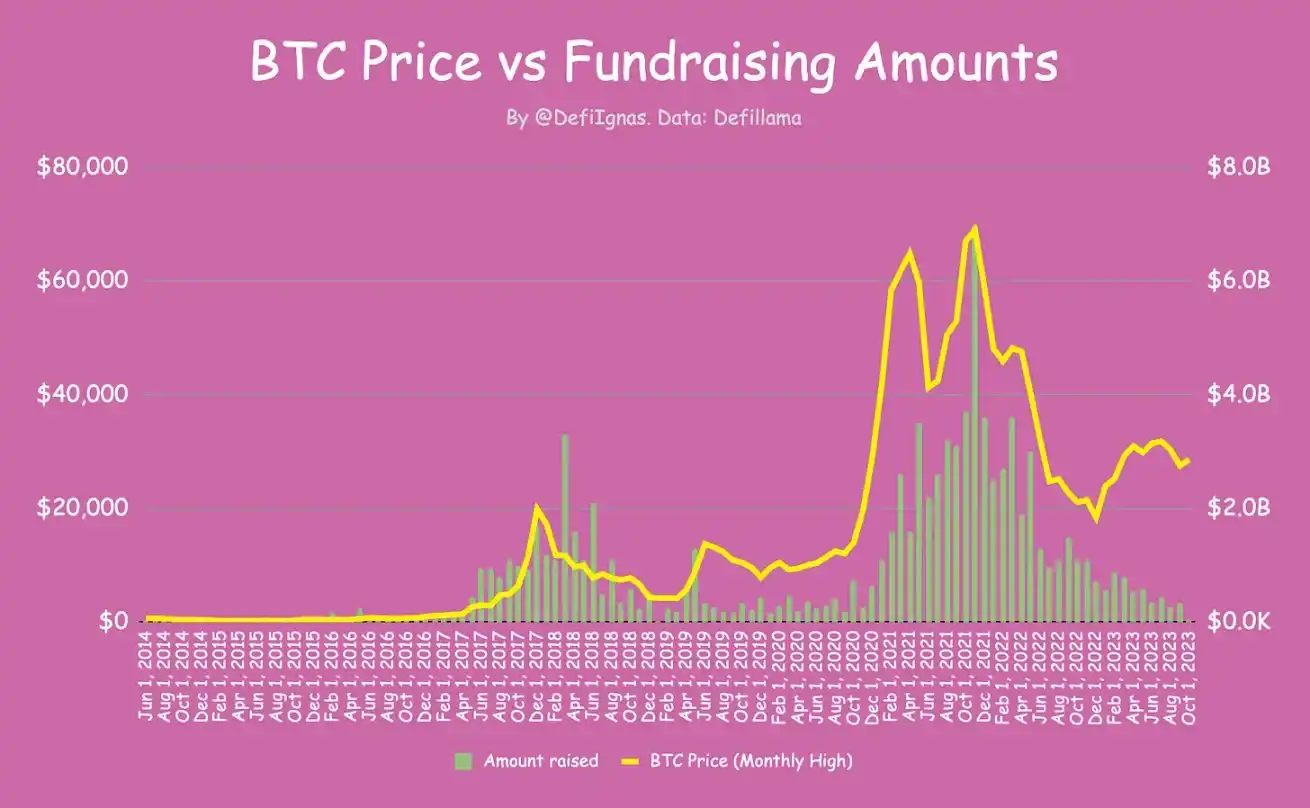
Interestingly, despite Bitcoin and Ethereum prices being higher than the peak of the 2018 bull market, the funding volume has returned to pre-2020 levels. Bitcoin has actually rebounded from its low point in 2022, but the amount of fundraising is continuously decreasing.
Venture capitalists (VCs) are often seen as market leaders who can make wise and forward-thinking decisions. So why do they seem to be following the overall market trend instead of setting it?
Despite a slight improvement in the market, VC fundraising has fallen to the levels of 2018-2019. Do they know something that we retail investors don't? Shouldn't they be "buying the dip" when valuations are lower? Especially since lock-up periods after investment may prevent immediate selling, they may end up having to sell in a bear market.
In order to find answers, I interviewed several cryptocurrency venture capitalists and founders of recently funded DeFi projects. I am pleased to share that Sachi Kamiya from Polygon Ventures, Etiënne from TRGC, and an anonymous angel investor (referred to as Anon here) shared their perspectives.
Caddi founder Jaimin also provided valuable insights from the perspective of a DeFi builder. Caddi is a browser extension that can help you save money and protect you from fraud in DeFi transactions. He recently raised $650,000 from venture capital firms such as Outlier Ventures, OrangeDAO, and Psalion VC, as well as angel investors Bryan Pellegrino, Alex Svanevik, and Pentoshi.
Situation How Bad Is It?
CoinCarp's charts provide different perspectives. The total financing amount of the cryptocurrency market in 2023 is 18.6 billion US dollars, with a total of 1053 financing transactions. The situation looks much better than in 2020.
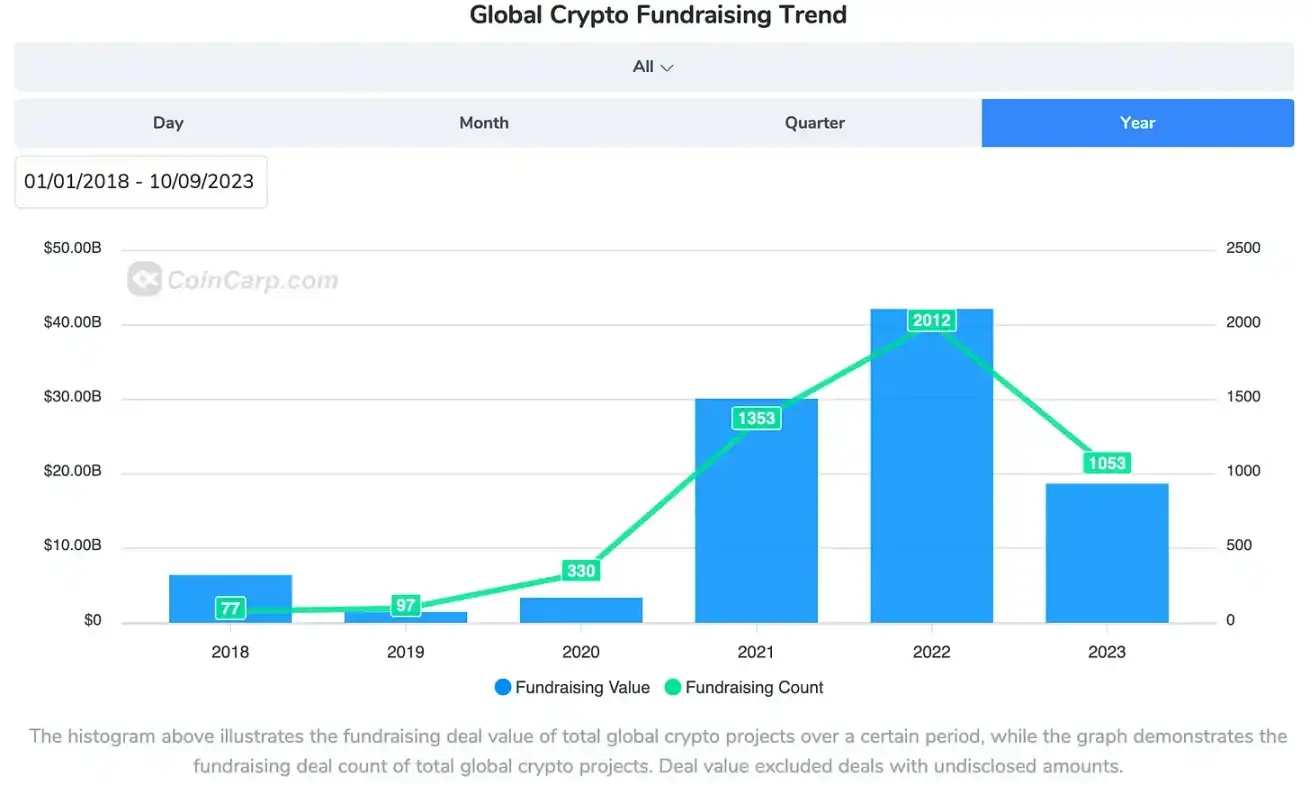
However, the chart includes Web2 examples, such as Stripe's $6.5 billion raised.

Speaking of my beloved DeFi, there were a total of 175 financings this year, with a total amount of 779 million US dollars and an average financing amount of 4.45 million US dollars per financing. Compared with last year, this number has dropped significantly. Last year, there were 341 financings with a total of 3.56 billion US dollars and an average financing amount of 10 million US dollars per financing.
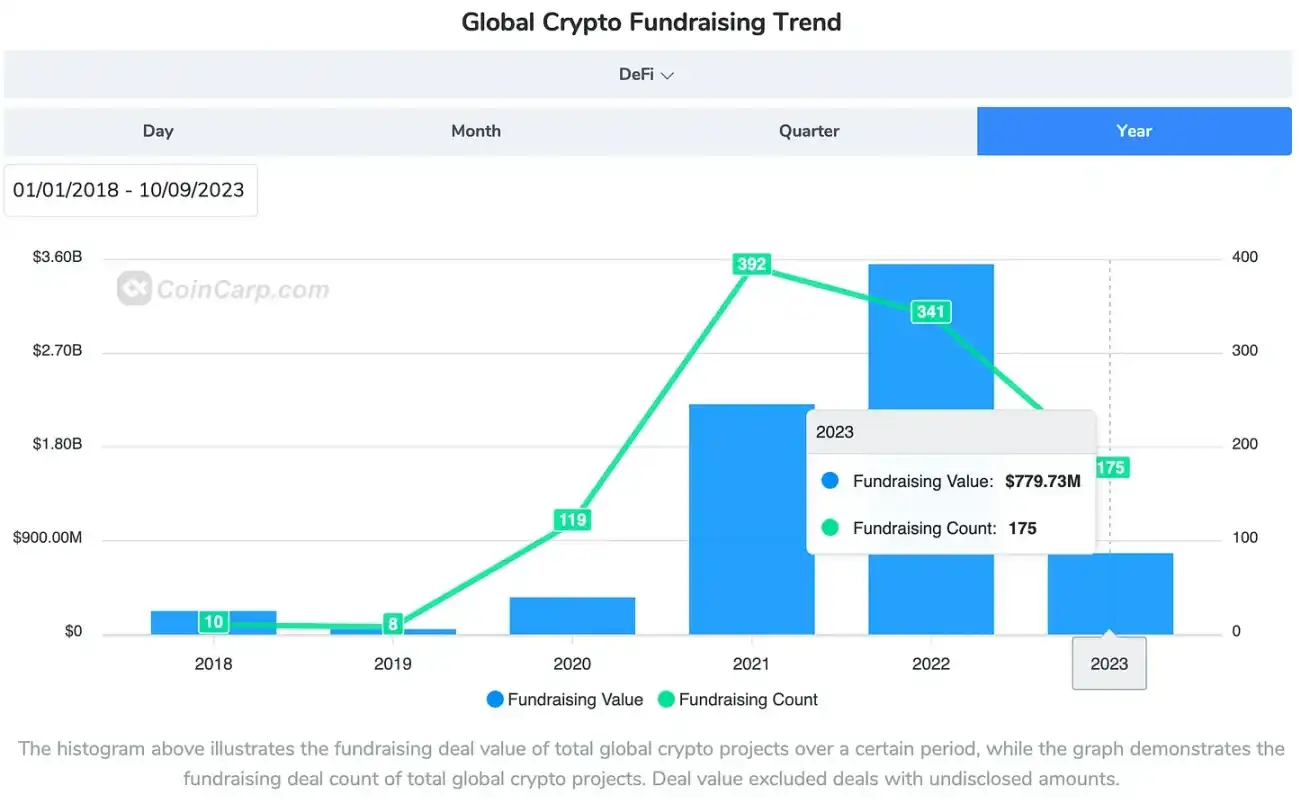
Therefore, funds are even tighter this year, with each round of financing raising an average of more than 55% less capital.
Unfortunately, the DeFi industry is actually the second worst-performing industry, only above NFT. In the past year, DeFi protocols have only raised $1.14 billion, while CeFi startups have raised $2 billion.
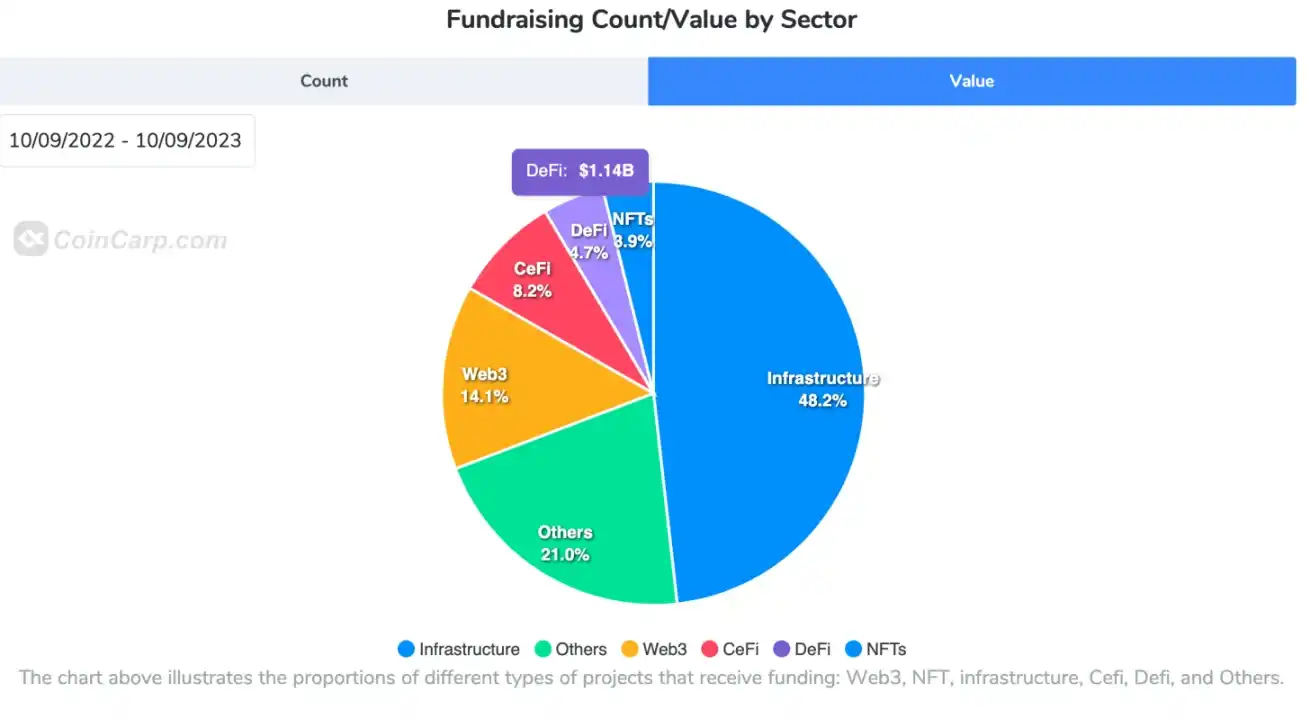
Careful observation shows that DEX dominates DeFi financing. In Q3 2023, DEX financing accounted for 38% of all DeFi financing.
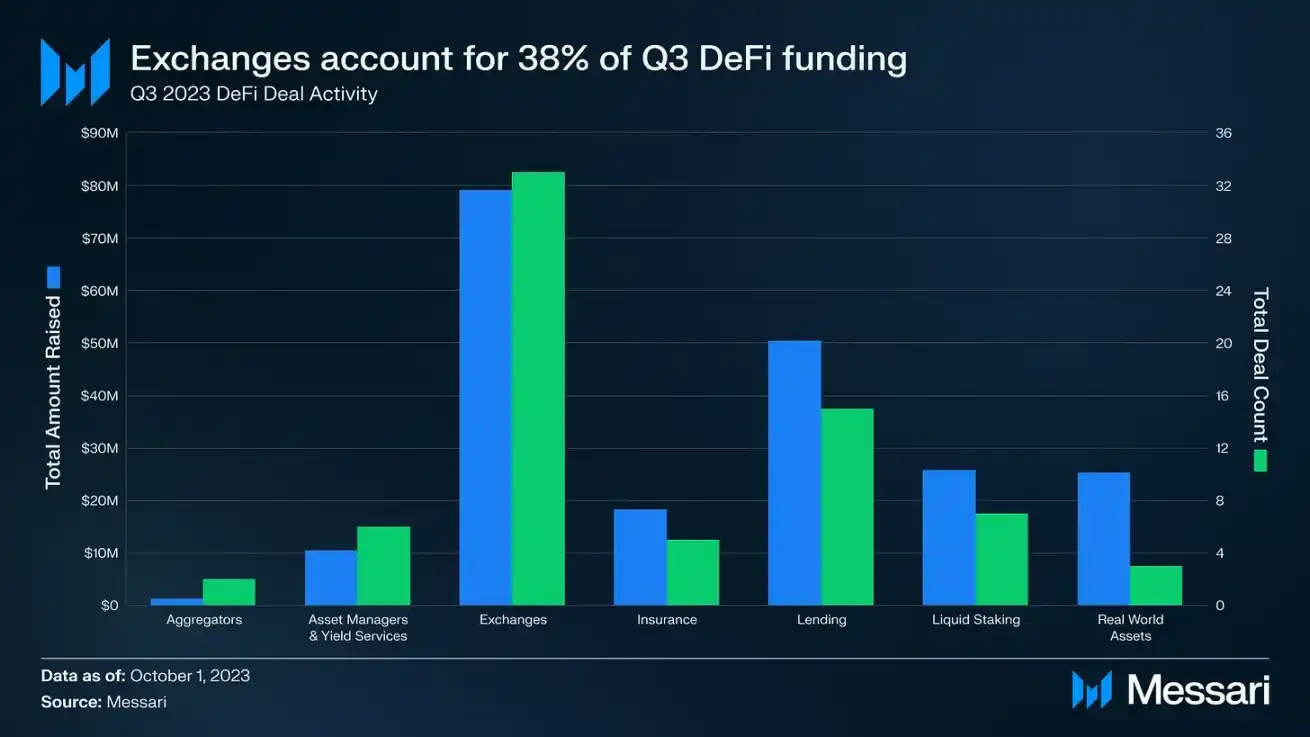
Source: Messari Q3 Financing Report
Due to financial constraints, multiple cryptocurrency companies are undergoing layoffs. Yuga Labs, Ledger, and Chainalysis announced significant layoffs last week.
Despite being in a bear market, some well-known protocols have successfully raised a large amount of funds. This indicates that investors have not completely given up on cryptocurrencies and DeFi. In fact, Blockchain Capital recently raised $580 million for investing in DeFi, gaming, and infrastructure projects. So, I hope this blog post can help these funds find the bottom of the market.
When asked about the current financing market from the perspective of DeFi builders, Jaimin commented, "The market is as bad as it has been in the past few years, mainly due to the macroeconomic environment." Sachi from Polygon Ventures has a similar view, stating that "the overall sentiment of cryptocurrency venture capital is bearish. Due to the negative sentiment, only a few early projects have raised funds."
Anon provided a number, stating that it may only represent 10% of the financing amount during a bull market.
Compared to past bear markets, Etiënne noticed that "unlike 2019, there are real funds waiting and watching, whereas in 2019 there were almost no funds waiting and watching."
This is why there are still huge opportunities in the market. Anon, Etiënne, and Sachi all agree that now is a good time to look for opportunities because project valuations are no longer as crazy as they were in the bull market. Sachi points out that investors "can take the time to do due diligence on each project, but VCs focus on user metrics and actual adoption."
Interestingly, this is precisely the most difficult thing to achieve for early-stage projects. Jaimin stated that "investors want to see exponential growth, whether it's in revenue, users, TVL, or trading volume. Sustainable growth in this market is very challenging because there are few new entrants, low volatility, low prices, and negative sentiment. Simply selling a vision is often not enough."
Sachi optimistically summed up, "Investing now is meaningful because some of these projects will perform well in the next cycle."
Why do we need VC?
In the encryption industry, there is a lot of distrust, hostility, and negativity towards VC. The main reason is obvious: institutional investors will dump retail investors.
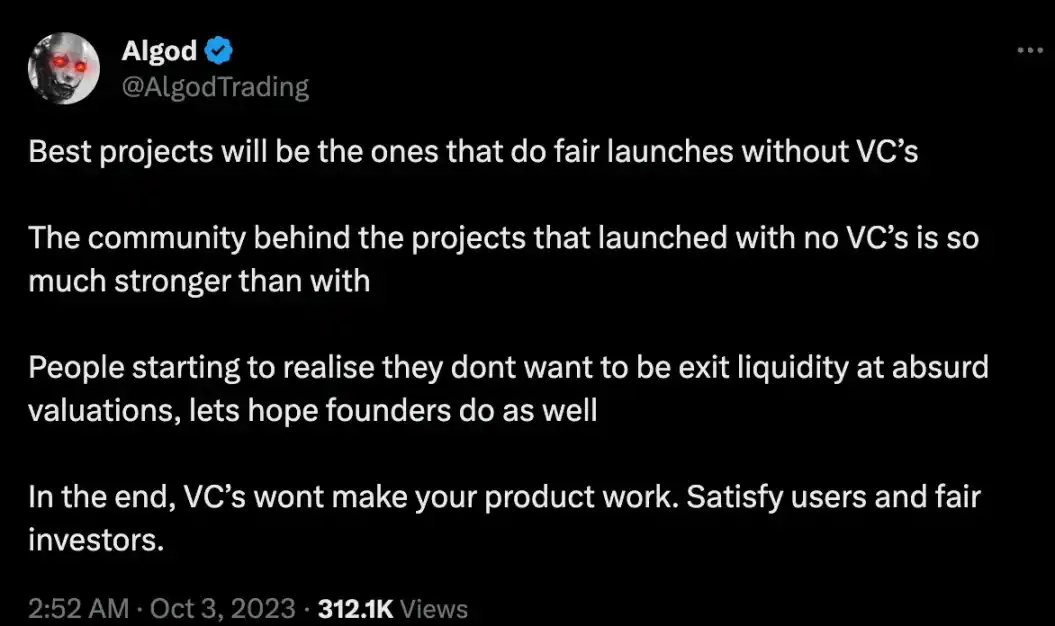
Algod stated on Twitter that the best projects are those that are launched fairly without venture capital, as people realize they don't want to exit liquidity. In another article, he also stated that compared to 2021, venture capital will become a bearish factor because "the community is key, and projects are starting to realize that scale is not driven by venture capital, but by ordinary people."
Some non-cryptocurrency investors also agree with this view.
For example, in an interview with Bloomberg, Jason Calacanis, an angel investor for Robinhood, Uber, and Superhuman, warned about the potential impact of "scam" VC investors selling cryptocurrencies to retail investors.
Calacanis believes that many of these tokens are securities sold by VCs to unsuspecting retail investors. He expects that companies and VCs who intentionally sell "worthless" tokens will face significant lawsuits and may even face criminal charges.
So, can we completely skip cryptocurrency venture capital? The most worrying thing is how "fair" the "fair distribution" really is.
Anon said, "Fair distribution is not so fair because the team and insiders already know about it before the actual distribution and may weaken liquidity." Jaimin also holds the same skeptical attitude, questioning whether the current distribution is truly "fair" because people can manipulate it in various ways and "mutual dumping always exists."
Welcome to join the official BlockBeats community:
Telegram Subscription Group: https://t.me/theblockbeats
Telegram Discussion Group: https://t.me/BlockBeats_App
Official Twitter Account: https://twitter.com/BlockBeatsAsia

 Related Articles