Modular blockchain: A new perspective on the controversy surrounding functional layers and DA economics.

Original author: Zeke, YBB Capital
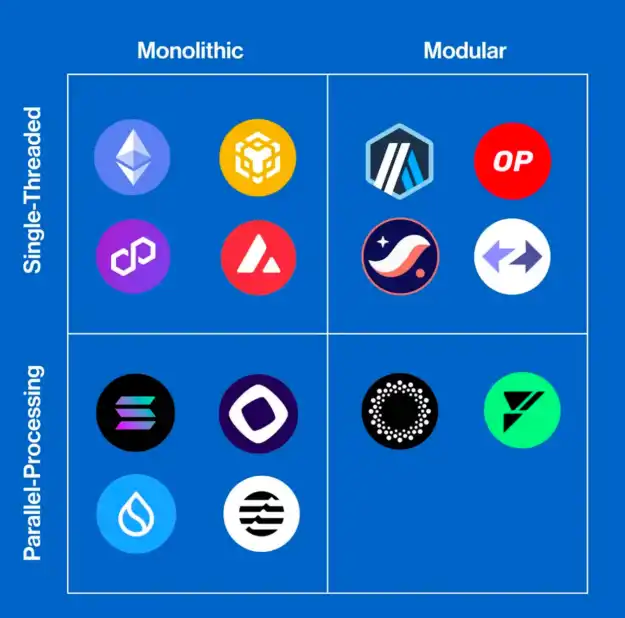
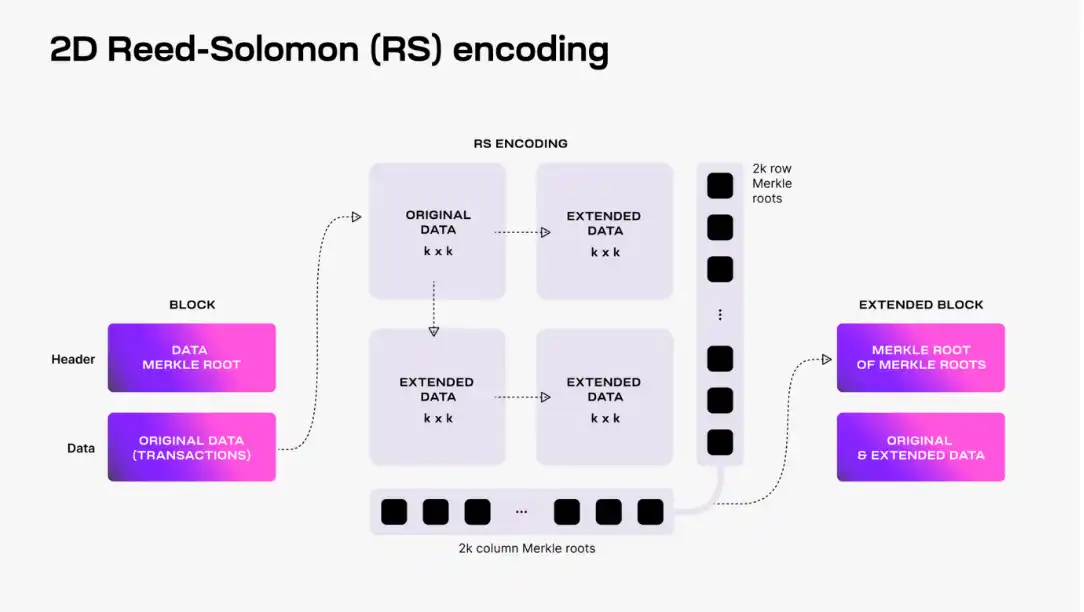
The "trilemma" of blockchain has always been a difficult gap for the industry to overcome, and successive public chain projects have tried to cross this gap through different architectural designs, hoping to become the so-called "Ethereum killer". However, the fact is cruel. Ethereum's position has never been surpassed in so many years, and the impossible triangle of blockchain remains unbreakable. So, is there a way to fill the gap and fill the impossible triangle for public chains? Mustafa Albasan's idea of modular blockchain stems from this. Continuing in 2019, Mustafa Albasan wrote the whitepaper for "Lazy Ledger", which detailed a new architecture where blockchain is only used for sorting and ensuring the availability of transaction data, rather than being responsible for transaction execution and verification. The purpose of this architecture is to solve the scalability issues of existing blockchain systems. At the time, he referred to this as the "smart contract client". And the execution of smart contracts is performed through another execution layer on this client, which is the prototype of Celestia. Later, the emergence of Rollup made this idea more certain. Because the logic of Rollup is to execute smart contracts off-chain, and then aggregate the results into proofs uploaded to the "client" execution layer. Through reflection on the architecture of blockchain and new scaling technologies, he has defined a new paradigm and named it "Modular Blockchain". Traditional single-blockchain architecture usually consists of four functional layers: Execution layer - The execution layer is mainly responsible for processing transactions and executing smart contracts. It includes the verification, execution, and updating of transaction status. Data-availability layer - The data-availability layer in modular blockchains is responsible for ensuring that data in the network can be accessed and verified. It typically includes functions such as data storage, transmission, and verification to ensure transparency and trust in the blockchain network. Consensus layer - responsible for the protocol between nodes to achieve consistency of data and transactions in the network. It verifies transactions and creates new blocks through specific consensus algorithms such as Proof of Work (PoW) or Proof of Stake (PoS). Settlement layer - responsible for completing the final settlement of transactions, ensuring the transfer of assets and recording them permanently on the blockchain, and determining the final state of the blockchain. A single-piece blockchain integrates the work of these components into the same system, and this highly integrated design approach inevitably leads to some inherent problems, such as poor scalability, poor flexibility, and difficulty in maintenance and updates. Celestia believes that a single blockchain no longer needs to do everything on its own. The future evolution of Web3 will be a "modular blockchain" that modularizes the blockchain and distributes its processes to multiple "dedicated layers", with each "dedicated layer" responsible for handling specific functional layers, creating a better system that is independent, secure, and scalable. If a design breaks down a system into smaller parts that can be exchanged or replaced, then this design is modular. The core idea is to focus only on doing things well in parts (the operation of a partial or single functional layer), rather than trying to do everything. If we use Cosmos Zones and Polkadot Parachains as examples, they can actually be seen as a form of modularity. From a modular perspective, redesigning the space for a single-blockchain and its modular stack will greatly enhance its potential. Modular blockchains with different architectures and specific use cases can work together through combination. With the possibility of diverse designs, this field has also given birth to many interesting innovative projects. The following discussion will focus on the controversy surrounding different functional layers and how Celestia interprets "modularity" from a modular perspective. If we consider Rollup as the execution layer for modularity, we will find that almost all modularity execution layer projects are built on top of Ethereum. The reason for this is obvious. Ethereum has a large amount of resources as a moat and is the most decentralized, but its scalability is poor, so there is great potential for redesigning the functional layer. From the dismal performance of the Move language public chain (Aptos, Sui) launched recently compared to the unprecedented situation of Layer2 on Ethereum, it is not difficult to see that the infrastructure narrative of blockchain has also shifted from making public chains to making Ethereum's Layer2. So is the existence of modularity good or bad? Has the execution layer centered around Ethereum stifled innovation in public chains? Firstly, starting from the perspective of the execution layer, the existing chains are reclassified. Here, we quote Nosleepjon's article "The Dual Suns of Tatum" to explain the current classification of execution layers in blockchain. The current blockchain can be divided into four categories: 1. Single-threaded single-shard blockchain: a monolithic blockchain that processes one transaction at a time. Due to limitations, most of them have turned to Rollup or horizontal scaling roadmap. Representative projects: Ethereum, Polygon, BNB Chain, Avalanche. 2. Parallel processing single-blockchain: a single-blockchain that processes multiple transactions at once. Representative projects: Solana, Monad, Aptos, Sui. 3. Single-threaded modular blockchain: a modular blockchain that processes one transaction at a time. This is because Rollup uploads data to Ethereum in the form of Calldata, and permanently stores this data, making it very expensive. However, the benefit is that it has the best security and orthodoxy among the three solutions, and the cost reduction of this solution requires waiting for the KanKun upgrade of EIP-4844. By introducing the transaction format of Blob carrying Transactions, the transaction format has an additional Blob location that can be used to store Layer2 data compared to the normal transaction format. Moreover, the Blob data will be deleted by the node after one month, which greatly saves storage space. Blob transaction format can provide cheaper data availability than Calldata. There are two main reasons for this: firstly, Calldata exists in the Execution Payload, while Blob data is stored in Prysm or Lighthouse nodes (rather than in Geth), which requires more resources to be consumed when Calldata needs to be read by the contract; secondly, Blob data is short-term storage, and the nodes will delete Blob data after one month. However, its gas cost is still higher than the latter two solutions. From a modular perspective, there are multiple ways to redesign the DA layer, which may lead to significant differences in the specific implementation of different projects. Therefore, a detailed explanation of modular DA projects requires a lot of space. Here, Celestia is used as a representative to explain the DA project. Decoupled Execution: Celestia's logic is to divide the protocol into different layers, each layer focusing on specific functions, and then these layers can be recombined to build blockchains and applications. Celestia focuses on the consensus and data availability layers in the hierarchy. Similar to some Layer1s, Celestia uses the Byzantine Fault Tolerance (BFT) consensus algorithm Tendermint for transaction ordering, but it is different from other Layer1s. Celestia does not reason about transaction validity or execute transactions, only packs and broadcasts transactions, and all transaction validity rules are enforced by Rollup nodes on the client side (i.e. decoupling the consensus layer from the execution layer). So, note a key point, "does not reason about transaction validity". That is, malicious blocks that conceal transaction data can also be published on Celestia. So how should the verification process be implemented? Celestia introduces two cores here, two-dimensional Reed-Solomon coding and Data Availability Sampling (DAS). DAS: This solution is used for lightweight node verification of the availability of block data, without the need for nodes to download the entire block. Only a portion of the block data needs to be sampled (the specific implementation requires two-dimensional Reed-Solomon encoding, which will be explained in detail below). Unlike DAC mentioned earlier, DAS does not require trust in the security of entities, only that the chain is sufficiently decentralized for the data to be trusted. 二维 Reed-Solomon Encoding (Erasure Coding): The basic idea of two-dimensional Reed-Solomon encoding is to apply Reed-Solomon encoding to both rows and columns separately. This way, even if errors occur in some rows and columns of two-dimensional data, they can still be corrected. By encoding block data, the block data is divided into k blocks, arranged into a k × k matrix, and extended to a 2k × 2k extended matrix through multiple Reed-Solomon encodings. Calculate the 4k independent Merkle roots of the rows and columns of the extended matrix; these roots are used as block data commitments in the block header. Celestia light nodes sample the 2k × 2k data blocks. Each light node randomly selects a unique set of coordinates in the extended matrix and queries the full node for the data blocks and corresponding Merkle proofs for these coordinates. Each received data block with a correct Merkle proof is broadcasted to the network. If we abstract it a bit, we can also say that the block data is divided into a matrix (for example, 8x8), and through encoding, additional "check" rows and columns are added to the original data to form a larger matrix (16x16). By randomly sampling some data from this larger matrix and verifying its accuracy, the integrity and availability of the entire data can be ensured. Even if some data is lost or damaged, the check data can still be used to recover the entire block of data. Block scaling: Celestia will expand as the number of light nodes increases. As long as there are enough nodes on the network to sample the entire block, Celestia will remain secure. This means that as more nodes join the network for sampling, the block size can increase accordingly without sacrificing security or decentralization. In traditional blockchains, doing so would sacrifice decentralization because larger block sizes would increase hardware requirements for node downloading and data verification. Sovereign Rollup: This is also a concept pioneered by Celestia, combining elements of various blockchain designs, including Layer 1 blockchains, Rollup, and early Bitcoin networks like Mastercoin. The key difference between Sovereign Rollup and Smart Contract Rollup (OP, ARB, ZKS, etc.) is how transactions are verified. In Smart Contract Rollup, transactions are verified by smart contracts on Ethereum. In contrast, in Sovereign Rollup, transactions are verified by the nodes of the Rollup itself. Sovereign Rollup publishes its transactions to another blockchain (such as Celestia) for ordering and data availability. The nodes of Sovereign Rollup then determine the correct chain. This design allows Sovereign Rollup to inherit multiple security aspects from the data availability (DA) layer, including liveness, security, resistance to reorgs, and censorship resistance. For the smart contract Rollup, the upgrade depends on the smart contract on the settlement layer. Upgrading Rollup requires changing the smart contract. It may require multi-signature to control who can initiate updates to the smart contract. Although it is common for teams to control the upgrade multi-signature, it may be controlled through governance. Since smart contracts exist on the settlement layer, they are also constrained by social consensus on the settlement layer. Sovereign Rollup upgrades through forks, similar to the first layer blockchain. When a new software version is released, nodes can choose to update their software to the latest version. If nodes do not agree to the upgrade, they can continue to use the old software. This provides a choice for the community, the people running the nodes, to decide whether they agree to the new changes. Even if the majority of nodes upgrade, they cannot be forced to accept the upgrade. Compared to Smart Contract Rollup, this feature makes Sovereign Rollup a "sovereign" Rollup. Quantum Gravity Bridge (QGB for short): a key component of the Celestia ecosystem, it serves as a bridge between Celestia and Ethereum (or other EVM L1 chains) to enable data and asset transfer between the two networks. By introducing the concept of Celestium (EVM L2 Rollup) and using Celestia for data availability, settlement is done on Ethereum. This allows for the simultaneous utilization of the advantages of both networks: Celestia's scalability and data availability, as well as Ethereum's security and decentralization. QGB, as a key part of Celestia's vision for an extensible, secure, and decentralized blockchain ecosystem, implements the interoperability required for future blockchain technology. The project is currently working on Zk QGB to further reduce gas fees for verification. Let's talk about the economic value of DA. This assumption is based on Polygon Hermez's expectation that they will eventually only need 14 bytes per transaction. With the current Danksharding specification of 1.3 MB/s, Layer2's TPS can reach around 100,000. Therefore, the expected revenue will reach an astonishing $30 billion. Advancing in decentralization is still the mainstream concept in this industry. Modular blockchain is essentially an extension of the value of Ethereum and an attempt to break the impossible triangle of blockchain. Although it is designed with diversity, it also makes construction more cumbersome and complex due to the multiple choices of modules, and the risks of different modules are like a blind box. How to build a relatively stable modular system is something to pay attention to. On the other hand, the impact is that under the trend of modularization, dozens of Layer2 will once again split liquidity, and cross-chain communication and security will also be the focus of the future. The modularization of BTC is also a recent hot direction, and there are some slightly feasible solutions that can also be appropriately focused on. Welcome to join the official BlockBeats community: Telegram Subscription Group: https://t.me/theblockbeats Telegram Discussion Group: https://t.me/BlockBeats_App Official Twitter Account: https://twitter.com/BlockBeatsAsia
I am a practitioner in the encryption industry. Please translate the following Chinese text into English without considering the context or industry-specific terms and names. Do not omit any English words or phrases, including capitalized ones such as ZKS, STARK, and SCROLL. If there are English characters in an tag, do not translate them and return the tag as is. If the content consists only of punctuation marks, return them as is. Do not translate HTML tags such as , , , and
. If an HTML tag contains English characters, omit the translation and return the tag as is. Please preserve the content within tags. Translate all Chinese characters.
The text to be translated is:
Foreword
Origin of Modularity
The birth of modular blockchain originated from two whitepapers. In 2018, Mustafa Albasan and Vitalik jointly wrote a paper titled "Data Availability Sampling and Fraud Proofs". The paper describes a system that allows light clients to receive and verify fraud proofs from full nodes, as well as designs a data availability proof system that reduces the trade-off between on-chain capacity and security. This solves the scalability issue of blockchain without sacrificing security and decentralization.What is modular blockchain?
Modular Design Principles
新视角
translates to New Perspective
in English.Around the Ethereum-centric execution layer
Blockchain Scaling Landscape
EndGame
二.Validiums DA Mode
However, since the data is kept off-chain, the entity operator of Validium can freeze users' funds. To prevent extreme situations, a Data Availability Committee (DAC) scheme must be introduced, where the DAC must sign off on each update of the state to confirm that it has received the data, reaching its required number of signatures. This is a controversial approach, as it requires trust in the security of the entity rather than the chain. Dankrad Feist, the proposer of EIP-4844 mentioned this scheme directly in his tweet.Three. Modular DA
Celestia
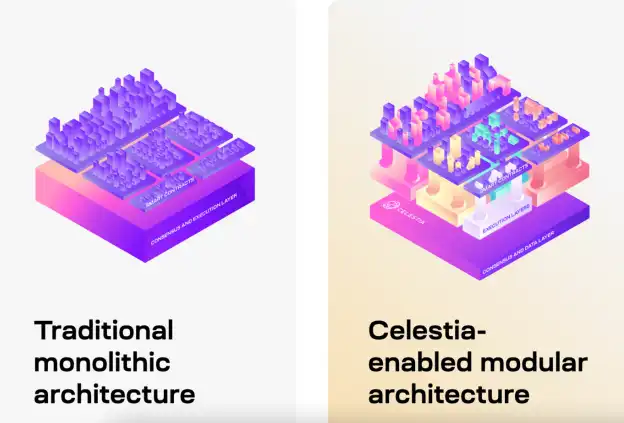
Comparison of the overall architecture of a single-blockchain with Celestia's modular architecture
Celestia validators can run QGB to provide strong data availability guarantees for block data at a cost lower than Ethereum's Calldata.DA Economics
Under such a huge cake, the future competition of the DA market in DA City will be very intense. Currently, in addition to the three mainstream solutions, there are also Stark's fractional scaling Layer3, zkPorter, and multiple modular DA projects that will join the war. From the perspective of existing Layer2 projects, the general-purpose chain is completely inclined to use Ethereum DA. Application chains and long-tail chains will be the main customers of "non-traditional DA". My personal opinion is that modular DA and soon-to-be-released Layer3 will become the mainstream choices in the future.Conclusion
This article is from a submission and does not represent the views of BlockBeats.

 Related Articles