Arthur Hayes: The Federal Reserve is destined to fail.

Original author: Arthur Hayes
Translated by: MarsBit
(The following views are the author's personal opinions and should not be used as a basis for investment decisions, nor should they be considered as recommendations or suggestions for engaging in investment transactions.)
I recently went kite surfing on Fuerteventura Island, which is one of the Canary Islands and technically a part of Spain. If you saw me, you would probably chuckle and say, "Dude, Arthur really needs to stick with cryptocurrency!"
My irresistible bad mood motivates me to invest a lot of time to become better. For me, the difficulty of this sport is that I have to focus on the kite tied to my waist, which can easily overwhelm you, while also standing on the board and navigating through the constantly changing water conditions. There is no rest time during kite surfing, at least not for me, because I am always strongly focused on all these variables - but I still look like Gumby flailing in the water.
A few years ago in Mauritius, I spent a week playing kite surfing and I felt that I made great progress. I could ride against the wind and almost switch directions continuously. However, before I arrived in Fuerteventura a few weeks ago, it had been many years since my last lesson. Even so, when I entered the game, I was very confident that I could pick up where I left off. This was a mistaken belief.
Fuerteventura has strong and sustained winds during the summer. However, the kite schools there do not take students to the beach because although the water is shallow, there are many exposed rocks. Considering that students like to be dragged by kites, it makes no sense to have them participate in regular people vs. rock competitions - even if they wear appropriate protective gear. Therefore, the school has switched to sailing classes in the open sea.
Fuerteventura Island is located on the coast of northwest Africa, surrounded by the fresh and turbulent waters of the Atlantic Ocean. The rough waves in the open sea add a great deal of difficulty for beginners. When I went out to sea on a small boat for the first time, I thought to myself, "Oh my God - I hope I don't come back in a body bag." My equipment included a wetsuit, life jacket, safety harness, and helmet, but I still felt completely exposed to nature. Once you jump into the water, you will sway up and down like a human buoy in waves ranging from half a meter to one meter. Then the instructor comes over, attaches the kite, and throws you a board - it's time to "learn".
I can stand up and ride for a while, but I find it difficult to judge how much force to give the kite so that I can maintain control and ride the waves. As usual, I often give the kite too much force, pushing myself off the board and into the water, sometimes hitting the surface first. Let me tell you, it hurts a lot. Being tied to a kite 25 meters above you, while being hit by the rough waves of the Atlantic, and hardly seeing anyone else, is quite unsettling. I need to focus a lot to lower my heart rate and calm myself down.
The situation in Mauritius is completely different. The Kite School is located in a protected marsh, several kilometers away from the waist-deep water. There are no waves. When you fall, you can put the kite at 12 o'clock, walk to your board, and then you can ride again.
I know most of you don't care about my efforts to improve my kite surfing skills - but I assure you my ramblings have a point. I'll explain later. For now, what you need to know is that today all the fund managers are deeply obsessed with drawing parallels between the way the Federal Reserve (FED) dealt with inflation in the early 1980s and today. Federal Reserve Chairman Jerome Powell believes he is today's Paul Volker (the former Fed chairman who was praised for curbing inflation in the 1970s), so we can expect him to try the same methods to get the US out of inflation. Since the end of 2021, he has said this in almost every interview, when he first sent a telegram saying that the Fed would begin tightening monetary policy by raising interest rates and reducing its balance sheet.
The problem is that the current economic and monetary situation in the United States is significantly different from that of 1980. Anyone who thinks that the Fed can execute the same playbook and achieve the same results will experience something similar to my recent kite surfing incident. In short, the methods that were effective in the idyllic past are not viable in today's difficult, chaotic, and competitive era.
Through this article, I want to show readers how the Federal Reserve is destined to fail, and the more they try to correct the ship using Volcker economics, the more they will push the United States in the opposite direction of their intended goals. The Fed hopes to cool domestic inflation in the United States, but the more they raise interest rates and reduce their balance sheet, the more they stimulate wealthy asset holders. The Fed will receive support from the US federal government to change its strategy, and I will refer to a paper written by Dr. Charles Calomis, an economics professor at Columbia University, published by the St. Louis Fed. The Fed is quietly telling the market that it has messed up and is devising a path to redemption. As we know, the path to redemption always requires more financial repression and printing money. Long live Satoshi Nakamoto!
Return to the Water
When you are taking a kite surfing lesson, there is a radio on your helmet so that the instructor can give you feedback. One of the most common mistakes I make is that when I finally find my surfboard, I focus more on the board than the kite. "Control your kite first, then grab your board," this sentence echoes in my ear over and over again. I must first focus on the most important thing - the kite - before I can move on to the fun part, putting my feet in the straps and trying to start the water sport.
The Federal Reserve is currently attempting to achieve similar goals. They want to control the quantity and price of money. I believe the quantity of money is more important than its price, just as controlling the kite on your body is more important than controlling the board that can move freely.
The Federal Reserve controls the amount of currency by changing the size of its balance sheet. The Fed buys and sells US Treasuries (UST) and mortgage-backed securities (MBS), causing fluctuations in its balance sheet. When the balance sheet rises, they call it quantitative easing (QE), and when it falls, they call it quantitative tightening (QT). The trading desk at the New York Fed is responsible for managing these open market operations. With the Fed holding and trading trillions of dollars worth of US Treasuries and MBS, I believe the US fixed income market is no longer free, as you have an entity that can print money at will, unilaterally change banking and financial rules, and always trades in the market, fixing rates at any politically advantageous position. Unless you want to get tough, don't confront the Fed.
When Volcker was in charge of the Federal Reserve, he advocated for a policy that was considered crazy at the time: targeting the quantity of money and allowing the price of money (the federal funds rate, or FFR) to fluctuate with the market's will. Volcker didn't care if short-term interest rates skyrocketed, as long as money/credit disappeared from the financial system. Understanding this is crucial. Although the Fed may have raised or lowered its policy rates in the 1980s, it did not attempt to force the market to trade at that level. From the Fed's perspective, the only variable that changed was the size of its balance sheet.
Starting from recently, the Federal Reserve has been hoping to ensure that short-term market interest rates match its policy rate. The way the Federal Reserve achieves this goal is by setting its reverse repurchase plan (RRP) and excess reserve rate (IORB) between the lower and upper bounds of the policy rate.
I know I've explained these things before, but if you don't understand how it works, then you'll have no idea how the Fed and other central banks influence the global currency market. Ignorant traders are bankrupt traders. Bankrupt traders don't pay fees, so I hope you all survive.
Approved participants, such as banks and money market funds (MMFs), can deposit overnight US dollars with the Federal Reserve and earn the overnight deposit interest rate (RRP) set by the Fed. This means that retail and institutional depositors will not buy US dollar-denominated bonds with yields below this level. Why take on more credit risk and earn less interest when you can safely deposit your money with the Fed? I shouldn't be so presumptuous - I bet Su and Kyle from Three Arrows Capital, which has already gone bankrupt, can come up with a way to convince people that this is a prudent investment.
In order to maintain a certain amount of bank reserve deposits with the Federal Reserve, the Federal Reserve bribes banks by paying them interest on these balances. The IORB rate is another limiting factor, as banks will not lend to individuals, companies, or the US government at rates lower than the risk-free rate they receive from the Federal Reserve.
There is another view that the Federal Reserve must pay interest to RRP and IORB depositors to reduce liquidity. These institutions have a total of nearly $5 trillion in deposits. Imagine what the inflation level would be if this money were actually used to create loans in the real economy. The Federal Reserve created so much funding through its quantitative easing program after the 2008 global financial crisis that it pays billions of dollars in interest every month to keep these funds isolated and prevent them from all flowing into the monetary system. For whatever reason, they have created a bad situation for themselves by repeatedly "saving" the legal banking system.
In practice:
The lower limit of the federal funds rate is 5.25%, the overnight repurchase rate (RRP) is 5.30%, the IORB rate is 5.40%, and the upper limit of the federal funds rate is 5.50%.
Currently, the Federal Reserve sets short-term interest rates and manages the size of its balance sheet. Powell has diverged from his predecessor Volcker in a very important aspect. In order to effectively manipulate short-term interest rates, the Federal Reserve must print money and then give it to the depositors of RRP and IORB. The problem is that if the Federal Reserve believes that it must raise interest rates and shrink the size of its balance sheet to curb inflation, then it is asking for trouble.
Let's first take a look at the banking system in isolation to understand why the current policy of the Federal Reserve is counterproductive. When the Fed implements quantitative easing, it purchases bonds from banks and lends reserves to them (i.e. IORB increases). When QT is executed, the opposite happens. If the Fed is only doing QT, then IORB will steadily decline. This means that banks must reduce their loans to the real economy and demand higher rates for any loans or securities investments, as they have purchased high-yield bonds worth billions of dollars from the Fed. This is one aspect.
On the other hand, with a scale of about 3.2 trillion US dollars, banks still have a lot of IORB that they don't need, and this money is deposited with the Federal Reserve to earn interest. Every time the Federal Reserve raises interest rates, it provides billions of dollars in funding to the same bank every month.
In order to control the quantity and price of currency, the Federal Reserve continuously increases (QE) and decreases (QT) bank reserves. Later on, I will explain mathematically how futile this is, but before showing some tables, I would like to provide some background information.
QT will not directly affect ordinary individuals and corporate depositors. However, by distributing billions of dollars to RRP depositors every month, the Fed also touches these groups. The reason why the Fed distributes cash to these people is that they want to control currency prices. This also directly offsets the tightening effect of QT, because the Fed gives free money to wealthy speculators, including individuals, companies, and banks. If you have a pile of cash and want to engage in zero financial analysis and zero risk, you can earn nearly 6% return on your deposit at the Fed. Every time the Fed raises interest rates, I cheer because I know that more free funds have been deposited into my MMF account.
In order to summarize how the Federal Reserve is attempting to ride two horses with one donkey, here are some convenient tables.
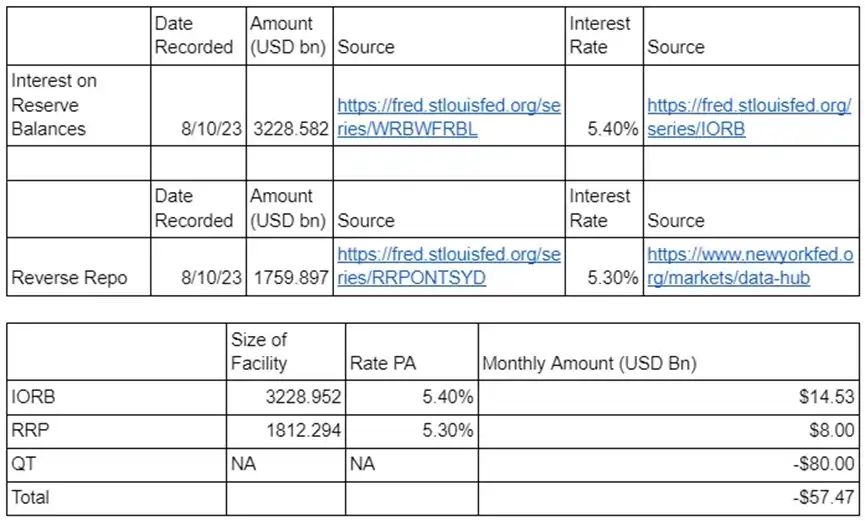
Technically speaking, the Federal Reserve should reduce its balance sheet by $95 billion per month, but in recent months it has only reduced it by an average of $80 billion.
Take a look at these two tables, and you will come to the conclusion that the Federal Reserve is still taking restrictive measures, as a total of $57.47 billion in liquidity is being withdrawn each month. However, I overlooked an important source of free funds: interest payments on US Treasuries. In the next section, I will explain how the Fed's actions affect the government's ability to finance itself by selling bonds. If we add this point, Sir Powell's pursuit becomes even more unrealistic.
Lost Paradise
After Europe self-destructed in World War II, the United States was able to establish and develop a manufacturing economy that was profitable and unchallenged, leading to great wealth and strong growth throughout the 1980s. There was a large, educated young workforce (the baby boomers) with abundant, cheap energy (even after the oil shocks of the 1970s, oil remained within the $10 range), and most importantly, the government had almost no debt.
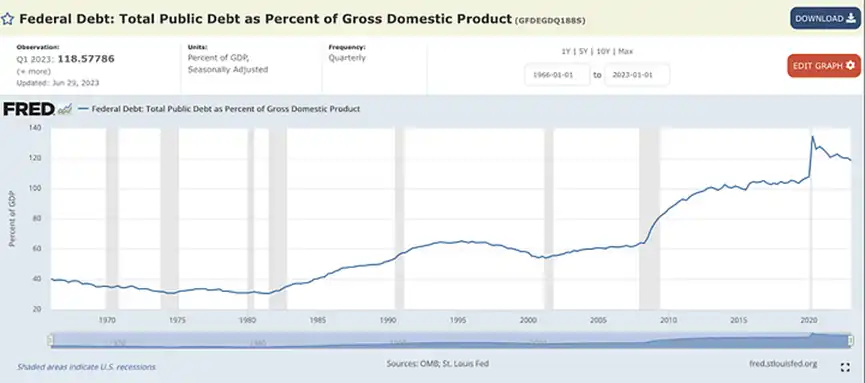
The key data here is that in 1980, US debt accounted for 30% of GDP. Today, this ratio is 118%. This means that when Volcker began tightening the money supply and interest rates soared, the US government's financial situation was not affected as much because the government did not have too much outstanding debt. This is completely opposite to 2023, as the current debt level is four times that of 2023.
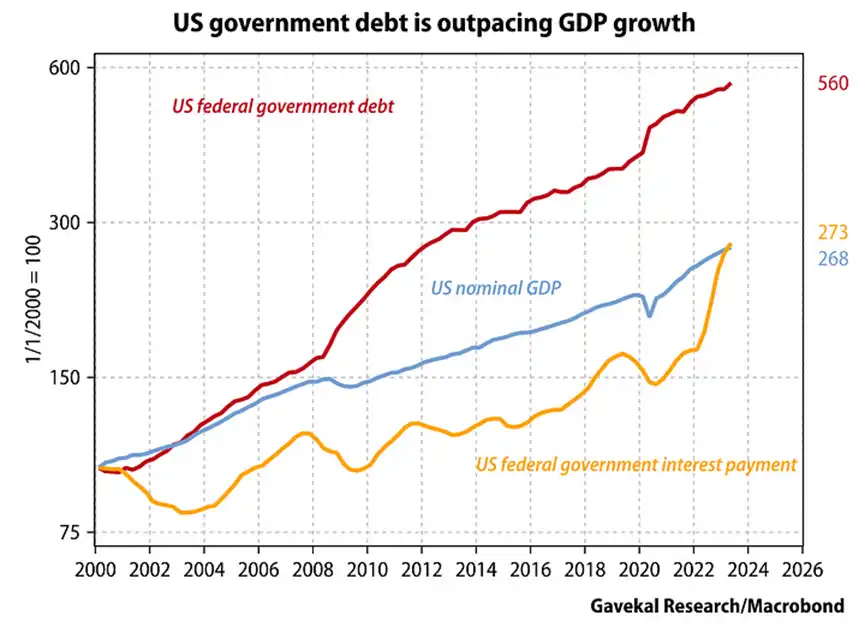
This is an excellent chart on the out-of-control growth of US government debt published by Gavekal Research. If the growth rate of debt is the same as the growth rate of nominal GDP, then the debt growth is sustainable; when it grows at a rate close to twice the growth rate of nominal GDP, it is a "prosperous" period.
——Faces of Rekt, Benjamin Franklin edition
The effect of the US government's debt balance on interest rates is significant. As the US Treasury Department cannot find any bond buyers below the federal funds rate, each time Powell raises interest rates, it increases the cost of providing funds for the government. Due to the short average maturity of US debt (2 to 3 years), high and rising budget deficits, the US Treasury Department must issue more and more debt to repay old debt, provide funds for interest payments on current debt, and pay for government spending. As a result, the US Treasury Department must pay interest to bondholders, which is even stronger than Sam Bankman-Fried's heart.
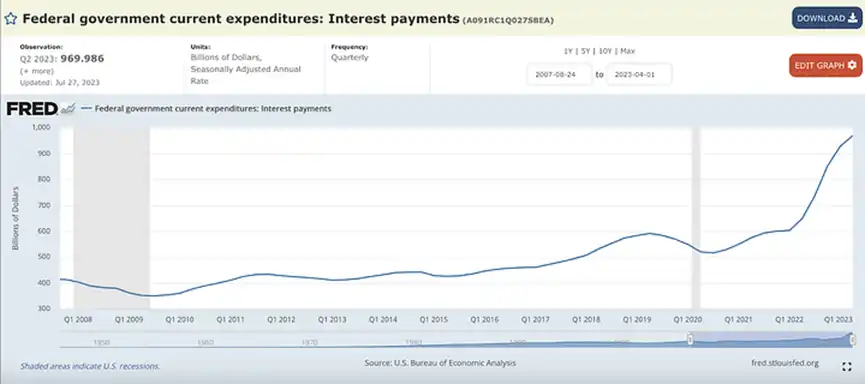
As of the second quarter of 2023, the US Treasury pays nearly $1 trillion in interest to debt holders each year. At a macro level, it is clear that as the Federal Reserve raises interest rates, the US Treasury will be incentivizing the wealthy through interest payments. When combined with funds provided through RRP and IORB tools, the Federal Reserve's efforts to control the price and quantity of money to tighten the monetary environment and suppress inflation ultimately have the opposite effect. The monetary situation of asset holders improves every month.
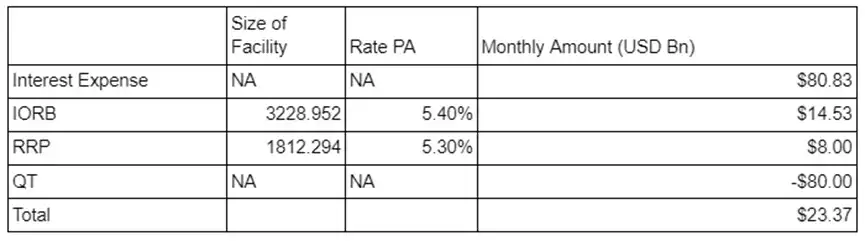
I estimate that the net inflow of liquid funds per month is about 23 billion US dollars.
This situation would not have occurred in the 1980s because the US government's debt situation did not require a large amount of interest payments to provide funding for past, present, and future debts. More importantly, the Federal Reserve does not pay interest to fix currency prices and/or attempt to offset potential inflationary consequences caused by past foolish behavior.
Consumer Basket
Why is the US economy booming while regional banks are struggling like zombies? Various indicators show that small businesses, which provide the driving force for the US economy, are struggling. This is because the wealthy are spending their money on services.
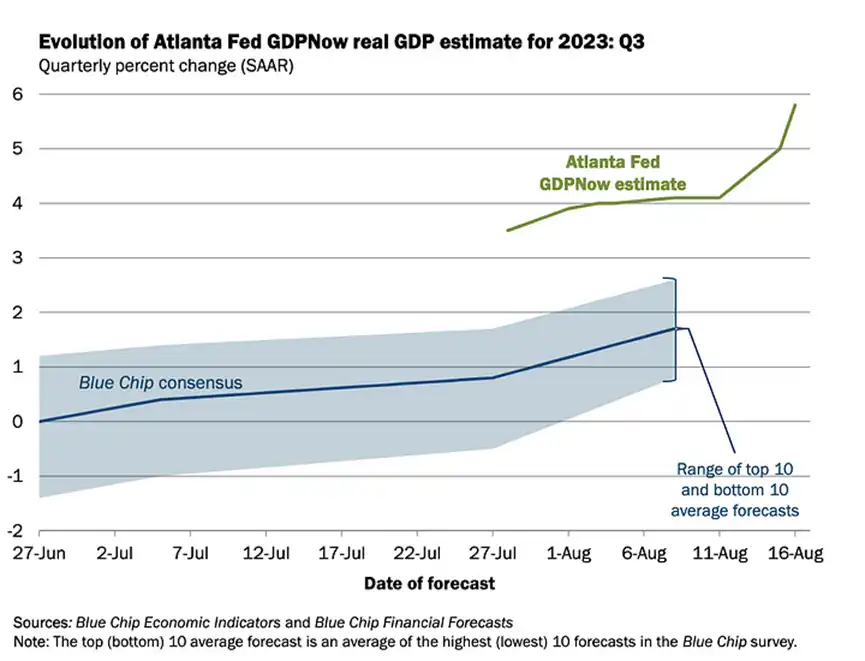
The United States, yes!!!! The Atlanta Fed is estimating real-time GDP and the US economy is booming. The error rate at the beginning of this quarter was high, but even with a 2% deduction, a forecast of 3% annualized GDP growth rate is still amazing.
When most Americans received their COVID vaccine subsidies, they went out and bought what they needed (or at least, social media told them what they needed). People bought new cars, vacation homes, washing machines, and so on. This is the reason for the global surge in commodity inflation and shortages: because the American middle class - relatively wealthy compared to ordinary citizens around the world - is buying things. However, the rich already have all these things. In fact, I would say that there is a limit to the number of bottles of Dom P that can be sprayed on a workbench, although I know Jho Low may disagree with me. When you give money to the rich, they spend more on services and buy more financial assets. You go from a cheap nail salon on the corner to a Bastian salon.
The service industry accounts for a large proportion in the consumer price index (CPI) basket. The Federal Reserve has proposed a method for measuring "super core" inflation, which is essentially the service industry.
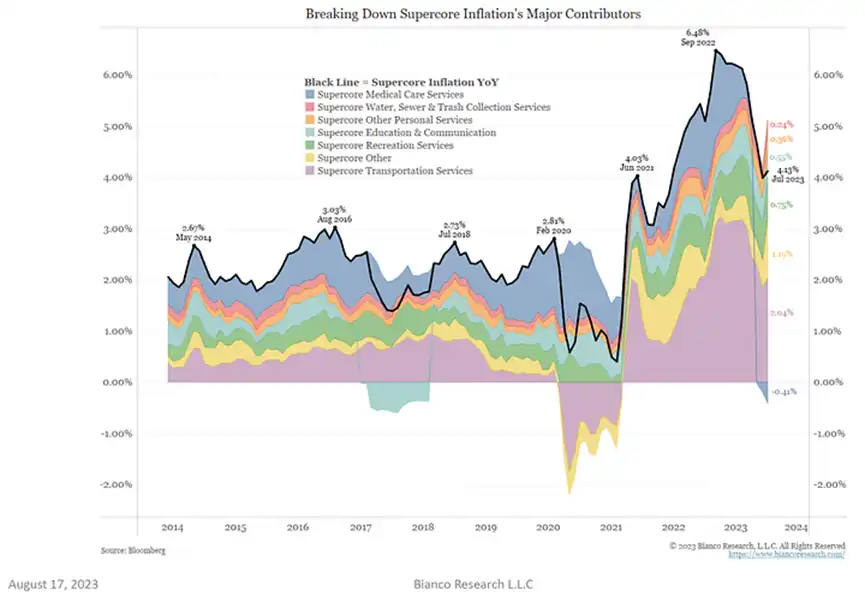 The content to be translated is:
Data source: Bianco Research
Translated content:Data source: Bianco Research
"Dear, wasn't that European summer vacation so much fun? Next, let's rent a small cabin in Aspen for the ski season and take a PJ. Don't worry, baby, we can afford it - all thanks to Powell Bauer."
Powell and his staff are focused on making this inflation indicator significantly decrease. However, if every time they use medicine (raising interest rates), it actually makes the largest service spender richer, how could it possibly decrease?
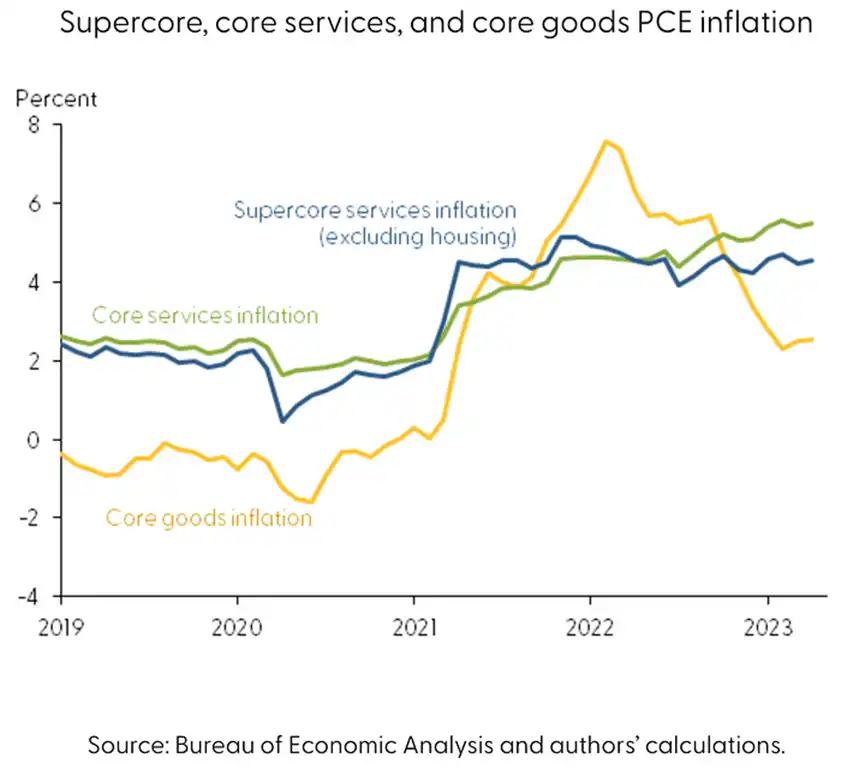
The service industry inflation is the highest among all manipulated government inflation indices.
Decentralization
Before looking ahead to the future, let's take a look back at the recent past.
Just because the Federal Reserve injects liquidity into the market does not mean that all assets will rise.
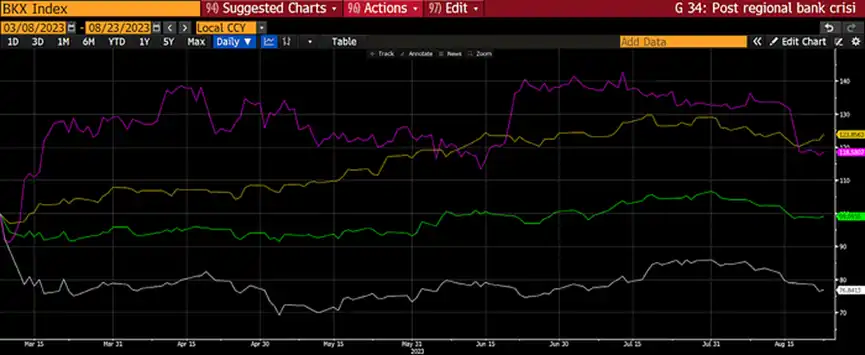
Using the starting index of 100 as of March 8, 2023 (the day Silvergate filed for bankruptcy), I examined the performance of the US Regional Bank Index (white), Russell 2000 Index (green), Nasdaq 100 Index (yellow), and Bitcoin (magenta).
If you are not a TBTF (Too Big To Fail) bank in the United States (there are 8 banks), then you are in trouble. This is what the 24% drop in the regional bank index tells us. These banks cannot make money when retail depositors can get nearly 6% interest from the Fed, but the banks' loan book yield is only 2% to 3% (as explained in my article "Kaiseki Cuisine"). As the Fed continues to raise rates, this problem will only get worse. Moody's recently downgraded a bunch of small banks due to this phenomenon.
As Lacy Hunt often says, if your bank is sick, you cannot have a healthy economy. Employees and businesses that drive the US economy rely on regional banks for credit. These banks are unable to provide funding when their balance sheets are severely damaged, causing these businesses to continue to be unable to expand and, in many cases, go bankrupt. This is what the Russell 2000 Index, which is mainly composed of small businesses, tells us. It hardly rose last quarter.
Large technology and artificial intelligence companies do not need banks. Either their business profits are abundant, and any capital expenditure can be directly funded by retained earnings, as is the case with companies such as Google, Facebook, Microsoft, and Apple, or they benefit from the artificial intelligence boom like Nvidia. I have received many speeches about this or that new "artificial intelligence" venture capital fund. If I want to spend money, I would rather go to a nightclub, so I will transfer these new funds to others. Obviously, this is the investment direction of those who have spare money, and I have no doubt that technology artificial intelligence startups will have all the cash they need. If the US banking system is sick, technology companies don't care. Those who have spare money are happy to sign contracts and repeatedly acquire technology giants. That's why the Nasdaq 100 index has risen 24% since the banking crisis erupted.
One of the value propositions of Bitcoin is that it is an antidote to a broken, corrupt, and parasitic fiat banking system. Therefore, as the banking system falters, the value proposition of Bitcoin becomes even stronger. In addition, Bitcoin benefits from increased fiat liquidity. The wealthy do not need physical goods, they need financial assets so that they can effortlessly consume their inner desires. Bitcoin's supply is limited, so as the denominator of fiat toilet paper increases, the value of Bitcoin in terms of fiat currency also increases. This is the reason why Bitcoin has risen 18% since March.
As long as the Federal Reserve sticks to its current course, technology stocks and cryptocurrencies will continue to rise. Apart from large technology and cryptocurrencies, there is nothing higher than getting a return of nearly 6% by depositing money with the Federal Reserve. If you are a non-dollar investor, the cash return on short-term government bonds or bank accounts may exceed your country's benchmark stock index. For example, in Brazil, the central bank policy interest rate is 13.15%, while the Ibovespa index has only returned about 5% so far this year. Cash is king globally.
Trapped
Trump Era
The content to be translated is:
Data source: Bianco Research
Translated content:Data source: Bianco Research
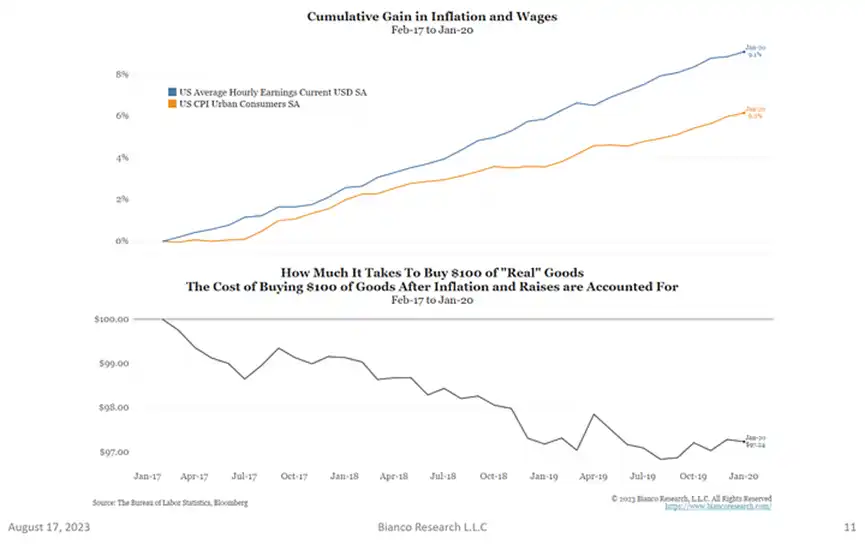
Bianco Research's chart shows that from 2017 to 2020, during Trump's presidency, wage growth exceeded inflation. This is indicated by the downward line in the bottom panel.
Biden Era
The content to be translated is:
Data source: Bianco Research
Translated content:Data source: Bianco Research
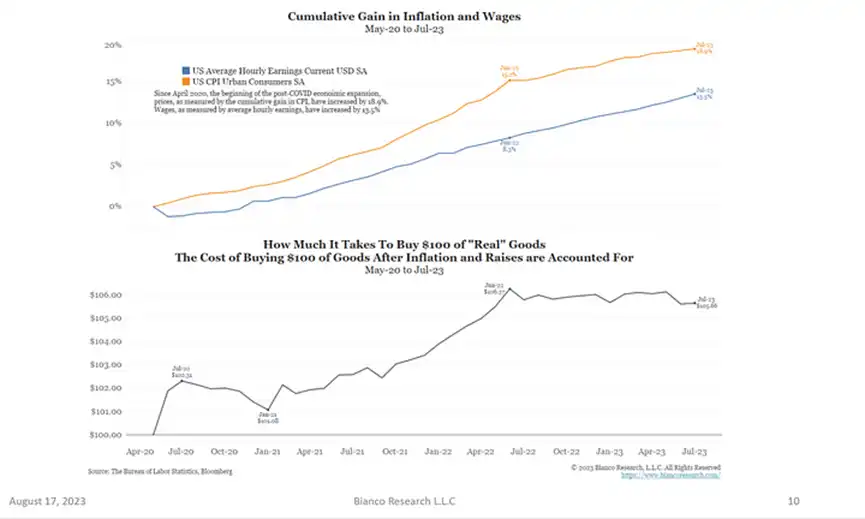
However, during President Biden's administration in the United States, wages have not kept up with inflation. The rising black line in the bottom panel indicates this.
The media tells you that former President Trump is a person who hates women, a racist, and a threat to democracy. In contrast, the media says that President Joe Biden is a tolerant and inclusive person, and a friend of the ordinary American working class. Considering the bias of the mainstream media, you would think that Biden would be the obvious favorite in the 2024 rematch against Trump - but their poll results are neck and neck.
Inflation is a top concern for anyone. If people can work hard and spend less money to buy more things, they won't really care who is responsible. But when the prices of gasoline and ground beef are high and constantly rising, God helps those politicians who must campaign for re-election. Excellent politicians know that if inflation occurs, they must control it, otherwise they will be forced to work for a living like the rest of us. What's the fun in that?!
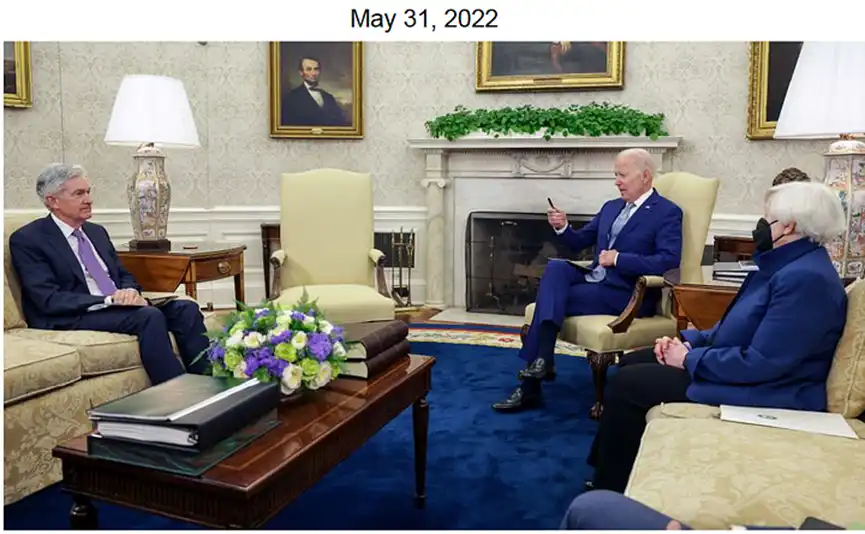
This is a photo of the meeting between US President Biden, US Treasury Secretary Yellen, and Federal Reserve Chairman Powell. Look at their body language. Doesn't it remind you of parents (Biden and Yellen) scolding their wayward son (Powell)? Look at Powell's β body language, he's not as submissive as a dad like Chad. What are they talking about? Inflation. Biden tells Powell that he must control inflation because if gas prices are too high on election day, everything Biden has done as president will be irrelevant. Let's see if this conversation is effective - maybe Biden should also call Hunter, although I think his son may have a hard time sitting still long enough to listen to this news.
The Federal Reserve will continue this foolish strategy of trying to control the quantity and price of money because politics demands it. Powell will not stop unless politicians give him the signal to do so. As the 2024 US election approaches, the Fed is more paralyzed than ever before. Powell does not want to change the Fed's policy from now until November next year because he is afraid of being accused of favoring any political party.
However, mathematics does not apply. Some things must change. Take a look at the chart below, where depositors continue to withdraw funds from banks with lower deposit rates and deposit them into MMFs, which essentially store funds with the Federal Reserve. If this continues, non-TBTF banks will continue to fail one after another, as this is a direct impact of Federal Reserve policy.
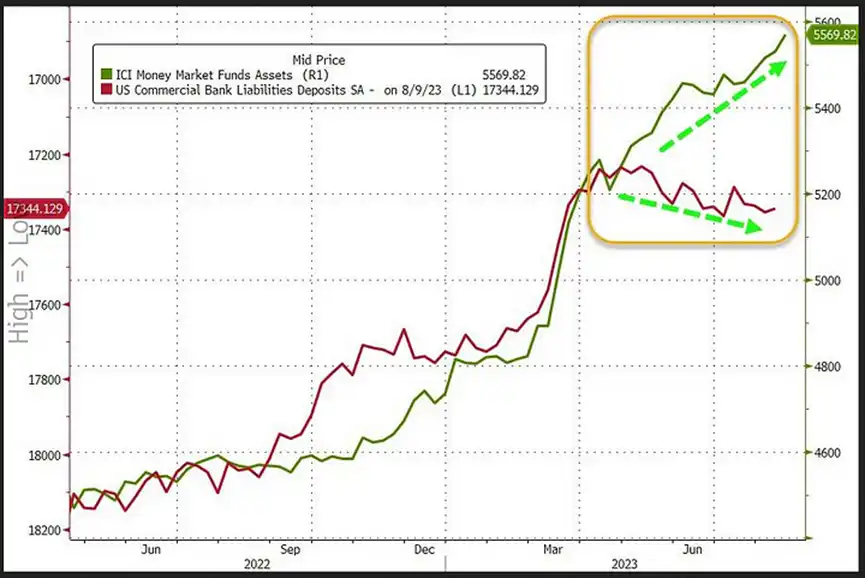
Data source: Bloomberg
More importantly, the US Treasury is expanding the scale of debt it must issue due to declining tax revenues, persistent fiscal deficits, and rising interest expenses (thanks to the Federal Reserve), and the volume of bond issuance will also increase. There must be a way to solve this thorny problem...
Currently, the biggest advantage of these scammers is that although they may not be honest in terms of reason, they will not completely lie to you. Fortunately, they will also tell you what they plan to do in the future. You just need to listen.
财政主导地位
translates to
Financial Dominance
in English.
For those who want to understand how the Federal Reserve and the US Treasury are doing the right thing mathematically and politically, the most important paper is the one published earlier this year by the St. Louis Fed. They have a research institution that allows authoritative economists to publish papers. These documents provide the basis for the Fed's policies. If you are serious about investing, you must read this article. I only excerpted a few parts of it.
Although this article focuses on the United States, the premise of fiscal dominance is global. Currently, Japan is a real-time example of what happens when fiscal dominance begins. Compared to the Federal Reserve, the Bank of Japan (BOJ) has much lower communication and transparency. The BOJ will never admit to being in a dominant position, nor will it publish papers criticizing its monetary policy, such as those from economics professors at the University of Tokyo. I will discuss Japan's situation more in the next section, but as always, Japan is playing out the global future. In the era of the modern US dollar reserve currency, the Bank of Japan was the first central bank to attempt quantitative easing. Then it turned to yield curve control (YCC). And now, the central bank has actually lost its independence in suppressing domestic inflation.
Dr. Calomiris will explain in detail what fiscal dominance is and its actual impact. Before I quote him, I would like to give readers a brief summary.
•When the central bank must formulate policies not to maintain price stability, but to ensure that the federal government has the ability to finance itself in the debt market, fiscal dominance will emerge.
•Due to the government's need for bond yields to be lower than nominal GDP growth and/or inflation rates, investors are not interested in buying these bonds. This is the definition of negative real yield.
• In order to find buyers to purchase these bonds, the central bank requires commercial banks to deposit a large amount of reserves. These reserves do not earn interest and can only be used to purchase government bonds.
• The profitability of commercial banks has declined as they are unable to attract deposits for lending, due to the deposit interest rates they are allowed to offer being much lower than the nominal GDP growth rate and/or inflation rate.
•Due to the inability of depositors to obtain actual returns from banks or government bonds, they have turned to financial instruments outside the banking system. In many cases, commercial banks themselves actively participate in channeling funds to different jurisdictions and/or asset classes in order to earn fees from clients. This is known as financial disintermediation.
• The unresolved question is whether commercial banks have enough political power to protect their customers and make this financial disintermediation possible.
Return to the "free" country. If it is easier for the Federal Reserve to directly cut interest rates, why go through all this trouble? Because, in the words of Dr. Caromilis, this is an "invisible" tax that most Americans will not notice or understand. While inflation is still rampant in the American middle class, maintaining high interest rates is a more expedient political solution than openly instructing the Federal Reserve to begin cutting interest rates and stimulating the market again (hopefully this will not happen) - or cutting government spending.
Now I will share some of the most important quotes from the article. However, I want to emphasize that you need to read the article yourself. I hope the St. Louis Fed website crashes because too many people decide to escape the trap of craving TikTok and Instagram and instead self-educate.
Who is Dr. Charles W. Calomiris?
"Charles W. Calomiris is the Henry Kaufman Professor of Financial Institutions at Columbia Business School and the Director of the UATX Center for Economics, Politics, and History."
Charles is a formal member of the Western economic enlightenment faction. He is not a Bitcoin fanatic or a crypto Twitter keyboard warrior like me. It is certain that his paper will be discussed at the central bank governors' conference to be held in Jackson Hole, Wyoming, USA soon.
Charles, in your own words, what is financial dominance?
This article considers the possibility of fiscal dominance, which means that the accumulation of government debt and deficits may lead to inflationary pressures, thus 'dominating' the central bank's intention to maintain low inflation.
What caused the dominance of fiscal policy? Did the US government spend too much money?
"The content in the financial report of the Ministry of Finance acknowledges that the combination of current government debt and projected deficits is arithmetically unfeasible, as it would result in an absurdly high government debt-to-GDP ratio."
When will financial dominance arrive?
"...If the global real interest rate returns to the historical average level of about 2% tomorrow, considering the current level of US government debt and the continued huge expected deficit, the US may immediately face fiscal dominance issues."
The actual interest rate = 2% (from Dr. Calomiris) + 4.7% (July 2023 core CPI inflation) = 6.7%
This is a constantly changing goal, but imagine what would happen if the entire US Treasury yield curve reached at least 6.7%. Game over!!
Why is this a bad thing for the people?
The dominant position of the government in finance leads to the government relying on inflation tax by "printing money" (increasing the supply of interest-free government debt). Specifically, I believe this situation occurs when the bond market begins to believe that the government's interest-bearing debt has exceeded its feasibility limit. The government's next bond auction will "fail" because the market is too enthusiastic about the issuance of new bonds. The government will then cancel the issuance and turn to printing money as an alternative solution.
A Fed-approved economist has just published a paper on the Fed's website, telling you about the future. Are you listening????!!!!
Let's talk specifically about how commercial banks will be affected in this situation.
What will happen to bank deposits?
In addition, if the dominance of fiscal policy becomes a reality, there may be some changes in the policy regarding reserve requirements. Given that current bank reserves earn interest and the existing zero-interest debt (inflation tax base) is currently limited to currency, if the government wants to provide funds for a large real deficit, it would be easier to do so if the government cancels interest payments on reserves. This potential policy change would mean a significant impact on the profitability of the banking system.
The banks are about to become tough.
This policy has some other impacts:
In addition to ending interest payments on bank reserves, the Federal Reserve must also stop paying RRP balances. No government department can offer a yield higher than long-term government bonds. Considering that the sole purpose of this practice is to control long-term government bond yields at levels far below inflation and nominal GDP growth rates, depositing money into MMFs and/or purchasing US government bonds will not be attractive. As a result, the high yield rates currently earned on cash will no longer exist.
Essentially, the Federal Reserve will end its attempt to control currency prices and instead focus solely on the quantity of money. The quantity of money can be changed by altering bank reserve requirements and/or the size of the Federal Reserve's balance sheet. Short-term interest rates will be significantly lowered, likely to zero. This will help regional banks regain profitability as they can now attract deposits and earn profitable interest rate spreads. It also makes financial assets outside of large tech companies attractive again. As the stock market rises overall, capital gains taxes will also increase, helping to fill the government's coffers.
Charles, why is squeezing banks the best choice?
Charles is ruthless, I can't even describe it myself.
First of all, the statutory deposit reserve ratio is a regulatory decision, usually determined by financial regulatory agencies rather than by legislative bodies to enact new taxes (which may be blocked in legislative bodies). Assuming that the regulatory agency with the power to change policies is under pressure from fiscal policy, it can be implemented quickly. In the case of the United States, this is the decision of the Federal Reserve Board on whether to require reserves on deposits and whether to pay interest on deposits.
The Federal Reserve is not accountable to the public like elected representatives. It can do whatever it wants without the consent of voters. Democracy is great, but sometimes dictatorship is better, faster, and stronger.
"Secondly, because many people are not familiar with the concept of inflation tax (especially in a society that has not experienced high inflation), they do not realize that they are actually paying an inflation tax, which makes it very popular among politicians."
Charles, can we be friends? Charles just said, "You are too stupid, unfocused, and haven't noticed how the government has been using inflation to gently soothe you."
Finally, Charles elaborated on why this would be the preferred policy for the Federal Reserve or other central banks.
If, as I have said below, a policy of canceling reserve interest and requiring a significant proportion of deposits as reserves can significantly reduce inflation, then I believe the Federal Reserve Board will find it difficult to refuse to implement this policy.
To understand the mathematical principles behind why this policy can reduce inflation, please read this article. There is a section that explains in detail why this policy actually reduces the inflation needed for the government to lower the debt-to-GDP ratio.
How can banks fight back?
Do you think Jamie Dimon, CEO of JPMorgan Chase, will be messed up without taking any protective measures?
This policy change will not only reduce the profitability of banks, but also significantly lower the actual return rate of bank deposits to below the return rate of other liquid assets. This may stimulate a new era of 'financial disintermediation' as consumers and businesses seek alternatives to low-interest bank deposits.
This will take us back to the period between 2008 and 2021, when cash was trash because it offered almost no returns, while stocks, real estate, cryptocurrencies, NFTs, art, and other assets could provide better returns. As a result, capital flowed out of the banking system and into these financial assets.
Charles continues to speak...
"The need to maintain a high inflation tax base may lead to a political choice to maintain a technologically backward banking system. (As discussed by Calomiris in 2021, this will continue and accelerate the recent political trend of restricting fintech bank licenses.)"
Easy-to-use digital banking systems make it easier for funds to leave the banking system. One important reason why three US banks collapsed within two weeks is that depositors can now transfer all their funds to another bank in less than 5 minutes. Bank runs happened so quickly that management was powerless to stop them. If financial dominance plays a role, there is no reason for banking regulators to encourage more innovation.
Of course, banks and their political allies may try to oppose financial innovation that allows businesses and consumers to exit banks, which could lead to an interesting regulatory battle over the future of financial intermediaries.
Financial Disintermediation
Financial disintermediation refers to the flow of cash from the banking system to other options due to low returns. Bankers have come up with various novel and creative methods to offer customers higher-yielding products as long as the costs are reasonable. Sometimes, regulatory agencies are not so satisfied with this "originality" or "innovation".
During the Vietnam War, the United States was always in a dominant financial position. Faced with high inflation, US regulators set a deposit interest rate ceiling for banks to control interest rates. In response, US banks opened offshore branches, mostly in London, which were not subject to US banking regulators and could freely offer market-based rates to depositors. The Eurodollar market was thus born, and its related fixed-income derivatives became the world's largest financial market in terms of trading volume.
Interestingly, efforts to control something often lead to the creation of a larger, more difficult-to-control beast. Until today, the Federal Reserve and the US Treasury have almost no understanding of all the corners and crevices of the European dollar market, and Bank of America was forced to create the European dollar market to protect its profitability. Similar things can also happen in the cryptocurrency field. This is an example of financial disintermediation that Charles talked about.
The leaders of large TradFi intermediaries (such as banks, brokerage firms, and asset management companies) are the smartest people on earth. Their entire job is to predict political and economic trends well in advance and adjust their business models to survive and thrive. For example, Jamie Dimon has long emphasized the unsustainability of the US government's debt burden and spending habits. He and his colleagues know that a reckoning is coming, which will result in sacrificing the profitability of their financial institutions to fund the government. Therefore, they must create something new in today's monetary environment, similar to the European dollar market of the 1960s and 1970s. I believe that cryptocurrency is part of the answer.
The action being taken by the United States and the West to crack down on cryptocurrency is mainly to make it difficult for operators who provide lunch to those who are not at The Racquet & Tennis Club on Park Avenue to conduct business. Think about it: the Winklevoss brothers - two tall, handsome, Harvard-educated billionaires in the tech industry - why can't their Bitcoin ETF be approved in the United States, while BlackRock's stubborn Larry Fink seems to be sailing smoothly? Perhaps it's because BlackRock's ESG policy is more mature. What I want to say is that cryptocurrency itself has never been the problem - the problem is who owns it.
Why are banks and asset management companies suddenly interested in cryptocurrencies just as the competition has ended? Does this make sense? They know that the government will come to seize their deposit base, and they need to ensure that the only available antidote to inflation - cryptocurrencies - is under their control. TradFi banks and asset management companies will offer cryptocurrency exchange-traded funds (ETFs) or similar types of managed products to provide customers with cryptocurrency derivatives in exchange for legal tender. Fund managers charge high fees because they are the only ones allowed to easily sell fiat currency for cryptocurrency financial returns. If cryptocurrencies can have a greater monetary system impact than the European dollar market in the coming decades, TradFi can make up for losses caused by unfavorable banking regulations. They do this by becoming the gatekeepers of their trillions of dollars in deposits through cryptocurrencies.
The only problem is that TradFi has done a good job of creating a negative impression of cryptocurrencies, and politicians actually believe it. Now, TradFi needs to change its rhetoric to ensure that financial regulators have the space to control capital flows as the federal government imposes hidden inflation taxes on bank depositors.
Banks and financial regulatory agencies can easily find common ground by restricting the physical redemption of any cryptographic financial products offered. This means that holders of these products will never be able to exchange and receive physical cryptocurrencies. They can only redeem and receive US dollars, which will be returned to the banking system, which is causing chaos from the front, back, and sides.
The more philosophical question is, can we still retain the spirit of Satoshi Nakamoto when this industry is filled with financial products that could be worth trillions of dollars, firmly locked within the legal TradFi system? Larry Fink doesn't care about decentralization. His business is based on BlackRock's asset concentration. Asset management companies like BlackRock will have an impact on Bitcoin improvement proposals, such as increasing privacy or censorship resistance. Companies like BlackRock, Vanguard, and Fidelity will compete to launch ETFs that track publicly traded cryptocurrency mining companies. Soon, miners will find that these large asset management companies will control a significant voting power over their stocks and will influence management decisions. I hope we can remain faithful to our Lord, but the devil is waiting for us and has given many an irresistible song of temptation.
Before I share some thoughts on trading, please allow me to ask Charles if there are any other ways to solve the problems of the US financial system.
"Of course, another policy path to reduce inflation tax is for the government to decide to reduce the fiscal deficit, thereby avoiding the rise of inflation and its adverse effects on the banking system."
Wow, that's so simple! But wait - Charles poured cold water on that stupid idea.
However, this may be a difficult policy to implement, as the main source of future deficits is the enormous expenditure on medical insurance and social security benefits. In addition, due to increased geopolitical risks related to China, defense spending appears likely to increase.
The three major spending habits of the US government are politically untouchable. The debate ends here - the US government must print money.
"In the end, it seems that the United States may either have to decide to limit welfare or take the risk of significant future inflation and financial backwardness."
"...Banks and their political allies will double their efforts to use regulation to protect the banking system from the impact of innovation and competition, just as they have been doing (see Calomiris, 2021). Ultimately, the United States may face a political choice between reforming welfare programs and tolerating high inflation and financial backwardness."
I still can't believe I just saw my talking points on the St. Louis Fed website. Thank you, Charles, you are my good friend.
Ueda-Domo
In order to evaluate whether the Bank of Japan has been dominated, let's use the checklist exercise that Charles gave us earlier.
Is the ratio of Japan's government debt to GDP very high?
Yes, it is, with a growth rate of 226%, it is one of the largest economies among developed countries.
Can the government bear a long-term average real interest rate of 2%?
No. Japan's inflation rate in July was 3.3%. If we add 2% (the long-term average real yield of bonds) to this level, we will get 5.3%. If the Japanese Ministry of Finance has to provide funding for all debts at these levels, interest payments will be several times tax revenue.
Has the government bond auction failed?
Yes. The auction of the 20-year Japanese government bonds last week was essentially a failure. Its tail was the largest in nearly 40 years. This means that private investors are unwilling to buy long-term bonds at such a large negative real yield.
Does the central bank prioritize maintaining low interest rates over raising them to combat inflation?
Yes. Japan's inflation is at its highest level in nearly 40 years. However, the Bank of Japan continues to issue meaningless forecasts, saying that it will return to below 2% in the "future," so they must continue to ease. This makes no sense, as their inflation rate has been over 2% for over a year. They have not yet specified how long the inflation rate must be above 2% before they can declare success and stop printing money to suppress Japanese government bond yields through bond purchases.
The ultra-low interest rates are stimulating the "animal spirit" of ordinary Japanese people's recovery. Some examples are the booming stock market (the Nikkei index is close to recovering the top of the 1989 bubble), and the rapidly rising prices of metropolitan apartments in cities such as Tokyo. Interestingly, I heard from my Japanese friends that workers are giving up lifetime employment so that they can become contract workers, enjoy fewer benefits, and immediately receive at least a 30% pay raise.
With the rise in prices of all physical and financial assets, the motivation for people to deposit money in banks and earn low returns has weakened. The Bank of Japan must take action quickly to establish the largest possible deposit base to implement an inflation tax. One of the discussions at the Jackson Hole meeting may be for the Bank of Japan to take action first, by requiring banks to increase reserve requirements and forcing these reserves to purchase government bonds. This would force the Federal Reserve and the US Treasury to first observe the impact of this policy on a vassal state of the US, and adjust it if necessary, before taking similar action domestically in the US.
Let's make some money
Dr. Calomiris' paper provides a very reliable "solution" to the problems of the Federal Reserve and the US Treasury. I bet this could be a way to find a foolproof way to buy long-term US government bonds at a government-affordable yield. The question now is how to adjust my investment portfolio and wait for fiscal dominance to force the policy prescription described by Dr. Calomiris to be implemented.
Currently, cash is good because, on a broad basis, only large technology and cryptocurrency surpass it in financial returns. I need to eat, unfortunately, most of the time I hold technology stocks or cryptocurrencies without income. Technology stocks do not pay dividends, and there are no risk-free Bitcoin bonds for investment. My fiat income of nearly 6% is great because I can pay for living expenses without selling or borrowing my cryptocurrency. Therefore, I will push my current cash investment portfolio to MMF and cryptocurrency on a barbell.
I don't know when the US Treasury market will collapse, forcing the Federal Reserve to take action. Given the political demand for the Fed to continue raising interest rates and reducing the size of its balance sheet, we can assume that long-term interest rates will continue to rise. The 10-year US Treasury yield recently broke through 4%, currently at a local high. This is the reason why risk assets such as cryptocurrencies have suffered heavy losses. The market believes that higher long-term interest rates will harm indefinite assets such as stocks and cryptocurrencies.
In his recent report, Felix's father predicted a severe market correction for all assets, including cryptocurrencies. It seems he is as valuable as ever. I need to be able to earn income and withstand market losses in the cryptocurrency market. That's why my investment portfolio is designed for this purpose.
I believe my prediction for the future is correct, because the Federal Reserve has indicated that bank reserve balances must grow, and it is foreseeable that the banking industry is not happy. The continuous rise in long-term US Treasury yields is a sign of deepening market structure deterioration. China, oil-exporting countries, Japan, the Federal Reserve, and others are no longer buying US Treasury bonds for various reasons. With the usual buyers on strike, who will step up to buy the tens of trillions of dollars in bonds that the US Treasury must sell in the coming months in a low-yield environment? The market is rapidly moving towards the scenario predicted by Calomiris, ultimately leading to auction failures and forcing the Federal Reserve and the Treasury Department to take action.
The market has not yet realized that the faster the Federal Reserve loses control of the US Treasury market, the faster the rate cuts and quantitative easing will restart. Earlier this year, we proved this point when the Fed abandoned its monetary tightening policy and expanded its balance sheet by hundreds of billions of dollars in just a few trading days to "save" the banking system from the impact of various regional bank defaults. The malfunctioning US Treasury market favors limited-supply risk assets such as Bitcoin. However, traditionally, investors have not been trained to view the relationship between risk-free rate bonds and priced risk assets in this way. We have to go down before we can go up. I don't intend to fight the market, but to watch and accept my stimulation.
I also believe that at some point, more investors will calculate and realize that the Federal Reserve and the US Treasury are collectively distributing billions of dollars each month to wealthy depositors. Some of this money will inevitably flow into technology stocks and cryptocurrencies. Although the significant adjustments in cryptocurrency prices may sound pessimistic to mainstream financial media, there is a lot of cash that needs to find a home in financial assets with limited supply, such as cryptocurrencies. While some people believe that Bitcoin will fall below $20,000, I tend to think that we will hover around $25,000 at the beginning of the third quarter. The ability of cryptocurrencies to withstand storms will be directly related to the interest income of finding a new home.
I am not afraid of the weaknesses of this cryptocurrency, but rather embrace them. Because I am not using leverage in this part of my investment portfolio, I do not care if the price drops significantly. Using algorithms, I will patiently buy some glorious junk coins, and I believe that when the bull market returns, these junk coins will become rock stars.
I still owe readers one last article about the upcoming frenzy of AI + encryption. Sigh, I'm still accumulating the shitcoin that I plan to talk about extensively in that article. Down 99% from its historical high in 2021, I want MOAR! I love buying the dip in bear markets because I believe in true quality. If you happen to be in Singapore for Token2049, please come listen to my keynote speech where I will discuss my investment thesis on this shitcoin.
But for now, the Federal Reserve is done for because it cannot focus on important things. However, after taking a few classes, I am much better now. It's time to lean back in my chair, trust my kite, and pull it across the Atlantic.
Original article link
Welcome to join the official BlockBeats community:
Telegram Subscription Group: https://t.me/theblockbeats
Telegram Discussion Group: https://t.me/BlockBeats_App
Official Twitter Account: https://twitter.com/BlockBeatsAsia

 Related Articles