Arthur Hayes: Hold Your BTC and Avoid Future Disasters in the U.S. Banking System

Original title: "Arthur Hayes: Save your BTC and avoid current and future disasters in the U.S. banking system"
Original author: Arthur Hayes
Original text Compilation: Kate, Marsbit
(Any opinion expressed below is the personal opinion of the author and should not form the basis for making investment decisions, nor should it be construed as engaging in investment transactions suggestions or recommendations.)

The economy of the pub has a lot in common with the national banking system.
Going to the bar is fun. You can listen to good music, hang out with friends and, for some, find a partner. However, after all the fun, there are always bills to pay - and sometimes they can be substantial. With no agreed set of rules for how the fees will be distributed, discussions about who pays and how much can get quite heated.
"I was only there for a little while."
"I just Had a drink."
"I didn't bring any girls."
Your Friends (you know the one) will always find excuses to avoid being part of those who have to split the bills. Early in my banking career, a group of close friends of mine (we call ourselves Fam) codified the "Bottle Rules" while chatting at work one day.
Bottle rules determine whether a crew member is part of the denominator and therefore must pay an equal share of the night's bill.
The rules are simple:
1. Girls don't have to pay.
2. If you only drink one glass, you will drink the whole bottle.
3. If you bring a girl to the table and she drinks, you have to drink the whole bottle.
4. If you bring a male friend and he only drinks one glass, he will drink the whole bottle, and you have to pay his share.
5. If you order champagne, you have to pay the full price yourself. This rule is crucial. There is one Fam member whose ego always trumps his willingness to pay on various occasions. At 1 Oak in Tokyo a few years ago, he miscalculated and thought he could buy a line of 6 bottles of Dom P for the price of a bottle. He orders a train, feels like a fool, and then - realizes his math error after getting the bill - tries to charge the entire team for his stupidity. He was severely reprimanded by another friend, and ended up paying the full price himself.
6. If you order a bottle of wine before the bar closes, you will have to pay the full price yourself. (The same champagne-drinking friend makes this mistake a lot.)
Now we come to the more pressing issue: how the banking system distributes the inevitable losses .
Countries love a sound banking system. A good banking system can pool the savings of citizens and lend them to the government and productive enterprises. In an ideal world, such lending creates economic growth.
However, the banking system often gets into trouble because they have low reserves - that is, they lend more money than they deposit. Their willingness to lend money they don't have often puts them in a position where they cannot meet all withdrawal requests from savers, especially in times of economic stress. These situations are often the result of a combination of political pressure, profit motives and/or risk mismanagement, which have resulted in large losses for banks, often from underwriting bad loans or from loan losses due to rising interest rates. A bank run ensues, and then the government must decide who will pay for bringing its glorious banking system back to solvency.
Should depositors, shareholders or bondholders share in the cost of bailing out banks? Or should the government print money to "bail out" failing banks and pass the cost on to all citizens in the form of inflation?
Before any crisis occurs, a well-functioning banking system establishes an agreed set of rules to manage such situations, ensuring that everyone knows how to deal with the prospect of failure bank, thus eliminating any surprises. Because the financial and political elite consider the banking system to be an integral part of a well-functioning country, it is safe to assume that in almost every country the banks will always be bailed out. The real question is, which idiots will be included in the denominator responsible for paying the bank's recapitalization charges? No matter what cost allocation agreement the parties had reached before the bank failed, once the bank did fail, all relevant stakeholders would lobby the government to avoid being part of the denominator.
Bianco Research has released a truly epic chart package that clearly illustrates the current and future disaster of the US banking system. Some of their diagrams will be presented in this post.
The United States of America or China
The US government is at a crossroads, so far, It is hesitant about the type of banking system it wants to make peace with America. Does it want a decentralized system of small and mid-sized banks that lend locally (i.e. the pre-2008 US banking system)? Or does it want a centralized system of a few large banks that lend primarily to national champions, the super rich and Jeffrey Epstein (i.e. China's banking system)?
After the 2008 global financial crisis, the writers responsible for banking regulation decided they would create a two-tier system. Eight banks were deemed too big to fail (TBTF) and received unlimited government guarantees on their deposits. JP Morgan leads the way, holding 16% of all U.S. deposits. There is no risk in depositing money with these large banks. If a TBTF bank screwed up, the US government would print money to make sure all depositors got their money back. Essentially, the eight banks are all state-owned, with profits privatized by shareholders but losses socialized by citizens. In return for the back-door deal, the eight banks were given a host of new rules to follow. These big banks then spend hundreds of millions of dollars on political campaign contributions to help fine-tune those rules and achieve the most favorable limits.


Source: Open Secrets
Every other bank will have to navigate the turbulent free market on its own. Not all deposits are guaranteed - with the risks involved, you might think that depositors should be clearly informed about how these banks lend. Instead, depositors are left to interpret banks' deliberately vague and misleading financial statements and draw their own conclusions about whether a particular bank is doing well.
All banks cater to different types of customers. TBTF Bank primarily serves large corporations and the ultra-wealthy, who are specialists in securities lending and trading. TBTF banks are also conduits for the monetary policy of the Federal Reserve (Fed) and the U.S. Treasury, which support the U.S. government by purchasing large amounts of U.S. Treasury securities.
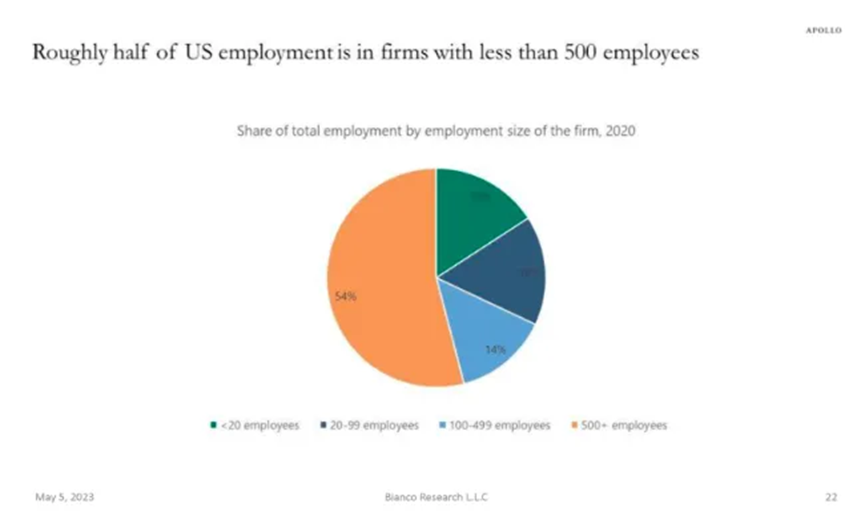
Non-TBTF banks, on the other hand, power the real engines of the U.S. economy—that is, they lend to small and medium-sized Personal loans. They take scraps discarded by TBTF banks from the proverbial forms and fill their loan books with commercial real estate, residential mortgages, auto loans, and personal loans (just to name a few). Take a look at the two charts below, which depict the importance of a strong network of small, non-TBTF banks to the U.S. economy.

Although these two groups of banks in the U.S. banking system are exposed to different types of credit risk through their respective loan books, they carry the same interest rate risk. Interest rate risk is that if inflation rises and the Fed raises short-term interest rates in response to inflation, the loans they underwrite at lower rates lose value. That's bond math. (I have discussed this at length in my article Kaiseki phenomenon.)
In March of this year, when three banks failed within a week, the Federal Reserve and the U.S. Treasury Department hastily concocted a plan called "Bank Term Funding Program (BTFP) relief program. Under the program, any bank holding U.S. Treasury securities (UST) or U.S. mortgage-backed securities (MBS) can turn them over to the Fed and receive 100% of face value in newly printed dollars.
Given that the fiat-based fractional reserve banking system and the American-style peaceful financial system in general is a game of confidence when the market sees their antics When it's bullshit, the reaction from those in power is not kind. Financial markets rightly saw through BTFP and recognized it as a thinly disguised way of printing $4.4 trillion to "save" the US banking system. The market expressed its displeasure with this inflationary move by pushing up the prices of gold and bitcoin. On the political front, many U.S. elected officials have gone out of their way to speak out against these bank bailouts. Liars never like to be unmasked, and the Fed and Treasury realized that the next time the banks needed a bailout, their intentions couldn't be so obvious. This means that any adjustments made to BTFP need to be implemented in secret. The adjustment we are most interested in relates to the type of collateral eligible for the BTFP program.
Gold is up 5% (white) and Bitcoin is up 40% (yellow) since the BTFP announcement on March 11, 2023.

But first, It is important that we understand what is causing this change. TBTF banks – and any bank with a significant portion of their assets in US securities or MBS securities – benefited from the BTFP announcement alone. The market knows that if and when these banks experience deposit outflows, they can easily meet their cash needs by handing over eligible bonds to the Fed and getting dollars back. Non-TBTF banks are not so lucky, as a significant portion of their assets are not eligible for BTFP financing.
In less than a quarter, the market sees through BTFP and puts pressure on non-TBTF banks. The market wonders, "If they can't use BTFP, who is going to pay for the interest rate losses on their loan books?" It makes them ask themselves, "Why would I want to take an equity stake in a bank that doesn't get implicit or explicit government support? ?” This question is especially important because the recent bailout of First Republic Bank showed that the “price” for the FDIC to arrange a strong combination of a failing non-TBTF bank with a healthy TBTF bank was equity and bondholders total loss. So shareholders started dumping their stakes in regional banks... 99% loss is better than 100% loss. Whoever sells first will sell the best.
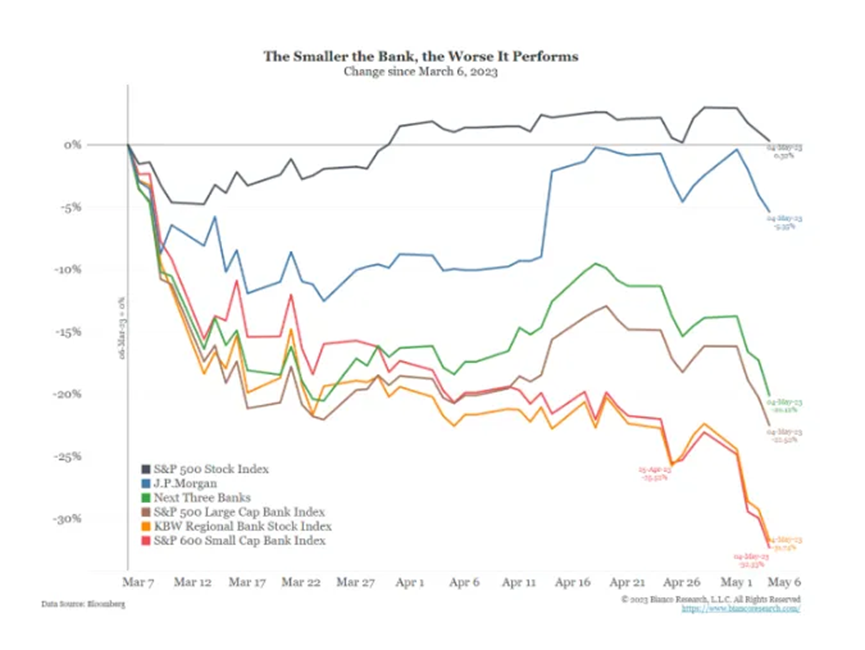
First Republic Bank is first victim after BTFP , the way it ended gave us more clues as to who was in the US government's favor and who was falling out of favor. The politics of bank bailouts are pernicious. In 2008, when the big banks received hundreds of billions of dollars in support from the government and handed out record bonuses, many citizens were outraged that they had lost their homes, cars and/or small businesses. Politicians are thus reluctant to support ostensibly obvious bank bailouts, not least because the US is (in theory) a capitalist society and allowing companies to fail is considered part of the system.
I'm sure US Treasury Secretary Janet Yellen was rebuked for BTFP and told that in any case the US government Neither can bail out more bankrupt banks. I think she was told that the private market would have to find a solution to manage the insolvency of non-TBTF banks - meaning that tweaking the BTFP to make any and all bank assets eligible for financing was out of the question . Not long ago, U.S. President Joe Biden told Federal Reserve Chairman Jerome Powell that stopping inflation was his top priority. Not against the President's wishes, the Fed was unable to lower interest rates enough to help stem the outflow of deposits from these crumbling banks when inflation was still at 5% (I'll elaborate on this later in this article). For political reasons, the two main financial arms of the government (the Federal Reserve and the US Treasury) were unable to change their policies to effectively deal with this banking crisis.
"I'm running for president because I'm tired of the so-called trickle-down economy. We now have the opportunity to build on the historic recovery and build an economy that works for working families .In order to transition from a rapid recovery to steady, steady growth, the most important thing we can do right now is bring inflation down. That's why I make addressing inflation my top economic priority." U.S. President Joe Biden wrote in a Wall Street Journal op-ed in May 2022
Responsible for liquidation The Federal Deposit Insurance Corporation (FDIC), the US government agency for bankrupt banks, did its best to bring TBTF Banks together and fulfill its "duty" to buy loss-making banks. Unsurprisingly, these profit-driven, government-backed businesses were reluctant to participate in bailing out First Republic Bank unless the government was willing to spend more. That's why many days later, after the stock price fell 99%, the FDIC took over First Republic Bank to sell its assets to pay off depositors.
Note: The share price of the bank is important for two reasons. First, banks must have a minimum amount of equity to back their liabilities, or exposure. If the stock price falls too far, it violates these regulatory requirements. Second, the decline in bank stock prices has prompted depositors to flee banks because they fear that there will be waves without wind.
In the 11th hour before the market opened on Monday, May 1, 2023, the FDIC provided the largest TBTF bank, JPMorgan, with a private In the deal, JPMorgan Chase agreed to buy First Republic Bank. The deal was so good that JPMorgan Chief Executive Jamie Dimon said on a shareholder call that the bank would immediately recognize a $2 billion profit. JPMorgan Chase, which has a government guarantee, refuses to buy a failing bank unless the government gives it a very lucrative deal that nets it $2 billion immediately. Where is Jamie's patriotism?
Don't let the numbers distract you from the important lessons of this rescue. The First Republic Bank deal illustrates the preconditions for TBTF Bank to be nationalized by acquisition. let's see.
Conditions:
Stockholders And bondholders are out. A donut, a bagel, a duck egg. Capeesh?
Response:
If your bank With interest losses (every bank has) on their loan portfolio that doesn't qualify for BTFP, you must sell those shares immediately! You don't want to get killed by the FDIC. Short sellers are not responsible for the plunge in these shitty bank stocks. Long-term holders are selling out of fear of a 100% loss of capital should the FDIC step in.
Conditions:
Guaranteed by the government TBTF banks must acquire failed banks by taking over their assets. TBTF banks can only do this with additional government assistance from the FDIC.
Response:
In the First Republic In the case of banks, JPMorgan Chase received low-interest loans from the FDIC, and the institution took 80% of the losses on the loan book. Essentially, it appears that the government will only expand collateral eligible for BTFP if TBTF banks buy out failed banks first. That's smart, most politicians and their voters don't realize that the US government has expanded its support for the banking system without an official announcement. Now, the FDIC's balance sheet will be inflated by failed bank loan books and potential losses on low-interest loans to TBTF banks. Therefore, the Powell, Yellen and Biden administrations cannot be easily accused of printing money to save the banks.
Key assumptions
If you believe, in a pinch , US policy makers will always do whatever is necessary to save the banking system, then you have to agree that all deposits in federally chartered banks will eventually be guaranteed. If you disagree, then you have to believe that some bank depositors will suffer.
To assess which side is more likely to be right, just look at the banks that have failed so far in 2023, and how they have been dealt with.
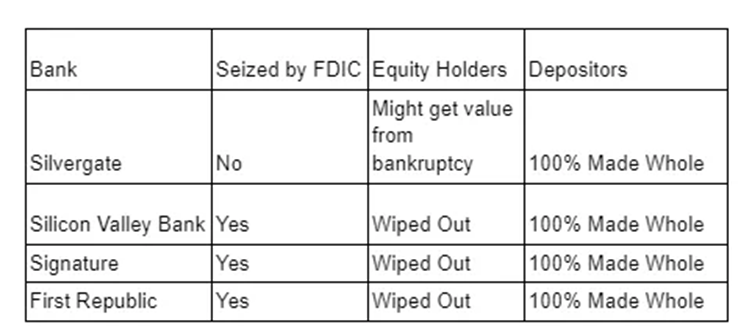
Note: Silvergate is not technically taken over by the FDIC as it was declared before full bankruptcy bankruptcy.
In all cases of FDIC seizures of banks, depositors are protected. Thankfully, despite Silvergate declaring bankruptcy, it was still able to compensate depositors. So even if you're at a non-TBTF bank, your money is likely to be safe. However, if the FDIC takes over the bank, there is no guarantee that a TBTF bank will swoop in and leave depositors safe and sound. If a bank declares bankruptcy, there is no guarantee that it will have enough assets to cover all deposits in full. Therefore, it is in your best interest to transfer all funds over the $250,000 insurance limit to a TBTF bank with a full government deposit guarantee. This will inevitably drive a large flow of deposits from non-TBTF banks to TBTF banks and further exacerbate the problem of deposit flight.
The reason why U.S. Treasury Secretary Yellen cannot provide comprehensive deposit guarantees to all banks is that this needs to be passed by the U.S. Congress. As I said above, there is no interest in seeing more bank bailouts from politicians.
Deposit outflow
Non-TBTF banks will continue to lose deposits at an accelerated rate.
First of all, as I said above, to be 100% sure that your deposit is safe, you must transfer your money from a non-TBTF bank to TBTF bank.
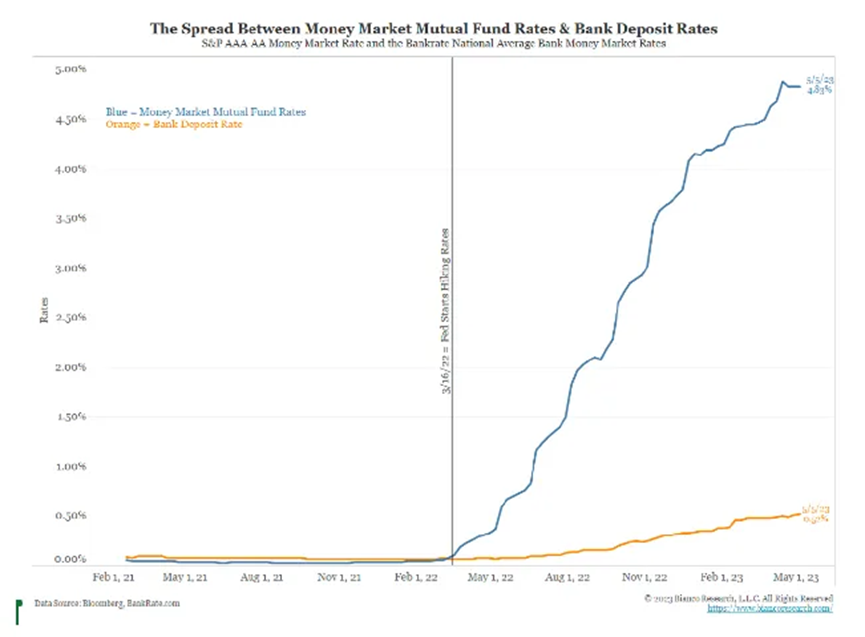
Secondly, all bank deposits will go to money market funds. Money market funds deposit money with the Federal Reserve and/or invest in short-term U.S. Treasury securities. Think about it -- you could earn 5% in a money market fund, or 0.50% in a bank depositor (see chart above). Why would you keep your money in a bank when you could use your phone to transfer your money and earn almost 10x the interest in the time it takes to watch a few TikTok videos?
Even if you don't know what a money market fund is and just want to keep your money in the bank, there's no reason to invest in a non-TBTF right now. TBTF banks can lose deposits and you don't have to worry because at the end of the day, the US government makes it clear that you will always get your money back. Non-TBTF banks are completely screwed, and deposit outflows will continue to lead to bankruptcy.
There is no scenario in which a non-TBTF bank does not fail if inflation, interest rates and banking regulation remain as they are. There will be a 100% failure rate. ensure!
Okay, maybe that's a little aggressive. The only banks that will survive are those that retain their operating models entirely. That means they take deposits and immediately deposit those funds with the Fed overnight. It's a super safe way to do banking, but unfortunately the Federal Reserve doesn't like it. For unknown reasons, they rejected the Apply.
Denominator
If my predictions about the eventual fate of all non-TBTF banks are correct, So how far can the U.S. money supply expand? This is the real problem. According to BTFP, we know that the potential expansion is at least $4.4 trillion (i.e. the amount of UST and MBS that are readily convertible into cash on the balance sheets of US banks).
We also now know that the preferred gimmick of the Fed, US Treasury and banking regulators is to insist that TBTF banks take on the debt of failed non-TBTF banks . TBTF banks perform this public service by accepting cheap capital and loss absorption paid for by government money printing and US taxpayer money. Thus, the money supply is essentially expanded by the total amount of lending by non-TBTF banks ($7.75 trillion).
It needs to be reminded that the reason these loans must be secured is due to deposit flight. As deposits flowed out, banks had to sell loans for well below par and realize losses. Realizing losses means they are capitalized below regulator limits and, in the worst case, they don't have enough remaining cash to pay depositors in full.
The only way all non-TBTF banks will not go bankrupt is if one of the following happens:
1. The Fed cuts interest rates, and the yield of reverse repurchase facility or 3-month treasury bills falls below the range of 2% to 3%. The range of 2% to 3% is an estimate of the blended yield for the bank's loan portfolio. The Fed is likely to cut rates, either because inflation is falling or because they want to prevent further stress on the US banking system. Banks can then raise deposit rates to match or slightly above what money market funds can offer, and bank deposits will grow again.
2. BTFP-eligible collateral extended to any loan on the U.S. bank's balance sheet.
Option 1 Easing financial conditions and risky assets such as bitcoin, gold, stocks, real estate, etc. are all pumps, all of which are on the rise.
This is a drop in the price of the currency.
Option 2 expands the amount of currency that will eventually be printed. Again, this only supports risky assets outside the banking system. That means gold and bitcoin prices go up, and stocks and real estate go down. Stocks fell because bank credit disappeared and companies were unable to finance their operations. Real estate isn't part of the financial system, but it's so expensive in nominal dollars that most buyers must finance the purchase. If mortgage rates stay high and no one can afford the monthly payments, house prices will fall.
This is an increase in the money supply.
Either way, both gold and bitcoin are going up because either the money supply increases or the price of money falls.
But what if currency prices continue to rise because inflation refuses to ease and the Fed keeps raising rates? As recently as last week, Powell was emphasizing that the Fed's goal was to kill the beast of inflation, before raising interest rates by 0.25% amid the banking crisis. In this scenario, non-TBTF banks would continue to fail as the spread between money market funds and deposit rates widened, causing depositors to flee, which led to bankruptcies that ultimately resulted in their loans being backed by the government anyway. As we know, the more loans the government guarantees, the more money must eventually be printed to cover the losses.
The only way the money printing presses won't get out of hand is if the US government decides to actually crash the banking system - but I fully believe that the US political elite would rather print money than Reluctance to resize the banking system.
Many readers may think that the problems in the banking industry are purely American. Considering that most of your readers are not peaceful citizens of the United States, you might think that this won't affect you. wrong! Due to the reserve currency status of the dollar, most countries adopt the monetary policy of the United States. What's more, many non-US institutions, such as sovereign wealth funds, central banks, and insurance companies, own dollar-denominated assets. Like it or not, the dollar will continue to lose value against hard assets like gold and bitcoin, as well as useful commodities like oil and copper. You're also on the denominator, like a bloody American douchebag.
Boom Boom Boom
If inflation stays high, the Fed continues to raise interest rates— — or just keep rates at current levels — then more banks will fail, we'll see more TBTF bailouts, and the government will continue to support the creation of bigger and bigger TBTF banks. This will expand the supply of money and gold, and Bitcoin will rise.
If inflation falls and the Fed cuts rates quickly, eventually, banks will stop failing. However, this will lower currency prices and gold and bitcoin will rise.
Some may ask why I have not considered the outcome that the banks survived long enough that their low-interest loans matured and Replaced by insured loans at higher yields. Depositors won't wait 12 to 24 months, and bank deposits are basically yielding 0%, while money market funds are yielding 5%. Tap, swipe, and in less than 5 minutes, your deposit base is complete, thanks to your mobile banking app. Just not enough time!
Owning gold and bitcoin is no way to lose unless you believe the political elite is willing to put up with a complete failure of the banking system. A real failure would mean the failure of a large number of chartered banks. This would stop all bank lending to businesses. Many businesses will fail because they cannot finance operations. In the absence of bank credit, the creation of new businesses also falls. Home prices will plummet as mortgage rates soar. Stock prices will fall as many companies buy low-interest debt in large quantities in 2020 and 2021, and when there is no affordable credit to roll over the debt, they will go bankrupt. Without the backing of bond purchases by the commercial banking system, long-dated U.S. Treasury yields would soar. If a politician was in power during a time when these things were happening, do you think they would be re-elected? Damn impossible! So while various monetary authorities and banking regulators may talk about a no-bailout drama, when trouble does come, they will dutifully press that "brrrr" button.
So it only goes up! Just make sure you're not the last dumb denominator in the western financial system when the bills come. Grab your bitcoins and get out!
Original link
Welcome to join the official BlockBeats community:
Telegram Subscription Group: https://t.me/theblockbeats
Telegram Discussion Group: https://t.me/BlockBeats_App
Official Twitter Account: https://twitter.com/BlockBeatsAsia

 Related Articles