Curve’s problems are a symptom of DeFi’s “yield disease”

Author's note: Today, the CRV lending position of the founder of Curve was finally liquidated. This article was published on August 4, 2023. At that time, the issue of the liquidation of the CRV holdings of the founder of Curve had already caused a lot of controversy. As a pioneer of DeFi Lego that once introduced the Curve War, it seems that it can no longer drive its own flywheel after entering the bear market. On the one hand, the claim that the founder borrowed and cashed out has always been like a shadow over the Curve protocol and CRV tokens; on the other hand, the critical infrastructure of the industry is in a survival crisis, which also reflects the growth bottleneck of the entire DeFi ecosystem.
This week, the Curve attack incident has caused a lot of controversy. Vulnerabilities at the programming language level are no longer enough to become the focus. The huge amount of liquidation faced by the founder has made the market panic, fearing that there will be a full collapse of DeFi. Although it is a relatively independent incident, the FUD against CRV reflects the symptoms that have long plagued DeFi. Careful digging shows that behind this vulnerability exploitation incident are the liquidity dilemma that Curve continues to face, the yield problem that DeFi cannot improve, and the months-long game that Curve's founder has launched.
"The main battlefield of long and short", sorting out the CRV timeline
In fact, FUD against CRV is not the first time. Since the end of last year, CRV has become the main battlefield for the confrontation between long and short forces. In the past six months, Curve and its founder have always appeared in our field of vision in various "strange" ways.
November 2022: "DeFi Defense War"
At the end of November 2022, the "on-chain big short" ponzishorter.eth (hereinafter referred to as ponzishorter) targeted Curve and tried to short its token CRV. Not long ago, Mango Market, which was also attacked by him, lost nearly $100 million. Therefore, this confrontation against CRV short-selling forces was called the "DeFi Defense War" by DeFi veterans.
From November 13, ponzishorter saw the good opportunity of the founder's "mortgage cashing" and decided to act immediately. Then he deposited about 40 million USDC into Aave and borrowed a large amount of CRV for selling. Most of these borrowed CRVs were pledged by Curve founder Michael Egorov in order to borrow stablecoins.
On the afternoon of November 22, ponzishorter decided to launch a general offensive and borrowed more than 80 million CRVs from Aave for selling. Retail investors noticed the price fluctuations and united to short sell. Curve founder Michael also paid 20 million CRV to Aave to ensure that his position would not be liquidated. With the purchase of spot market and the continuous lending of tokens in the lending pool, CRV liquidity dropped sharply and the price rose from around $0.4 to around $0.6.
At about 9 p.m., CRV rose above $0.63, and ponzishorter began to face liquidation. In the end, all of its more than $60 million in collateral positions were forcibly liquidated, leaving about $1.7 million in bad debts on the Aave platform. The next day, Curve released its Stablecoin "crvUSD" code and white paper, and the price of CRV soared from $0.6 to $0.74. The "DeFi Defense War" ended with the complete failure of the shorts.
May-June 2023: Buying luxury homes, fraud, and "loan cash"
On May 28, according to Australian Financial Review, Curve founder Michael Egorov and his wife Anna Egorova spent $41 million to buy Avon Court, a luxury home in Melbourne, setting a record for the highest real estate transaction in Victoria, Australia so far this year. In addition, they were also exposed to have bought a two-story, five-bedroom Italian-style mansion for $18.25 million in March last year. The community was in an uproar.

Egorov's mansion Avon Court in Melbourne
Then in early June, three well-known VCs, ParaFi, Framework Ventures and 1kx, filed a lawsuit against Egorov, accusing him of fraud and misappropriation of trade secrets. The three VCs claimed that Egorov deceived them into using the funds to recruit developers, lawyers and other staff, but actually used the funds to obtain Curve governance rights. In response, Egorov's defense team responded that the accusation was "a trick."

ParaFi, Framework Ventures and 1kx's lawsuit documents against Egorov
At the end of the month, it was discovered that Egorov had deposited about 38 million CRV into Aave again. As prices continued to fall, Egorov had to pay more collateral to reduce his liquidation risk. As of this time, Egorov had deposited about $180 million worth of CRV into Aave, a total of 277 million, and lent out 64.23 million USDT, with a lending health factor of 1.68.
According to the circulating supply of more than 850 million coins shown by CoinGecko, the founder of Curve controls about one-third of the circulating supply of CRV. Egorov's lending behavior was therefore interpreted by many as a "cash-out behavior" in the context of insufficient market liquidity. But there are also voices that believe that this may be a "short inducement" behavior.
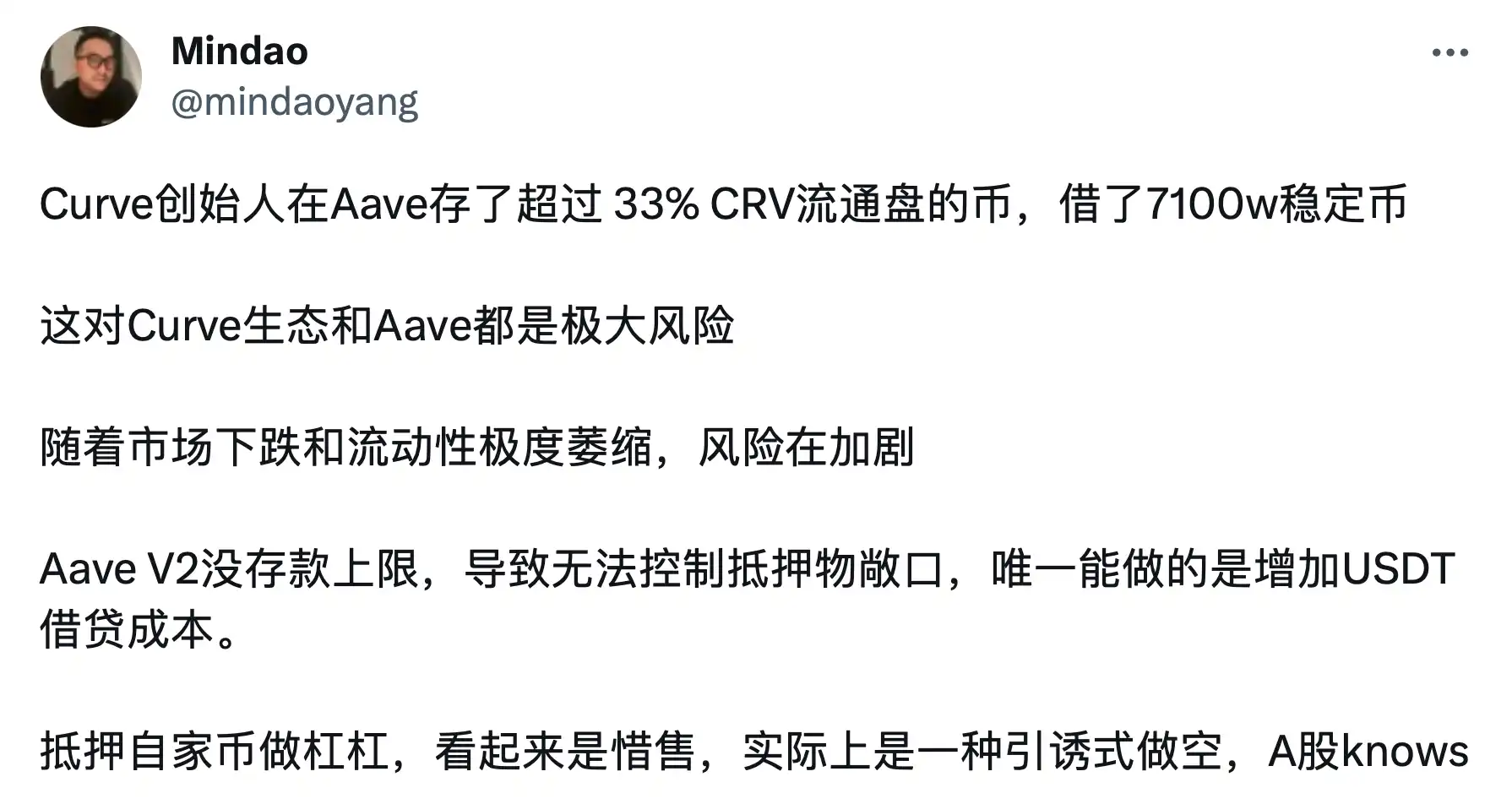
dForce founder mindao believes that Egorov's "mortgage cashing" is a trap for short selling
July-August 2023: "Second Defense War"
In the past few days, the industry has begun to discuss the possibility of a major DeFi crash. In the early morning of July 31, the official Twitter account of Ethereum EVM compiler Vyper tweeted that some Vyper versions are vulnerable to reentrancy lock failures, and any projects that rely on these versions should contact the team immediately. The Curve team then tweeted that some stablecoin pools had been attacked.
According to Paidun monitoring, Curve lost about $52 million in just a few hours. Affected by the incident, Curve's TVL also dropped sharply from $3.2 billion to $2.4 billion, and the price of CRV also quickly fell below $0.6. According to dexscreener information, the instantaneous price of CRV was close to zero in the early hours of the morning. Soon, people's attention focused on the founder of Curve. Due to the price drop, Egorov's on-chain CRV mortgage lending health rate began to decline, and he also transferred another 16 million CRV to Aave.
At noon, Bitmain and Matrixport co-founder Jihan Wu posted on social media: "CRV is one of the most important infrastructures in the upcoming RWA wave. I have bought at the bottom and it does not constitute financial advice." But Egorov's lending health does not seem optimistic. The interest rate of his loan of about $15.8 million from Fraxlend is 105.%, and it will reach 10,000% in 3 days. CRV then fell below $0.5, a 24-hour drop of 20%. People began to worry, is DeFi going to die?

Egorov’s lending health was once close to the critical point of liquidation
But things soon took a turn for the better. Around 12 o’clock in the evening, Huang Licheng confirmed on social media that he had purchased 3.75 million CRV from the founder of Curve through OTC and pledged it in the Curve protocol. The next day, Sun Yuchen’s relevant address also transferred 2 million USDT to Egorov’s address and received 5 million CRV. Rumors began to spread that the founder of Curve was trading CRV over-the-counter at an average price of $0.4.
Following this, projects such as Yearn Finance, Stake DAO, and a number of institutions and VCs such as DWF all participated in the firefighting of CRV. According to monitoring, Egorov sold a total of 54.5 million CRV on that day, recovering about $21.8 million in funds, and the health rate of its main loan positions has returned to above 1.6. Subsequently, the price of CRV also rebounded to around $0.6, and the long-short battle over CRV came to an end again.
What is really happening in DeFi?
More than once, deliberate inducement to short puts the protocol and the entire DeFi at risk. We can't help but ask, what is the founder of Curve thinking? It is undeniable that compared with other founders, Egorov is indeed very "personal". But the dilemma faced by Curve is not an isolated case. Now, the entire DeFi is suffering from "income disease".
Gamble again
What we talk about most about DeFi is decentralization and security. Both are important, but both traditional finance and decentralized finance cannot do without a core point, which is to make money, especially to make rich people make money. This is crucial for whales and institutions with tens of millions of US dollars in on-chain assets. Letting these people make money is the most realistic problem facing DeFi.
Any "local dog" with an APY of hundreds is unreliable. DeFi needs a "large pool" that can accommodate at least millions of funds and provide LPs with considerable and stable returns. For example, in the past, LUNA, its financial engine Anchor, can provide 20% fixed annualized returns for $18 billion in funds. After LUNA's thunderstorm, the old DeFi is "fragrant" again. Although the APY is not as high as 20%, it has withstood the test of the market and time. However, the crypto market, which suffered a triple blow from LUNA, 3AC and FTX, did not provide these old protocols with too many opportunities to make a comeback, especially Curve.
As one of the most important infrastructures in the DeFi stablecoin market, no one doubts the important role Curve plays in the ecosystem. But in terms of profitability, Curve is indeed showing signs of fatigue. Taking the basic income of stablecoins as an example, there is a clear gap in income between Curve and the top five TVL liquidity pools on Aave. Especially under the catalysis of the recent fierce long-short game on the chain, Aave's basic income far exceeds Curve. The main income of most of Curve's liquidity pools still comes from the emission of CRV.
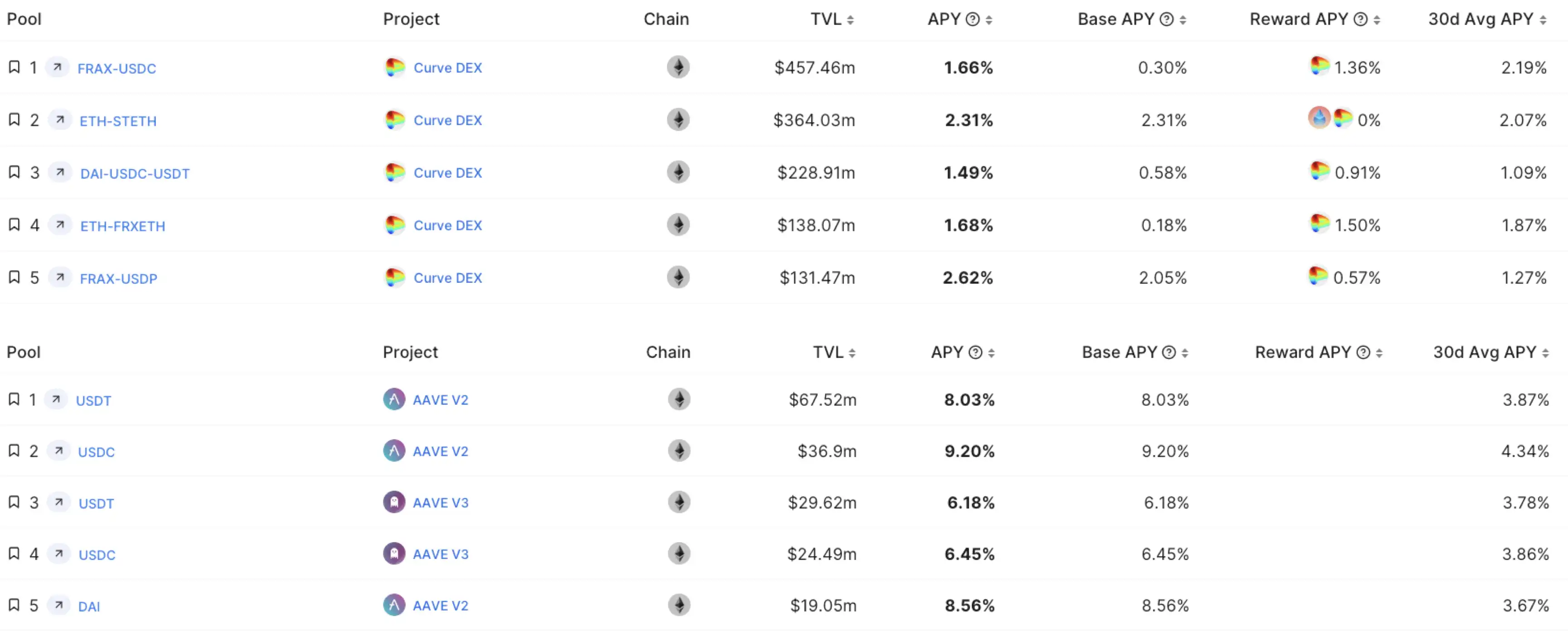
The yields of the top 5 liquidity pools of Curve and Aave TVL, data source: DeFi Llama
In an interview with BlockBeats, Bowen, founding partner of Smrti Labs, said that in the current DeFi field, protocols like Lybra and GMX that can accommodate a certain amount of funds and have considerable yields are more favored by large investors. The eUSD/USDC pool provided by Lybra currently has an APR of 11.3%, and the average yield of the stablecoin pool on GMX in the past 30 days can reach 9.57%. They are all stablecoins, but for large investors, they will go wherever they can make more money, so Curve has been facing the problem of decreasing liquidity instead of increasing it.
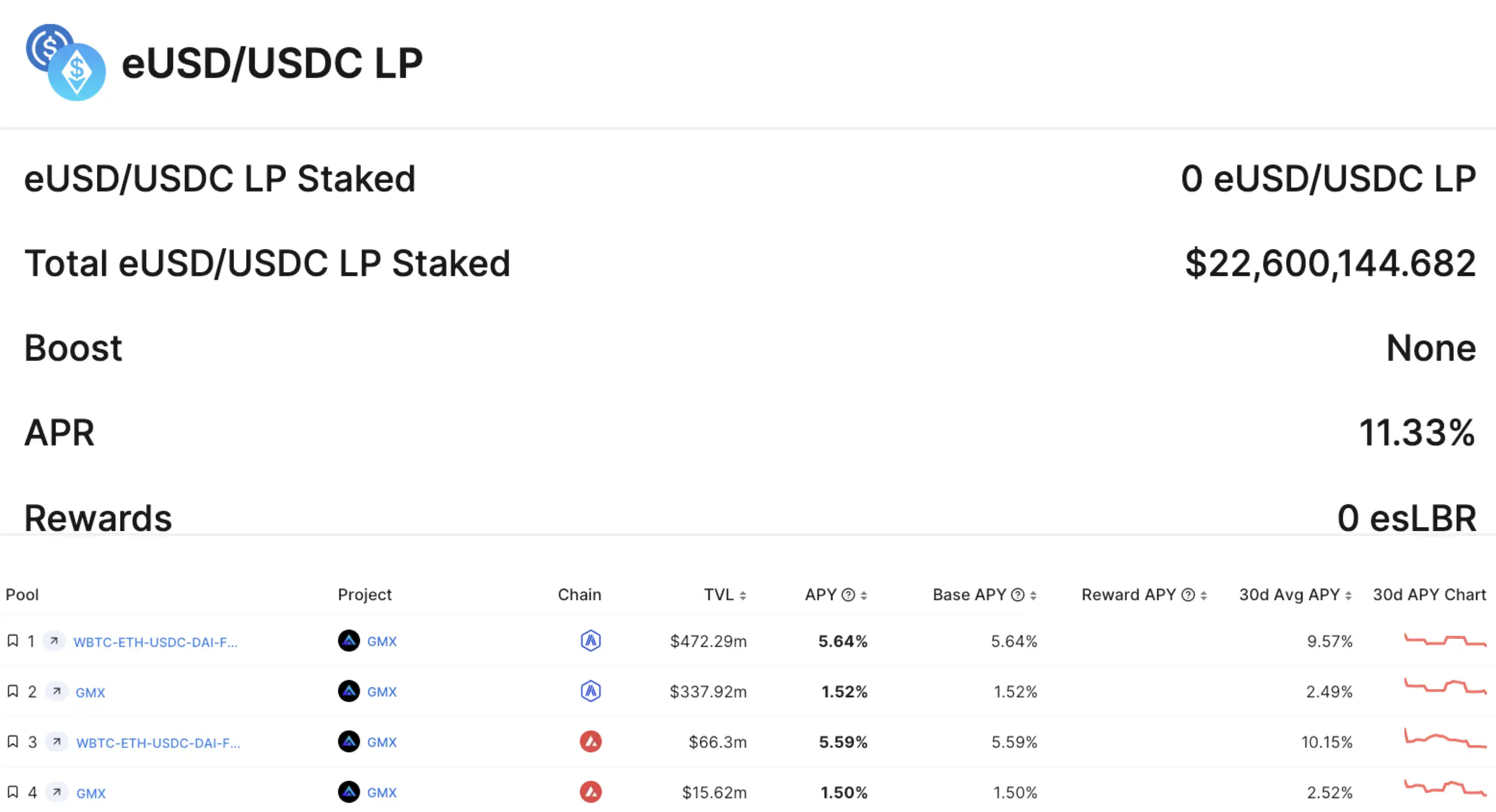
Lybra eUSD and GMX pool yields, data source: Lybra Finance, DeFi Llama
The basic income is low, and the price performance is not good. How to improve the income of LPs? The idea of the founder of Curve is to take a gamble in the market and make the price of CRV higher.
Unlike other old DeFi, Curve does have some unique "advantages" in this regard.
First of all, due to the stimulation of Curve's veToken bribery mechanism, most CRV tokens are in a locked state, which makes CRV much worse in terms of liquidity than other large-cap DeFi tokens. Sometimes, the cost of borrowing CRV on Aave is even lower than buying it directly on the exchange, because too low liquidity will cause the buyer to have a large premium in the purchase process.
In addition, as mentioned above, the founder of Curve controls one-third of the total circulation of CRV, which provides a team that wants to control the price of the currency with many possibilities for operation. One of the methods is to use the pretext of "reluctant to sell" to induce short selling.
From the results, this method was used very well in the "DeFi Defense War" at the end of last year. It not only raised the price of the currency, but also made Curve the focus of market attention again, and made a wave of PR for the upcoming crvUSD. In this CRV long-short duel, the founder of Curve seemed to lose badly. Not only did the price of the currency fail to return to the previous level, but he was also forced to sell a lot of CRV holdings.
But from another perspective, Evgorov still got the result he wanted. In Bowen's words, it was "kidnapping everyone to help CRV carry the sedan chair." Now Evgorov's CRV holdings have dropped to about 20% of the total circulation, but CRV has gained a group of powerful supporters, including top players such as Wu Jihan, Du Jun, and Sun Yuchen, as well as a group of "institutional friends" such as DWF.
Related reading: "Curve founder sells CRV through OTC to repay loans. Which institutions or individuals did CRV sell to? "
Now that everyone has common interests, Curve and CRV have a promising future. From this perspective, Egorov's gamble is not too bad.
Profit dilemma: big investors can't make money in DeFi
After LUNA's explosion, liquidity problems began to spread throughout the crypto market. The subsequent collapse of Three Arrows Capital (3AC) was due to the inability to generate target returns due to reduced market activities, which led to the withdrawal of funds by large customers and eventually collapsed. According to some former internal employees of 3AC who revealed to BlockBeats, in the later stages of the company's operation, the large-scale assets managed by the team could hardly find any scenarios that could generate expected returns. The FTX crash at the end of the year made the market even worse.
Since the Federal Reserve started the process of raising interest rates, liquidity tightening has been eroding various markets around the world, especially cryptocurrencies defined as risky assets. Although people are talking about the openness, transparency and risk resistance of decentralized finance after several crashes, this cannot prevent the tightening dagger from slowly inserting into the heart of DeFi.
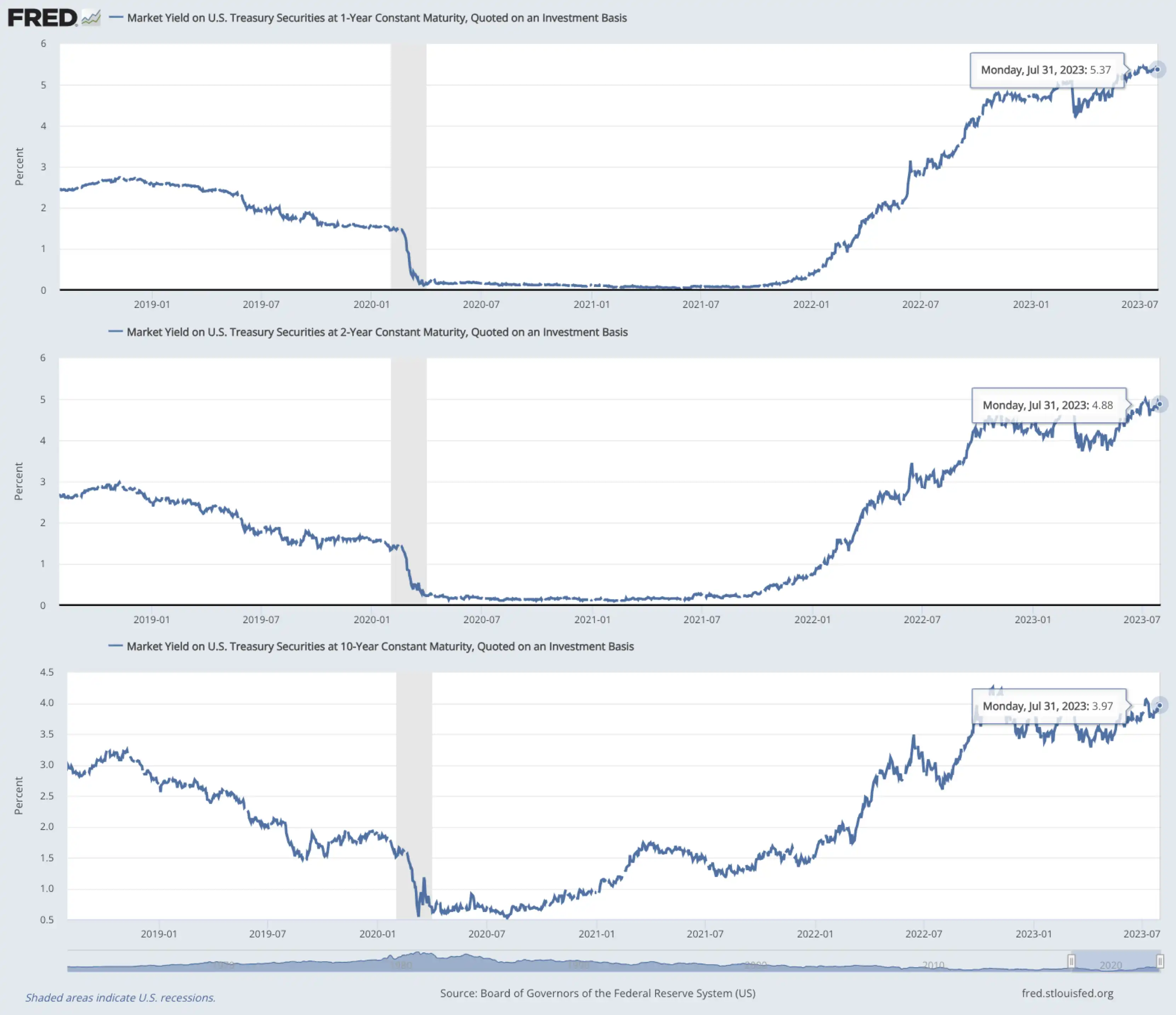
U.S. one-year, two-year and ten-year Treasury yields, data source: FRED
As of now, the yields of one-year, two-year and ten-year U.S. Treasury bonds are 5.37%, 4.88% and 3.97% respectively. Leaving aside the yield curve, the yields of both short-term and long-term Treasury bonds have been rising steadily since the end of 2021. Compared with mainstream DeFi protocols such as Curve and Aave, even the current yield of ten-year Treasury bonds is significantly higher than their average yield.
In contrast, DeFi's yield level has gradually declined. According to DeFi Llama data, the median DeFi yield has dropped from 6% at the beginning of last year to 2% in July this year, which is almost unprofitable for large investors. "Why take a risk multiplier of two or three times to get a 3% return in DeFi when you can get a 5% return in U.S. Treasuries?" Bowen explained to BlockBeats.
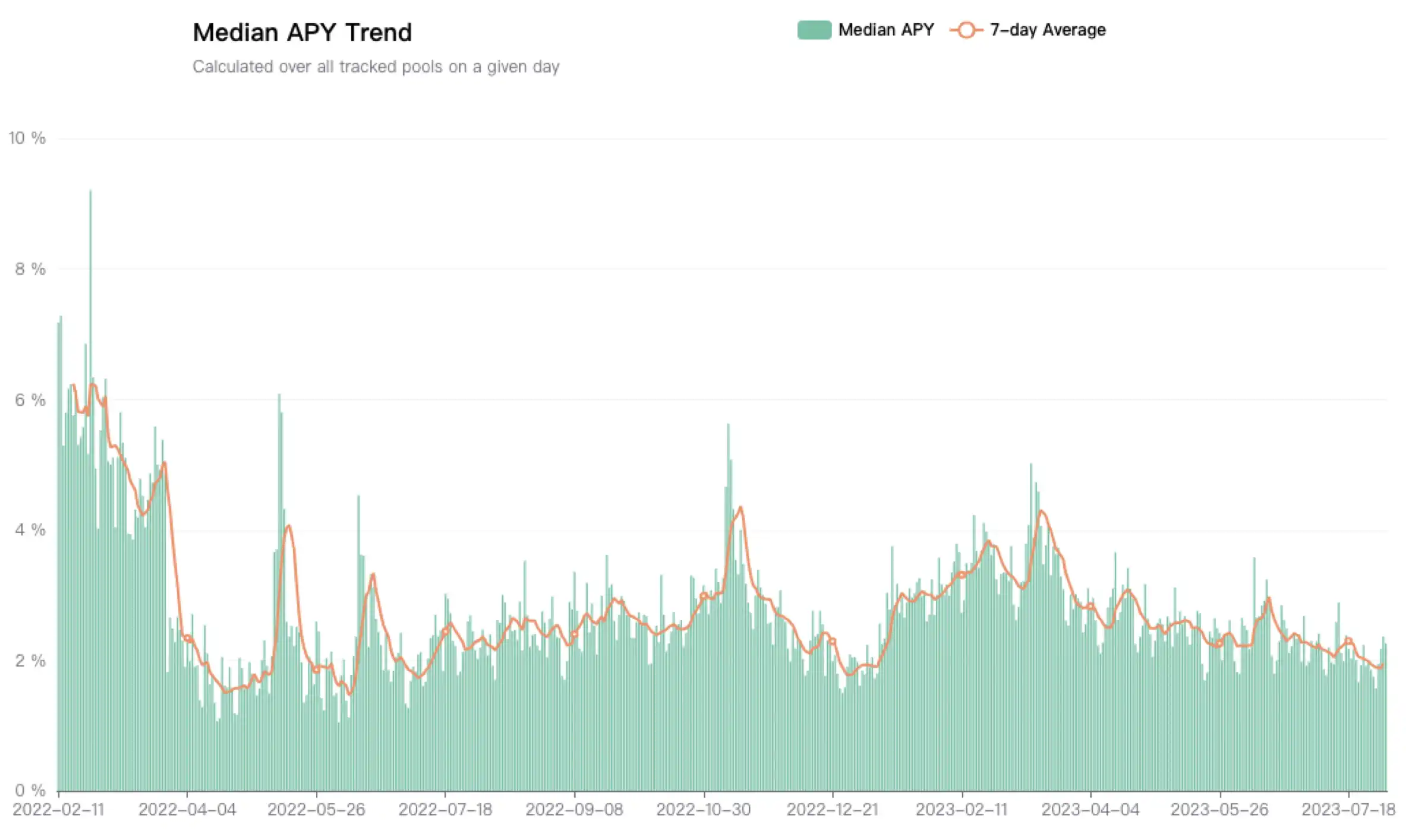
DeFi median yield change, data source: DeFi Llama
For customers with large capital, DeFi is no longer as good as it used to be. In the past, you could get a 3% return in just one day, let alone a year. Therefore, under the dual cover of liquidity tightening and regulatory shadows, it does not seem to be a wise choice to keep funds in DeFi. Bowen believes that most of the funds that are still in the DeFi market may be funds that are inconvenient or even impossible to "land". "Other money that can run away has already run away."
Since you can't leave, you need to solve the problem internally. In addition to PoS staking rewards and protocol token emission, what other ways can provide stable and substantial returns for big players?
The first thing that comes to mind is Real Yield. In essence, Real Yield means that the protocol pays users income based on their actual income, denominated in ecosystem native tokens such as ETH or stable currencies such as USDC, eliminating inflation and unstable income caused by token emission. GMX, which became popular at the end of last year, is the leading representative of this narrative.
Related reading: "A preliminary exploration of the sustainability of DeFi business model under the background of Real yield"
According to Nansen data, at the end of August 2022, the number of transactions of GMX once exceeded Uniswap, becoming the protocol with the largest number of transactions in a single week on the Arbitrum network. In the white paper of GMX, the team clearly mentioned that in addition to obtaining GMX token rewards, GLP token holders (i.e. LP) also receive platform fee income denominated in ETH. After the price of GMX tokens rose sharply to US$56 in September, the Real Yield narrative also became a new hope to save DeFi.
But in fact, during the bear market, this kind of income generated by relying on the so-called "actual income of the protocol" is not reliable. Soon everyone discovered that, except for protocols such as Uniswap and GMX that have great attraction and can accommodate large amounts of funds, most DeFi protocols cannot generate income during the bear market. In an interview with BlockBeats, 1inch co-founder Anton Bukov revealed that without DeFi aggregator products, most DEXs simply cannot survive during the bear market because these DEXs have no liquidity.
Related reading: "Exclusive interview with 1inch: How to innovate in the DEX field under the shadow of Uniswap monopoly? "
After a brief "spring agitation" at the beginning of the year, the market entered a deep bear in April this year. In addition to the batch operations of "Lu Mao Studio", on-chain behavior has reached a handful, and the Real Yield narrative soon died. However, surprisingly, since June, the tokens of Compound and MakerDAO, two old DeFi, have begun to rise and created new highs for the year.
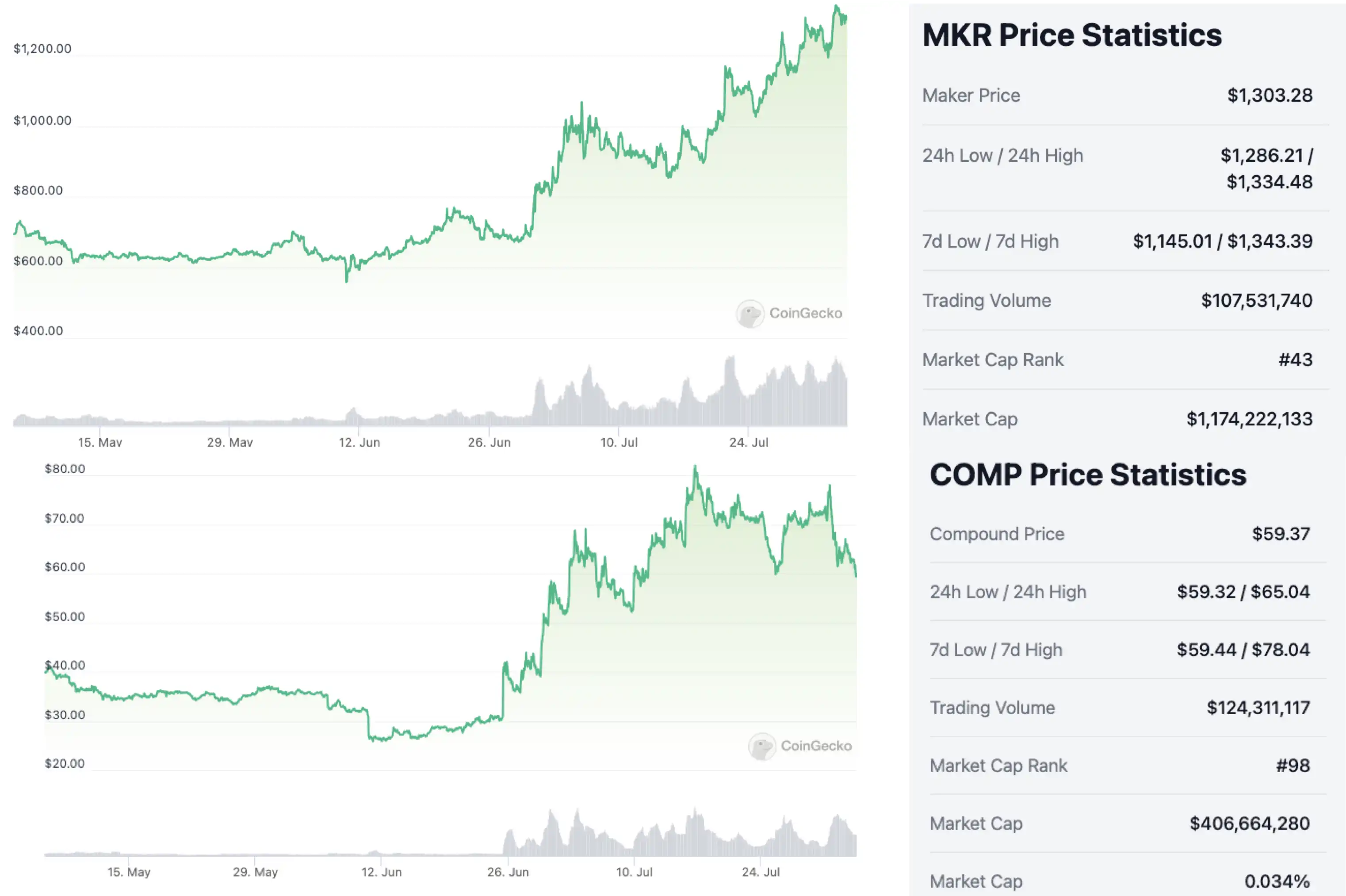
MKR and COMP token price changes, data source: CoinGecko
The market's explanation for the rise is: RWA.
In the crypto market, the concept of Real World Asset has been repeatedly hyped in the past few years, and this time it has been used in the DeFi field. Since there is no way to generate enough income on the chain, can the income of the real world be brought into DeFi? Previously, the "Endgame" proposal article published by the founder of MakerDAO after the Tornado Cash incident had caused a round of discussion about RWA.
Now there are rumors in the market that MakerDAO has significantly increased its income in the past few months by purchasing U.S. Treasury bonds with treasury funds. The founder of Compound also announced his new company Superstate at the end of June, which is responsible for bringing assets such as bonds to the chain and providing potential customers with income comparable to the real world. After the announcement of the news, the price of COMP tokens rose by more than 23% in 24 hours.
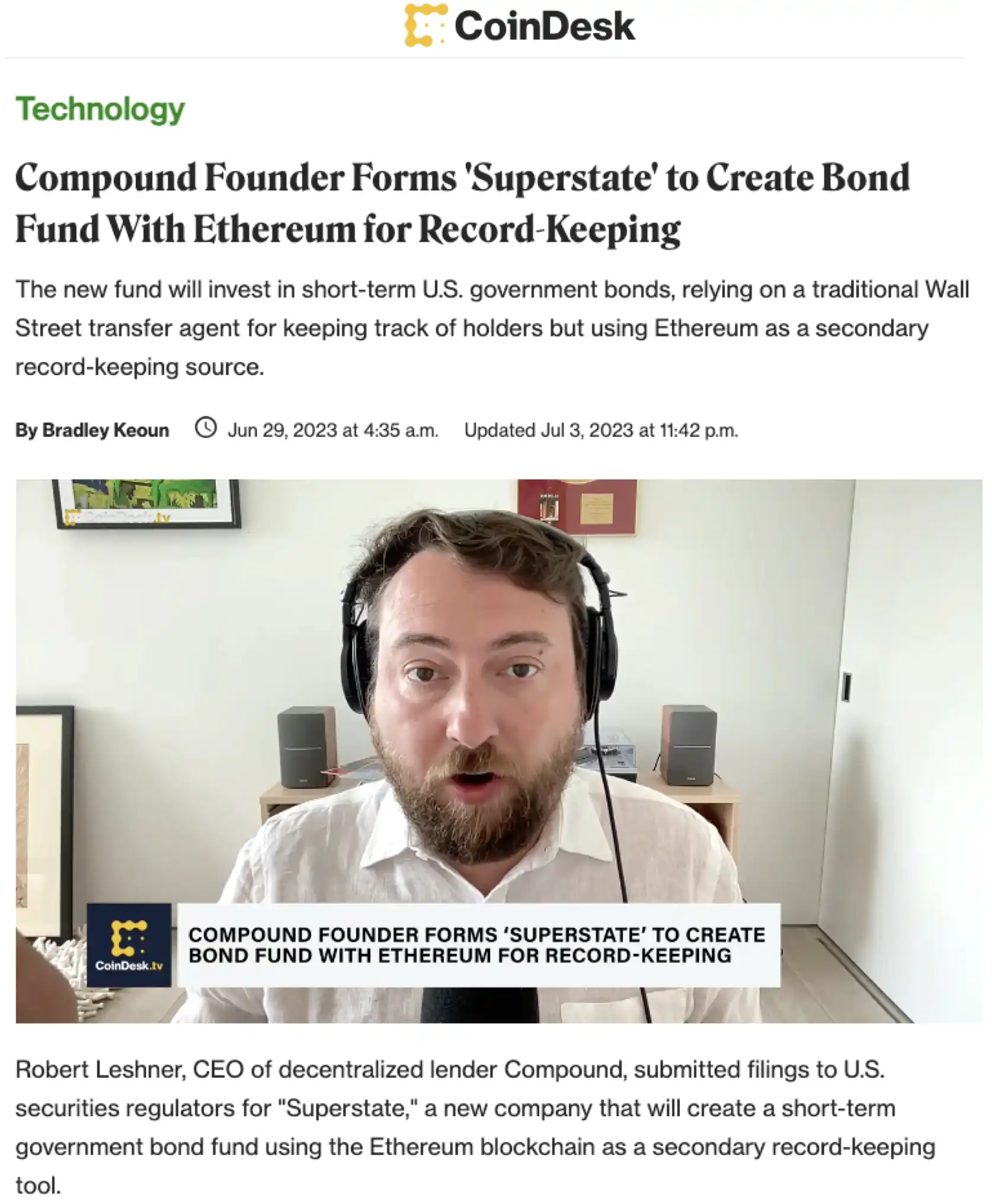
Report on Compound founder's new company Superstate
Under the wave of compliance in Hong Kong, the popularity of RWA has reached a new high. Most of the offline Web3 activities in Hong Kong since June are related to RWA. People not only hope to obtain better on-chain returns through this narrative, but also hope to rely on it to attract more traditional funds to enter the market and create a new round of crypto cycle.
But for now, RWA may not be able to fundamentally solve DeFi's "income disease". Because the asset management model is not yet mature, the current RWA is basically limited to exposure to treasury bonds, especially U.S. Treasuries. On the one hand, this reduces DeFi's ability to resist regulation. On the other hand, it also means that once the Fed reverses, the RWA protocol that relies on U.S. bonds will fail again and enter an irreversible trend of declining returns. In the eyes of many people, the Fed is not far from a reversal.
Related reading: "MakerDao's hidden worries are not just about RWA exposure"
Whether it is token economics such as Staking and veToken, or narrative outlets such as Real Yield and RWA, they all reflect DeFi's painful struggle in the face of "yield disease". The current innovations in the DeFi field seem to be only treating the symptoms and not the root cause. Perhaps the only way to cure this disease is to "wait for the bull market."
Welcome to join the official BlockBeats community:
Telegram Subscription Group: https://t.me/theblockbeats
Telegram Discussion Group: https://t.me/BlockBeats_App
Official Twitter Account: https://twitter.com/BlockBeatsAsia