Move War: What are the independent innovations of Aptos and Sui technology solutions?
Original author: PAUL VERADITTAKIT
Translated by: Deep Tide TechFlow
Since the birth of Bitcoin, we have witnessed the "L1 war", which has driven the development of cutting-edge technology to solve the blockchain trilemma. The demand for highly scalable solutions has always existed because no single solution can meet the industry's needs while ensuring top-level security. This has led to the birth of Sui and Aptos, which leverage the architecture of Facebook's abandoned Diem and Novi projects.
Aptos
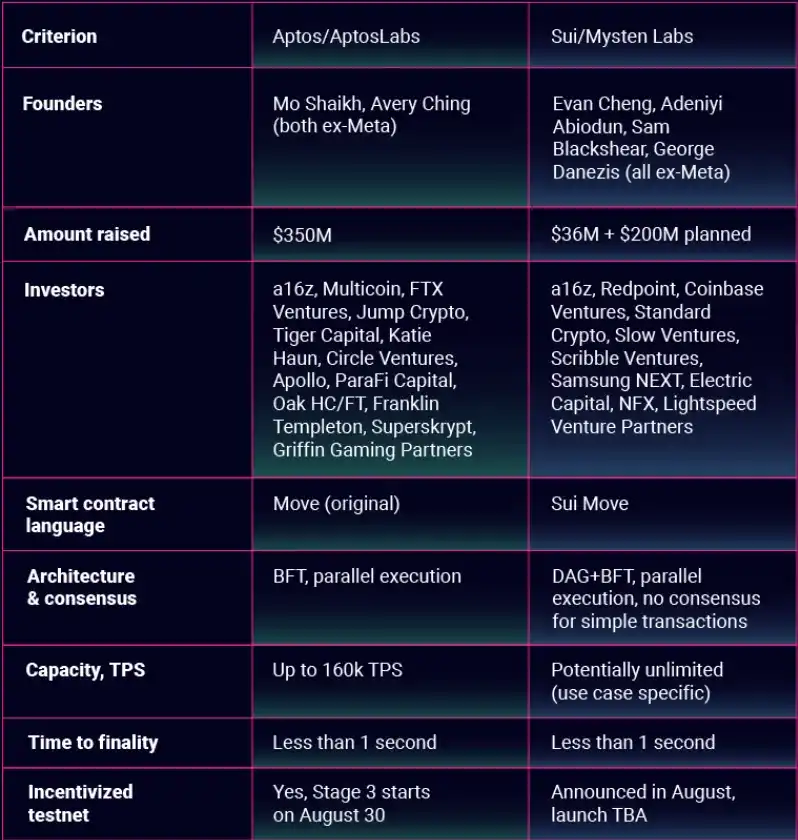
Aptos Labs, led by Mo Shaikh and Avery Ching (executives from Diem/Novi), has created the Aptos blockchain with the aim of revitalizing Diem's technology and competing with market leaders such as Ethereum and Bitcoin. Aptos aims to provide flexible, scalable, and secure infrastructure. It leverages Diem's architecture and cutting-edge technology to ensure high throughput, low latency, and verifiable state synchronization.
Sui
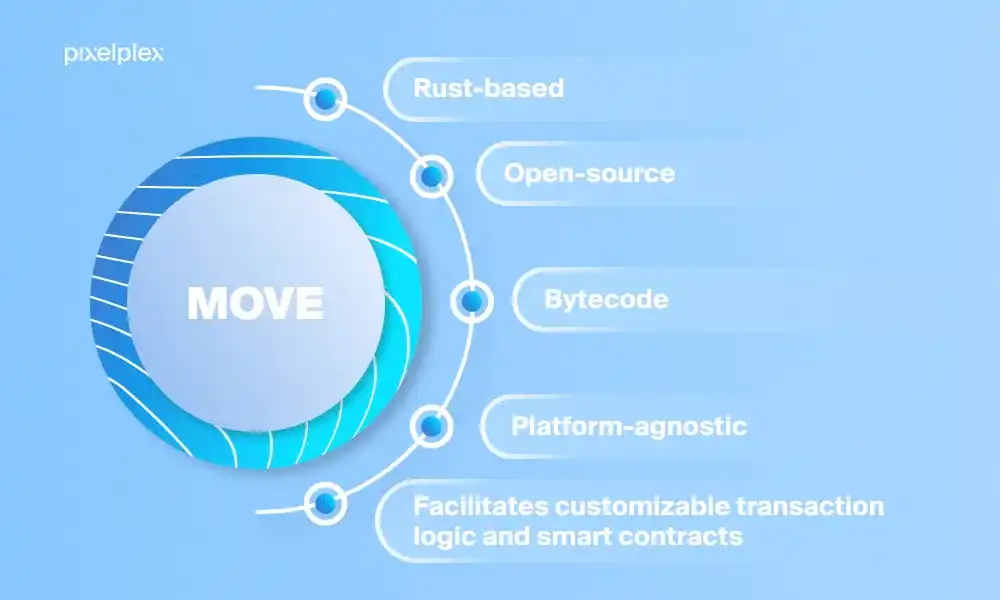
Both of these blockchains use Move, which is a Rust-based programming language that enables parallel processing. The Move ecosystem includes compilers, virtual machines, and other development tools. Aptos utilizes the core implementation of this language, although Sui has made some minor modifications to better suit its architecture.
Background
Move is a bytecode language used for designing custom transactions and smart contracts. What sets Move apart from other languages, such as Solidity, is its emphasis on resource management and the scarcity and access control of digital assets. Scarcity limits the formation of assets to reduce the risk of double-spending, while access control determines ownership and asset access. Move's resource management is based on linear logic mathematical concepts, treating assets as absolute resources that are permanently lost once depleted. This specificity of resources allows for secure transfer between program storage locations without the need for implicit deletion or duplication, hence the name "Move".
Sui's Move Variations
Although Aptos' Move largely copied Diem's white paper, Sui added an object-oriented storage system to track all content such as addresses and transactions.
Sui classifies attributes as objects, defined as follows:
Shared Object: mutable, without a clear owner, and can be used in multi-party transactions without authorization.
Ownership: It has a unique owner and can only be changed by that user.
只读对象:There is no unique owner, and it cannot be changed after publication. It can be used by all users in transactions.
Classifying these assets into different domains can reduce processing and transaction time, and provide scalability for NFTs, gaming products, and more. This is also the main foundation of Sui in the NFT/gaming industry.
Sui/Aptos Consensus Mechanism
Consensus is a process that enables blockchain nodes (validators) to reach agreement on the reliability of transactions and blocks. Aptos and Sui are both built on the widely recognized concept of Byzantine Fault Tolerance (BFT). The core principle of consensus mechanisms is that even if up to 1/3 of validators become malicious or fail, the network can still operate normally.
Byzantine Fault Tolerance (BFT)
The basic concept of Byzantine fault tolerance is as follows:
A network is composed of validators who collectively possess N voting rights to decide whether to approve a new block.
N usually takes the value of 3F+1 and must be able to accommodate F validators with voting rights. This means that up to F validators may be malicious, slow, disconnected, and so on.
In each round, a leader is selected in a random and observable manner.
In each cycle, the leader proposes a new block and the rest of the validators vote on it.
As long as there are 2F+1 votes from trusted validators, they can reach a unanimous decision.
Task Parallelization Technology
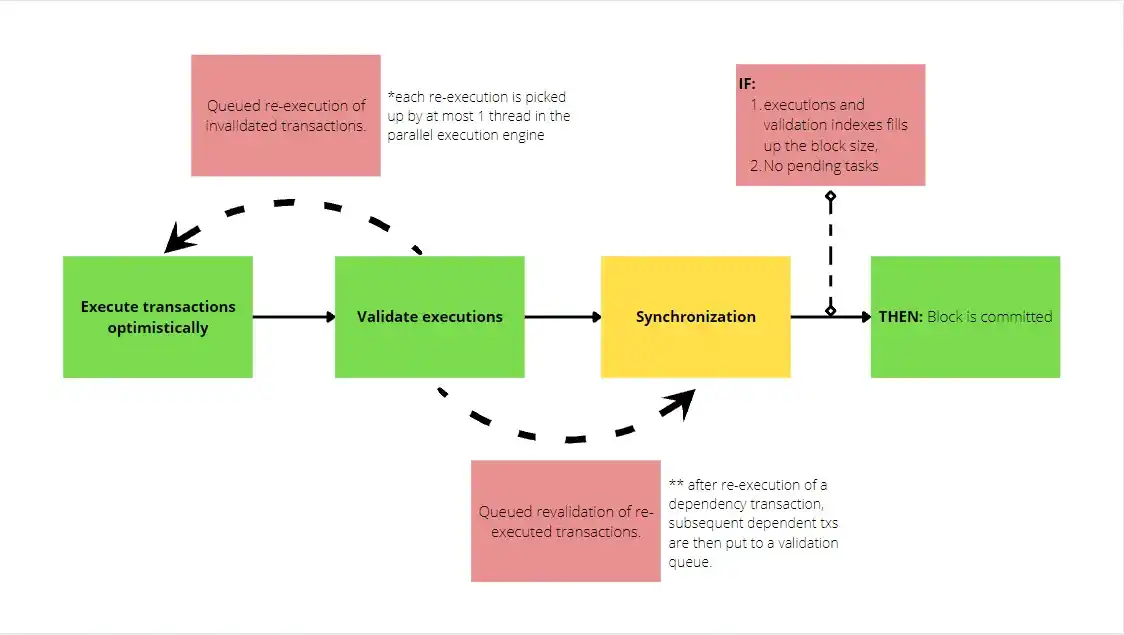
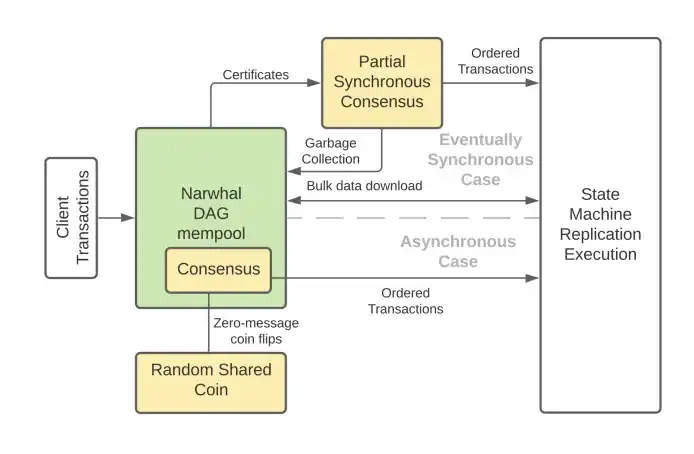

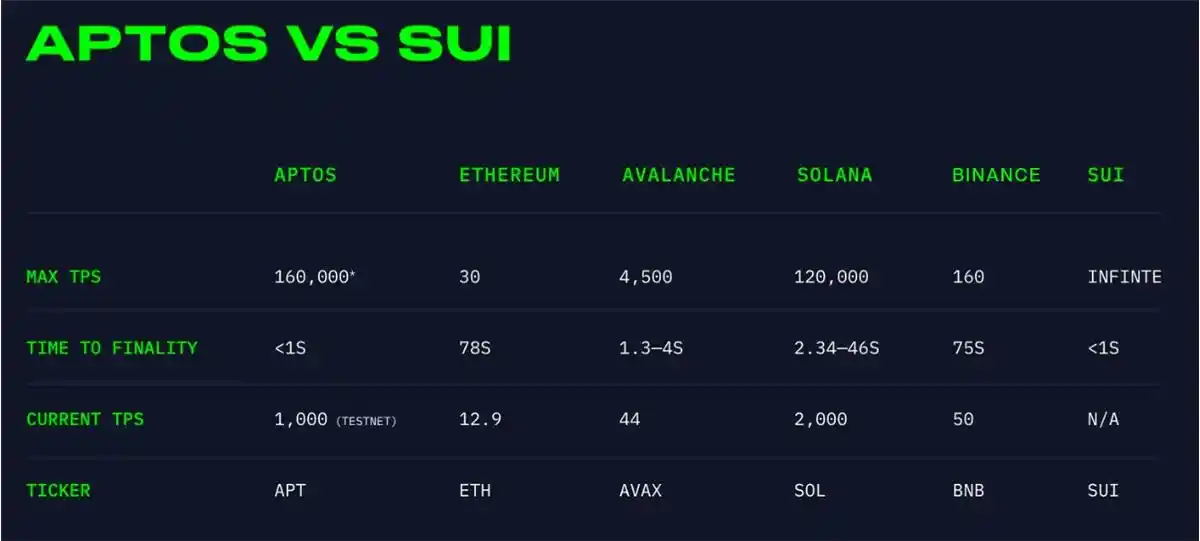
Collaborative scheduling - allows for optimization of resource allocation during the scheduling phase to speed up transaction processing.
Aptos Blockchain's versatile architecture makes it suitable for applications in different fields. Its main goal is to decentralize cloud infrastructure that supports Web 2.0 applications and promote the widespread adoption of Web 3.0. With scalability, security, and low cost, Aptos Blockchain is ideal for applications in finance, supply chain management, decentralized finance (DeFi), gaming, identity management, and more. The platform focuses on solving real-world problems, making it an attractive choice for developers and businesses seeking powerful and scalable blockchain solutions.
As an unlicensed first-layer blockchain, Sui Blockchain provides instant settlement, high throughput, and low latency, suitable for various industries and use cases. It focuses on energy efficiency and decentralization, making Sui an ideal choice for finance, Internet of Things (IoT), gaming, social media, content sharing, and other latency-sensitive fields. Sui is committed to supporting decentralized applications that are sensitive to latency, making it a strong competitor in the blockchain ecosystem.
Market Performance
Aptos has received a large amount of funding from well-known venture capital firms, totaling approximately $400 million. Investors include Andreessen Horowitz, FTX Ventures, Jump Crypto, a16z, Tiger Global, and Multicoin Capital. This strong financial support highlights investors' confidence in the Aptos project and its potential for growth and success. The participation of these well-known companies not only provides financial support but also opens doors for potential partnerships and collaborations, further solidifying Aptos' position in the market.
Sui has also received strong support from major investors such as Lightspeed Venture Partners, Andreessen Horowitz, and Redpoint. In its latest Series B funding round, Sui raised an impressive $300 million, in addition to the $36 million raised in its Series A funding, bringing its total funding to $336 million. The massive funding and a valuation of over $2 billion highlight the market's interest and confidence in the Sui project. The participation of well-known investors has paved the way for strategic alliances and partnerships, contributing to the growth and development of Sui's ecosystem.
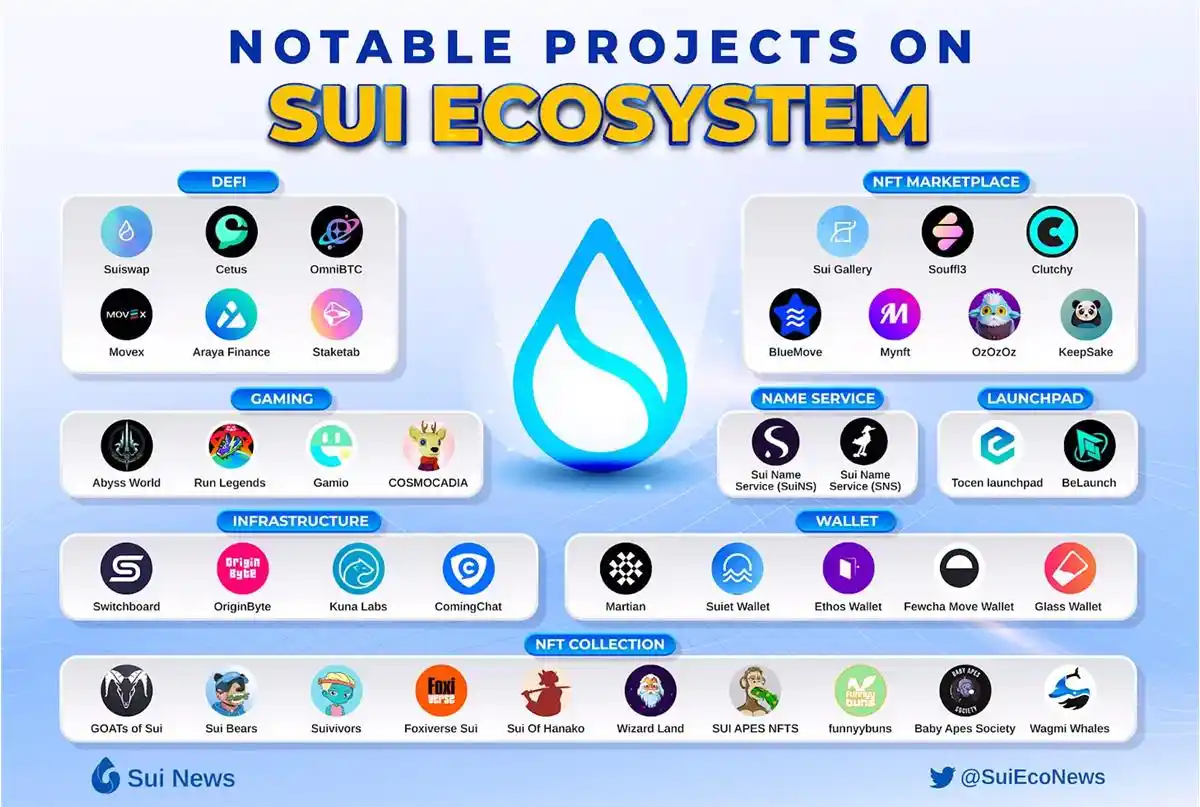
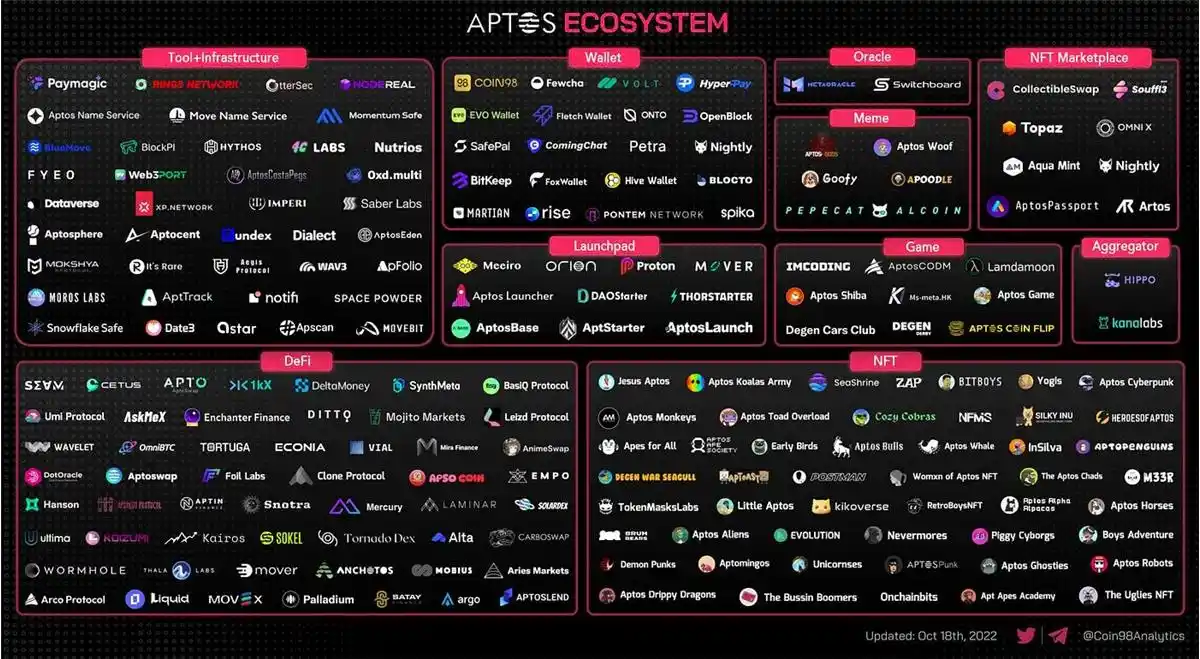
In addition, Aptos and Sui have both cultivated vibrant and active communities of developers, enthusiasts, and users. These communities actively contribute to the ecosystem through application development, participation in discussions, and sharing of ideas. Both platforms promote innovation, collaboration, and adoption in a community-driven manner, creating a strong ecosystem for Aptos and Sui.
Summary and Reflection
Although it is currently unclear which solution will emerge as the winner in the dominant market, Aptos and Sui have made significant progress in their development, greatly advancing the current state of blockchain design. Aptos has gained market share by entering the market relatively early and attracting a lot of attention, while Sui has benefited from its innovative and security-focused approach. One thing is certain: based on its enormous potential to improve the scalability and security of the crypto network, Move-based technology is destined to have a lasting impact on the industry.
Source Link
Welcome to join the official BlockBeats community:
Telegram Subscription Group: https://t.me/theblockbeats
Telegram Discussion Group: https://t.me/BlockBeats_App
Official Twitter Account: https://twitter.com/BlockBeatsAsia

 Related Articles